In the vast cosmic nursery of our universe, massive stars represent one of astronomy's most captivating mysteries. While we've documented countless "baby pictures" of these celestial giants through the Hubble Space Telescope, the fundamental question of how these stellar behemoths form continues to challenge our understanding of astrophysics. Unlike human development, which modern medicine has mapped in exquisite detail, the birth of massive stars—those exceeding eight to ten solar masses—remains shrouded in both literal and figurative darkness.
The SOFIA Massive (SOMA) Star Formation Survey represents a groundbreaking effort to pierce this veil of cosmic mystery. Recently released images from this comprehensive study showcase the Hubble's remarkable ability to capture the hidden processes of stellar birth, revealing unprecedented details about how the universe's most influential stars come into being. These observations are particularly crucial because massive stars serve as the primary architects of galactic evolution, driving cosmic chemistry and structure through their powerful stellar winds, intense radiation, and spectacular supernova deaths.
The challenge facing astronomers is formidable: these stellar infants are not only separated from us by thousands of light-years, but they're also cocooned within dense clouds of gas and dust that obscure direct observation. However, by leveraging Hubble's infrared capabilities and capitalizing on natural openings created by protostellar jets, researchers are finally beginning to decode the mechanisms behind massive star formation—a process that occurs in merely 100,000 years, a cosmic blink of an eye.
The Paradox of Massive Star Formation
At the heart of this astronomical puzzle lies a fundamental contradiction that has perplexed astrophysicists for decades. According to our understanding of stellar physics, once a forming star reaches approximately eight solar masses, its outward radiation pressure should become so intense that it effectively prevents any additional material from falling onto the star. This radiation pressure barrier should theoretically cap stellar mass at relatively modest levels, yet observations consistently reveal stars with masses exceeding 100 times that of our Sun.
This paradox becomes even more intriguing when we consider the timeline. Massive stars form with astonishing rapidity—completing their formation in as little as 100,000 years, compared to the millions of years required for Sun-like stars. Research published in the Astrophysical Journal has attempted to model various mechanisms that might explain this accelerated growth, including disk-mediated accretion and competitive accretion scenarios, yet no single theory fully accounts for all observations.
Adding another layer of complexity, massive stars exhibit a strong tendency toward clustered formation. Unlike their lower-mass cousins, which can form in relative isolation, massive protostars almost invariably appear in groups. This clustering creates a dynamic environment where gravitational interactions, competing accretion streams, and overlapping stellar feedback mechanisms all influence the formation process. Understanding these interactions requires not just observing individual protostars, but mapping the entire ecosystem of star-forming regions.
Hubble's Infrared Vision: Piercing the Cosmic Veil
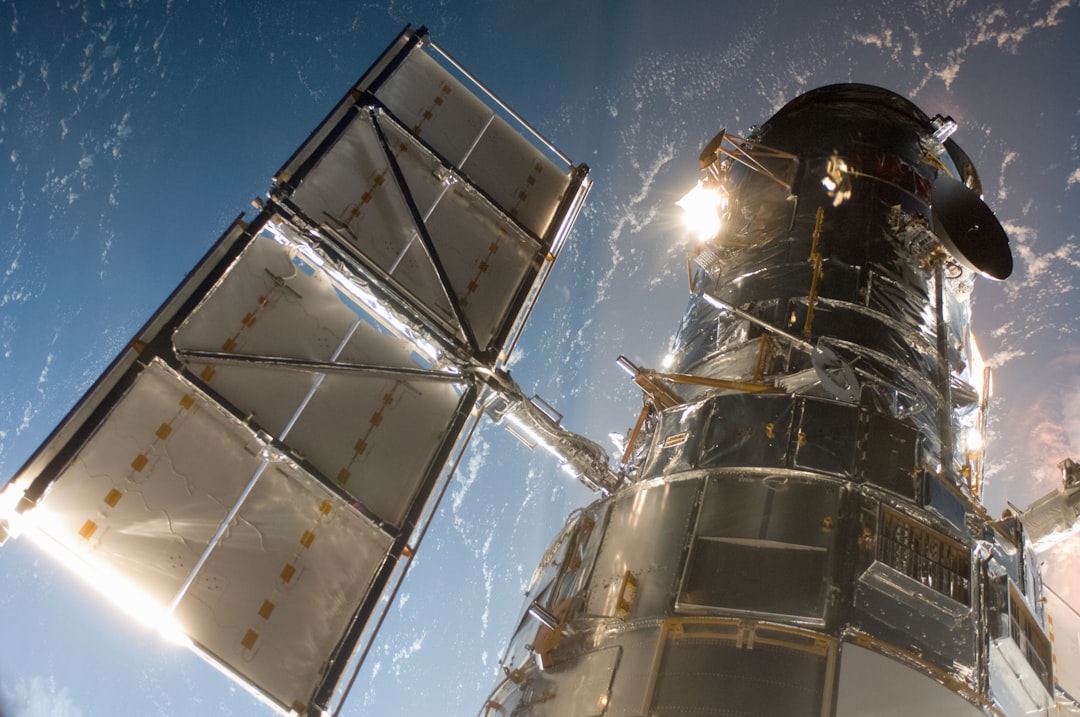
The Hubble Space Telescope's infrared capabilities provide a crucial advantage in studying these hidden stellar nurseries. While visible light is completely blocked by the dense molecular clouds surrounding forming stars, infrared radiation can penetrate these dusty barriers, revealing the underlying structure and activity. This capability transforms Hubble into a cosmic ultrasound machine, allowing astronomers to peer into the "wombs" where stars are born.
The young protostars themselves become unwitting collaborators in this observational endeavor. Their powerful bipolar jets—streams of material ejected at velocities reaching hundreds of kilometers per second—carve channels and cavities through the surrounding gas and dust. These jets, driven by complex magnetic field interactions with the protostellar accretion disk, create natural windows through which Hubble can observe the central star-forming region. The light that escapes through these openings carries vital information about the protostar's temperature, luminosity, mass accretion rate, and evolutionary stage.
"These observations represent a critical bridge between theoretical models and observed reality. By capturing light filtering through jet-carved cavities, we're essentially getting a direct view of processes that were previously accessible only through computer simulations," explains Dr. Rafael Fedriani of the Instituto de Astrofísica de Andalucía, lead researcher on the SOMA survey.
Stellar Nurseries Under the Microscope
Cepheus A: A Nearby Laboratory for Massive Star Formation
Located a mere 2,300 light-years from Earth, Cepheus A represents one of our closest opportunities to study massive star formation in detail. This star-forming complex hosts dense molecular clouds, regions of ionized gas, and a collection of protostars at various evolutionary stages. The region's proximity makes it an invaluable laboratory for testing theories about massive star formation and validating observational techniques that can then be applied to more distant regions.
The dominant feature of Cepheus A is the massive protostar designated HW2, which single-handedly provides approximately half of the region's total luminosity. With a current mass of 16 solar masses and still actively accreting material, HW2 exhibits the fastest growth rate observed for its class of objects. Studies using the Atacama Large Millimeter/submillimeter Array (ALMA) have revealed complex disk structures around HW2, suggesting that material continues to flow onto the star despite its already substantial mass—a direct challenge to the radiation pressure barrier problem.
G033.91+0.11: The Beauty of Reflected Light
The star formation region G033.91+0.11 showcases a different aspect of protostellar observation through its prominent reflection nebula. Unlike emission nebulae, where gas is energized by ultraviolet radiation and emits its own light, reflection nebulae shine by scattering and reflecting light from nearby sources—in this case, a massive hidden protostar. The blue-white appearance of the nebula results from the preferential scattering of shorter wavelengths, the same physical process that makes Earth's sky blue.
This reflected light carries a wealth of information about both the illuminating protostar and the surrounding dust. By analyzing the nebula's spectrum and morphology, astronomers can infer the protostar's luminosity, temperature, and the composition of the dust grains doing the scattering. The asymmetric structure of the nebula also provides clues about the geometry of the hidden protostar's disk and the distribution of material in its immediate environment.
GAL-305.20+00.21: Ionization in Action
In contrast to G033.91+0.11's reflection nebula, GAL-305.20+00.21 features a prominent emission nebula created by intense ionizing radiation from its embedded massive protostar. The ultraviolet photons streaming from this young stellar object strip electrons from surrounding hydrogen atoms, creating a region of ionized gas that glows with characteristic red and pink hues—the signature of hydrogen alpha emission.
The size and structure of this emission nebula provide direct measurements of the protostar's ionizing luminosity and, by extension, its mass and evolutionary state. As the protostar continues to grow and heat up, the ionized region expands, eventually creating what astronomers call an HII region—a bubble of hot, ionized gas that can extend for dozens of light-years and trigger the formation of new stars at its expanding edges.
IRAS 20126+4104: A Star in Transition
Perhaps the most scientifically intriguing object in the SOMA survey is IRAS 20126+4104, a massive protostar located approximately 5,300 light-years away in the constellation Cygnus. Classified as a B-type protostar, this object represents an extreme example of stellar youth—extraordinarily luminous, incredibly hot, and possessing a mass many times that of our Sun, yet still in the process of formation.
The spectacular jets emanating from IRAS 20126+4104's poles have been the subject of intensive study, with observations spanning radio, infrared, and optical wavelengths. These jets, traveling at velocities exceeding 200 kilometers per second, create shock waves as they collide with surrounding material, heating the gas to temperatures of tens of thousands of degrees and causing it to emit in bright regions of ionized hydrogen. Detailed studies published in Monthly Notices of the Royal Astronomical Society have mapped the jet's structure down to scales of just a few astronomical units—comparable to the size of our inner solar system.
Recent research in 2023 revealed that IRAS 20126+4104 has reached a critical evolutionary milestone: it has become a Zero-Age Main Sequence (ZAMS) star, meaning it has initiated sustained hydrogen fusion in its core. This transition marks the end of the protostellar phase and the beginning of the star's main sequence lifetime. Remarkably, even as it begins fusing hydrogen, IRAS 20126+4104 continues to accrete material from its surrounding disk while simultaneously losing mass through its powerful jets—a delicate balancing act that illustrates the complex dynamics of massive star formation.
Key Insights from the SOMA Survey
- Accretion Mechanisms: The survey has identified multiple pathways through which massive protostars overcome radiation pressure barriers, including disk-mediated accretion where material approaches the star through a rotating disk rather than falling directly inward, reducing the effectiveness of radiation pressure.
- Jet Dynamics: High-resolution observations reveal that protostellar jets are not smooth, continuous flows but rather exhibit complex structure including knots, bow shocks, and variable ejection velocities, suggesting that the accretion process itself is episodic and variable.
- Environmental Effects: The clustered nature of massive star formation creates feedback loops where the radiation and winds from one forming star influence the accretion and evolution of neighboring protostars, potentially explaining the observed mass distribution in stellar clusters.
- Evolutionary Timescales: By observing protostars at different evolutionary stages, the SOMA survey is helping to construct a timeline of massive star formation, from initial collapse through disk formation, active accretion, jet launching, and finally arrival on the main sequence.
- Chemical Enrichment: The intense radiation and powerful winds from massive protostars drive chemical reactions in surrounding gas, creating complex organic molecules and altering the composition of material available for future star and planet formation.
The Broader Impact on Galactic Evolution
Understanding massive star formation extends far beyond academic curiosity—these stellar giants play a disproportionately important role in shaping the universe we observe. Despite representing only a small fraction of all stars by number, massive stars dominate the energy budget of galaxies through their intense radiation output. A single massive star can produce as much light as tens of thousands of Sun-like stars, making them the primary source of illumination in star-forming galaxies.
The chemical impact of massive stars is equally profound. Through their powerful stellar winds and eventual supernova explosions, these stars inject heavy elements—everything heavier than helium—into the interstellar medium. This process of chemical enrichment is responsible for creating the elements necessary for rocky planets and, ultimately, life itself. Research from the European Southern Observatory has shown that the distribution of elements in galaxies directly reflects the history of massive star formation and evolution.
Perhaps most dramatically, massive stars influence the structure and dynamics of entire galaxies. Their ultraviolet radiation ionizes vast regions of space, creating the glowing nebulae that trace spiral arms and star-forming regions. Their supernova explosions inject enormous amounts of energy into the interstellar medium, driving galactic-scale winds and potentially regulating the overall rate of star formation. Some theoretical models even suggest that supernova feedback from massive stars may be a crucial factor in determining the maximum mass that galaxies can achieve.
Future Prospects and Continuing Mysteries
While the Hubble Space Telescope has provided unprecedented views of massive star formation over its three decades of operation, the arrival of new observational facilities promises to deepen our understanding even further. The James Webb Space Telescope, with its superior infrared sensitivity and angular resolution, is already revealing details of protostellar disks and jets that were previously inaccessible. JWST's ability to observe at longer infrared wavelengths allows it to penetrate even denser regions of dust, potentially revealing the very earliest stages of massive star formation.
Ground-based facilities are also contributing crucial data. The Atacama Large Millimeter/submillimeter Array (ALMA) excels at mapping the cold gas and dust that fuel star formation, revealing the intricate structures of accretion disks and the complex chemistry occurring in star-forming regions. The upcoming Extremely Large Telescope, with its 39-meter primary mirror, will provide unprecedented spatial resolution, potentially allowing direct imaging of accretion disks around individual massive protostars.
Despite these technological advances, fundamental questions remain. The exact mechanism by which massive stars overcome radiation pressure barriers continues to be debated. The role of magnetic fields in channeling accretion and launching jets requires better observational constraints. The influence of binary and multiple star systems on massive star formation—given that most massive stars appear to form in binary or higher-order systems—remains poorly understood.
The SOMA survey and similar programs represent crucial steps toward answering these questions. By combining Hubble's proven capabilities with complementary observations from other facilities, astronomers are slowly but steadily revealing the secrets of massive star formation. Each new image and dataset brings us closer to understanding how the universe's most influential stars come into being, shaping the cosmos from their birth through their spectacular deaths. As we continue to study these stellar nurseries, we're not just learning about star formation—we're uncovering the fundamental processes that have shaped the universe's evolution over cosmic time and created the conditions necessary for our own existence.