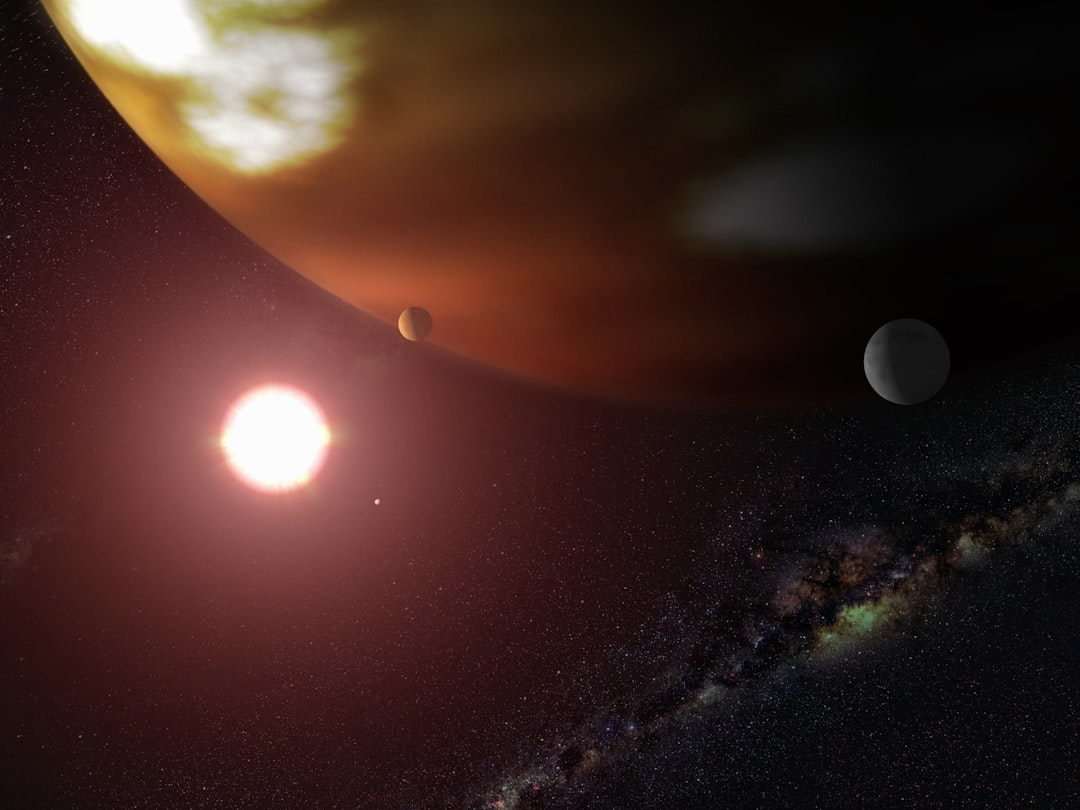
White Dwarf–Red Dwarf Binaries Power Cosmic Lasers: Supercomputer Simulations Crack a Longstanding Mystery
Astronomers have long been intrigued by a peculiar class of binary star systems that pulse with long-period bursts of radio waves — emissions that arrive every few minutes rather than every few seconds, setting them apart from the more familiar signals produced by rapidly spinning neutron stars, known as pulsars. These enigmatic long-period radio transients have challenged theorists for years, but a new study from Caltech researchers is finally shedding light on the underlying physics. Using sophisticated supercomputer simulations, scientists have produced the clearest picture yet of how interacting white dwarf–red dwarf binary systems generate and power intense beams of coherent radio light — effectively functioning as natural cosmic lasers known as masers.
The results, published in The Astrophysical Journal Letters, mark a significant advance in our understanding of stellar magnetospheric physics and open a new computational avenue for modeling radio emissions from binary systems that include an interacting white dwarf. They also reveal that the emission mechanism powering these systems is ten times more efficient than previously estimated — a finding with far-reaching implications for radio astronomy and our inventory of exotic astrophysical objects.
A Tale of Two Stars: The White Dwarf–Red Dwarf Binary
A white dwarf is the dense, Earth-sized remnant of a Sun-like star that has exhausted its nuclear fuel and shed its outer layers. Despite being roughly the mass of the Sun compressed into a volume comparable to Earth, white dwarfs are no longer undergoing fusion; they glow simply from residual thermal energy accumulated over their long stellar lives. M-type red dwarf stars, by contrast, are the most common stars in the galaxy — cool, dim, magnetically active, and capable of surviving for tens of billions of years.
When a white dwarf and a red dwarf exist in close proximity as a binary pair, the interaction between their magnetic fields and orbital motions can create extraordinary physical conditions. As the two stars orbit each other — sometimes completing a full orbit in just a couple of hours — powerful electrical currents are generated across the space between them. It is this process that ultimately drives the coherent radio emissions observed by radio telescopes on Earth and in space.
From Jupiter and Io to the Stars: The ECMI Connection
To understand the mechanism at work in these stellar binaries, astronomers have drawn a remarkably apt analogy from our own solar system. As far back as 1955, radio astronomers detected intense, sporadic radio bursts emanating from Jupiter — bursts that, for years, defied explanation. The mystery deepened when scientists realized the bursts were correlated with the orbital position of Io, Jupiter's innermost large moon and the most volcanically active body in the solar system.
In 1969, Caltech scientists Peter Goldreich, Professor Lee A. DuBridge, and Donald Lynden-Bell proposed an elegant solution: as Io sweeps through Jupiter's powerful magnetic field, it acts like a conductor moving through a magnetic environment, generating a colossal electric current between itself and Jupiter's magnetosphere. They argued that this interaction produced a flux tube — a tube-shaped channel carrying roughly one million amperes of electrical current — linking Io directly to Jupiter's polar regions.
This prediction was later confirmed by direct satellite imaging, and subsequent research demonstrated precisely how these currents power Jupiter's radio emissions. The mechanism, now called electron cyclotron maser instability (ECMI), describes a process in which energetic electrons spiral along magnetic field lines and, under the right conditions, become collectively unstable in a way that produces extraordinarily intense, coherent radio radiation. Think of it as electrons spontaneously "lasing" — much like the photons in a laser pointer — but powered by magnetic fields rather than optical cavities.
For a deeper understanding of Jovian radio emissions and the Io-Jupiter connection, NASA's Jupiter exploration pages provide an excellent primer on the planet's complex magnetosphere.
Caltech Researchers Simulate the Cosmic Maser Engine
The new study was conducted by Yici Zhong and Elias R. Most, both researchers from the Theoretical AstroPhysics Including Relativity and Cosmology (TAPIR) group and the Walter Burke Institute for Theoretical Physics at the California Institute of Technology (Caltech). Zhong holds the position of Sherman Fairchild Postdoctoral Scholar Research Associate in Theoretical Astrophysics, while Most is an Assistant Professor of Theoretical Astrophysics and a William H. Hurt Scholar.
Zhong and Most focused their simulations on two well-documented white dwarf–M-dwarf (WD-MD) binary systems: GLEAM-X J0704–37 and ILT J1101+5521. These systems were chosen because they represent some of the best-characterized examples of long-period radio transients known to be driven by stellar interactions rather than neutron star rotation. GLEAM-X J0704–37, in particular, had already been confirmed by fellow Caltech researcher Antonio Rodriguez (PhD '25) to be powered by ECMI — making it an ideal test bed for detailed theoretical modeling.
In GLEAM-X J0704–37, the white dwarf and red dwarf orbit each other with a period of roughly two hours. This rapid orbital motion generates a sustained, powerful electrical current — analogous to the Io-Jupiter flux tube but scaled up to stellar proportions — that continuously energizes the ECMI process. The simulations traced in unprecedented detail how electrons within this current become collectively unstable, spiraling around magnetic field lines and radiating coherent radio waves in a tightly focused beam.
How the Maser Appears as a Pulse
One of the most counterintuitive aspects of these systems is that, much like a classical pulsar, the maser itself is never truly "switched off." Instead, it emits continuously in a narrow beam that sweeps through space as the binary system evolves. An observer on Earth only detects the radio emission when this beam happens to sweep across our line of sight — creating the illusion of a brief, periodic pulse even though the underlying emission is constant.
This geometry helps explain why long-period radio transients with pulse periods of several minutes are so puzzling: they do not fit the standard pulsar model, where rotation periods of milliseconds to seconds are expected, yet they share many phenomenological similarities. The WD-MD binary model elegantly accounts for these discrepancies without invoking exotic neutron star physics.
"The electrons become collectively unstable and start dancing around magnetic field lines in unison like a Viennese waltz. The results confirm that Peter Goldreich's and Donald Lynden-Bell's theory about Jupiter and Io is applicable beyond planets in our solar system. And we show that the mechanism is 10 times more efficient than was previously thought."
— Elias R. Most, Assistant Professor of Theoretical Astrophysics, Caltech
Key Findings and Scientific Implications
The simulations produced several results of broad significance to the astrophysics community:
- Universality of the Io-Jupiter model: The same ECMI mechanism that powers Jupiter's radio emissions — first theorized over five decades ago — is directly applicable to stellar-scale binary systems, extending our understanding of magnetospheric physics across many orders of magnitude in scale.
- Tenfold efficiency boost: The ECMI mechanism in WD-MD systems is ten times more efficient at converting energy to radio emission than prior estimates suggested. This has direct implications for the expected luminosities and detectability of such systems across the universe.
- A new computational framework: The simulations provide a reproducible, physics-based model for generating synthetic radio light curves from interacting white dwarf binaries — a valuable tool for interpreting future radio survey data.
- Implications for long-period radio transients: As next-generation radio telescopes such as the Square Kilometre Array (SKA) come online, they are expected to discover many more long-period radio transients. This work provides a theoretical framework for classifying and interpreting those detections.
- Broader applicability: The principles demonstrated here may extend to other interacting binary systems, including those involving brown dwarfs or even exoplanets orbiting magnetically active stars, where similar ECMI processes might operate.
The Broader Context: Long-Period Radio Transients
The discovery of long-period radio transients in the past several years has been one of the most exciting developments in observational radio astronomy. Unlike classical pulsars — which spin rapidly and emit due to their rotation — these sources repeat on timescales of minutes to hours, far too slow to be explained by a rotating neutron star under standard models. Several candidate explanations have been proposed, including ultra-long-period magnetars, white dwarf pulsars, and interacting binary systems.
The work of Zhong and Most provides strong theoretical support for the binary star explanation in at least some of these systems. By demonstrating that WD-MD binaries can naturally produce the observed radio luminosities and pulse characteristics via ECMI, they help narrow down the physical zoo of long-period transient sources. This is particularly timely given ongoing efforts by facilities such as the Murchison Widefield Array (MWA) and LOFAR to systematically survey the radio sky for these elusive objects.
Looking Ahead
As radio survey technology advances and more long-period transients are catalogued, the theoretical framework established by Zhong and Most will become increasingly important. Future work is expected to refine the models by incorporating more realistic treatments of the stellar magnetospheres, the geometry of the flux tube, and the role of stellar activity on the red dwarf's surface in modulating the emission. Connecting simulated radio light curves directly to observed data from specific systems will be a key goal for the TAPIR group going forward.
Ultimately, this research reminds us that some of the most powerful phenomena in the cosmos are governed by the same fundamental physics that shapes our own cosmic neighborhood. From the volcanic moon Io to binary star systems hundreds of light-years away, the universe reuses its most elegant mechanisms across astonishing scales of size and energy. For more on white dwarf science and stellar remnants, the HubbleSite offers a rich collection of imagery and explainer content for both specialists and the general public.