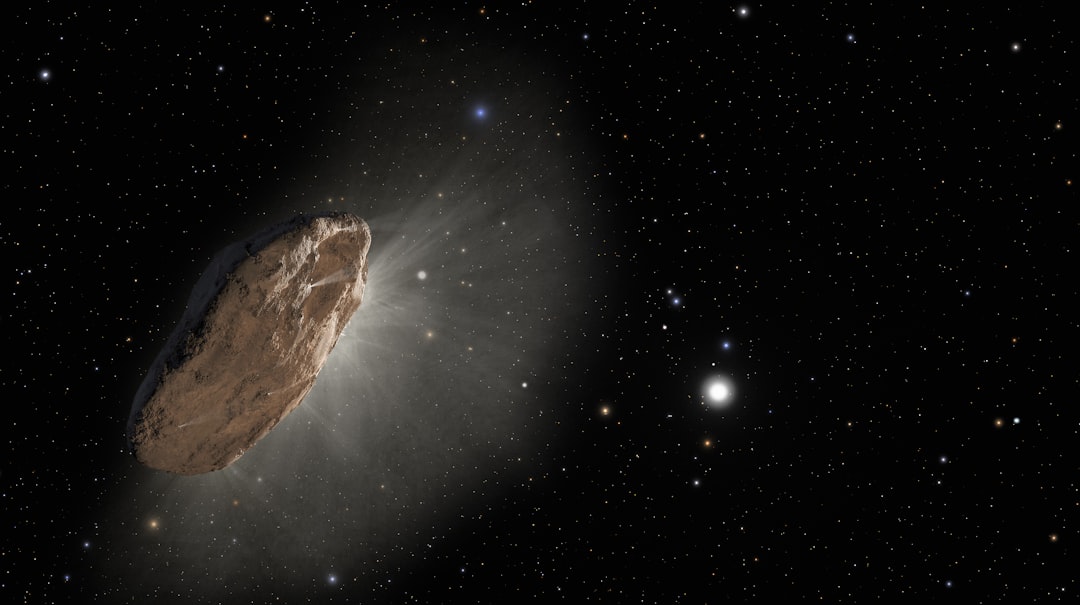
The quest to reach the tens of thousands of Near-Earth Objects (NEOs) scattered throughout our cosmic neighborhood has long been hampered by the extraordinary computational challenges of trajectory planning. These celestial bodies—ranging from small asteroids to larger rocky worlds—represent some of the most accessible and potentially valuable resources in our solar system, yet getting to them efficiently has remained a formidable obstacle. Now, groundbreaking research from Alessandro Beolchi at Khalifa University of Science and Technology offers a revolutionary approach that dramatically reduces both computational demands and mission costs while opening new pathways to these miniature worlds.
Published in a comprehensive study on low-energy round-trip trajectories, this innovative methodology represents a paradigm shift in how we approach interplanetary navigation. By cleverly combining multiple mathematical models and accounting for modern propulsion technologies, the research team has identified over 2 million viable mission profiles to 80 different near-Earth asteroids—achievements that would have been computationally prohibitive using traditional methods employed by NASA's trajectory planning systems.
The Limitations of Traditional Trajectory Planning
For decades, space agencies have relied on a technique called the "Patched-Conics" method to chart courses through the solar system. This approach, while effective for its time, operates on several simplifying assumptions that made calculations manageable in an era of limited computing power. The method fundamentally depends on the Two-Body Problem—a mathematical framework that considers only the gravitational interaction between the Sun and the spacecraft, effectively treating the solar system as if no other celestial bodies exerted meaningful influence.
This simplification worked adequately when missions relied exclusively on chemical propulsion systems, which deliver thrust in short, powerful bursts. Think of it like flooring the accelerator in a car for brief moments—you get where you're going quickly, but not necessarily efficiently. For much of space exploration history, speed trumped efficiency, and the computational savings of ignoring Earth's gravity and other planetary influences seemed like a reasonable trade-off.
However, as our ambitions in space have grown and technologies have evolved, these traditional methods have begun to show their age. The Jet Propulsion Laboratory and other institutions have recognized that the future of space exploration demands more sophisticated approaches that can leverage modern propulsion systems and computational capabilities.
A Revolutionary Multi-Model Framework
The breakthrough achieved by Beolchi and his colleagues lies in their ingenious integration of multiple astrodynamical models, each optimized for different phases of an asteroid mission. Rather than forcing a single mathematical framework to describe the entire journey, they recognized that different regions of space require different analytical approaches.
Near-Earth Phase: The Three-Body Solution
When a spacecraft operates in Earth's immediate vicinity, the gravitational interplay between our planet and the Sun creates a complex dynamical environment. The researchers employed the Circular Restricted Three-Body Problem (CR3BP) to model this phase with unprecedented accuracy. This framework captures the subtle gravitational "tug-of-war" between Earth and the Sun, revealing the existence of Lagrange points—five special locations in space where gravitational forces create stable parking spots for spacecraft.
These Lagrange points, designated L1 through L5, have become increasingly important in mission planning. The European Space Agency has extensively studied these locations, recognizing their potential as staging areas for deep-space missions. What makes them particularly valuable in Beolchi's methodology is their associated invariant manifolds—invisible "highways" through space that allow spacecraft to coast away from Earth with minimal fuel expenditure.
"These invariant manifolds act like cosmic rivers, carrying spacecraft along predetermined paths with virtually no propellant cost. By strategically positioning missions to intersect with these natural pathways, we can dramatically reduce the energy requirements for reaching near-Earth asteroids," explains the research team in their published findings.
Deep Space Phase: Simplified Two-Body Dynamics
Once a spacecraft ventures far enough from Earth that our planet's gravitational influence becomes negligible, the model seamlessly transitions to the classical Two-Body Problem, considering only the Sun and the spacecraft. This elegant switching between models optimizes computational efficiency—using complex calculations only where necessary and simplifying where appropriate. The return journey is calculated independently, with the two trajectories "stitched together" at the target asteroid, allowing for maximum flexibility in mission design.
Embracing Modern Propulsion Technologies
Perhaps the most significant innovation in this new methodology is its accommodation of Solar Electric Propulsion (SEP) systems and other continuous-thrust technologies. Unlike chemical rockets that deliver explosive bursts of acceleration, SEP systems provide gentle, sustained thrust over extended periods—imagine the difference between sprinting and marathon running.
The thrust from an ion engine or other electric propulsion system might seem almost imperceptible at any given moment, often compared to the weight of a single sheet of paper resting on your hand. However, when applied continuously over months or years, this gentle push accumulates into substantial velocity changes. NASA's Glenn Research Center has pioneered much of the development in electric propulsion, recognizing its transformative potential for deep-space exploration.
Traditional trajectory planning software assumed nearly instantaneous velocity changes—appropriate for chemical rockets but wholly inadequate for modeling electric propulsion. Beolchi's team fundamentally restructured their algorithms to account for the continuous-thrust profiles characteristic of modern propulsion systems, opening up entirely new classes of trajectories that would have been invisible to conventional planning methods.
Remarkable Results: Millions of Pathways Revealed
When the research team applied their refined methodology to a sample of 80 near-Earth asteroids—each with relatively circular, low-eccentricity orbits—the results exceeded all expectations. The algorithms identified more than 2 million distinct, viable round-trip trajectories, each representing a potential mission profile with its own characteristics in terms of flight time, energy requirements, and launch windows.
Case Study: The Mini-Moon 1991 VG
Among the most intriguing findings was the trajectory profile for asteroid 1991 VG, an object that temporarily became a "mini-moon" of Earth. The optimized path revealed what researchers call an "alternate gate" transfer—a mission architecture where a robotic probe departs Earth along a trajectory toward the L1 Lagrange point (located between Earth and the Sun), rendezvous with the asteroid, and then returns home via the L2 point on the opposite side of our planet. This elegant solution minimizes energy expenditure while maximizing mission flexibility.
Case Study: The Notorious Apophis
The algorithm proved equally adept at handling more challenging targets. Asteroid 99942 Apophis, famous for its highly eccentric and inclined orbit—and its close approaches to Earth that once raised concerns about potential impacts—presented a stern test of the methodology. Despite the orbital complexity, the system generated efficient trajectory solutions that would have been extraordinarily difficult to discover using traditional methods.
Quantifying the Advantages: Cost and Safety Benefits
When researchers compared their results against trajectories in NASA's Near-Earth Object Human Space Flight Accessible Targets Study (NHATS) database, the advantages became strikingly clear. While the total delta-v (the cumulative velocity change required for the mission) remained comparable between the two approaches, the new methodology achieved a dramatic reduction in launch escape energy—the amount of energy needed to break free from Earth's gravitational embrace.
Lower launch energy translates directly into reduced mission costs. Smaller rockets can be used, or alternatively, larger payloads can be carried on the same launch vehicle. For resource-constrained space agencies and emerging commercial space companies, these savings could mean the difference between a mission being feasible or remaining on the drawing board.
Equally important are the safety improvements for return trajectories. The optimized paths bring spacecraft back to Earth at significantly lower velocities, reducing the intensity of atmospheric reentry. This means less demanding requirements for heat shielding, lower structural loads on the spacecraft, and improved safety margins—critical factors for missions that might eventually carry human crews or return valuable samples to Earth.
Key Advantages of the New Methodology
- Computational Efficiency: Dramatically reduced processing requirements by strategically combining multiple mathematical models, making trajectory optimization accessible to smaller research institutions and commercial entities
- Energy Optimization: Exploitation of invariant manifolds and Lagrange points enables missions with substantially lower propellant requirements, extending spacecraft operational lifetimes
- Modern Propulsion Integration: Native support for continuous-thrust propulsion systems like solar electric propulsion, reflecting the reality of contemporary spacecraft capabilities
- Launch Cost Reduction: Lower escape energy requirements translate directly into reduced launch vehicle costs or increased payload capacity for the same launch system
- Enhanced Safety: Gentler return trajectories reduce reentry heating and structural loads, improving mission safety and reducing heat shield mass requirements
- Mission Flexibility: The discovery of millions of viable trajectories provides mission planners with unprecedented options for launch windows, flight times, and target selection
Implications for Future Asteroid Exploration
As humanity stands on the threshold of a new era in asteroid exploration—driven by scientific curiosity, resource utilization prospects, and planetary defense considerations—these advanced trajectory planning methods will prove increasingly indispensable. The NASA Planetary Defense Coordination Office continues to identify new potentially hazardous asteroids, expanding the catalog of objects we might want to visit for characterization or deflection testing.
Commercial ventures are also eyeing near-Earth asteroids as potential sources of valuable materials, from water ice for propellant production to precious metals. Companies developing asteroid mining capabilities will need exactly the kind of efficient, cost-effective trajectory solutions that Beolchi's methodology provides. The ability to reach more targets with less fuel and lower costs could accelerate the timeline for commercial asteroid utilization from distant dream to near-term reality.
Furthermore, as space agencies plan increasingly ambitious human exploration missions beyond low Earth orbit, near-Earth asteroids represent ideal "stepping stone" destinations. They offer scientifically valuable targets closer than Mars, allowing us to develop and test deep-space exploration capabilities in a more forgiving environment. Efficient trajectories that minimize mission duration and maximize crew safety will be paramount for these pioneering human missions.
The Road Ahead: From Theory to Practice
While this research represents a significant theoretical advance, the true test will come in its application to actual mission planning. Space agencies and research institutions worldwide are likely to incorporate these methods into their trajectory optimization toolkits, validating the approach through real mission scenarios. The ESA's Hera mission, planned to visit the Didymos binary asteroid system, and future missions in NASA's Discovery and New Frontiers programs could benefit from these optimized trajectory solutions.
The methodology also opens avenues for further research. Extensions could include modeling gravitational influences from other planets for trajectories that venture further into the solar system, or incorporating more complex propulsion profiles that combine chemical and electric systems. As our catalog of near-Earth objects continues to grow—currently numbering over 30,000 known NEOs—the ability to efficiently calculate trajectories to this expanding population becomes ever more critical.
In an era where space exploration must balance scientific ambition with fiscal responsibility, innovations that reduce costs while improving safety represent genuine breakthroughs. Beolchi and his colleagues have provided the space exploration community with a powerful new tool—one that promises to make our neighboring asteroids more accessible than ever before, opening new possibilities for discovery, resource utilization, and ultimately, humanity's expansion into the solar system.