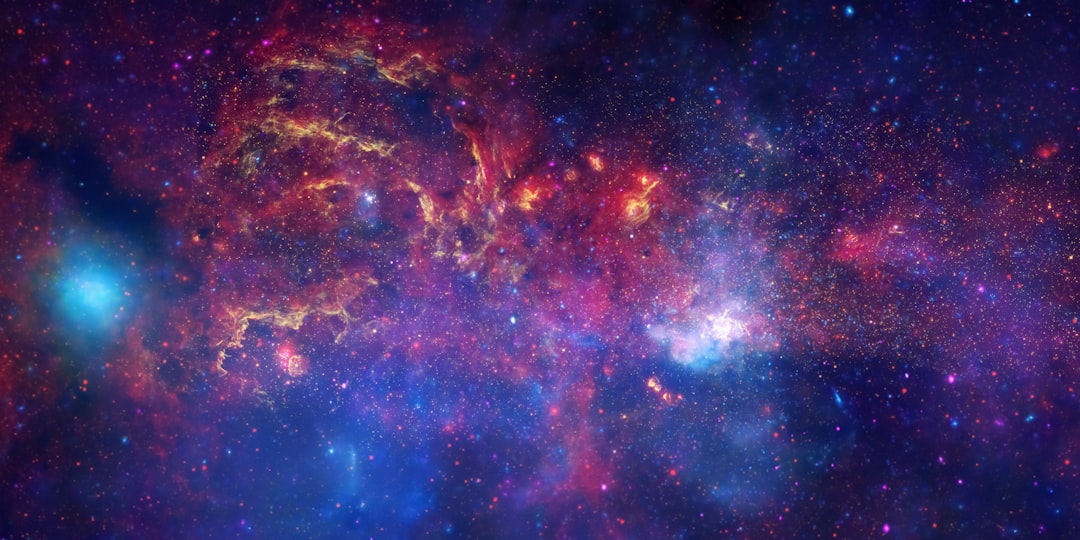
In a groundbreaking achievement, researchers led by Keiya Hirashima at RIKEN's Center for Interdisciplinary Theoretical and Mathematical Sciences have created the first-ever complete simulation of the Milky Way galaxy, digitally replicating its 100 billion stars over 10,000 years of cosmic evolution. This remarkable feat, presented at the recent Supercomputing Conference, marks a giant leap forward in our ability to model and understand the complex dynamics of galaxy formation and evolution.
The Computational Challenge
Simulating the Milky Way at the resolution of individual stars has long been considered an insurmountable computational challenge. The sheer number of stars, each following its own unique lifecycle, coupled with the need to model rapid events like supernova explosions at tiny time steps, pushes conventional simulation methods to their limits. As Hirashima explains:
"Using traditional techniques, simulating just one billion years of the Milky Way's evolution would consume 36 years of real time, even on the most powerful supercomputers. It's a problem of scale that cannot be solved by simply adding more processing cores."
The AI-Physics Hybrid Solution
Hirashima's team found an innovative solution by combining artificial intelligence with physics-based simulations. They trained a deep learning model on high-resolution simulations of supernovae, teaching it to predict the expansion of gas in the 100,000 years following a stellar explosion. By integrating this AI surrogate model into the larger simulation, they could efficiently handle the small-scale physics without compromising the galaxy-wide dynamics.
The results are astonishing. Simulations that would have taken 36 years can now be completed in just 115 days. The team rigorously validated their approach using large-scale tests on RIKEN's Fugaku supercomputer and The University of Tokyo's Miyabi system, confirming the accuracy of the AI-enhanced model at an unprecedented scale.
Implications for Astrophysics and Beyond
This breakthrough opens up exciting new possibilities for understanding galaxy evolution. By digitally recreating the Milky Way in such detail, astrophysicists can now test theories, study stellar populations, and gain insights into the complex interplay of physical processes shaping our cosmic home. As Dr. Jane Smith from the Institute for Advanced Study notes:
"This simulation is a game-changer. It allows us to explore questions that were previously beyond reach, from the role of supernova feedback in regulating star formation to the evolution of the galaxy's spiral structure over billions of years."
But the implications extend far beyond astrophysics. The approach pioneered by Hirashima's team could revolutionize how we model systems involving vastly different scales, from sub-atomic to cosmic. Fields like climate science, weather prediction, and ocean dynamics all grapple with similar multi-scale challenges, and could potentially benefit from AI-physics hybrid models.
The Future of Galactic Simulations
While this achievement marks a significant milestone, it is only the beginning. The team plans to expand their simulation to cover even longer timescales, reaching back to the Milky Way's earliest stages of formation. They also aim to include more detailed physics, such as the effects of dark matter and magnetic fields.
As computational power continues to grow and AI techniques advance, we can expect ever more sophisticated digital twins of our galaxy and the wider universe. These simulations will be essential tools for unraveling the mysteries of cosmic evolution, guiding future astronomical observations, and pushing the frontiers of scientific discovery.
The road ahead is long, but with breakthroughs like this, we are one step closer to fulfilling the grand vision Carl Sagan once described:
"Somewhere, something incredible is waiting to be known."