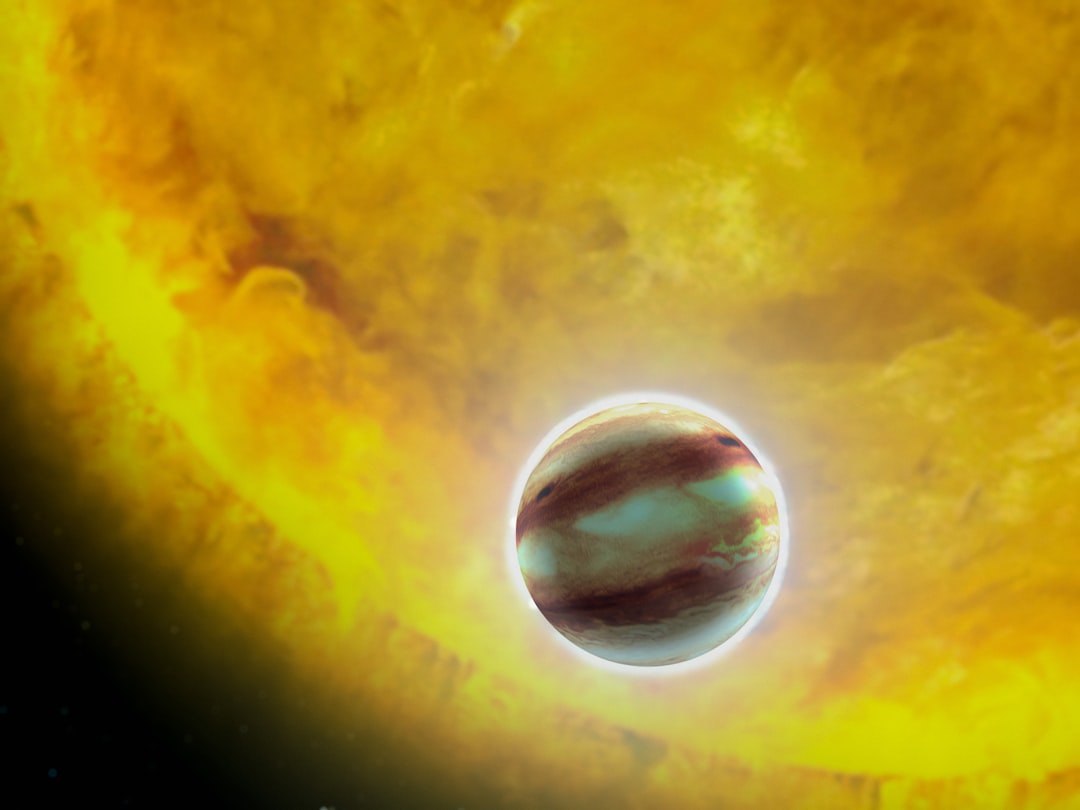
For decades, astronomers operated under the assumption that binary star systems—pairs of stars locked in gravitational embrace—were essentially planetary deserts. The conventional wisdom held that the chaotic gravitational dance between two stars would tear apart any nascent planetary material before it could coalesce into worlds. Yet recent discoveries have turned this understanding on its head, revealing that these stellar pairs may actually be prolific planet factories, churning out worlds at rates that rival or even exceed single-star systems like our own Sun.
The catch? Many of these planets don't survive long enough to enjoy stable orbits. New research published in the Monthly Notices of the Royal Astronomical Society reveals a cosmic irony: while circumbinary discs—the swirling rings of gas and dust that encircle both stars in a binary pair—can efficiently produce gas giant planets, the same complex gravitational environment that enables their formation also frequently ejects them into the cold darkness of interstellar space as rogue planets.
This groundbreaking study, conducted by Matthew Teasdale and Dimitris Stamatellos from the Jeremiah Horrocks Institute for Mathematics, Physics, and Astronomy at the University of Lancashire, provides the first comprehensive simulation of how disc fragmentation operates in binary star environments. Their findings not only explain the growing catalog of circumbinary exoplanets discovered by missions like NASA's Kepler Space Telescope, but also suggest that the Milky Way may be teeming with billions of planetary orphans cast out from their binary birthplaces.
The Abundance of Binary Stars and the Planet Formation Puzzle
Binary star systems are far from cosmic rarities—they represent a substantial fraction of all stellar systems in our galaxy. Current estimates suggest that between 40-50% of Sun-like stars exist in binary or multiple star systems, making them one of the most common stellar configurations in the universe. For years, this abundance presented a paradox: if binaries are so common, yet supposedly hostile to planet formation, where did all the planets we observe come from?
The traditional concern centered on the protoplanetary disc, the rotating disk of gas and dust from which planets form. In a binary system, gravitational forces from both stars can warp, truncate, or completely disrupt these discs. The competing pulls create tidal forces that can prevent material from settling into the stable, circular orbits necessary for gradual planet assembly. In extreme cases, these forces can shred the disc entirely, scattering its contents before any planetary building blocks can form.
However, the discovery of more than 50 circumbinary exoplanets in recent years has forced astronomers to reconsider these assumptions. The first confirmed circumbinary planet, Kepler-16b, discovered in 2011, orbits a pair consisting of an M-dwarf (red dwarf) and a K-type orange dwarf star. This "Tatooine-like" world, named after the fictional planet from Star Wars with its double sunset, proved that planets could indeed form and survive in these supposedly inhospitable environments.
Two Pathways to Planet Formation: Accretion Versus Fragmentation
To understand how planets form in binary systems, we must first examine the two primary mechanisms of planetary genesis that operate throughout the universe. The first and more familiar process is core accretion, a bottom-up approach that builds planets grain by grain. This painstaking process begins with microscopic dust particles in the protoplanetary disc electrostatically sticking together. These aggregates grow into pebbles, then rocks, then boulders, eventually forming kilometer-sized bodies called planetesimals.
Core accretion is particularly effective at forming rocky, terrestrial planets like Earth, Mars, and Venus. Once a planetesimal reaches sufficient mass—typically around one-tenth the mass of Earth—its gravity becomes strong enough to accelerate the accretion process dramatically. At this point, it can sweep up remaining material in its orbital path and, if conditions are right, capture a gaseous atmosphere. The entire process typically takes several million to tens of millions of years to produce a fully formed planet.
The second mechanism, and the focus of Teasdale and Stamatellos's research, is disc fragmentation or gravitational instability. This top-down process operates on dramatically shorter timescales—potentially as brief as a few thousand years. When regions of a protoplanetary disc become sufficiently dense and cool, they can become gravitationally unstable and collapse directly into planet-sized objects, similar to how stars themselves form from collapsing molecular clouds. This process is thought to be the primary formation mechanism for gas giant planets on wide orbits, particularly those found far from their host stars where core accretion would take prohibitively long.
"Close to a binary star it's simply too violent for planets to form. But move farther out and the disc becomes an ideal environment for planet formation," explained Dr. Matthew Teasdale, who led the research as part of his doctoral project at the University of Lancashire.
Simulating Planetary Birth in Binary Systems
The research team employed sophisticated hydrodynamic simulations to model how disc fragmentation proceeds in different stellar environments. Their computational approach allowed them to track the evolution of gas and dust over thousands of simulated years, observing how gravitational instabilities develop and collapse into protoplanets. The simulations incorporated realistic physics, including gas pressure, gravitational forces, and thermal processes that heat and cool the disc material.
The researchers examined three distinct scenarios to isolate the effects of binary companions on planet formation:
- Circumstellar discs: Traditional discs surrounding single stars, serving as the baseline comparison for understanding how planetary formation differs in binary environments
- Fiducial circumbinary discs: Simplified models of discs surrounding binary pairs, using the same temperature profile as the circumstellar discs to provide a controlled comparison
- Realistic circumbinary discs: More sophisticated models where each star in the binary individually heats the surrounding disc, creating complex temperature gradients and thermal structures that more accurately represent actual binary systems
The simulations varied key parameters including the binary separation (how far apart the two stars orbit), the mass ratio between the stars, and the orbital eccentricity (how circular or elliptical the binary orbit is). These variables significantly influence the gravitational environment and, consequently, the planet formation process. Data from observatories like the European Southern Observatory's Very Large Telescope helped inform realistic parameter ranges for the simulations.
Surprising Findings: Binary Systems as Planetary Factories
The simulation results revealed several unexpected and significant findings that challenge previous assumptions about planet formation in binary systems. Most strikingly, realistic circumbinary discs proved to be the most prolific planet producers, generating an average of 9 ± 0.9 protoplanets per disc. This exceeded both the fiducial circumbinary discs (6.5 ± 0.6 protoplanets) and even the circumstellar discs around single stars (7.5 ± 0.8 protoplanets).
The enhanced planet formation efficiency in realistic binary systems stems from the complex heating patterns created by both stars. Each star contributes to heating the disc, but the heating is non-uniform, creating regions of varying temperature and density. These thermal gradients can actually promote gravitational instability in certain zones of the disc, particularly at intermediate distances where the material is cool enough to fragment but still dense enough to collapse efficiently.
The research also revealed critical spatial patterns in planet formation. Fragmentation occurred predominantly beyond what the researchers termed a "binary-imposed forbidden region" extending to approximately 50 astronomical units (AU) from the binary center—roughly the distance from our Sun to the Kuiper Belt. Most planets formed at even greater distances, with final orbital radii peaking around 100 AU, placing them in the outer reaches of their planetary systems.
Interestingly, the planets formed in realistic circumbinary discs tended to have lower individual masses compared to those formed around single stars. This occurs because the available disc mass gets distributed among a larger number of forming planets. However, more of these objects fall within the true planetary mass range (roughly 1-13 Jupiter masses) rather than becoming brown dwarfs or low-mass stars, making circumbinary discs particularly efficient at producing gas giant planets specifically.
The Influence of Binary Characteristics
The simulations demonstrated that not all binary systems are equally effective at producing planets. Wider binary separations—where the two stars orbit farther from each other—led to earlier and more efficient disc fragmentation compared to tighter binaries. This makes intuitive sense: wider separations create larger, more stable regions where the disc can cool and fragment without being disrupted by the stars' gravitational tug-of-war.
The mass ratio between the binary components also played a crucial role. Systems with more equal-mass stars created more symmetric heating patterns and gravitational influences, leading to different fragmentation characteristics compared to systems where one star significantly outweighed its companion. Similarly, the orbital eccentricity of the binary affected planet formation, with more circular orbits generally providing more stable environments for disc evolution.
The Dark Side: Planetary Ejections and Rogue Worlds
Despite their efficiency at producing planets, circumbinary systems have a significant drawback: they're equally efficient at ejecting them. The same complex gravitational environment that enables rapid planet formation also creates a fundamentally unstable dynamical system. When multiple planets form in a circumbinary disc, they create what astronomers call an n-body system—a collection of objects whose mutual gravitational interactions become chaotic and unpredictable over time.
The simulations revealed that circumbinary discs eject a significantly higher fraction of protoplanets compared to circumstellar discs. These ejections occur through close gravitational encounters between planets or between planets and the binary stars themselves. During these encounters, gravitational energy is exchanged, and one or more objects can be accelerated to velocities exceeding the system's escape velocity, sending them careening into interstellar space.
The typical ejection velocities measured in the simulations ranged from 2 to 6 kilometers per second—fast enough to escape the gravitational pull of the binary system but slow compared to stellar velocities in the galaxy. These ejected worlds become rogue planets or free-floating planetary-mass objects, wandering the Milky Way untethered to any star. Research from NASA's Jet Propulsion Laboratory suggests there may be billions or even trillions of such orphaned worlds in our galaxy, potentially outnumbering planets in stable solar systems.
"Binary stars were once seen as hostile environments for planet formation. What we're finding is that they can actually be extremely productive. Once you get past the danger zone, planets can form quickly and in large numbers," noted co-author Dr. Dimitris Stamatellos.
Implications for Exoplanet Demographics and Future Observations
These findings have profound implications for our understanding of exoplanet demographics throughout the galaxy. If binary systems—which constitute nearly half of all stellar systems—are efficient planet producers, then the total planetary census of the Milky Way may be substantially higher than previous estimates suggested. However, the high ejection rate means that many of these worlds never settle into stable, long-term orbits, complicating our ability to detect them through traditional methods.
The research strongly supports the conclusion that gravitational instability represents a viable and potentially significant formation channel for circumbinary gas giant planets. This mechanism may explain the population of wide-orbit gas giants discovered around binary stars, particularly those beyond 10 AU where core accretion becomes inefficient due to long orbital timescales and low material densities.
For observational astronomers, these results suggest that surveys should focus on wide-separation binary systems when searching for circumbinary planets. Missions like the James Webb Space Telescope and future facilities such as the Nancy Grace Roman Space Telescope are well-equipped to detect planets at the large orbital distances where circumbinary worlds preferentially form. Direct imaging techniques, which work best for planets on wide orbits, may prove particularly effective for discovering these worlds.
The high ejection rate also suggests that searches for rogue planets should prioritize regions of recent star formation, where young binary systems may have recently ejected planetary populations. Gravitational microlensing surveys, which can detect free-floating planets through their gravitational effects on background starlight, may reveal a substantial population of circumbinary-origin rogues drifting through the galaxy.
Future Directions and Unanswered Questions
While this research represents a major advance in understanding planet formation in binary systems, numerous questions remain. Future simulations will need to explore longer timescales to track the ultimate fate of circumbinary planetary systems over millions of years. Do some planets survive the chaotic early phases to establish stable orbits? What fraction of initially formed planets ultimately get ejected versus retained?
Additionally, the simulations focused primarily on gas giant formation through disc fragmentation. The formation of rocky planets through core accretion in circumbinary systems remains less well understood and represents an important avenue for future research. Could terrestrial worlds form in the inner regions of circumbinary discs where conditions are too hot for gravitational instability but suitable for grain growth and planetesimal formation?
The research also opens intriguing questions about the potential habitability of circumbinary worlds. While the gas giants formed through disc fragmentation would themselves be inhospitable to life as we know it, they might host large moons that could potentially be habitable. Additionally, if terrestrial planets can form in the inner regions of circumbinary systems, they would experience unique environmental conditions, including variable stellar illumination and complex seasonal cycles driven by the binary orbital dynamics.
As our observational capabilities continue to advance and our theoretical understanding deepens, the story of planet formation in binary systems grows increasingly complex and fascinating. Far from being planetary wastelands, these stellar pairs emerge as dynamic laboratories where worlds form rapidly and abundantly—even if many don't survive to tell the tale. The next generation of space telescopes and computational simulations will undoubtedly reveal even more surprises about these remarkable cosmic environments.