Could the Clues to Ancient Alien Civilizations Be Hiding in a Bucket of Moon Dust?
For decades, humanity's grand quest to answer one of its most profound questions — are we alone in the universe? — has been dominated by a single, elegant strategy: listen. The Search for Extraterrestrial Intelligence (SETI) has largely focused on scanning the skies for radio signals that alien species might have broadcast, whether deliberately or as a byproduct of their technological civilization. Powerful radio telescopes have swept vast swaths of the cosmos, hoping to intercept that one anomalous transmission that would rewrite everything we know about our place in the universe.
But this approach carries a fundamental, deeply uncomfortable problem — one that scientists refer to as the "synchronicity problem." The Milky Way galaxy is approximately 13.6 billion years old, and the window of time during which any given civilization might be actively broadcasting detectable signals is, on cosmic timescales, almost vanishingly thin. What if technologically advanced alien civilizations existed and flourished a billion, or even five billion, years ago, but have long since gone silent? The odds that we exist at precisely the same cosmic moment as another civilization that is actively transmitting in our direction represent an extraordinary leap of faith — a gamble on cosmic coincidence of the highest order.
Now, a bold and imaginative new paper challenges this fundamental assumption. Available in pre-print on arXiv and submitted to the International Journal of Astrobiology, the study by Lewis J. Pinault, an associated researcher at the SETI Institute, and his co-authors proposes a radical alternative: instead of listening for signals that may no longer exist, we should search for physical artifacts — microscopic traces of alien technology — hidden within the lunar soil itself.
"Rather than waiting for a signal that may never come, we can search for durable physical evidence of technological activity that could have persisted across billions of years — preserved, of all places, in the dust of our own Moon."
— Concept underlying the Pinault et al. research proposal
The Moon as a Cosmic Archive
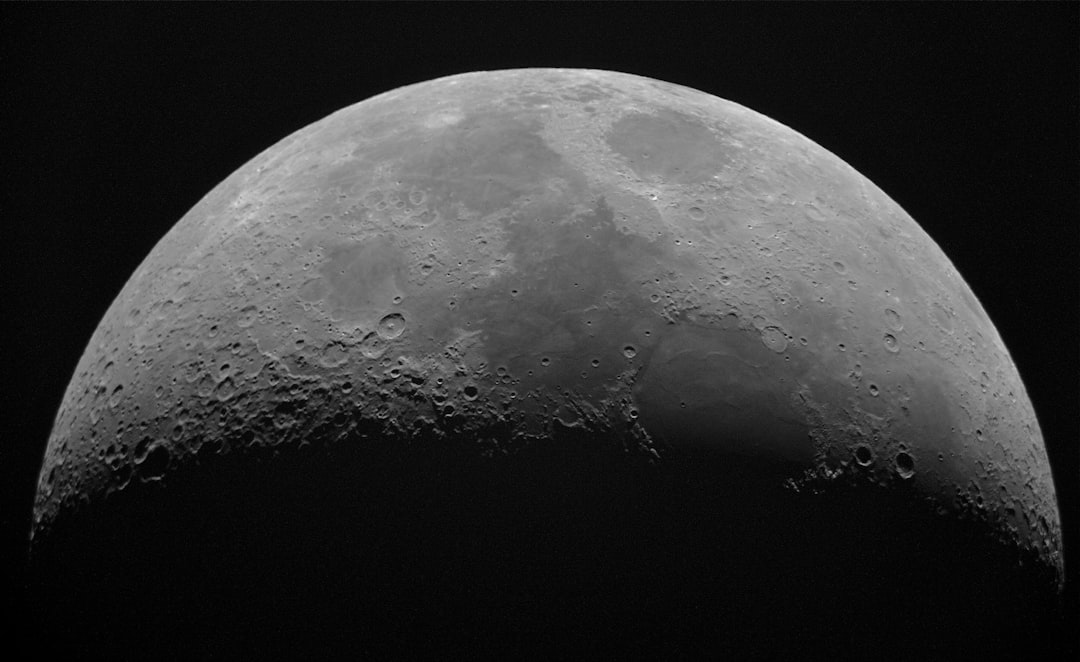
Before dismissing this idea as science fiction, consider the remarkable properties of the lunar surface as a natural preservation medium. The Moon is, in a very real sense, one of the solar system's finest archivists. Unlike Earth, which is a geologically restless planet constantly erasing its own history through plate tectonics, volcanic activity, erosion, and the water cycle, the Moon is largely geologically inert. It offers a stable, ancient surface that has been quietly collecting material from across the cosmos for billions of years.
The Moon presents several distinct advantages as a repository for microscopic alien artifacts:
- No atmosphere: Without an atmosphere, incoming particles are not vaporized or chemically altered before reaching the surface, as they would be on Earth.
- No plate tectonics: The lunar crust does not recycle itself the way Earth's does. Material that lands on the Moon tends to stay near where it landed, rather than being subducted into a planetary interior.
- No water cycle: There are no oceans, rivers, or rainfall to wash particles away or chemically degrade them over millennia.
- Impact gardening: The continual bombardment of the lunar surface by micrometeorites churns the top layer of soil — a process known as impact gardening or regolith overturn. This process gradually buries incoming particles under up to a few meters of regolith (lunar soil), shielding them from the destructive effects of cosmic rays and solar radiation that would otherwise degrade them on the open surface.
- Ancient, undisturbed record: Much of the lunar surface has remained relatively unchanged for billions of years, making it an extraordinary long-term record of the material that has passed through the inner solar system.
In essence, the Moon functions as a passive but extraordinarily patient collector — a cosmic Petri dish that has been gathering material from the wider galaxy for most of the solar system's 4.6-billion-year history. It is, in the words of planetary scientists, one of the best-preserved geological records in the entire solar system. NASA's Artemis program, which aims to return humans to the lunar surface, may thus have implications far beyond human exploration — it could inadvertently open a window onto the history of intelligent life in the galaxy.
Two Types of Cosmic Artifacts: Arkhipov and Bracewell Particles
The paper distinguishes between two fundamentally different categories of microscopic particles that could, in theory, carry evidence of alien technological civilization to the lunar surface.
Arkhipov Particles: The Unintentional Industrial Debris
The first category is named after Alexei Arkhipov, a Ukrainian astronomer who first proposed this concept in the 1990s. Arkhipov Particles are the microscopic, unintentional byproducts of alien industrial or engineering activity — the cosmic equivalent of industrial effluent or shrapnel.
Consider one of the most ambitious theoretical engineering projects ever conceived by human minds: the Dyson Sphere, or more realistically a Dyson Swarm — a vast array of energy-harvesting structures built around a star to capture a significant fraction of its total energy output. First formally proposed by physicist Freeman Dyson in 1960, such a megastructure would represent a hallmark of what the Soviet astronomer Nikolai Kardashev classified as a Type II civilization on his famous Kardashev Scale — a civilization capable of harnessing the total energy output of its home star.
Even the most perfectly engineered megastructure suffers from wear. Components collide, degrade, and are destroyed over centuries and millennia. The resulting debris — fragments of advanced engineered materials measured in microns — could be ejected from the host star system by stellar radiation pressure, gravitational perturbations, or energetic events. Once in interstellar space, these grains could drift across light-years over vast timescales, eventually being captured by our own solar system's gravitational field.
This scenario is far less implausible than it might initially appear. Our Sun completes one full orbit around the Milky Way galaxy approximately every 225 to 230 million years — what astronomers call a galactic year or cosmic year. Over the solar system's 4.6-billion-year history, it has completed roughly 20 full circuits of the galaxy, sweeping through an enormous volume of the Milky Way and encountering material from countless different stellar neighborhoods. The interstellar medium is not empty — it is threaded with gas, dust, and potentially the detritus of civilizations that have risen and fallen over geological timescales.
Bracewell Particles: Intentional Interstellar Probes
The second category carries an even more extraordinary implication. Bracewell Particles are named after the physicist and astronomer Ronald Bracewell, who in 1960 proposed that an advanced civilization might choose to communicate not by radio waves, but by sending self-replicating or information-carrying probes to other star systems. In this framework, Bracewell Particles represent intentionally designed and dispatched microscopic probes — often described as "smart dust" — engineered to travel to target solar systems and either transmit information, gather data, or simply serve as a durable record of their creators' existence.
The concept connects to broader theoretical discussions in astrobiology and SETI, including the notion of von Neumann probes — self-replicating machines that could, in principle, spread across an entire galaxy over millions of years, even at sub-light speeds. If even one spacefaring civilization in the Milky Way's history chose to seed the galaxy with such dust-scale probes, some of those probes might have arrived in our solar system — and settled on the Moon — eons before the first complex life evolved on Earth. For more on the theoretical underpinnings of this concept, the European Space Agency's overview of SETI concepts provides valuable context.
The Interstellar Journey: An Extraordinary Gauntlet
The journey from an alien star system to our Moon is not a gentle one. Any particle making this crossing must survive one of the most hostile environments imaginable: the vast, cold emptiness of interstellar space, which is simultaneously threaded with high-energy cosmic rays, ultraviolet radiation, and microscopic grains of interstellar dust traveling at enormous velocities.
The good news, according to the paper, is that materials engineered by a sufficiently advanced civilization might be up to the task. The authors specifically discuss refractory materials — substances that maintain their structural integrity at extreme temperatures and under intense radiation. These include:
- Advanced ceramics — including carbides and nitrides with exceptional hardness and thermal resistance
- Graphene — the single-atom-thick lattice of carbon atoms with extraordinary mechanical strength and chemical stability
- Titanium-tungsten superalloys — metals known for their resistance to both high temperatures and radiation damage
- Other exotic engineered composites that a civilization millions of years more advanced than our own might have developed
The paper estimates that grains of such refractory materials could survive interstellar transit for somewhere between 100 million and 1 billion years — a timescale long enough to cross significant fractions of the Milky Way. This is not mere speculation; our own materials science is already producing substances of remarkable durability, and a civilization operating at Kardashev Type II or Type III scale would likely have access to materials engineering capabilities that dwarf our own by orders of magnitude.
Upon entering our solar system, however, a new challenge emerges. Particles falling inward under the Sun's gravity accelerate dramatically. By the time they reach 1 Astronomical Unit (AU) — approximately the mean distance between Earth and the Sun — they would be traveling at roughly 42 km/s. Striking the Moon's surface at this velocity would result in complete vaporization and total destruction of any complex internal structure. The particles must decelerate significantly before impact.
Remarkably, the paper proposes that the Sun itself provides a natural braking mechanism. For particles of the right size and density, solar radiation pressure — the gentle but persistent push of sunlight — can counteract the inward gravitational pull sufficiently to slow the grains to survivable impact velocities. This elegant natural solution means that the Moon acts not just as a collector, but as a selectively gentle one — preferentially preserving particles within a specific size range, which happens to correspond well to micron-scale technological grains.
Finding Needles in a Cosmic Haystack: The Role of AI
Even if such particles do exist on the Moon, finding them presents a challenge of almost incomprehensible magnitude. The authors offer a sobering calculation: a single cubic meter of lunar regolith — equivalent to roughly 1.5 metric tonnes of fine-grained lunar soil — contains on the order of one trillion micron-sized grains. Searching through this material manually, grain by grain, would take longer than the age of the universe many times over. No conventional analytical approach could make a meaningful dent in the problem.
The solution, unsurprisingly in this era of rapid technological development, lies in artificial intelligence and advanced imaging technology. The proposed methodology is elegant in concept, even if extraordinarily demanding in practice:
- Lunar regolith samples are processed through a high-resolution scanning electron microscope (SEM), which produces detailed images of individual grains at the micron scale.
- These images are fed in real-time into a computer vision model — specifically, the authors highlight a model called YOLO-ET (You Only Look Once — Extraterrestrial Technology), which the research team has developed and used in previous work.
- The AI model flags any particles whose morphology, elemental composition, or structural properties are anomalous relative to natural lunar mineral grains.
- Flagged candidates are then subjected to deeper analysis using either a Focused-Ion-Beam (FIB) facility — which can slice specimens at nanometer precision to reveal internal structure — or nano-CT scanning, which produces three-dimensional images of a grain's interior without destroying it.
This pipeline represents a marriage of astrobiology, materials science, and machine learning that would have been science fiction a generation ago. It echoes, in spirit, the ambitious methodology employed by projects like SERENDIP, where automated signal-processing algorithms sift through enormous volumes of radio telescope data searching for anomalous patterns — but applied now to physical matter rather than electromagnetic waves.
The possible forms these technological artifacts might take remain a subject of active theoretical debate. They could manifest as micron-scale grains of non-natural elemental compositions or isotopic ratios. Alternatively, they might be captured within agglutinates — the tiny, glassy beads of material created when micrometeorite impacts briefly flash-melt the lunar regolith. These natural glass beads can encapsulate foreign grains, potentially preserving them in a protected matrix for billions of years, like insects trapped in amber.
The Scientific Value of Silence: What a Null Result Would Tell Us
One of the most scientifically sophisticated aspects of this research program is its recognition that a negative result — finding nothing — is not a failure. In science, the ability to confidently rule out a hypothesis carries genuine and profound value, and the authors have carefully worked out what constraints a null result would place on the prevalence of advanced civilizations in the galaxy.
The mathematics are striking. If a thorough search of one cubic meter of lunar regolith yields no evidence of technological material, this finding statistically rules out scenarios in which Sun-like stars throughout the Milky Way have collectively dispersed more than 0.1 Earth masses of artificial dust over the entire history of the galaxy. While this might sound like a generous upper limit, it is actually quite restrictive when considered in the context of true megastructure engineering. For a Kardashev Type II civilization — one harnessing the full power of its host star — 0.1 Earth masses represents merely a tiny fraction of the material budget available for industrial activity on cosmic timescales.
Similarly, a null result would imply that no civilization in our galactic neighborhood has been intentionally dispatching Bracewell Probes at a rate exceeding roughly 0.4 kilograms per billion years. This constraint is admittedly modest, but it establishes a measurable, scientifically defensible lower bound on the activity of spacefaring civilizations — something that purely radio-based SETI has struggled to provide in an equivalent quantitative framework.
This approach aligns with a broader shift in the SETI community toward the search for technosignatures