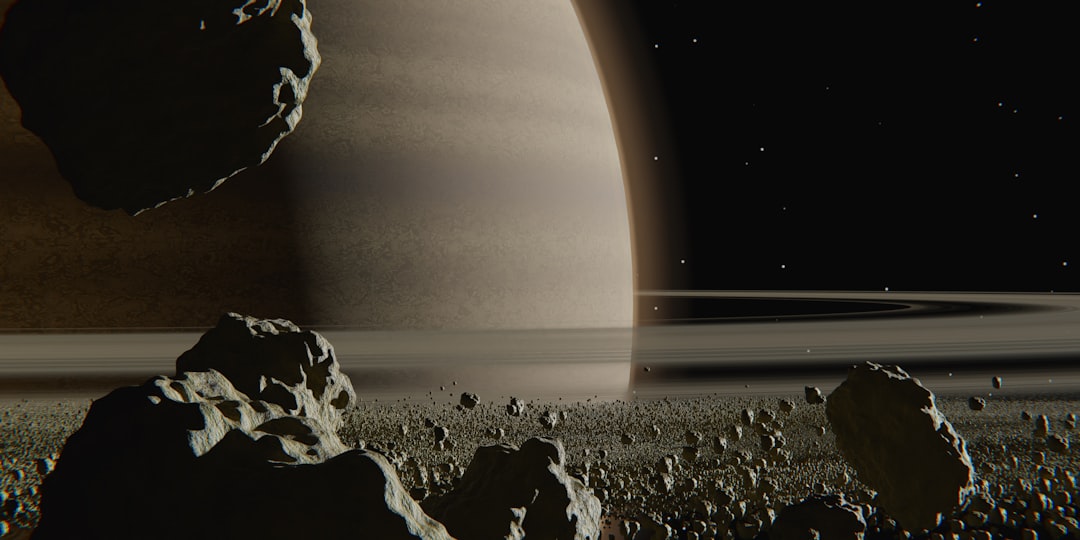
In the vast tapestry of our Solar System, Saturn stands as one of the most enigmatic jewels, adorned with its magnificent ring system and accompanied by a retinue of 274 confirmed moons. Recent groundbreaking research suggests that a cataclysmic collision hundreds of millions of years ago may have simultaneously created Titan—Saturn's largest moon—while spawning the debris that eventually formed the planet's iconic rings. This revolutionary hypothesis, developed by scientists at the SETI Institute, challenges our understanding of planetary system evolution and offers a unified explanation for several long-standing mysteries surrounding the Saturnian system.
The research, led by planetary scientist Matija Ćuk and set for publication in the Planetary Science Journal, presents a comprehensive timeline of catastrophic events that reshaped Saturn's satellite system approximately 400 million years ago. This work represents a significant advancement in our understanding of how planetary systems evolve dynamically over geological timescales, demonstrating that even ancient celestial bodies continue to bear the scars of violent cosmic upheavals that occurred relatively recently in astronomical terms.
The Puzzle of Saturn's Unusual Architecture
Saturn presents planetary scientists with a constellation of interconnected mysteries that have long defied simple explanation. The gas giant's axial tilt of 26.7 degrees stands in stark contrast to theoretical predictions, which suggest that gas giants should form with minimal tilts. This peculiarity demands an explanation rooted in the system's dynamic history. Additionally, the age of Saturn's rings has been a subject of intense debate within the planetary science community, with multiple lines of evidence pointing toward a surprisingly recent origin—perhaps only a few hundred million years old, rather than dating back to the Solar System's formation 4.6 billion years ago.
The research team at the NASA Cassini mission provided crucial observational data that revealed the rings' youthful characteristics, including their pristine, ice-rich composition and relative lack of contamination from cosmic dust. These observations suggested that something dramatic must have occurred in Saturn's recent past—a cataclysm that fundamentally restructured the entire satellite system.
Among Saturn's moons, Iapetus presents another confounding mystery with its unusual 15-degree orbital inclination relative to Saturn's equatorial plane, its distinctive two-toned coloration, and its peculiar walnut-like shape characterized by a prominent equatorial ridge. Meanwhile, Titan—the second-largest moon in the Solar System after Jupiter's Ganymede—exhibits a puzzling absence of impact craters despite its ancient age, suggesting a surface that has been recently resurfaced or renewed through some geological process.
Titan's Gravitational Influence and Orbital Migration
At the heart of this new hypothesis lies Titan's powerful gravitational influence on the entire Saturnian system. As the dominant satellite, containing more than 96% of the mass in orbit around Saturn (excluding the rings), Titan's tidal migration away from the planet serves as the primary driver of evolutionary changes throughout the system. This migration occurs as Titan's gravitational interactions with Saturn cause the moon to gradually spiral outward, a process that continues to this day at a rate that has surprised researchers.
The research team's simulations revealed that Titan's outward migration triggered a cascade of resonant interactions with other moons, fundamentally altering their orbits and stability. According to the study, Saturn's unusual obliquity was likely generated by a secular spin-orbit resonance with the other planets in our Solar System, a phenomenon directly driven by Titan's orbital expansion. This resonance would have gradually tilted Saturn's rotation axis over millions of years until a critical threshold was reached.
"Saturn's obliquity was likely generated by a secular spin-orbit resonance with the planets, while Hyperion is caught in a mean-motion resonance with Titan, with both phenomena driven by Titan's orbital expansion. The age of the rings and some of the moons of Saturn is an open question, and multiple lines of evidence point to a recent cataclysm involving disruption of past moons."
The Ancient Collision Hypothesis: Proto-Hyperion Meets Proto-Titan
The cornerstone of this new research involves the proposed existence of an additional moon that no longer exists—a body the researchers have designated "proto-Hyperion." According to their sophisticated computer simulations, this outer, mid-sized satellite occupied a crucial position in Saturn's satellite system until approximately 400 million years ago. As Titan's migration progressed and Saturn's spin-orbit resonance with the other planets reached a critical point, proto-Hyperion's orbit became increasingly unstable.
The simulations, which incorporated detailed gravitational dynamics and tidal interactions, demonstrated that proto-Hyperion would have experienced increasingly chaotic orbital perturbations. Eventually, this instability led to a close encounter with the massive proto-Titan, resulting in a catastrophic merger that fundamentally transformed both bodies. This collision would have released enormous amounts of energy and generated substantial debris—fragments that would play crucial roles in forming the Saturnian system we observe today.
Lead author Matija Ćuk explained the significance of this discovery in understanding the current satellite system:
"Hyperion, the smallest among Saturn's major moons provided us the most important clue about the history of the system. In simulations where the extra moon became unstable, Hyperion was often lost and survived only in rare cases. We recognized that the Titan-Hyperion lock is relatively young, only a few hundred million years old. This dates to about the same period when the extra moon disappeared. Perhaps Hyperion did not survive this upheaval but resulted from it."
The Role of Hyperion: A Cosmic Witness
Modern-day Hyperion stands as a peculiar remnant of this ancient collision. Unlike most large celestial bodies, which gravitational forces have shaped into spheres, Hyperion maintains an irregular, sponge-like appearance, often described as walnut-shaped. With dimensions of approximately 360 × 280 × 225 kilometers, it represents one of the largest non-spherical bodies in the Solar System. This unusual morphology has long puzzled scientists, but the new hypothesis offers an elegant explanation.
According to the research team's models, Hyperion likely formed from debris generated during the proto-Titan and proto-Hyperion collision. Some of this material accreted into the irregularly shaped moon we observe today, while its unusual form reflects the chaotic conditions of its formation. The fact that Hyperion is locked in a mean-motion resonance with Titan—where its orbital period relates to Titan's by a simple numerical ratio—provides crucial evidence for the timing of this event, as such resonances typically form relatively quickly after major disruptions.
Cascade Effects: The Formation of Rings and Inner Moons
The proto-Titan and proto-Hyperion merger set off a remarkable chain reaction throughout the Saturnian system. The collision excited Titan's orbital eccentricity, causing its orbit to become more elliptical rather than circular. This change initiated powerful resonant interactions with Saturn's inner moons, which the researchers designate as "proto-Dione" and "proto-Rhea"—predecessors to the moons we observe today.
These resonant interactions created gravitational perturbations that destabilized the inner satellite system, leading to additional collisions and disruptions. The research published in the Planetary Science Journal suggests that this cascade of events resulted in the destruction and subsequent re-accretion of Saturn's inner moons. During this tumultuous period, the majority of the debris coalesced to form new moons, while a smaller but significant fraction remained in orbit around Saturn to eventually form its spectacular ring system.
This hypothesis elegantly explains several key observations:
- Ring Age and Composition: The rings' youthful appearance and pristine ice composition align with a formation event occurring only a few hundred million years ago, rather than billions of years in the past
- Iapetus's Orbital Inclination: Proto-Hyperion's gravitational perturbations prior to the collision would have tilted Iapetus's orbit to its current 15-degree inclination
- Titan's Crater-Free Surface: The merger event would have completely resurfaced Titan, explaining why this ancient moon displays such a geologically young appearance with minimal impact cratering
- Inner Moon Characteristics: The re-accretion process explains why Saturn's inner moons show evidence of being geologically young despite the system's ancient age
Advanced Simulation Techniques and Methodology
The research team employed state-of-the-art N-body simulations to model the complex gravitational interactions within Saturn's satellite system over hundreds of millions of years. These computational models incorporated multiple factors including tidal forces, orbital resonances, and the effects of Saturn's oblateness (its equatorial bulge). By running thousands of simulations with slightly varying initial conditions, the researchers could identify which scenarios most accurately reproduced the Saturnian system's current configuration.
The simulations tracked the evolution of Saturn's obliquity, the orbital parameters of multiple moons, and the stability of various resonant configurations. Particularly crucial was modeling the breaking of Saturn's spin-orbit resonance with Neptune, an event that would have occurred as Titan's migration changed the system's resonant frequencies. This breaking point appears to have triggered the instability that led to proto-Hyperion's fateful encounter with proto-Titan.
Implications for Planetary System Evolution
This research carries profound implications extending far beyond Saturn itself. It demonstrates that planetary systems remain dynamically active over geological timescales, capable of dramatic reorganizations even billions of years after their initial formation. The concept that major satellite systems can experience recent cataclysmic events challenges earlier assumptions that such systems quickly settle into stable configurations that persist largely unchanged.
The findings also highlight the importance of tidal migration in shaping planetary systems. As large moons migrate outward due to tidal interactions with their host planets, they can trigger cascading instabilities that fundamentally restructure entire satellite systems. This mechanism may operate in other planetary systems throughout our Solar System and beyond, suggesting that the dynamic histories we observe around Saturn might represent a common evolutionary pathway.
Scientists at the European Space Agency have noted that understanding these processes helps interpret observations of exoplanetary systems, where we often observe satellites and rings around giant planets but lack the detailed information available for Saturn.
Future Observations and the Dragonfly Mission
While the hypothesis presented by Ćuk and colleagues provides a compelling framework for understanding Saturn's satellite system, direct confirmation requires additional observational data. Fortunately, NASA's Dragonfly mission to Titan promises to deliver crucial information that could validate or refine this model. Scheduled for launch in July 2028, this revolutionary rotorcraft will arrive at Titan in 2034, becoming the first mission to explore the surface of an ocean world beyond Earth.
The Dragonfly mission will investigate Titan's surface composition, geology, and atmospheric chemistry with unprecedented detail. Critically, it will be able to determine the age of Titan's surface features through various dating techniques, including crater counting in areas where impacts have occurred and analyzing the products of atmospheric chemistry that accumulate over time. These measurements will directly test the prediction that Titan's surface was resurfaced approximately 400 million years ago.
Additional observations from future missions to Saturn's other moons, particularly Iapetus and Hyperion, could provide further evidence supporting or challenging this hypothesis. Determining the precise ages and compositions of these bodies would help reconstruct the timeline of events that shaped the Saturnian system.
A Dynamic Cosmic History
The research team's work paints a picture of the Saturnian system as a dynamic, evolving environment shaped by dramatic events in its recent past. Rather than viewing Saturn's rings and moons as primordial features dating back to the Solar System's formation, this hypothesis positions them as relatively young structures born from cosmic violence and ongoing gravitational interactions.
As the authors conclude in their paper: "While the events described here took place hundreds of millions of years ago and are difficult to confirm directly, recent observations have consistently challenged previous models and revealed new dynamical pathways. Our hypothesis predicts a dynamically active and relatively young Saturnian system whose present configuration is the product of recent, dramatic events."
This perspective transforms our understanding of Saturn from a static, ancient system into one that has undergone recent and dramatic transformation. The collision between proto-Hyperion and proto-Titan emerges as a pivotal event that simultaneously created the Solar System's most massive moon while generating the debris that would become its most spectacular ring system—a cosmic connection that links two of Saturn's most distinctive features through a single cataclysmic event.
As we await data from future missions and continue to refine our models of planetary system evolution, Saturn's rings and moons stand as testament to the dynamic nature of our Solar System. They remind us that even in the apparent stability of the cosmos, violent transformations can reshape entire worlds, leaving behind clues that patient observation and careful analysis can eventually decipher. Whether or not every detail of this specific scenario proves correct, it represents the kind of bold, comprehensive thinking necessary to unravel the complex histories written in the architecture of planetary systems throughout the universe.