Even the Rubin Observatory's Test Camera Produces Stunning Images
When the Vera C. Rubin Observatory (VRO) held its highly anticipated First Look Event in July 2025, the world was treated to a breathtaking glimpse of the cosmos. Among the remarkable images unveiled was the now-iconic Cosmic Treasure Chest — a dazzling mosaic that immediately signaled the observatory's extraordinary potential. Yet, long before the facility's flagship instrument captured a single photon for public release, a smaller, unsung hero had already been quietly doing the groundwork.
That hero is ComCam — the Commissioning Camera — and it deserves far more credit than its modest engineering designation might suggest.
What Is ComCam, and Why Does It Matter?
ComCam was purpose-built as a comprehensive, end-to-end engineering test instrument for the VRO's complex systems. Mounted on the Simonyi Survey Telescope atop Cerro Pachón in Chile in 2022, it was activated for an intensive seven-week observing run in late 2024 before being carefully removed in December of that year. During those seven weeks alone, ComCam gathered an impressive ~16,000 exposures, stress-testing everything from the telescope's tracking systems and mirror alignment to its data pipeline and image-processing software.
Crucially, ComCam is not merely a placeholder — it is a fully functional, scaled-down version of the observatory's primary instrument: the Legacy Survey of Space and Time (LSST) camera. That flagship camera holds the remarkable distinction of being the largest digital camera ever built for astronomy, boasting an extraordinary 3,200 megapixels. ComCam, by comparison, produces 144-megapixel images — still an impressive feat that dwarfs even the highest-end consumer cameras available today. Each ComCam frame covers a patch of sky equivalent to the area of two full Moons, offering a tantalizing preview of the sweeping panoramic views the LSST camera will routinely deliver.
"ComCam was never meant to be the star of the show — but the images it has produced remind us that even the rehearsal can be breathtaking."
To mark the two-year anniversary of the start of ComCam testing, the NSF–DOE Vera C. Rubin Observatory released a striking new image captured during that brief but productive observing campaign. The timing feels deliberate — as if the team recognized the palpable public hunger for more VRO imagery and chose to offer this gem as both a celebration and an appetizer for what is to come.
The Seagull Nebula: A Portrait of Stellar Creation
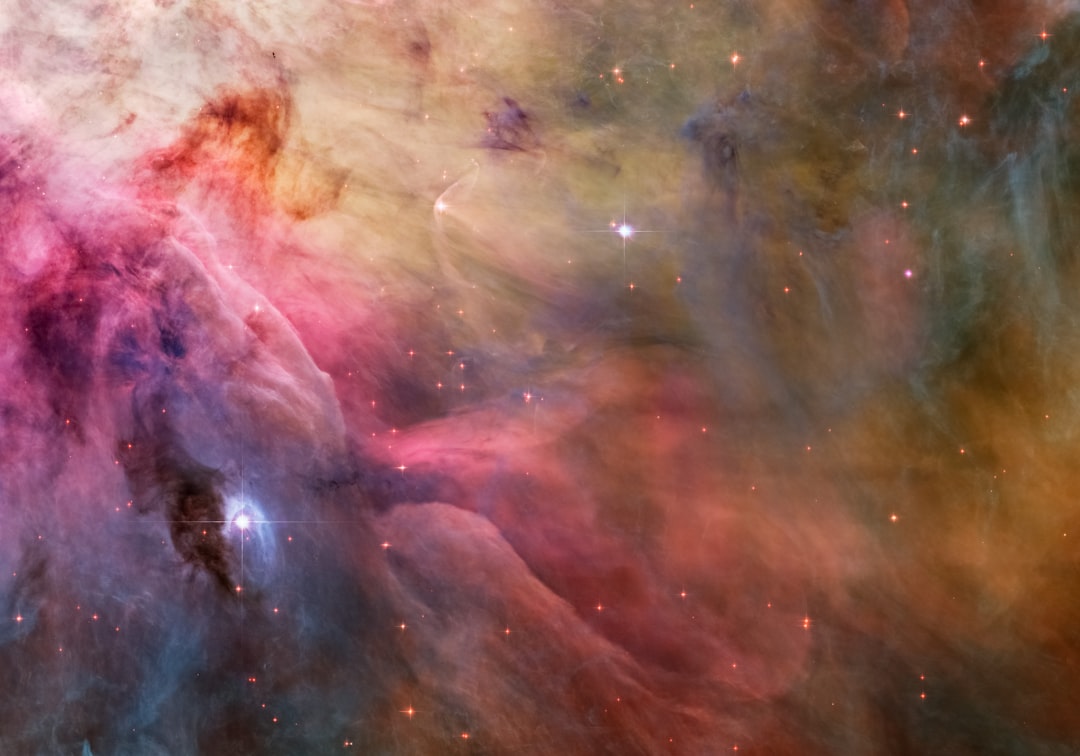
The newly released image showcases IC 2177, popularly known as the Seagull Nebula, a sprawling emission nebula located approximately 3,700 light-years from Earth in the constellation Monoceros, on the border with Canis Major. The Seagull Nebula is a composite structure formed by three distinct gas clouds, and ComCam's image specifically highlights Sharpless 2-292 (Sh2-292), the region corresponding to the bird's distinctive head in the full nebular portrait.
The NOIRLab image-processing team — comprised of T.A. Rector (University of Alaska Anchorage/NSF NOIRLab), D. de Martin, and M. Zamani (NSF NOIRLab) — worked with the raw ComCam data to produce a final image of remarkable scientific and aesthetic quality, using the same sophisticated image-processing pipeline that will be applied to data from the full LSST camera during its decade-long sky survey.
What the Colors Tell Us
Far from being mere decoration, the vivid colors in the Seagull Nebula image encode critical astrophysical information about the region's composition and physical processes:
- Pink and red hues: These glow from ionized hydrogen gas (H-alpha emission). Energetic ultraviolet radiation from massive, hot young stars strips electrons from surrounding hydrogen atoms; as those electrons recombine with the atoms, they release photons at characteristic wavelengths, producing the nebula's signature rosy glow.
- Blue regions: These arise from reflected starlight — fine interstellar dust particles scatter shorter blue wavelengths of light from nearby young stars, creating ethereal blue halos and wisps throughout the nebula.
- Dark filaments and pillars: Dense clumps and columns of cold molecular gas and dust that have not yet been ionized or blown away, and which may themselves be actively collapsing to form new stars.
The Seagull Nebula is classified as an HII region — a cloud of partially ionized hydrogen gas — and is one of the most active stellar nurseries in our cosmic neighborhood. The region is dominated by hot, luminous O-type and B-type stars, whose fierce radiation fields carve out enormous cavities in the surrounding molecular cloud, simultaneously triggering the collapse of adjacent gas clumps and seeding new generations of stars in a self-perpetuating cycle of star formation. This process, known as triggered star formation, makes regions like the Seagull Nebula invaluable laboratories for understanding how stars are born across the universe.
A Smaller Camera, the Same Exceptional Pipeline
One of the most remarkable aspects of ComCam's results is not the hardware itself, but the software ecosystem surrounding it. ComCam operated with the same image-processing and data reduction pipeline that will power the full LSST camera — the Rubin Science Pipelines. This means every ComCam image served a dual purpose: producing scientifically and visually compelling results and rigorously validating the data systems that will eventually handle one of the largest astronomical datasets in history.
When the LSST begins its full operations — expected to survey the entire Southern Hemisphere sky every few nights for ten years — it will generate approximately 20 terabytes of data per night, producing a catalog of over 37 billion stars and galaxies. ComCam's testing period was instrumental in ensuring those pipelines are robust, reliable, and ready for that unprecedented data torrent. You can learn more about the observatory's full scientific mission at the official LSST Science website.
ComCam's Legacy: More Than a Stepping Stone
Although ComCam has been physically removed from the telescope, its work is not entirely finished. The camera will continue to serve a supporting role — used to validate new LSST software updates and to assist with various maintenance and calibration operations as the observatory transitions to full science mode. It remains, in essence, a trusted member of the team.
It is worth pausing to appreciate what ComCam's images represent in the broader arc of astronomical history. Just a few decades ago, producing an image of this quality would have required a world-class scientific instrument operating at a premier observatory under ideal conditions — and even then, it would have been considered exceptional. The fact that an engineering test camera, never intended for public outreach or deep science, can produce imagery rivaling the finest professional astrophotography speaks volumes about the staggering pace of progress in detector technology, telescope optics, and computational image processing.
"ComCam still produces amazing images that would turn any astrophotographer green with envy — after all, it was used with the same image-processing pipeline that the LSST camera will use."
The Vera C. Rubin Observatory is poised to revolutionize our understanding of the universe across an extraordinary range of scientific frontiers — from mapping the distribution of dark matter through gravitational lensing, to cataloging millions of previously unknown solar system objects, to detecting transient phenomena like supernovae and variable stars in real time. The Hubble Space Telescope transformed how humanity perceives the cosmos over three decades; Rubin may well do the same for the next generation.
Looking Ahead
As the Vera C. Rubin Observatory moves further into its commissioning phase and the LSST camera begins delivering its first full-resolution science images, the spotlight will inevitably shift away from ComCam. And that is entirely as it should be — the understudying camera will have done its job magnificently. But before we move on, it is worth raising a figurative toast to ComCam and the dedicated engineers, scientists, and image processors who coaxed such extraordinary beauty from a camera built primarily to find flaws.
Not bad, indeed, for a test camera.