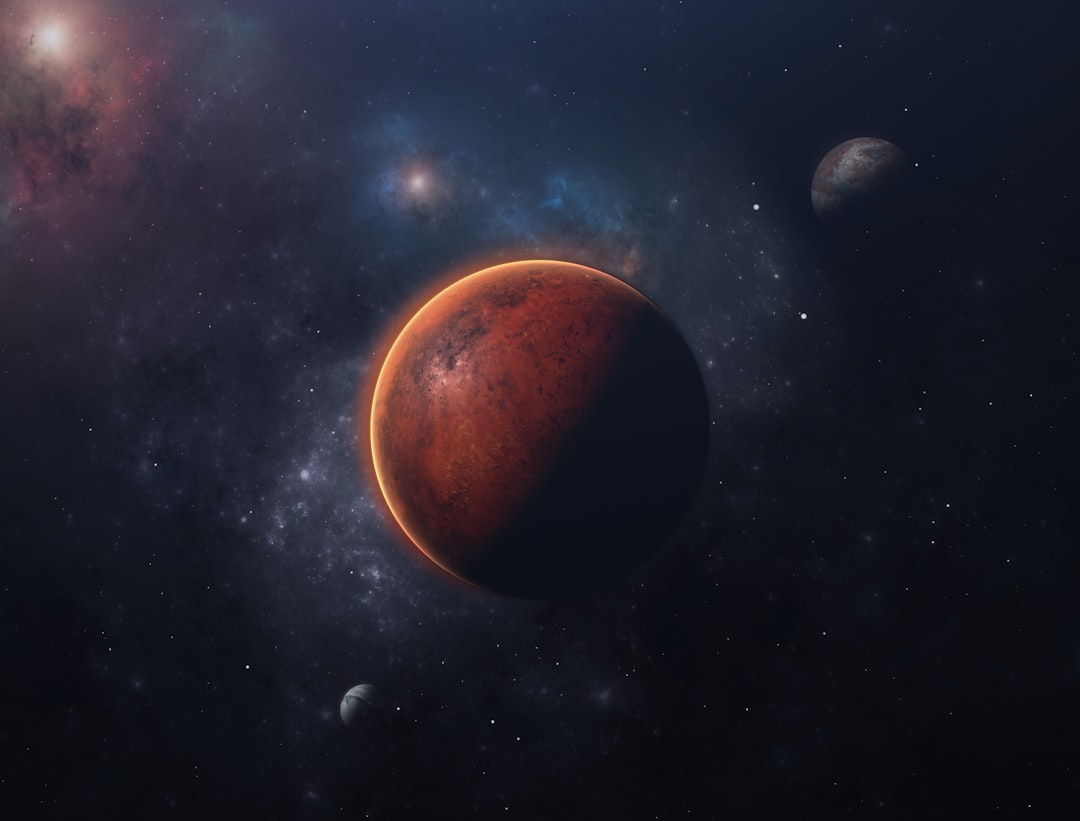
In the harsh cosmic environment of our solar system, planetary magnetic fields have long been considered the essential shield protecting worlds from the Sun's relentless bombardment of charged particles. Earth's robust magnetosphere, generated by its churning liquid iron core, deflects the solar wind and preserves our atmosphere, making life possible on our planet's surface. Without this protective bubble, Earth would likely resemble the barren, desiccated landscape of Mars—a world that lost its global magnetic field billions of years ago.
However, groundbreaking observations from NASA's MAVEN spacecraft have revealed that even planets without protective magnetospheres possess unexpected defensive mechanisms against solar radiation. This remarkable discovery, published in the prestigious journal Nature Communications, demonstrates that Mars can still deflect portions of the solar wind through a previously undetected atmospheric phenomenon, fundamentally changing our understanding of how unmagnetized planets interact with their host stars.
The research, led by Dr. Christopher Fowler from West Virginia University's Center for Kinetic Plasma Physics, focuses on the detection of the Zwan-Wolf effect within Mars' ionosphere—a discovery that occurred during a powerful coronal mass ejection (CME) that struck the Red Planet in December 2023. This finding has profound implications not only for understanding Mars' atmospheric evolution but also for assessing the habitability potential of exoplanets orbiting distant stars.
Understanding Planetary Magnetic Defense Systems
To fully appreciate this discovery's significance, we must first understand how magnetic fields protect planets from stellar radiation. On Earth, our planet's geodynamo—the convective motion of electrically conductive liquid iron in the outer core—generates a powerful dipole magnetic field extending tens of thousands of kilometers into space. This magnetosphere acts as an invisible force field, deflecting the continuous stream of charged particles flowing from the Sun at speeds exceeding 400 kilometers per second.
When solar wind particles encounter Earth's magnetic field lines, they experience electromagnetic forces that redirect them around our planet, channeling them toward the polar regions where they create the spectacular auroral displays we know as the Northern and Southern Lights. Without this protection, Earth's atmosphere would gradually erode into space, much like what happened to Mars approximately 4 billion years ago when its global magnetic field collapsed.
Mars presents a stark cautionary tale of atmospheric loss. Once possessing a thick atmosphere capable of supporting liquid water on its surface, the Red Planet lost its global magnetic field when its core cooled and solidified. Over billions of years, the unrelenting solar wind stripped away much of Mars' atmosphere, reducing surface pressure to less than 1% of Earth's and transforming the planet into the cold, arid world we observe today.
The Zwan-Wolf Effect: A Hidden Protective Mechanism
The Zwan-Wolf effect, first theorized in the 1970s by physicists studying Earth's magnetosphere, describes how strong dipole magnetic fields deflect charged particles in the solar wind. When these high-energy particles collide with magnetic field lines, electromagnetic forces compel them to flow around the planet through structures called magnetic flux tubes—cylindrical regions where magnetic field lines remain parallel and contained.
Scientists have extensively documented this effect at Earth and detected potential signatures at the outer gas giant planets Jupiter and Saturn, which possess powerful magnetic fields. However, the new research demonstrates for the first time that the Zwan-Wolf effect can also operate within the ionosphere of an unmagnetized planet like Mars.
"We are discovering new ways in which our sun can interact with and affect planets in our solar system. It's amazing to think that an eruption on the sun can disturb the atmosphere of Mars 142 million miles away," explained Dr. Christopher Fowler, lead author of the study.
Mars' ionosphere—an electrically charged atmospheric layer created when solar ultraviolet radiation ionizes atmospheric gases—acts as a weak substitute for a global magnetic field. When solar wind plasma interacts with this ionized layer, it induces localized magnetic fields that drape around the planet's dayside, creating what scientists call an induced magnetosphere.
MAVEN's Serendipitous Discovery
The detection of the Zwan-Wolf effect at Mars occurred during an extraordinary cosmic event. In December 2023, a powerful interplanetary coronal mass ejection (ICME)—a massive eruption of plasma and magnetic fields from the Sun's corona—struck Mars with exceptional force. This space weather event dramatically compressed and disturbed Mars' induced magnetosphere, amplifying the normally subtle Zwan-Wolf effect to levels detectable by MAVEN's sophisticated plasma instruments.
NASA's MAVEN (Mars Atmosphere and Volatile Evolution) spacecraft, which concluded its primary mission after more than 11 years of groundbreaking observations, carried instruments specifically designed to measure Mars' upper atmosphere and ionosphere. During the December 2023 CME impact, MAVEN detected large-amplitude magnetic structures draping around Mars, with coincident deflections in plasma flow at the leading edge of each structure.
The spacecraft observed ionospheric plasma flowing downward and tailward at each magnetic structure's leading edge—a telltale signature of the Zwan-Wolf effect in action. These observations revealed that the effect was squeezing and deflecting solar wind plasma around Mars, reducing plasma density in front of the planet and providing measurable atmospheric protection.
How the Effect Operates Without a Global Magnetic Field
Dr. Fowler used an illuminating analogy to explain the fundamental physics governing solar wind deflection. He compared the flow of charged particles from the Sun to water streaming around rocks in a riverbed. However, there's a crucial difference: in a stream, physical collisions between water molecules determine flow patterns. In the tenuous space environment, particles rarely collide with each other. Instead, electromagnetic forces control how particles are deflected around planetary bodies.
On magnetized planets like Earth, the Zwan-Wolf effect operates above the atmosphere within the magnetosphere itself, where it helps force solar wind plasma through magnetic flux tubes. These tubes act as conduits, channeling plasma around the planet while maintaining magnetic field line integrity. The effect essentially "squeezes" the magnetic field, increasing its strength and enhancing deflection efficiency.
For unmagnetized planets, the mechanism differs significantly. Mars' induced magnetosphere, generated by solar wind interaction with its ionosphere, creates magnetic field lines that drape around the planet's dayside in a configuration somewhat analogous to Earth's magnetosphere shape. The Zwan-Wolf effect operates within this induced field structure, but because the magnetic fields are much weaker than those of magnetized planets, the effect typically remains below detection thresholds of standard plasma analyzers.
Key Findings and Observations
- Continuous but subtle operation: Researchers conclude that the Zwan-Wolf effect likely operates continuously in Mars' ionosphere, but normally remains too weak for spacecraft instruments to detect during typical solar wind conditions.
- Space weather amplification: Powerful solar storms like the December 2023 CME dramatically enhance the effect, compressing Mars' induced magnetosphere and amplifying magnetic field strengths to detectable levels.
- Deep atmospheric penetration: MAVEN detected Zwan-Wolf signatures at the lowest altitudes sampled during the spacecraft's orbit (approximately 125 kilometers during deep-dip campaigns), suggesting the effect impacts atmospheric layers even closer to the Martian surface.
- Plasma density reduction: The squeezing effect reduces solar wind plasma density in front of Mars, providing measurable protection to the upper atmosphere and potentially slowing atmospheric escape rates during solar storm events.
- Universal applicability: The discovery suggests similar protective mechanisms may operate at other unmagnetized solar system bodies with atmospheres, including Venus, Saturn's moon Titan, and even active comets.
Implications for Atmospheric Evolution and Planetary Habitability
This discovery carries profound implications for understanding how Mars' atmosphere has evolved over billions of years. While scientists have long known that Mars loses atmosphere to space through various processes—including solar wind stripping, photochemical escape, and impact erosion—the presence of even weak protective mechanisms like the Zwan-Wolf effect suggests atmospheric loss rates may be more complex than previously modeled.
The finding is particularly relevant for understanding Mars' ancient climate. Geological evidence, including dried river valleys, lake beds, and mineral deposits, indicates Mars once possessed a much thicker atmosphere and liquid water on its surface. Understanding all mechanisms that can protect or strip atmospheric gases helps scientists reconstruct the timeline of Mars' transformation from a potentially habitable world to its current state.
Beyond Mars, this research has important implications for assessing the habitability potential of exoplanets. Astronomers have discovered thousands of planets orbiting other stars, many of which likely lack strong magnetic fields. The demonstration that unmagnetized planets can still possess partial protection from stellar wind suggests that the "habitable zone" around stars—the region where liquid water can exist—may be broader than calculated based solely on considerations of stellar radiation and planetary magnetic fields.
Dr. Fowler emphasized the broader significance: "Understanding the generation, propagation, and impact of these structures at Mars broadens our knowledge of how our Sun interacts with our solar system, and of the physical processes that facilitate this interaction."
Future Research Directions and Unanswered Questions
While this discovery represents a major advance in planetary science, numerous questions remain unanswered. One critical unknown concerns the depth to which the Zwan-Wolf effect penetrates Mars' atmosphere. MAVEN detected signatures at its lowest operational altitudes around 125 kilometers, but the spacecraft's orbit prevented measurements closer to the surface.
Future missions to Mars, including potential atmospheric probes or landers equipped with plasma instruments, could measure the effect's vertical extent and determine how deeply it influences atmospheric chemistry and dynamics. Understanding whether the effect reaches the lower atmosphere, where most of Mars' remaining atmospheric mass resides, would significantly refine models of atmospheric escape and evolution.
Researchers also seek to quantify how much atmospheric protection the Zwan-Wolf effect actually provides. While the December 2023 observations clearly demonstrated the phenomenon's existence, calculating its effectiveness at reducing atmospheric loss rates requires additional measurements during various solar wind conditions and space weather events.
The discovery also raises questions about similar processes at other solar system bodies. Venus, which like Mars lacks a global magnetic field but possesses a much thicker atmosphere, likely exhibits the Zwan-Wolf effect more prominently. Future missions to Venus, including NASA's planned VERITAS and DAVINCI missions, could investigate how the effect operates in Venus' dense ionosphere.
Even more intriguingly, the effect may operate at Saturn's moon Titan, which possesses a thick nitrogen atmosphere despite lacking a magnetic field. Titan's atmosphere, denser than Earth's at the surface, interacts with Saturn's magnetosphere in complex ways that future missions could investigate for Zwan-Wolf signatures.
Protecting Future Exploration
Understanding Mars' interaction with solar wind and space weather events has practical implications for future human exploration. Astronauts on Mars will face radiation exposure from both galactic cosmic rays and solar energetic particles, particularly during solar storms. While the Zwan-Wolf effect provides some atmospheric protection, it offers minimal shielding for surface explorers, who will require robust habitat shielding and advanced warning systems for space weather events.
The research also highlights the importance of space weather monitoring for protecting robotic missions. The December 2023 CME that enabled this discovery also posed potential hazards to spacecraft electronics and operations. As humanity expands exploration throughout the solar system, understanding how different planetary environments respond to solar activity becomes increasingly critical.
"Understanding how these space weather events impact our solar system is important, not only for keeping our robotic—and potentially, human—explorers safe in the future, but for protecting the space assets that we rely on for our everyday technology here on Earth," Dr. Fowler noted.
A New Chapter in Planetary Defense Science
The detection of the Zwan-Wolf effect in Mars' ionosphere represents a paradigm shift in understanding how planets defend themselves against stellar radiation. For decades, scientists believed that only planets with strong global magnetic fields possessed effective protection mechanisms. This discovery demonstrates that nature provides alternative, albeit weaker, defensive strategies for unmagnetized worlds.
The finding emerged from MAVEN's extended mission, highlighting the value of long-duration spacecraft observations. MAVEN's presence at Mars during the December 2023 solar storm was fortuitous—the spacecraft happened to be in the right orbital position with instruments operating optimally when the CME struck. This serendipitous timing enabled scientists to capture data that would have otherwise remained undetected, emphasizing how unexpected discoveries often emerge from sustained planetary monitoring programs.
As researchers continue analyzing MAVEN's extensive dataset and planning future Mars missions, our understanding of the Red Planet's complex interaction with the solar wind will undoubtedly deepen. Each new discovery brings us closer to answering fundamental questions about planetary evolution, atmospheric loss, and the conditions necessary for life to emerge and persist on worlds throughout the universe.
The research also serves as a reminder that even in our well-studied solar system, surprises await discovery. Mars, observed by humans for millennia and explored by spacecraft for over half a century, continues revealing new secrets about how planets interact with their cosmic environment. These insights not only illuminate Mars' past and present but also guide our search for habitable worlds among the billions of planets orbiting distant stars across the galaxy.