Measuring the Distance Between Quasar Pairs Just Got Easier
One of the most fundamental challenges in modern cosmology is accurately measuring the vast distances that separate objects across the universe. To determine the expansion rate of the cosmos — characterized by the Hubble constant (H₀) — astronomers rely on the well-established relationship between a galaxy's distance and its recessional velocity, the speed at which it appears to move away from us due to cosmic expansion. This velocity is measured through redshift, the stretching of light to longer wavelengths as objects recede. However, this approach becomes significantly more complicated when applied to quasar pairs — systems of two galaxies with extraordinarily bright cores that are in the process of merging. Now, researchers at the University of Alberta have devised a more precise method for measuring the separation between these double quasars, with important implications for how we understand both galactic evolution and the expansion of the universe itself.
What Are Quasars and Why Do They Matter?
Quasi-stellar objects (quasars) are among the most energetic and luminous phenomena in the known universe. Powered by supermassive black holes (SMBHs) — objects containing millions to billions of times the mass of our Sun — residing at the centers of distant galaxies, quasars release extraordinary amounts of energy as matter falls into the black hole through a rapidly spinning accretion disk. The friction and gravitational forces within these disks heat the infalling material to extreme temperatures, causing the galactic core to temporarily outshine every single star in its host galaxy combined. In many cases, powerful relativistic jets of plasma are launched perpendicular to the disk, extending for millions of light-years into intergalactic space.
Quasars are not merely spectacular objects to observe — they serve as critical cosmological probes. Because they are so luminous, they are detectable at enormous distances, allowing astronomers to study the universe as it existed billions of years ago. When two quasar-hosting galaxies undergo a gravitational merger, their central regions eventually coalesce as well, producing an even more massive SMBH and triggering intense bursts of star formation and energetic feedback into the surrounding environment. Understanding the timeline and mechanics of these mergers is therefore essential for tracing the co-evolution of galaxies and their central black holes across cosmic time.
- Quasars can be observed up to 13 billion light-years away, making them among the most distant objects detectable.
- The most luminous quasars radiate energy equivalent to trillions of times the Sun's output.
- Supermassive black holes powering quasars can have masses exceeding 10 billion solar masses.
- Quasar pairs in merging systems are key laboratories for studying SMBH binary formation and gravitational wave precursors.
- The frequency of quasar mergers helps constrain models of large-scale structure formation in the universe.
The Challenge of Measuring Quasar Pair Separations
When astronomers observe two quasars that appear close together in the sky, they are looking at a two-dimensional projection of a fundamentally three-dimensional universe. While the angular separation across the plane of the sky can be measured with great precision using modern telescopes, the line-of-sight separation — the distance between the two quasars along the axis pointing toward Earth — is far more difficult to determine accurately.
Traditionally, astronomers have attempted to resolve this by measuring the recessional velocities of both quasars using the light emitted by gas clouds within their host galaxies. A small difference in their velocities would indicate a small physical separation along the line of sight. However, this approach is severely complicated in quasar systems because the active SMBHs continuously drive powerful galactic winds and outflows that push surrounding gas outward at velocities that can reach thousands of kilometers per second. As a result, the measured velocity of this gas deviates significantly from the actual velocity of the host galaxy, introducing enormous systematic errors in distance estimates — sometimes as large as 10 million light-years.
"When we spot two quasars close together in an image, we're looking at a projection of a three-dimensional universe, so we know their separation across the sky very precisely, but their separation along our line of sight carries a large uncertainty. Being able to measure the true physical separation is an important factor in deciding how long it takes two quasar-hosting galaxies to merge." — Dr. Huanqing Chen, University of Alberta
This depth-perception problem has long been a significant obstacle to building accurate catalogs of merging quasar systems and, by extension, to testing models of galaxy formation and black hole growth. A more reliable measurement technique has been urgently needed by the field.
The Research Team and Their Approach
The new study was led by Dr. Huanqing Chen, an assistant professor of astrophysics at the Augustana Campus at the University of Alberta. Dr. Chen was joined by Camille Avestruz, a researcher at the Leinweber Institute for Theoretical Physics and an assistant professor at the University of Michigan, along with Jakob Wiest, a graduate student in the University of Michigan's Astronomy and Astrophysics program. Their findings were published in The Astrophysical Journal Letters, one of the most prestigious rapid-publication journals in the field of astronomy and astrophysics.
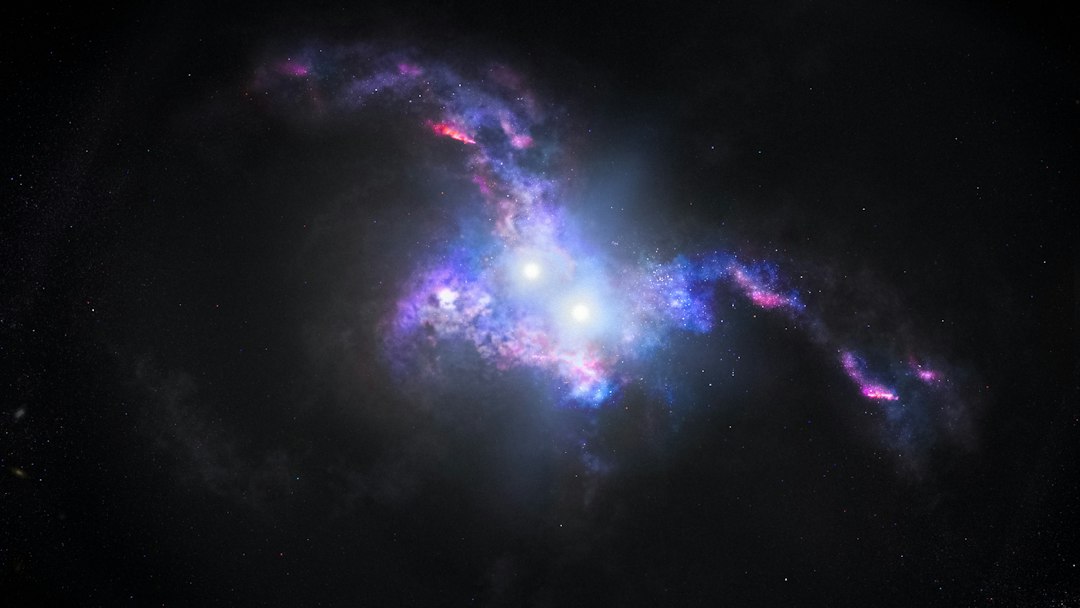
Illustration showing quasars coming together in merging galaxies. Credit: NASA
Rather than relying on conventional redshift measurements of gas emission lines — which are so heavily distorted by quasar-driven outflows — the team investigated a fundamentally different physical phenomenon known as the Quasar Proximity Effect (QPE).
The Quasar Proximity Effect: A New Cosmic Ruler
The Quasar Proximity Effect exploits the fact that a quasar's intense ultraviolet and X-ray radiation ionizes and heats the intergalactic gas in its immediate vicinity, creating a distinctive ionized bubble around it. Astronomers can detect this bubble by examining the hydrogen absorption spectrum of a background light source passing through or near the quasar's environment. Specifically, neutral hydrogen gas absorbs radiation at a characteristic wavelength known as the Lyman-alpha line (121.6 nanometers), creating a series of dark absorption features in the spectrum known as the Lyman-alpha forest. However, gas that has been fully ionized by quasar radiation becomes transparent to this light, causing a distinctive clearing — or lack of absorption — in the spectrum near the quasar.
Dr. Chen offered an elegantly intuitive analogy to explain how this translates to distance measurement between a quasar pair:
"If you picture two light bulbs that sit at exactly the same spot, you see a single bright region. If one is placed in front of the other, you see a second bright patch out ahead — and how far ahead it sits tells you how far apart the bulbs are. With quasars, we use those transparent regions the same way, to work out the separation between the two." — Dr. Huanqing Chen
In a quasar pair, the foreground quasar carves out its own ionization zone, but the background quasar's light also passes through and illuminates the gas surrounding the foreground object. By carefully analyzing the position and extent of these transparent ionized regions in the spectrum of the background quasar, the team can calculate how far apart the two quasars truly are along the line of sight — a measurement that is entirely independent of the distorted gas velocities that plague conventional methods.
Applying the Method: Simulations and Algorithms
Using sophisticated hydrodynamic simulations of intergalactic gas and quasar radiation fields, the team developed and tested algorithms capable of extracting precise line-of-sight separation measurements from quasar pair spectra. Because the proximity effect is driven by the quasar's radiation — which propagates outward at the speed of light and is not subject to the mechanical forces that distort gas velocities — it provides a far more physically clean signal for distance estimation.
Two Hubble Space Telescope images revealing pairs of quasars that existed 10 billion years ago, residing at the hearts of merging galaxies. Credit: NASA/ESA/STScI
The results were striking. Whereas conventional redshift measurements yield line-of-sight distance estimates with margins of error equivalent to tens of millions of light-years, the new proximity effect method can pin down the physical separation of a quasar pair to within as little as half a million light-years — an improvement in precision of roughly two orders of magnitude. Critically, this improvement does not require astronomers to acquire entirely new observational data. The method can, in principle, be applied retroactively to existing archival quasar-pair spectra already collected by major observatories such as the Sloan Digital Sky Survey (SDSS) and the Very Large Telescope (VLT).
"Those observations can take years to obtain, if they can be obtained at all. This method could let astronomers characterize a quasar pair's true separation without that second observation. The approach is worth investigating further, because there's a lot of potential in it." — Dr. Huanqing Chen
Scientific Implications and Future Directions
The ability to more precisely measure the three-dimensional separations of quasar pairs carries broad implications across multiple areas of astrophysics and cosmology. More accurate separation measurements will allow astronomers to better determine the merger timescales of quasar-hosting galaxies — a key input for models of SMBH growth and the buildup of massive galaxies across cosmic history. Improved quasar-pair statistics will also sharpen constraints on the SMBH binary population, which are among the most sought-after sources of low-frequency gravitational waves detectable by pulsar timing arrays such as the North American Nanohertz Observatory for Gravitational Waves (NANOGrav).
Furthermore, better quasar distance measurements contribute to ongoing efforts to resolve the so-called Hubble tension — the persistent discrepancy between different observational methods for measuring the universe's expansion rate. By providing an independent means of establishing distances across cosmological scales, the proximity effect technique adds a new and potentially valuable tool to the astronomer's cosmological toolkit.
The immediate next step for Dr. Chen and the team is to test how the method's precision can be further enhanced by analyzing finer, smaller-scale features in real — rather than simulated — quasar spectra. The transition from simulated data to real observational data will be the crucial test of the technique's robustness and will determine whether it can be routinely incorporated into future quasar surveys conducted by next-generation facilities such as the Square Kilometre Array (SKA) and the Vera C. Rubin Observatory's Legacy Survey of Space and Time (LSST).
Key Takeaways
- A new method exploiting the Quasar Proximity Effect can measure line-of-sight separations between quasar pairs with errors as small as 0.5 million light-years, compared to tens of millions using conventional redshift methods.
- The technique relies on ionized hydrogen regions in quasar spectra rather than the distorted gas velocity measurements that compromise traditional approaches.
- The method was validated using hydrodynamic simulations and can be applied to existing observational archives, avoiding the need for costly new data collection campaigns.
- More precise quasar pair separations will improve our understanding of galaxy merger timescales, SMBH binary formation, and potentially the measurement of the Hubble constant.
- The research was published in The Astrophysical Journal Letters by a team from the University of Alberta and the University of Michigan.