New Simulations Reveal How Galactic Centers Grow Together
One of the most profound and enduring challenges in modern astrophysics is understanding how the hearts of galaxies form and evolve over cosmic time. At the centers of virtually all large galaxies lies an extraordinary confluence of matter and energy: a supermassive black hole (SMBH) surrounded by a densely packed nuclear star cluster (NSC) and, in many cases, a flattened nuclear stellar disc (NSD). These structures are not mere curiosities — they are thought to regulate star formation, drive powerful galactic outflows, and shape the large-scale evolution of the galaxies they inhabit. Yet despite decades of observation and theoretical work, the precise mechanisms by which these features form and interact have remained stubbornly elusive.
Now, a landmark new study led by researchers from the Leibniz Institute for Astrophysics Potsdam (AIP) has shed unprecedented light on these processes. Using a cutting-edge, high-resolution galaxy simulation, the team has demonstrated for the first time that nuclear star clusters and nuclear stellar discs are not independent structures with separate origins — they are intimately linked, co-evolving features that grow together from the same reservoir of gas and stars. Their results, published in the prestigious journal Astronomy & Astrophysics, represent a pivotal step toward a unified theory of galactic center formation.
The Galactic Center: A Cosmic Crossroads
To appreciate the significance of this research, it helps to understand what makes galactic centers so scientifically compelling. The central few hundred light-years of a galaxy are among the most extreme environments in the Universe — regions where stellar densities can be millions of times higher than in the outskirts of a galaxy like the Milky Way, where gravitational forces are immense, and where the influence of a supermassive black hole can be felt across vast distances.
Nuclear star clusters are among the densest stellar systems known. Containing anywhere from millions to billions of solar masses of stars packed into a region just a few light-years across, they are found at the centers of roughly 70–80% of all galaxies. Our own Milky Way hosts one, surrounding the infamous Sagittarius A*, a supermassive black hole with a mass of approximately 4 million solar masses. Similarly, nuclear stellar discs are flattened, rotating structures of stars and gas that can extend over hundreds of light-years, observed in edge-on galaxies as distinct planar features embedded within the galactic bulge.
For nearly a decade, both structures have been observed coexisting in the same galaxies, yet astronomers found no clear statistical correlation between their masses or sizes. This was puzzling: if the two structures shared a common origin, one would expect their properties to be related. Previous simulations struggled to reproduce both features simultaneously and realistically, leaving a significant gap between theory and observation.

The SMUGGLE-Ring Simulation Framework
The research was led by SungWon Kwak, a postdoctoral researcher at the AIP, alongside an impressive international collaboration spanning institutions including the Observatoire de la Côte d'Azur (OCA), the SNU Astronomy Research Center, the Università di Bologna, the Osservatorio di Astrofisica e Scienza dello Spazio di Bologna, the Kavli Institute for Astrophysics and Space Research at MIT, the University of California, Riverside, Tsinghua University, and the Institut für Physik und Astronomie at the Universität Potsdam.
The centerpiece of their work is the Stellar Feedback in Galaxies and its Effects (SMUGGLE-Ring) project — an advanced physics framework designed for use in astrophysical simulations to model, with remarkable fidelity, how stars and their feedback processes shape the galaxies in which they live. Unlike simpler models that treat galactic components as static or averaged-out distributions, SMUGGLE-Ring incorporates the full complexity of stellar birth, life, and death, including the powerful shock waves generated by supernovae and the radiation pressure from young, massive stars.
Through a high-resolution hydrodynamical simulation — a method that tracks the behavior of gas as a fluid governed by the laws of fluid dynamics and gravity — the team modeled the evolution of a barred spiral galaxy similar to the Milky Way over several billion years. This allowed them to watch, in computational time-lapse, the natural emergence of both nuclear star clusters and nuclear stellar discs from first principles.
The Galactic Bar: A Cosmic Conveyor Belt
The simulation's most striking insight concerns the role of the galaxy's stellar bar — the elongated, bar-shaped structure of stars that cuts across the central regions of many spiral galaxies, including our own. Bars are not merely decorative features; they are powerful dynamical engines that profoundly influence the flow of gas throughout a galaxy.
In the simulation, the stellar bar acts as a gravitational funnel, systematically redirecting gas from the galaxy's outer regions inward toward the galactic center. As this gas accumulates in the central zone, it reaches sufficient densities to trigger star formation. The dying massive stars among these newly born stellar populations then explode as supernovae, generating shock waves that compress surrounding gas and ignite further rounds of star formation — a self-sustaining cycle of stellar birth that persists over billions of years.
"Our simulation achieves this by showing how the galactic bar acts like a cosmic conveyor belt, channeling gas inward to feed both structures simultaneously from the exact same reservoir."
— SungWon Kwak, Leibniz Institute for Astrophysics Potsdam
Over the multi-billion-year timeframe of the simulation, this process results in the formation of hundreds of millions of solar masses' worth of new stars in the galactic center. Crucially, the simulation reveals that both the nuclear star cluster and the nuclear stellar disc are fed by this shared gas reservoir — meaning their apparent independence in observational surveys is a consequence of their different structural responses to the same underlying process, not evidence of fundamentally different origins.
Why Previous Observations Were Misleading
One of the most elegant aspects of the new study is its explanation for why earlier observational surveys failed to detect a clear link between nuclear star clusters and nuclear stellar discs. The answer lies in the timing and geometry of their evolution.
As co-author Dr. Cristina Chiappini of the AIP explains:
"The apparent disconnection does not mean that the stars themselves differ fundamentally in age, chemical composition, or motion."
— Dr. Cristina Chiappini, Leibniz Institute for Astrophysics Potsdam
The simulation shows that during periods of sustained growth, the relative masses and sizes of the cluster and disc begin to diverge — not because they are growing from different sources, but because the geometry of star formation changes over time. Stars born in the earliest, most compact phases of growth contribute primarily to the nuclear star cluster, while later generations of stars, forming in a more spatially extended gas distribution, add mass to the growing stellar disc. When observed at different evolutionary stages, the two structures can appear remarkably dissimilar, masking their shared heritage.
This finding has profound implications for how astronomers interpret observational surveys of galactic centers. Properties such as stellar ages, chemical abundances (metallicities), and kinematic signatures — all tools used to probe the formation histories of stellar populations — may not clearly distinguish the two structures if they truly share the same progenitor gas reservoir.
A Star Cluster Spirals Inward: Connecting to Real Galaxies
Among the most captivating moments in the simulation was the merger of an infalling star cluster with the central nuclear star cluster. At one point in the simulation's timeline, a massive star cluster containing approximately 30 million solar masses of stars was observed spiraling inward under the influence of gravity and dynamical friction — a process by which a massive body loses orbital energy as it interacts with the surrounding sea of stars and dark matter — before ultimately merging with the central nuclear star cluster.
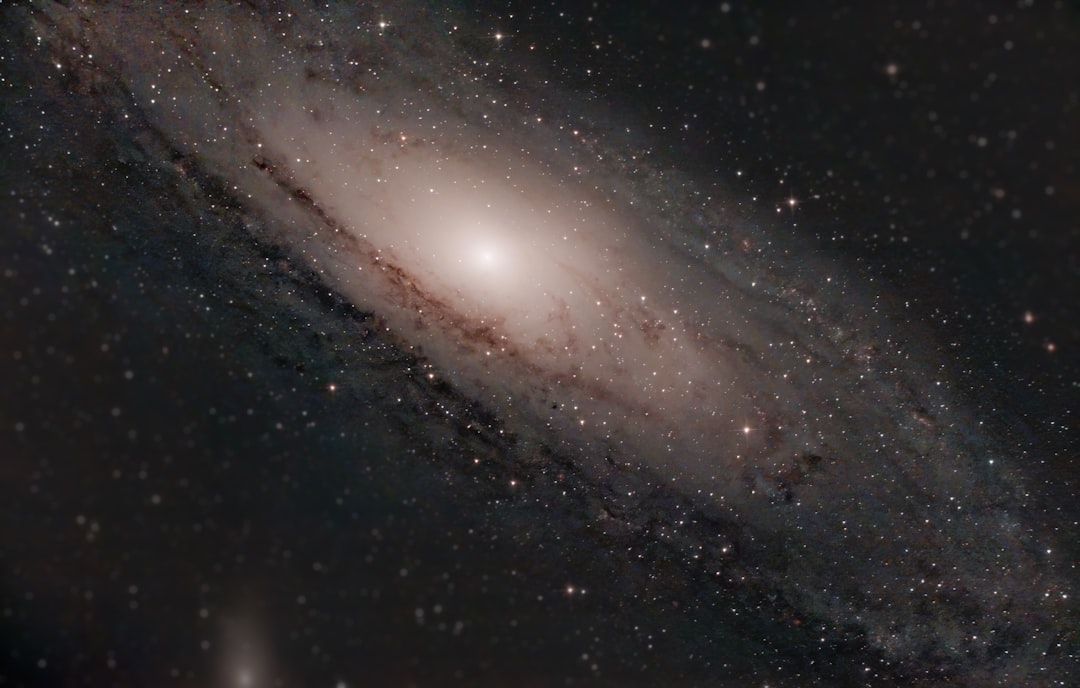
This is not merely a computational curiosity. Recent observations of NGC 1365, a spectacular barred spiral galaxy located approximately 56 million light-years away in the Fornax Cluster, have revealed a massive young star cluster embedded deep within the galaxy's bar. Astronomers expect this cluster to follow precisely the same fate: spiraling inward over tens to hundreds of millions of years and merging with NGC 1365's central nuclear star cluster, dramatically increasing its mass. Such mergers could also indirectly influence the growth of the supermassive black hole residing within the nuclear star cluster, as additional stellar mass in the nucleus alters the gravitational dynamics of the entire region.

The Critical Role of Dark Matter
Perhaps one of the most technically sophisticated aspects of the SMUGGLE-Ring simulation is its treatment of dark matter — the invisible, non-luminous substance that constitutes roughly 27% of the Universe's total energy content and forms the gravitational scaffolding upon which galaxies are built. Many previous simulations of galactic centers simplified dark matter by treating it as a fixed, unchanging gravitational background. The new simulation takes a fundamentally different approach.
Co-author Dr. Ivan Minchev of the AIP explains the significance of this advancement:
"Previous studies rely on fixed background potentials for the galactic bar and dark matter halo, but the realistic dynamical treatment between stars and the dark matter halo using live particles in our model allows us to form a realistic bar that evolves in time and then naturally forms nuclear structures. Furthermore, our model also exhibits a 'dark gap' around the bar region, which is found in many observations and is known as evidence of the interaction between stars and dark matter by the rotation of the stellar bar."
— Dr. Ivan Minchev, Leibniz Institute for Astrophysics Potsdam
The emergence of this "dark gap" — a region of reduced dark matter density around the stellar bar — in the simulation is a particularly noteworthy validation. This feature has been observed in real galaxies and had long been interpreted as evidence of gravitational interactions between the rotating stellar bar and the dark matter halo, but had never been self-consistently reproduced in a simulation of galactic center formation. Its appearance in the SMUGGLE-Ring simulation lends significant credibility to the model's overall realism.
What This Means for Future Astronomy
The implications of these findings extend far beyond the specific question of how nuclear star clusters and stellar discs form. By establishing that these two structures are co-evolutionary products of the same underlying physical process — gas inflow driven by a stellar bar — the study provides a new theoretical framework for interpreting a wide range of astronomical observations.
Key areas where this research is expected to have impact include:
- Interpreting spectroscopic surveys: Future instruments like the VLT/MOONS spectrograph and the James Webb Space Telescope (JWST) will provide detailed chemical and kinematic maps of galactic nuclei. The new co-evolution framework will be essential for correctly interpreting these data.
- Understanding black hole growth: Since nuclear star clusters are closely associated with supermassive black holes, and both appear to grow in tandem via shared gas inflows, this work may help explain the well-known M-sigma relation — the observed correlation between black hole mass and host galaxy properties.
- Galaxy evolution across cosmic time: Because the simulation spans billions of years, it offers a template for how galactic centers across the Universe have evolved from the epoch of peak star formation (around 10 billion years ago) to the present day.
- Dark matter distribution: The reproduction of the "dark gap" feature opens new avenues for using galactic bar observations as indirect probes of dark matter halo structure and density profiles.
- Milky Way archaeology: As a simulation of a Milky Way-like barred spiral, the results have direct implications for our understanding of our own Galaxy's central structures, complementing observations by missions such as ESA's Gaia spacecraft.
A New Window on Cosmic History
A key advantage of sophisticated computational simulations like SMUGGLE-Ring is their ability to act as a kind of time machine — allowing researchers to observe processes that unfold over millions or billions of years, far beyond any human timescale, and to probe regions of the Universe too distant or obscured for direct observation. From a single simulation run, astronomers can trace the formation of a galaxy's stellar bar, follow the inward cascade of gas, witness the ignition of new stellar populations, and watch the nuclear stellar disc gradually expand outward from the growing central cluster.
This synthetic observational power, when calibrated against real data from telescopes like the Hubble Space Telescope and NASA's James Webb Space Telescope, represents one of the most powerful methodological tools available to 21st-century astrophysics. The SMUGGLE-Ring team's work is a compelling demonstration of what becomes possible when state-of-the-art computational techniques are combined with detailed physical models and validated against the best available observations.
As future telescopes map ever-greater numbers of galactic nuclei in exquisite detail, the theoretical framework established by this research will serve as an indispensable guide — helping astronomers decode the complex, intertwined histories written in the stars, gas, and dark matter at the hearts of galaxies across the cosmos.