Only Binary Stars Can Create Interacting Supernovae
When massive stars die, they do not go quietly. Supernova explosions represent some of the most energetic events in the known universe, releasing more energy in a matter of seconds than our Sun will emit over its entire 10-billion-year lifetime. These cataclysmic detonations occur when a star's internal nuclear fusion can no longer generate sufficient outward pressure to counteract the crushing inward pull of its own gravity. The stellar core collapses in milliseconds, and the resulting shockwave tears the star apart in a blinding flash that can briefly outshine entire galaxies.
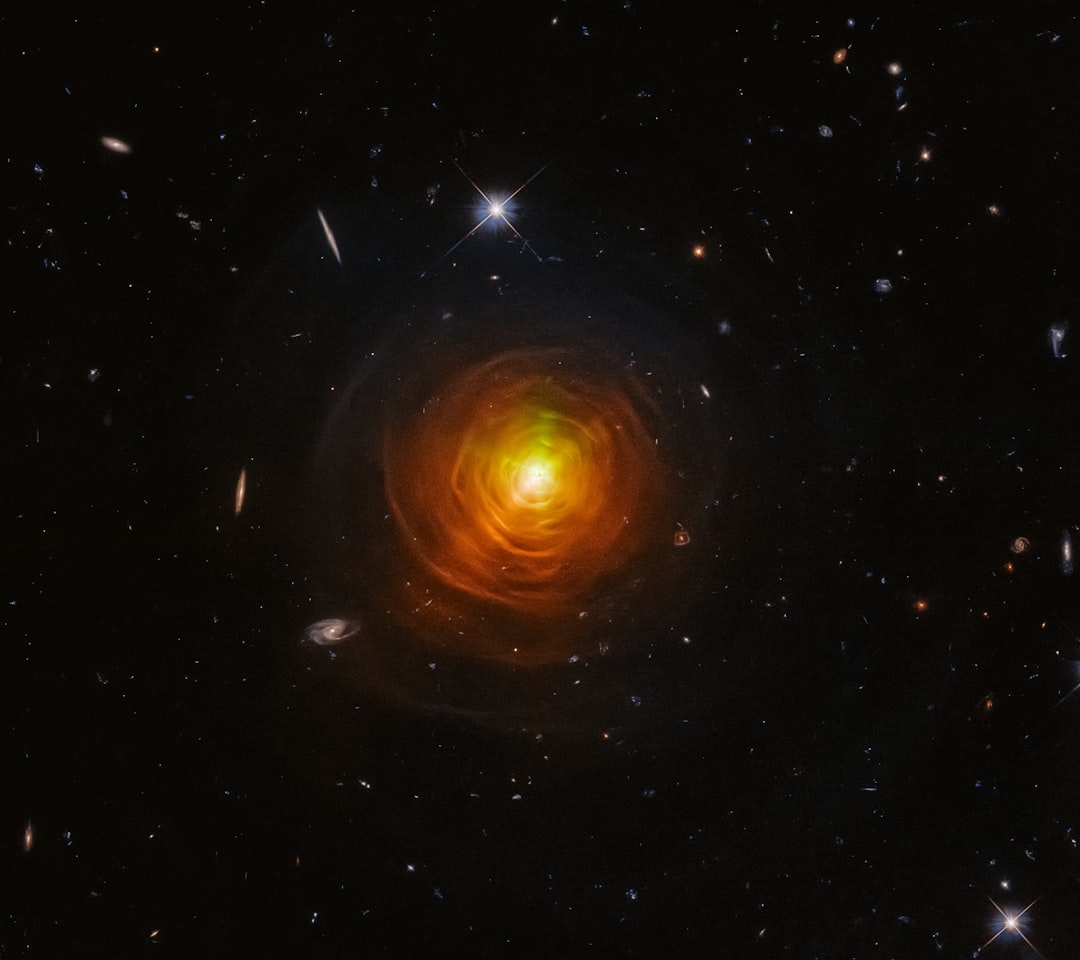
Most supernovae fade from view within a few months — brilliant but transient cosmic fireworks. Yet a fascinating and scientifically important subset of these explosions defy this pattern entirely, burning bright for years rather than months. These are known as interacting supernovae, and they rank among the most luminous transient events ever observed. Their extraordinary longevity arises when the expanding shockwave and debris from the explosion collide violently with dense clouds of gas and dust that envelop the dying star — material known as circumstellar material (CSM). This collision converts the kinetic energy of the explosion into light with remarkable efficiency, sustaining the supernova's luminosity far beyond what the explosion alone could provide.
Despite decades of observation, a fundamental question has persisted: where does all this dense circumstellar material come from? How does a star shed such enormous quantities of mass so close to the end of its life, and with such precise timing? A compelling new answer has emerged from researchers in Taiwan, and it points squarely to the role of companion stars in binary systems.
A New Study Cracks the Case
A new research letter published in The Astrophysical Journal Letters may have solved this long-standing puzzle. Titled "Interacting Binary Stars as Progenitors for Interacting Supernovae," the study is led by Sung-Han Tsai of the Institute of Astronomy and Astrophysics, Academia Sinica (ASIAA) in Taiwan, with collaborators contributing expertise in stellar evolution, hydrodynamics, and observational astrophysics.
"Dense, compact circumstellar media (CSM) are required to power strongly interacting supernovae (SNe), yet their physical origin remains uncertain." — Tsai et al., The Astrophysical Journal Letters
To address this uncertainty systematically, the researchers constructed a comprehensive grid of binary stellar evolution models, methodically varying parameters such as stellar masses, orbital separations, and mass transfer rates. This grid-based approach allowed them to survey a wide parameter space and identify which configurations naturally produce the kind of dense, compact CSM observed around interacting supernovae — without invoking exotic or poorly understood physics.
The Critical Role of Binary Stars
It is easy to think of stars as solitary objects like our Sun, but in reality, most massive stars exist in binary or multiple-star systems. Studies suggest that the majority of stars with masses greater than eight times that of the Sun — the threshold for core-collapse supernovae — have at least one companion star. This statistical reality has profound implications for how these stars live and, crucially, how they die.
When two stars orbit each other closely enough, gravity does not simply hold them together — it actively shapes their evolution. Each star is surrounded by a gravitational boundary known as its Roche lobe, a teardrop-shaped region within which material is gravitationally bound to that star. If a star expands — as massive stars inevitably do in their later evolutionary stages — its outer layers can overflow the Roche lobe and spill onto its companion. This process, known as Roche lobe overflow (RLOF), is one of the primary mechanisms by which binary stars exchange mass and fundamentally alter each other's evolutionary trajectories.
The new study identifies a specific flavor of this mass transfer — called Case C mass transfer — as the key mechanism responsible for producing the dense CSM that powers interacting supernovae. Understanding what makes Case C mass transfer special requires a brief tour through the late stages of a massive star's life.
What Is Case C Mass Transfer?
Astrophysicists categorize mass transfer in binary systems according to when it occurs relative to the donor star's evolutionary state. Case A transfer occurs while the star is still burning hydrogen in its core on the main sequence. Case B transfer occurs after hydrogen exhaustion but before helium ignition in the core. Case C mass transfer — the focus of this research — is initiated after core helium ignition, meaning it occurs very late in the star's life, when the star has already swelled into a red supergiant and is rapidly approaching the end of its nuclear burning phases.
This late timing is what makes Case C transfer so consequential for interacting supernovae. As the researchers explain:
"Case C mass transfer — initiated after core helium ignition — naturally produces the dense, nearby CSM inferred in interacting events."
During this process, the bloated outer envelope of the massive star overflows its Roche lobe and transfers material onto the companion. Crucially, not all of this transferred gas remains gravitationally bound to either star. A significant fraction escapes the binary system entirely, drifting outward to form a dense cocoon of circumstellar material that envelops both stars. This is the raw material that will later fuel the spectacular light show of an interacting supernova.
Timing Is Everything
The elegance of the Case C mass transfer scenario lies not just in the physics, but in its extraordinary timing. For interacting supernovae to work as observed, the CSM must be located very close to the star — within a specific range of distances — when the explosion occurs. If the gas were ejected too early, it would have drifted too far away by the time of the supernova, and the shockwave would not encounter enough material to generate sustained, intense luminosity.
The researchers found that Case C mass transfer threads this needle with remarkable precision. Their grid models show that:
- Donor stars with masses between 10 and 20 solar masses (M⊙) are the primary candidates for producing interacting supernovae through this mechanism.
- Binary systems with orbital separations of approximately 1,000 to 2,700 solar radii (R⊙) undergo Roche lobe overflow within only a few thousand years before core collapse.
- The mass transfer episodes eject between 0.01 and 0.2 M⊙ of material, forming CSM that extends to distances of roughly 1016 to 1018 centimeters — precisely the scales inferred from observations of interacting supernovae.
- If the supernova does not occur within roughly 1,000 years of the mass transfer episode, the CSM disperses too far and the interaction signature is lost.
As lead author Tsai described it:
"We found that binary stars can prepare the stage for interacting supernovae with remarkable timing. The companion star helps create a dense cocoon around the dying star just before the explosion, providing the fuel that powers these cosmic fireworks."
This is a striking departure from earlier models that attributed CSM production to single-star eruptive mass loss events — poorly understood, episodic outbursts like those seen in luminous blue variables (LBVs) such as Eta Carinae. The Case C binary scenario requires no such exotic, ad hoc processes. The physics is well-understood gravitational mass transfer, operating within the framework of established stellar evolution theory.
How the Explosion Becomes a Light Engine
When the massive star finally exhausts its nuclear fuel and undergoes core collapse, the resulting explosion sends a shockwave outward at thousands of kilometers per second. This shockwave, together with the high-velocity ejecta from the disrupted star, plows into the surrounding cocoon of CSM that was laid down thousands of years earlier by the binary mass transfer episode.
The collision between the fast-moving ejecta and the slower-moving CSM is extraordinarily violent. The kinetic energy of the expanding debris is efficiently converted into radiation — light across a broad range of wavelengths, from radio waves to X-rays. This is the engine that sustains the luminosity of an interacting supernova for months or even years beyond what radioactive decay alone could power.
The interaction zone is also a hotbed of complex plasma physics. Rayleigh–Taylor instabilities (RTI) develop at the interface between the lighter, fast-moving ejecta and the denser, slower CSM — the same fluid instability that causes a denser fluid to sink through a lighter one under gravity. In simulations, these instabilities produce dramatic finger-like protrusions and mushroom-shaped spikes that dramatically increase the surface area of the interaction region, further enhancing energy conversion and creating intricate, turbulent structures observable in supernova remnants.
Explaining a Famous Supernova: SN 2014C
One of the most compelling validations of the Case C mass transfer model comes from its ability to explain observations of SN 2014C, one of the best-studied interacting supernovae in recent decades. NASA's Chandra X-ray Observatory and multiple ground-based telescopes have monitored this object intensively since its discovery in the galaxy NGC 7331.
SN 2014C was initially classified as a relatively standard Type Ib supernova — a core-collapse explosion that had shed its hydrogen envelope before detonation. But within about a year of the explosion, it dramatically brightened at radio and X-ray wavelengths, revealing that the shockwave had slammed into a dense shell of hydrogen-rich CSM at a distance of roughly 1016 centimeters from the explosion site. This behavior was puzzling, because where had a stripped-envelope supernova found a hydrogen-rich CSM cocoon so close to home?
Earlier models attempted to explain SN 2014C's extended luminosity through the radioactive decay of nickel-56 (56Ni), a common product of core-collapse supernovae that decays through cobalt-56 into iron-56, releasing gamma rays that heat the ejecta and power the light curve. However, as the new paper notes, reproducing SN 2014C's observed luminosity through 56Ni decay alone would require an implausibly large quantity of the isotope — far beyond what any realistic explosion model could produce.
Case C mass transfer, by contrast, provides a physically natural explanation. A binary companion could have triggered late-stage Roche lobe overflow that ejected a shell of hydrogen-rich material that settled at precisely the right distance, waiting to intercept the supernova shockwave years after the explosion. The researchers found that a subset of their Case C binary models produce CSM configurations that match the observations of SN 2014C well, lending strong empirical support to the framework.
How Common Are These Events?
One of the more striking conclusions of the new study is that interacting supernovae produced through Case C mass transfer are not rare curiosities — they may represent a significant fraction of all core-collapse supernovae (CCSNe). The authors estimate that this channel could account for approximately 13% of all core-collapse supernovae, a substantial contribution that has important implications for our understanding of supernova demographics and the chemical enrichment of galaxies.
Core-collapse supernovae are the primary forges of many heavy elements in the universe — from oxygen and silicon to iron and beyond. They are also the primary sources of neutron stars and, in some cases, stellar-mass black holes. A more accurate census of the different physical channels that produce these explosions is therefore essential for understanding the chemical evolution of galaxies and the compact object population of the universe. For further reading on core-collapse supernovae and their role in cosmic chemical evolution, the European Space Agency's (ESA) resources on supernovae and the HubbleSite's supernova explainer provide excellent overviews.
Remaining Uncertainties and Future Directions
As with any major scientific advance, this study opens as many questions as it answers. The authors acknowledge several important uncertainties that will need to be addressed by future theoretical and observational work:
- The precise geometry and dynamics of Roche lobe overflow — including whether the mass transfer occurs through a focused stream or a more diffuse outflow — significantly affects how dense the CSM is and how it is spatially distributed around the binary system.
- Radiative cooling in the ejected material influences how quickly the CSM compresses and clumps, affecting its optical depth and thus its ability to reprocess the supernova's energy into visible light.
- Some observed interacting supernovae appear to have CSM that is even more compact than the Case C models naturally produce, suggesting that mass transfer may occur even closer to core collapse in some systems, or that additional confinement mechanisms are at work.
- The models presented represent an idealized grid; real binary systems exhibit a continuous spectrum of mass ratios, orbital eccentricities, and prior mass-loss histories that could significantly broaden or modify the predicted outcomes.
Future observations with next-generation facilities such as the Square Kilometre Array (SKA) and the Nancy Grace Roman Space Telescope will be critical for testing the predictions of this model. Radio observations, in particular, are exquisitely sensitive to the density and structure of CSM, making them a powerful diagnostic tool for distinguishing between different mass-loss histories in supernovae progenitors.
A Physically Motivated Solution to a Long-Standing Mystery
Perhaps the most significant aspect of this research is what it doesn't require. Previous attempts to explain interacting supernovae often invoked eruptive, poorly understood mass-loss mechanisms — sudden, violent outbursts driven by uncertain internal instabilities that are difficult to model from first principles. The Case C binary mass transfer scenario requires none of this. It operates within the well-established framework of gravitational physics and stellar evolution, producing CSM through a physically transparent mechanism that emerges naturally from the properties of the binary system.
As the authors put it:
"In contrast to earlier binary interactions or single-star mass loss, Case C transfer operates at the right time and scale to shape the immediate pre-SN environment without requiring ad hoc eruptive mechanisms."
And in their concluding statement, the researchers are direct about the significance of their findings:
"Our results identify late-stage binary interaction as a robust and physically motivated channel for producing the dense CSM that powers interacting SNe."
This work represents a meaningful step forward in our understanding of how the most dramatic stellar