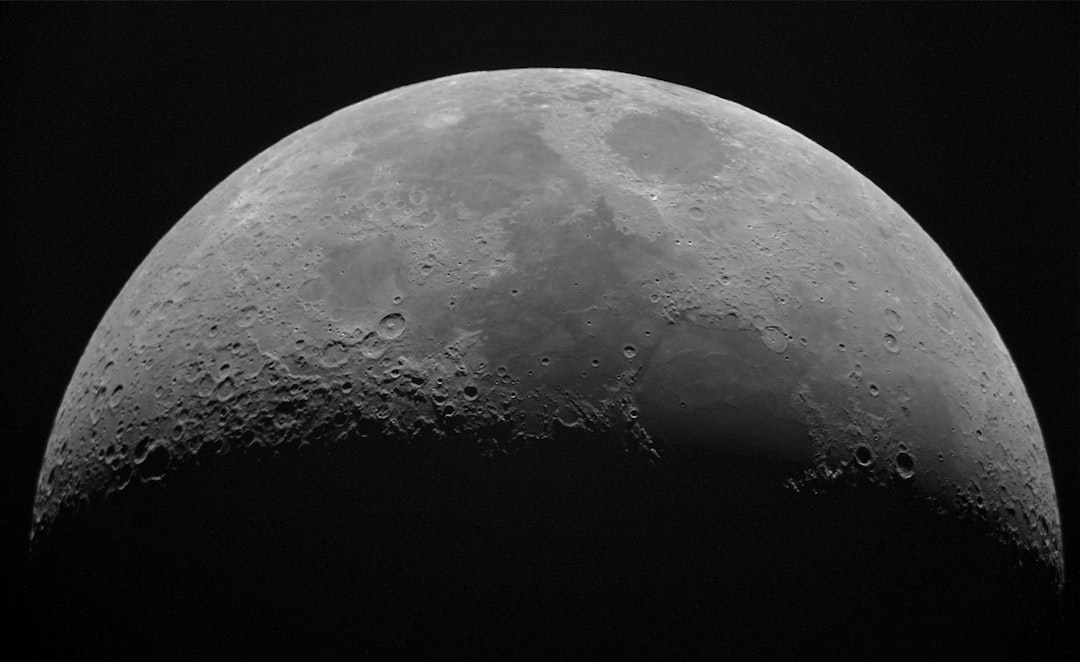
The United States finds itself at a critical juncture in its lunar exploration ambitions, with NASA and the Department of Energy jointly committing to an ambitious timeline that could reshape humanity's presence on the Moon. A newly announced Memorandum of Understanding between these federal agencies sets a bold target: deploying a functional nuclear fission reactor on the lunar surface by 2030. This initiative represents not just a technological challenge, but a strategic response to international competition and a potential solution to one of the Moon's most fundamental obstacles—the prolonged darkness of its two-week night cycle.
The announcement comes during a turbulent period for America's space agency. Following the cancellation of the Mars Sample Return mission and significant workforce disruptions, NASA faces questions about its direction and capabilities. Newly confirmed Administrator Jared Isaacman, a billionaire entrepreneur with deep ties to commercial spaceflight, has made clear his intention to revitalize the agency's mission, with the Artemis program and permanent lunar habitation at the forefront of his agenda.
The Challenge of Lunar Night: Why Nuclear Power Is Essential
Understanding the urgency behind this nuclear reactor initiative requires grasping the unique environmental challenges of Earth's only natural satellite. The Moon's rotation creates a day-night cycle lasting approximately 29.5 Earth days, meaning any location on the lunar surface experiences roughly 14 consecutive days of darkness. During this extended night, temperatures can plummet to -173 degrees Celsius (-280 degrees Fahrenheit), and more critically for human operations, no solar energy reaches the surface.
For a permanent lunar base supporting continuous human presence—a cornerstone of the Artemis program's long-term vision—this presents an insurmountable challenge for conventional power systems. Solar panels, which have proven remarkably effective for daytime operations and orbital platforms, become entirely useless during the lunar night. Unlike Earth, the Moon possesses no atmosphere to create wind patterns, no fossil fuels formed through biological processes, and no readily available chemical energy sources.
Battery storage systems offer a theoretical solution, but the mathematics quickly become prohibitive. According to energy calculations from Department of Energy analyses, storing sufficient electrical energy to power even a modest lunar habitat through 14 days of darkness would require battery banks weighing multiple tons. Given that launch costs to the Moon remain in the range of $10,000 to $100,000 per kilogram depending on the mission architecture, the economic feasibility of battery-based systems collapses under scrutiny.
Nuclear Options: From RTGs to Fission Reactors
Radioisotope Thermoelectric Generators (RTGs) have served as the reliable workhorses of deep space exploration for decades. These elegant devices, which convert heat from radioactive decay directly into electricity, have powered iconic missions from the Voyager spacecraft to the Curiosity and Perseverance Mars rovers. The NASA Radioisotope Power Systems program has refined this technology to remarkable levels of reliability and safety.
However, RTGs face fundamental scaling limitations. Current RTG designs produce between 100 and 300 watts of electrical power—sufficient for a rover's instruments and communications systems, but woefully inadequate for a crewed lunar base. A typical American household consumes approximately 30 kilowatt-hours per day, and a lunar habitat supporting multiple astronauts, life support systems, scientific equipment, and resource processing facilities would require even more. Scaling RTG technology to meet these demands would require dozens of units, each containing expensive plutonium-238, making the approach economically and logistically impractical.
This reality leaves nuclear fission reactors as the only viable near-term solution. Unlike RTGs, which rely on passive radioactive decay, fission reactors actively split atomic nuclei in a controlled chain reaction, generating substantially more power from a given mass of fuel. While fusion reactors promise even greater efficiency, that technology remains decades away from practical deployment even on Earth, let alone in the harsh lunar environment.
"A fission surface power system on the Moon would enable continuous power regardless of location, available sunlight, and other environmental conditions," according to NASA's official statement on the lunar fission power initiative. "This technology would benefit future exploration missions to Mars and beyond."
The Kilopower Initiative and Commercial Development
NASA and the Department of Energy haven't approached this challenge unprepared. The agencies have invested in fission surface power research for over a decade, with the most significant recent effort being the awarding of three contracts worth $5 million each in 2022. These contracts went to industry teams led by aerospace giants and innovative newcomers alike: Lockheed Martin, Westinghouse Electric Company, and IX—a joint venture between Intuitive Machines and X-energy.
The design specifications for these lunar reactors reflect the unique constraints of space missions. The system must fit within a 12-foot diameter cylindrical container—compatible with current launch vehicle payload fairings—and produce at least 40 kilowatts of continuous electrical power for a minimum of ten years without refueling or maintenance. To put this in perspective, 40 kilowatts could power approximately three to four average American homes, or alternatively, support a small lunar outpost with life support, research equipment, resource extraction systems, and habitat environmental controls.
The engineering challenges are formidable. The reactor must withstand launch vibrations and accelerations, operate reliably in one-sixth Earth gravity, dissipate waste heat in a vacuum environment without convective cooling, resist micrometeorite impacts, and function through extreme temperature swings. Additionally, the design must incorporate inherent safety features that prevent criticality during launch and landing, while ensuring reliable startup and shutdown procedures that can be executed remotely or with minimal crew intervention.
Competing Approaches and Technologies
While the specific technical details of the three competing designs remain proprietary, each team brings distinct expertise and philosophy to the challenge. Lockheed Martin, with its extensive experience in space systems and nuclear naval propulsion support, likely emphasizes proven technologies and conservative engineering margins. Westinghouse, a pioneer in commercial nuclear power since the 1950s, brings deep reactor design expertise but must adapt terrestrial technologies to space requirements.
The IX joint venture represents a different approach, combining Intuitive Machines' recent lunar landing experience (including the first commercial lunar landing in February 2024) with X-energy's innovative TRISO fuel technology. TRISO (TRi-structural ISOtropic particle fuel) encapsulates uranium in multiple protective layers, providing inherent safety features particularly attractive for space applications where traditional containment structures add prohibitive mass.
Geopolitical Context: The New Space Race
The aggressive 2030 timeline for lunar reactor deployment cannot be separated from international competition. Administrator Isaacman explicitly referenced the Trump administration's policy of "American space superiority" in announcing the Memorandum of Understanding, with clear implications for competing efforts by China and Russia.
The International Lunar Research Station (ILRS), a collaborative project between China and Russia announced in 2021, includes plans for a nuclear power system by 2035. China has already demonstrated impressive lunar capabilities, including the first-ever soft landing on the Moon's far side and successful sample return missions. Russia, despite economic challenges, maintains substantial nuclear engineering expertise from its civilian power program and nuclear icebreaker fleet.
This competition extends beyond mere national prestige. Lunar resources, including water ice in permanently shadowed craters, rare earth elements, and potential helium-3 deposits, represent significant economic and strategic value. The nation that establishes reliable, long-term lunar infrastructure first gains substantial advantages in exploiting these resources and setting precedents for international space law and resource utilization frameworks.
Technical and Programmatic Challenges Ahead
Despite the bold timeline and clear motivation, significant obstacles remain before a functioning reactor operates on the lunar surface. The 2030 target allows just four years for completing detailed design, fabricating prototypes, conducting extensive testing, obtaining regulatory approvals, and integrating the system with lunar lander vehicles—a timeline that many nuclear engineers and space systems experts consider highly optimistic.
Nuclear reactor development typically requires 10-15 years from concept to operation, even for terrestrial applications with established supply chains and testing infrastructure. Space-rated nuclear systems face additional complications: every component must be qualified for launch loads, vacuum operation, and radiation exposure, while the entire system undergoes rigorous safety analysis to satisfy both the Nuclear Regulatory Commission and NASA's own safety review boards.
The cultural clash between traditional aerospace contractors and "New Space" approaches adds another layer of complexity. Administrator Isaacman's background in commercial spaceflight and stated embrace of the "move fast and break things" philosophy contrasts sharply with the methodical, risk-averse culture that has dominated both nuclear engineering and human spaceflight since their inception. While this entrepreneurial approach has achieved remarkable successes in commercial launch services, nuclear reactor development involves regulatory frameworks and safety considerations that may resist rapid iteration.
Regulatory and Safety Considerations
Any nuclear reactor launched from U.S. territory must satisfy multiple regulatory authorities. The Nuclear Regulatory Commission oversees nuclear safety aspects, while the Department of Transportation regulates the transport of nuclear materials. NASA's own safety protocols for human spaceflight add additional requirements, and international treaties including the Outer Space Treaty of 1967 impose obligations regarding potentially hazardous activities in space.
Previous space nuclear systems, including the RTGs used on dozens of missions, underwent years of safety analysis and testing to demonstrate that they could survive launch accidents without releasing radioactive material. A fission reactor, with its larger inventory of nuclear fuel and more complex systems, faces even more stringent requirements. The design must prove it cannot achieve criticality (begin a chain reaction) during any credible accident scenario on Earth, while also demonstrating reliable operation once safely deployed on the lunar surface.
Long-Term Vision and Implications
Success in deploying a lunar fission reactor would represent far more than a technological achievement or geopolitical victory. It would fundamentally transform humanity's relationship with space, enabling permanent off-world settlements rather than temporary expeditions. Reliable, continuous power opens possibilities for extensive resource extraction, in-situ manufacturing using lunar materials, large-scale scientific facilities, and eventually, the Moon as a staging point for missions to Mars and the outer solar system.
The technologies developed for lunar fission power would also find applications on Mars, where solar power faces different but equally challenging limitations due to dust storms, greater distance from the Sun, and the planet's day-night cycle. A proven space fission reactor design could support Martian settlements, resource processing facilities, and propellant production plants that convert Martian carbon dioxide and water into rocket fuel.
Whether the United States achieves its ambitious 2030 target remains uncertain. The technical challenges are real, the timeline is aggressive, and NASA's recent struggles raise questions about the agency's ability to execute such a complex program rapidly. However, the fundamental need for nuclear power on the Moon is undeniable, and the combination of government investment, commercial innovation, and international competition creates conditions where breakthrough achievements become possible.
One certainty emerges from this initiative: nuclear fission reactors will eventually operate on the lunar surface, powering humanity's first permanent foothold beyond Earth. The question is not if, but when—and which nation's flag will fly beside that first extraterrestrial reactor as it illuminates humanity's future among the stars.