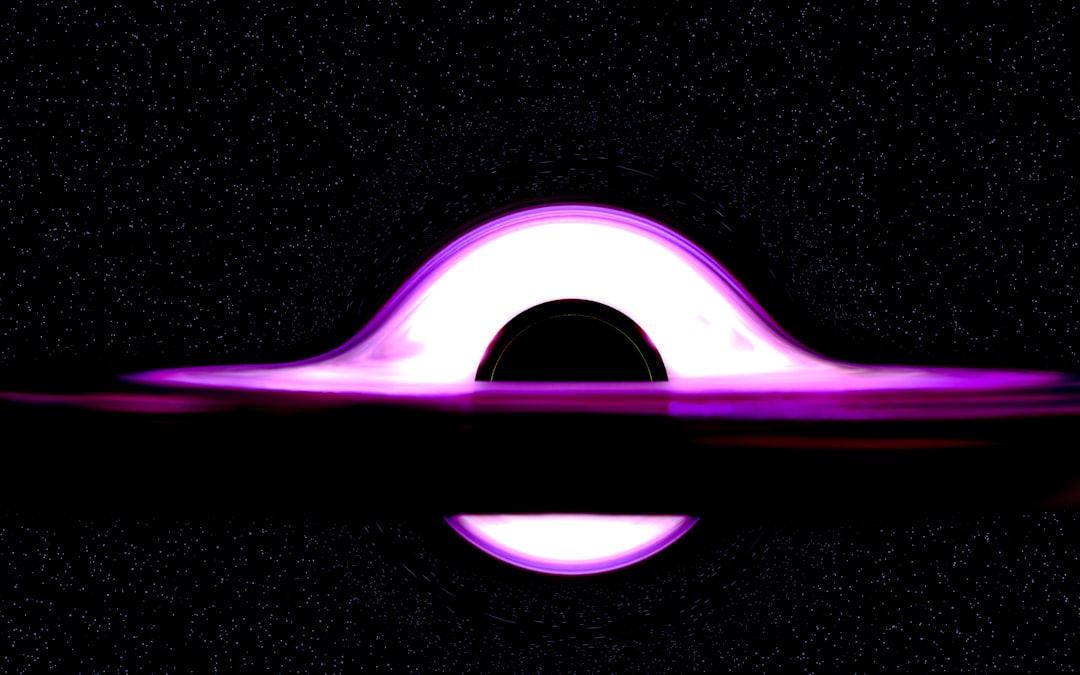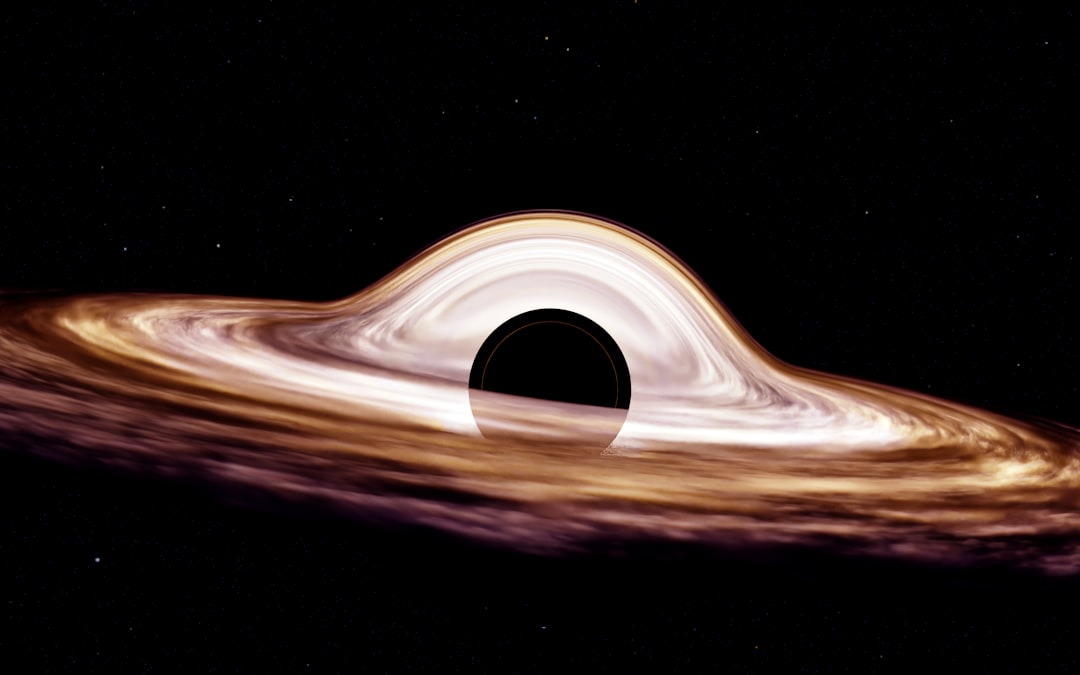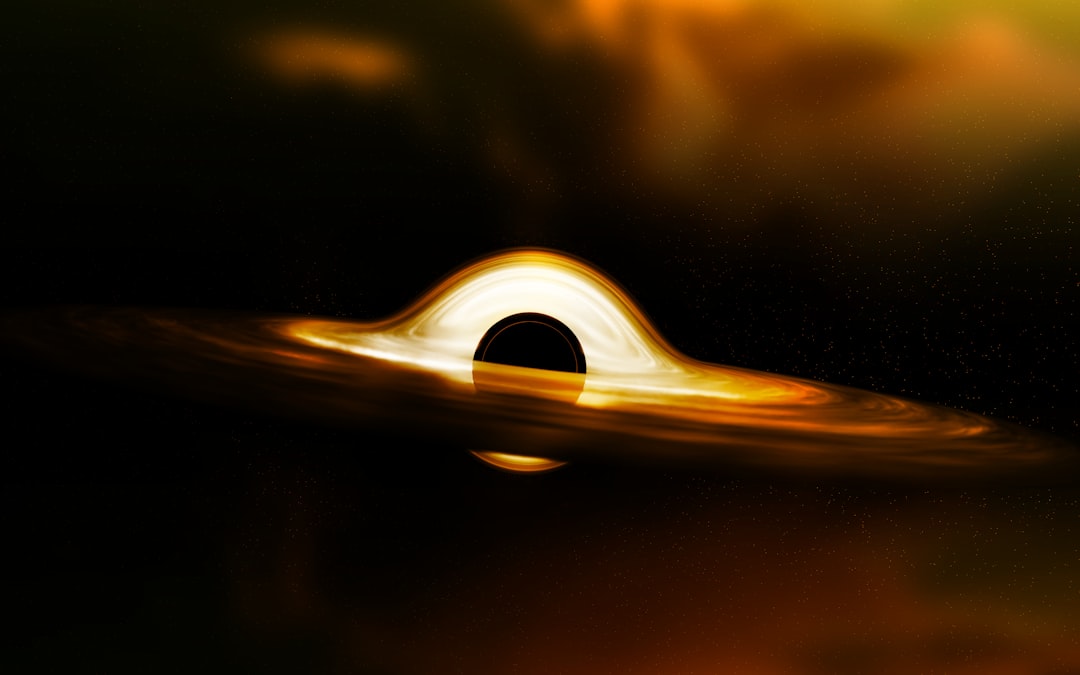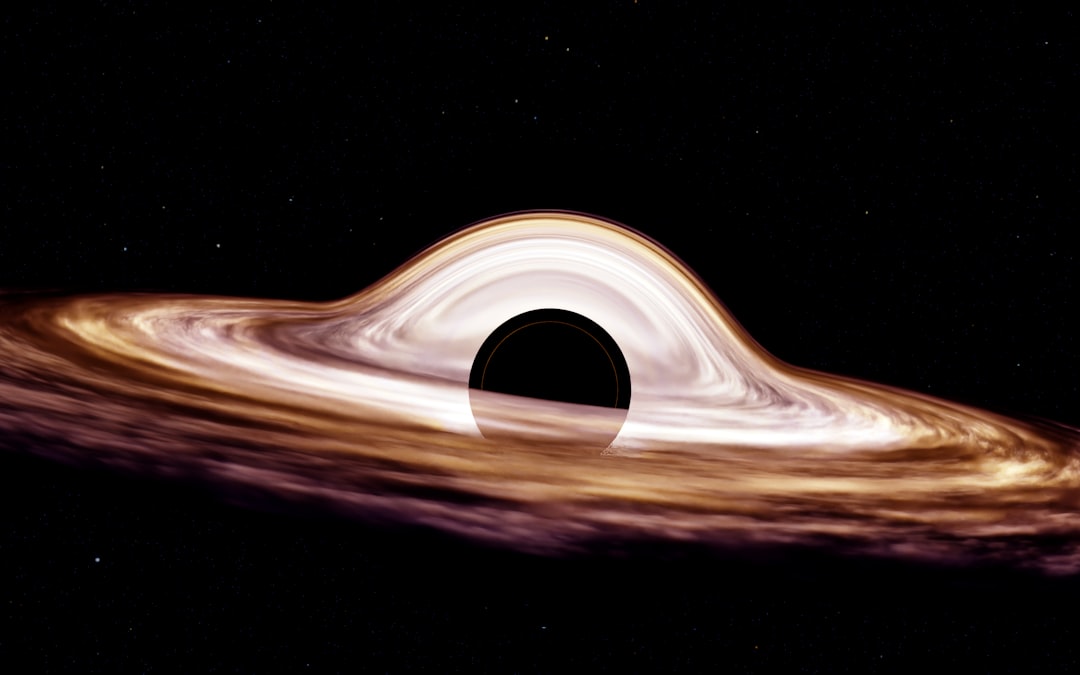
The heart of our galaxy has long been thought to harbor one of the universe's most enigmatic objects: a supermassive black hole known as Sagittarius A* (Sgr A*). For decades, astronomers have assembled compelling evidence supporting this conclusion, from the frenzied orbits of nearby stars to the groundbreaking 2022 image captured by the Event Horizon Telescope. Yet in the ever-questioning realm of astrophysics, a provocative alternative theory has emerged that challenges this fundamental assumption about our galactic center.
New research published in the Monthly Notices of the Royal Astronomical Society presents a compelling case that what we've long interpreted as a supermassive black hole might instead be an ultra-dense concentration of fermionic dark matter—a fundamentally different type of cosmic object that could revolutionize our understanding of galactic structure. Led by Valentina Crespi from the Institute of Astrophysics La Plata in Argentina, this study demonstrates that exotic dark matter particles could produce virtually identical observational signatures to those attributed to black holes, calling into question one of astronomy's most celebrated discoveries.
The implications of this research extend far beyond a simple reclassification of the Milky Way's central object. If validated, this hypothesis would forge an unprecedented connection between the dark matter halo enveloping our galaxy and the massive concentration at its core, suggesting they are two manifestations of the same continuous cosmic substance rather than separate phenomena.
The Traditional Black Hole Paradigm: Evidence and Observations
The case for Sagittarius A* being a supermassive black hole has been built on multiple lines of converging evidence accumulated over several decades. At the heart of this evidence lie the S-stars—a collection of massive, young stars executing extraordinarily rapid orbits around the galactic center. These stellar speedsters, particularly the well-studied S2 star observed by the European Southern Observatory, complete their elliptical paths in mere decades, reaching velocities that approach a significant fraction of light speed at their closest approach to the central object.
Through precise astrometric measurements spanning more than two decades, astronomers have calculated that these stellar orbits demand the presence of an object containing approximately four million solar masses concentrated within a remarkably small volume. The mathematical precision of these orbital calculations, combined with observations from multiple independent research teams, appeared to leave little room for alternative explanations.
Additionally, the region hosts the mysterious G-sources—massive clouds of gas and dust whose trajectories similarly indicate the gravitational influence of an enormously massive central object. These G-objects, including the famous G2 cloud that survived its close encounter with the galactic center in 2014, provided further confirmation that something extraordinarily dense and massive occupies this cosmic real estate.
The seemingly definitive proof arrived in 2022 when the Event Horizon Telescope collaboration released their stunning image of the galactic center. The image revealed a dark central region—the so-called "shadow"—surrounded by a bright ring of superheated material spiraling toward what appeared to be a black hole's event horizon. This visual evidence was hailed as the final confirmation of the supermassive black hole hypothesis.
The Dark Matter Alternative: Fermionic Particles as Galactic Architects
Despite the apparently overwhelming evidence, a persistent minority of researchers have explored alternative explanations rooted in the mysterious properties of dark matter. The new study by Crespi and colleagues resurrects and significantly strengthens one such alternative: that the galactic center hosts not a singularity, but rather an ultra-compact concentration of fermionic dark matter particles.
To understand this hypothesis, we must first grasp what fermions are and why they behave differently from the matter that forms black holes. Fermions constitute one of the two fundamental classes of particles in quantum physics, distinguished by their adherence to the Pauli exclusion principle. This quantum mechanical rule states that no two identical fermions can occupy the same quantum state simultaneously—a property that prevents them from collapsing into the infinitely dense singularity that defines a black hole.
Familiar fermions include quarks, leptons, protons, and neutrons—essentially all the building blocks of ordinary matter. However, the researchers propose the existence of dark fermions: hypothetical particles that interact only through gravity, not through electromagnetic forces. This would render them invisible to telescopes while still allowing them to exert powerful gravitational effects on their surroundings.
"This is the first time a dark matter model has successfully bridged these vastly different scales and various object orbits, including modern rotation curve and central stars data," explained study co-author Dr. Carlos Argüelles. "We are not just replacing the black hole with a dark object; we are proposing that the supermassive central object and the galaxy's dark matter halo are two manifestations of the same, continuous substance."
The researchers tested two specific fermion masses in their models: 56 keV (kiloelectronvolts) and 300 keV particles. These different masses produce cores of varying compactness, with the heavier 300 keV fermions creating a more tightly concentrated central object. Remarkably, both models successfully reproduce the observed orbits of S-stars and G-objects, with orbital parameters differing by less than one percent from traditional black hole predictions.
Bridging Galactic Scales: From Core to Halo
One of the most compelling aspects of the fermionic dark matter hypothesis is its potential to unify two seemingly separate galactic features: the central massive object and the galaxy's dark matter halo. Observations from the Gaia space observatory and other instruments have long indicated that the Milky Way is embedded within an extensive halo of invisible matter extending far beyond the visible stellar disk.
This dark matter halo explains several crucial observations that cannot be accounted for by visible matter alone:
- Galactic rotation curves: Stars in the outer regions of the Milky Way orbit faster than they should based on visible matter alone, requiring additional gravitational mass
- Stellar velocity distributions: The motion of stars throughout the galaxy indicates the presence of substantial invisible mass
- Satellite galaxy dynamics: The orbits and velocities of the Milky Way's companion galaxies reveal the influence of a massive dark matter distribution
- Gravitational lensing effects: The bending of light from background objects demonstrates the presence of matter that cannot be directly observed
The fermionic dark matter model proposes that these particles form a continuous distribution throughout the galaxy, with a dense core-diluted halo morphology. In this scenario, the same type of dark matter particles that create the diffuse galactic halo have collapsed under their own gravity to form an ultra-compact concentration at the galactic center. This unified explanation elegantly connects phenomena occurring on vastly different spatial scales, from the innermost light-hours of the galaxy to its outer reaches extending hundreds of thousands of light-years.
Mimicking Black Hole Signatures: The Shadow in the Image
Perhaps the most challenging observation for any alternative to the black hole hypothesis is the Event Horizon Telescope's image showing a dark central region surrounded by a luminous ring. This "shadow" was widely interpreted as the photographic signature of a black hole's event horizon—the point of no return beyond which nothing, not even light, can escape.
However, the researchers demonstrate that their fermionic dark matter model can produce remarkably similar shadow-like features. The key lies in understanding that this darkness doesn't necessarily require an event horizon. Instead, it can result from the extreme gravitational lensing effects produced by any sufficiently compact and massive object. The ultra-dense core of fermionic dark matter, while not possessing a true event horizon, can bend light so dramatically that it creates a central region devoid of direct illumination, surrounded by a bright ring of gravitationally lensed emission from orbiting material.
A 2024 study also published in the Monthly Notices of the Royal Astronomical Society provided additional support for this interpretation, demonstrating that dark matter cores can generate "image features similar to those expected in the black hole case of the same mass as the dark matter core, with the central brightness depression and surrounding ring-like structure being the most relevant."
"Our model not only explains the orbits of stars and the galaxy's rotation but is also consistent with the famous 'black hole shadow' image," emphasized lead author Valentina Crespi. "The dense dark matter core can mimic the shadow because it bends light so strongly, creating a central darkness surrounded by a bright ring."
Distinguishing Reality: The Challenge of Observational Precision
Despite the theoretical elegance of the fermionic dark matter hypothesis, the researchers acknowledge a fundamental challenge: the predicted differences between the two models are extraordinarily subtle. The orbital parameters of S-stars differ by less than one percent between the black hole and dark matter scenarios, placing them well within current observational uncertainties.
This near-perfect mimicry means that definitively distinguishing between these competing explanations will require observational capabilities that push beyond current technological limits. The researchers identify several potential avenues for future investigation:
- Higher precision astrometry: More accurate measurements of stellar positions and velocities over extended time periods could reveal subtle deviations from black hole predictions
- Interior orbital observations: Detecting and tracking stars or gas clouds orbiting even closer to the central object than S2 would probe stronger gravitational fields where differences might become more pronounced
- Photon ring detection: Confirming or refuting the existence of photon rings—circular patterns created by light orbiting just outside a black hole's event horizon—could provide decisive evidence
- Gravitational wave observations: Future space-based gravitational wave detectors might detect subtle differences in the gravitational wave signatures from objects spiraling into the galactic center
The question of photon spheres represents a particularly interesting test case. General relativity predicts that photons can execute boomerang-like trajectories near a black hole's event horizon, creating distinctive circular features in high-resolution images. These photon rings are a direct consequence of the spacetime singularity at a black hole's core and would not exist around a fermionic dark matter concentration. While one research group claimed to have detected such a photon ring around Sagittarius A*, their findings faced substantial criticism from the broader astronomical community, leaving this question unresolved.
Implications for Cosmology and Fundamental Physics
If subsequent observations validate the fermionic dark matter hypothesis, the implications would reverberate throughout multiple fields of physics and astronomy. This would represent not merely a reclassification of one object, but a fundamental reconceptualization of how matter organizes itself on cosmic scales.
First, it would provide the first direct evidence for the particle nature of dark matter, which despite comprising approximately 85% of the universe's matter content, remains entirely undetected in laboratory experiments. Establishing that dark matter consists of fermions with specific masses would dramatically narrow the search space for particle physics experiments and provide crucial guidance for dark matter detection efforts worldwide.
Second, it would suggest that what we interpret as supermassive black holes in other galaxies might also be ultra-compact dark matter concentrations. This could resolve several puzzling observations, including the unexpectedly rapid formation of massive black holes in the early universe and certain anomalies in the behavior of active galactic nuclei.
Third, the unified core-halo model would provide a natural explanation for the tight correlations observed between supermassive black hole masses and properties of their host galaxies—relationships that have long puzzled astronomers studying galactic evolution.
However, the researchers emphasize appropriate scientific caution in their conclusions. As they note in their paper: "All in all, we conclude that it is necessary to have a better quality and quantity of data to differentiate between the black hole and fermionic models. In addition, accurate enough data from stars orbiting inside the S2 orbit is crucial, given it tests stronger gravitational potentials in the surroundings of Sgr A*."
The Path Forward: Next-Generation Observations
The resolution of this profound question about the nature of our galaxy's heart will ultimately depend on technological advances in observational astronomy. Several upcoming and proposed facilities could provide the precision needed to distinguish between these competing models:
The Extremely Large Telescope (ELT), currently under construction in Chile, will possess unprecedented angular resolution capabilities that could track stellar motions with far greater precision than current instruments. Similarly, next-generation interferometric arrays building on the Event Horizon Telescope's success could reveal finer details in the structure of the central object's immediate environment.
Space-based gravitational wave detectors, such as the proposed Laser Interferometer Space Antenna (LISA), might detect gravitational waves from extreme mass ratio inspirals—small objects spiraling into the galactic center—whose characteristics would differ depending on whether they're falling into a black hole or a dark matter core.
The stakes of this investigation extend beyond academic curiosity. Understanding the true nature of galactic centers touches on fundamental questions about the universe's structure, the identity of dark matter, and the limits of general relativity. Whether Sagittarius A* proves to be a black hole or a dark matter concentration, the answer will deepen our comprehension of how the cosmos organizes itself on the largest scales.
As observational capabilities continue to advance, astronomers stand poised to potentially witness another paradigm shift in our understanding of the universe—a reminder that even our most confident conclusions must remain open to revision in the face of new evidence and innovative theoretical frameworks. The dark heart of the Milky Way keeps its secrets still, but the tools to unlock them may be closer than ever before.