A Stellar Merger Solves a Puzzling Paradox in the Heart of Orion
When the Hubble Space Telescope was launched in 1990, an eager astronomical community had compiled an ambitious list of targets they hoped the revolutionary new instrument would observe. High on that list was the well-known Orion Nebula — a jewel of the winter sky visible to the naked eye and one of the most studied objects in all of astronomy. Located approximately 1,400 light-years from Earth, the Orion Nebula represents the closest massive star-forming region to our solar system, making it an irreplaceable natural laboratory for understanding how stars and planetary systems are born.
Hubble's early years were troubled by a famously flawed mirror, a manufacturing defect that blurred its vision until corrective optics were installed by astronauts in December 1993. Once repaired, the telescope turned its gaze on Orion with breathtaking results, revealing the nebula's complex structure in extraordinary detail. Among its most striking early discoveries were unusual, dark objects with luminous tails streaming away from them — structures that had been glimpsed before with ground-based telescopes, but never in such vivid clarity.
In a landmark 1993 paper published in the Astrophysical Journal, researchers determined that these objects were protoplanetary disks — flattened reservoirs of gas and dust encircling young stars, the very raw material from which planets form. The team coined the term proplyd (short for ionized protoplanetary disk) to describe them. But Orion's proplyds carried an intriguing distinction: they bore elongated tails shaped by the fierce radiation pouring from nearby massive stars. And those tails, it turned out, were at the center of a decades-long scientific paradox.
The Proplyd Paradox: A Tale of Two Timescales
The central mystery can be stated simply: why do the protoplanetary disks and their surrounding gas shells appear to be so much younger than the stars they orbit? According to well-established models of stellar evolution, stars in the Orion Nebula Cluster are approximately one million years old. Given the intensity of the radiation bombarding the proplyds from nearby massive stars, the disk material should have been completely eroded and dispersed long ago — yet there they still are, brimming with gas and dust.
This puzzle, known as the proplyd lifetime problem, has vexed astronomers for years. A second, related conundrum compounded the mystery: careful measurements of the Orion Nebula's expanding gas shell revealed that it, too, behaves as though it is far younger than the stars driving its expansion. The shell's dynamics simply do not add up when measured against the known ages of its stellar engines.
"A longstanding tension exists between the stellar ages in the Orion Nebula Cluster (ONC) and the rapid external photoevaporation of its protoplanetary discs." — Wilhelm et al., Astronomy & Astrophysics
Now, a bold new hypothesis published in the journal Astronomy & Astrophysics proposes a dramatic solution to both problems at once. The paper, titled "A triple-induced merger in θ 1 Ori C solves the proplyd lifetime problem and the curiously young shell of M42," is led by Maite Wilhelm, an astronomer at Leiden University in the Netherlands, and her co-authors argue that a stellar merger — a cosmic collision between stars — fundamentally reshaped the Orion Nebula's environment relatively recently in astronomical terms.
Theta-1 Orionis C: Orion's Stellar Powerhouse
At the heart of this story is a single extraordinary star: θ 1 Ori C1 (Theta-1 Orionis C1), the most massive and luminous star in the famous Trapezium Cluster. The Trapezium — named for the quadrilateral arrangement of its four brightest stars — occupies the very core of the Orion Nebula and is responsible for lighting up the entire nebula. Its intense ultraviolet radiation ionizes the surrounding gas, causing it to glow with the colorful splendor that makes the Orion Nebula one of the most photographed objects in the sky.
θ 1 Ori C1 is the undisputed ruler of this stellar kingdom. It is classified as an O-type star — the hottest, most massive, and most luminous category of stars on the main sequence. With a mass exceeding 33 times that of the Sun, it blazes at a surface temperature of roughly 40,000 Kelvin and pours out ultraviolet radiation at a rate that dwarfs the output of our own comparatively modest star. This radiation is the primary driver of photoevaporation — the process by which energetic photons strip material away from the surfaces of nearby protoplanetary disks, sculpting them into the distinctive tailed shapes that Hubble revealed so memorably.
The rate of this photoevaporation has been carefully measured, and therein lies the problem. The amount of material stripped from the proplyds is simply inconsistent with the stars having been shining at their current intensities for a full million years. Something must have changed — and changed relatively recently.
The Shell's Surprising Youth
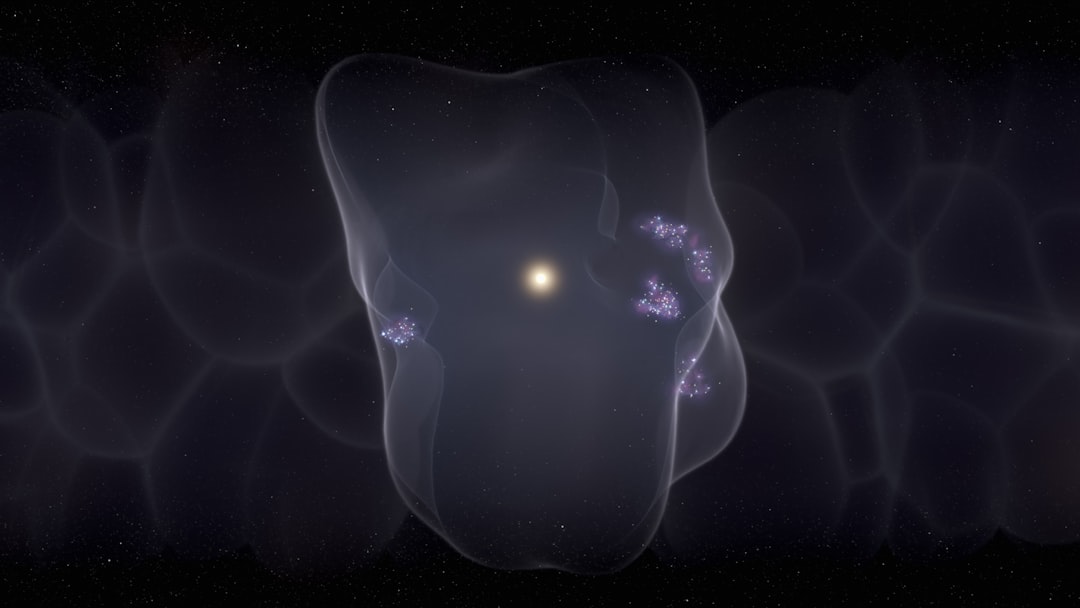
A second line of evidence deepens the puzzle. Astronomers have measured the expansion velocity of the Orion Nebula's shell — the bubble of hot, ionized gas that surrounds the cluster — to be approximately 13 kilometers per second. When this velocity is combined with the shell's measured radius of about 2.5 parsecs (roughly 8 light-years), a straightforward calculation yields a dynamical age of only about 0.3 million years. Yet the stars driving that expansion are estimated to be around a million years old — more than three times older.
"It is striking to observe that two processes powered by the ONC's massive stars both appear to have younger dynamical ages than the inferred stellar age." — Wilhelm et al., Astronomy & Astrophysics
This double discrepancy — the unexpectedly young proplyds and the unexpectedly young shell — strongly suggests that something dramatic happened in Orion's recent past that suddenly amplified the energy output of its central stars. Previous researchers proposed explanations involving multiple populations of stars with different ages, possibly triggered by the ejection of massive stars that disrupted the cluster and initiated fresh rounds of star formation. But these scenarios struggled to account for all the observed properties of the system and never gained wide acceptance.
A Cosmic Collision: The Merger Hypothesis
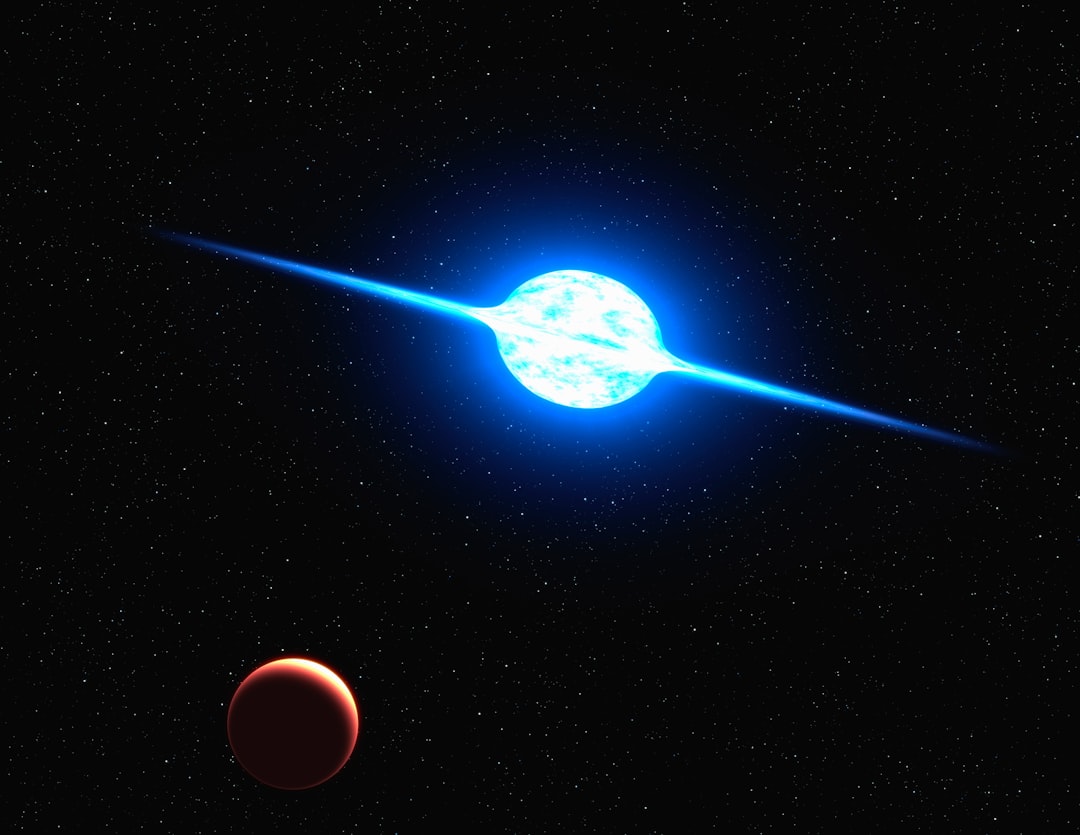
Wilhelm and her colleagues propose an elegant and startling alternative: θ 1 Ori C1 is not a single star that has always existed in its current form. Instead, they argue that the star we see today is the product of a catastrophic merger between two binary stars — a collision that occurred relatively recently and dramatically boosted the merged object's luminosity and stellar wind power.
The scenario unfolds as follows. θ 1 Ori C1 currently has a known binary companion, θ 1 Ori C2. According to the researchers, the gravitational influence of C2 triggered a process known as von Zeipel-Lidov-Kozai (vZLK) oscillations — a subtle but powerful gravitational mechanism that can operate in triple-star systems. In such systems, a distant third body can cause the orbital eccentricity of an inner binary pair to oscillate dramatically over time, eventually driving the two inner stars into a collision.
In this case, the gravitational perturbations from C2 pushed the inner binary's orbit to become so elongated that the two stars came close enough to merge. The result was the birth of the massive, highly luminous O-type star we observe today as θ 1 Ori C1. This merger happened after the bulk of star formation in the cluster was already complete — meaning that for most of their first million years, the proplyds were bathed in the comparatively mild radiation of two separate, less-massive stars rather than the ferocious output of the merged colossus.
- Pre-merger: Two less-massive binary stars emit moderate radiation; proplyds survive largely intact
- The merger event: vZLK oscillations drive the binary pair to collide and merge into a single, far more luminous and massive star
- Post-merger: θ 1 Ori C1's dramatically increased UV output begins rapidly photoevaporating the surrounding proplyds and accelerating the nebula's shell expansion
- Today: We observe the proplyds and shell at an early stage of their erosion, consistent with only ~0.3 million years of intense irradiation
The team rigorously tested this scenario against computer simulations of stellar dynamics, demonstrating that such a triple-system merger is not only physically plausible but statistically reasonable given what we know about the population of stars in the Orion Nebula Cluster.
The Shell Problem: An Additional Ingredient
While the merger elegantly explains the proplyd lifetime problem, the researchers found that it alone was not quite sufficient to account for the shell's apparently young dynamical age. The level of energy required to accelerate the Orion Nebula's expanding bubble to its observed velocity exceeds what a stellar merger, however dramatic, would straightforwardly provide.
To bridge this gap, Wilhelm and her co-authors invoke a secondary mechanism: the cool gas evaporating from the photoionized proplyd disks. As the newly supercharged θ 1 Ori C1 begins rapidly eroding the surrounding disks, it injects large quantities of cooler, denser gas into the interior of the expanding shell. When this material mixes with the hot gas already inside the bubble, it generates additional pressure — effectively providing an extra push that can account for the shell's observed expansion rate.
This two-component model — a stellar merger augmented by evaporated disk material — brings the theoretical predictions into much closer alignment with the observed properties of the Orion Nebula's shell. It is a satisfying solution precisely because it uses the same merger event to explain multiple independent observational puzzles simultaneously.
Bonus Clues Hidden in the Star Itself
The merger hypothesis gains additional credibility from two peculiar properties of θ 1 Ori C1 that have long puzzled astronomers. The star possesses a strongly tilted magnetic field — its magnetic axis is significantly misaligned with its rotation axis — a configuration that is difficult to explain if the star formed and evolved in isolation. Stellar mergers, however, are expected to produce exactly this kind of magnetic complexity, as the violent coalescence of two stars churns and amplifies magnetic fields in unpredictable ways.
Even more tellingly, θ 1 Ori C1 shows a notable excess of nitrogen in its atmosphere relative to other massive stars of similar type. This chemical enrichment is a known signature of stellar mergers, in which material from the deep, processed interiors of the merging stars becomes mixed into the outer layers of the newly formed object. Taken together, these two independent lines of evidence strongly support the idea that θ 1 Ori C1 has had a violent past.
Broader Implications: Rethinking Stellar Collisions
Beyond resolving the specific paradoxes of the Orion Nebula, this work carries profound implications for our understanding of stellar evolution and the environments in which planetary systems are born. Stellar mergers have historically been considered exotic, rare events — spectacular curiosities rather than common phenomena with widespread consequences. This research challenges that assumption.
"This is the first time we have witnessed the consequences of a major stellar collision in our own cosmic neighbourhood. It also shows that stellar collisions may be much more common than we previously thought, and that they can have far-reaching consequences." — Simon Portegies Zwart, co-author
If a stellar merger can so dramatically reshape the environment of the nearest massive star-forming region to Earth, similar events may be influencing the evolution of protoplanetary disks — and thus the formation of planets — in star-forming regions across the galaxy. The timing of a merger relative to the epoch of planet formation could determine whether nascent planetary systems survive long enough to fully assemble, or are blasted apart by the sudden surge in radiation.
"Our idea shows that subtle effects in triple-star systems can have a major impact on the environments in which stars form, and potentially even on planets that are still taking shape." — Maite Wilhelm, lead author
The vZLK mechanism at the heart of this scenario is itself a topic of intense ongoing research. It has been invoked to explain phenomena ranging from gravitational wave sources detected by LIGO to the unusual orbits of comets in our own solar system. Its role in driving stellar mergers within young star clusters adds yet another dimension to this already rich physical process.
Looking Ahead: Orion Under the James Webb Telescope
The Orion Nebula is among the prime targets of the James Webb Space Telescope (JWST), whose infrared sensitivity and unprecedented resolution are already revealing new details about protoplanetary disks and the complex interplay of radiation and gas in star-forming environments. The ESA/NASA Webb mission's observations of Orion — conducted under the PDRs4All program — are expected to provide the kind of detailed measurements that will allow astronomers to rigorously test the merger scenario proposed by Wilhelm and her colleagues.
Future observations may be able to directly probe the chemical composition and magnetic field structure of θ 1 Ori C1 with even greater precision, potentially confirming or refining the merger hypothesis. Dynamical models of the Trapezium Cluster's history can also be refined as proper motion measurements of individual stars improve, potentially allowing astronomers to reconstruct the cluster's past in ever-greater detail.
For now, the Orion Nebula — humanity's closest window into the drama of star and planet formation — has revealed yet another layer of its extraordinary complexity. What appeared to be a simple contradiction in the ages of stars and disks has unmasked a story of cosmic violence: two stars colliding in the dark, their merger igniting a transformation that reshaped an entire stellar nursery and may have determined the fate of countless worlds still struggling to be born.
The full findings are published in Astronomy & Astrophysics, with the lead author being Maite Wilhelm of Leiden University's Leiden Observatory.