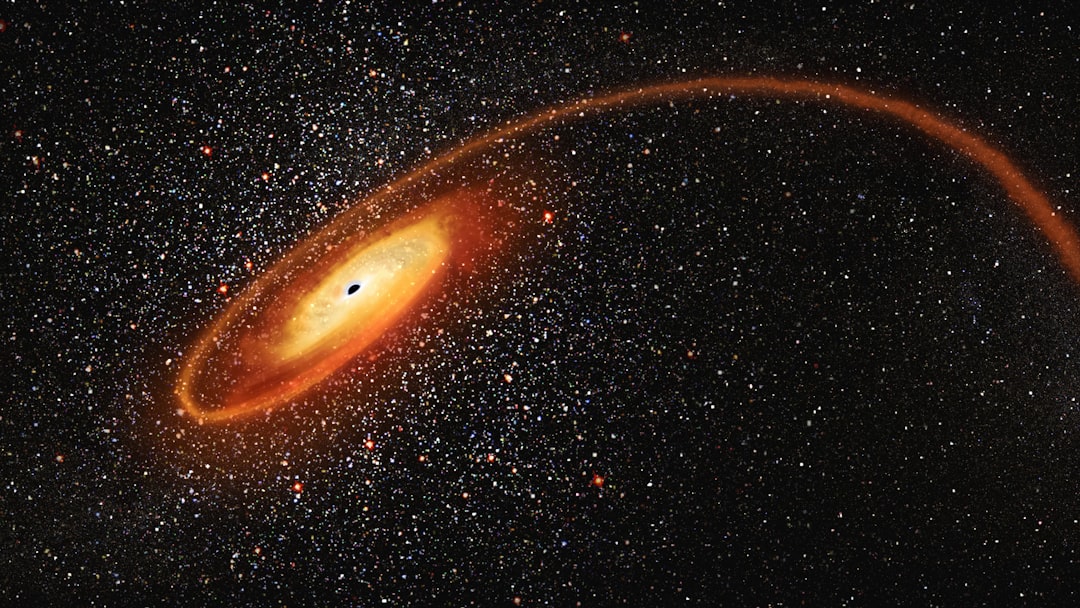
A Rapidly-Growing Black Hole in a Nearby Galaxy Could Provide a Window Into the Early Universe
An international team led by researchers from the prestigious Max Planck Institute for Radio Astronomy (MPIfR) has made a landmark discovery that is reshaping our understanding of how supermassive black holes grow and evolve. While observing SDSS J110546.07+145202.4, a spiral galaxy located approximately 1.8 billion light-years from Earth in the constellation Leo, scientists detected something unprecedented: a radio-bright outburst that has persisted for over eight years — far longer than any previously recorded event of its kind. The findings were published in The Astrophysical Journal, one of the most respected peer-reviewed journals in astrophysics.
An Unprecedented Radio Outburst
For nearly a decade, this otherwise unremarkable spiral galaxy has blazed with extraordinary brilliance across the radio spectrum. The source of this intense radiation is the supermassive black hole (SMBH) lurking at the galaxy's center — a compact gravitational giant that has been voraciously consuming surrounding matter and, in doing so, generating one of the most energetic displays astronomers have ever recorded at this cosmic distance.
Short-lived bursts of radio emission near black holes are not entirely uncharted territory. These events, broadly classified as Active Galactic Nuclei (AGN), occur when the extreme physical conditions surrounding a black hole's accretion disk — a swirling reservoir of superheated gas and dust — cause the galactic center to temporarily outshine every single star in its host galaxy combined. The accretion process generates colossal amounts of energy, which can be released as powerful jets of plasma and radiation across the electromagnetic spectrum.
What makes this discovery truly exceptional, however, is its duration. While most observed radio transients associated with AGN activity last anywhere from a few days to a few weeks, the outburst in SDSS J110546.07+145202.4 has now endured for several years. This makes it the first known event of its kind — a phenomenon without precedent in the observational record.
"Luminous radio radiation from rapidly growing, lightweight black holes is rare to begin with. Their transition into a long-lasting, radio-bright state has never been observed before." — Dr. Stefanie Komossa, Max Planck Institute for Radio Astronomy
A Multi-Wavelength Investigation
The research was spearheaded by Dr. Stefanie Komossa of the MPIfR, whose team assembled a remarkable coalition of scientific institutions to study this object. Collaborating partners included researchers from the Australia Telescope National Facility (ATNF), the Sydney Institute for Astronomy (SIfA), the Osservatorio Astrofisico di Torino, the State Key Laboratory of Radio Astronomy and Technology, the University of Science and Technology of China, the HUN-REN–ELTE Extragalactic Astrophysics Research Group, the Konkoly Observatory, the MTA Center of Excellence, the International Gemini Observatory, and multiple universities across the globe.
To build the most complete picture possible of this extraordinary event, the team combined newly acquired observations with archival data drawn from multiple world-class observatories. Their dataset spanned an impressive range of the electromagnetic spectrum — from high-energy X-rays and optical wavelengths to radio frequencies and infrared light. This multi-wavelength approach is critical in modern astrophysics, as different forms of radiation reveal distinct physical processes occurring at and around the black hole system.
Key findings from the team's analysis include:
- The SMBH at the center of SDSS J110546.07+145202.4 is of relatively low mass compared to many known supermassive black holes, yet it is growing at an exceptionally high rate through continuous accretion of surrounding material.
- The sustained accretion of matter over several years appears to have triggered and maintained a persistent relativistic jet — a tightly focused beam of plasma ejected at near-light speed from the black hole's polar regions.
- The event represents the first-ever observed transition of a low-mass, rapidly-accreting black hole into a prolonged, radio-luminous state.
- Multiple wavelength data confirm that the system's energy output is extraordinary relative to the central black hole's mass, suggesting a near- or super-Eddington accretion rate.
The Physics of Extreme Accretion and Jet Formation
To appreciate the significance of this discovery, it helps to understand the physics at play. When a black hole accretes matter, the infalling gas forms a rapidly rotating accretion disk. Friction within this disk heats the material to temperatures of millions of degrees, causing it to emit radiation across the electromagnetic spectrum. In some cases, powerful magnetic fields threading through the disk can funnel a fraction of the infalling material into tightly collimated relativistic jets — streams of charged particles and electromagnetic radiation that shoot outward from the black hole's poles at velocities approaching the speed of light.
The precise mechanism by which jets are launched and sustained remains one of the most pressing open questions in high-energy astrophysics. Leading theoretical models, including the Blandford-Znajek mechanism, suggest that the rotational energy of the black hole itself — extracted via its interaction with surrounding magnetic fields — may power these jets. The extraordinary longevity of the outburst in SDSS J110546.07+145202.4 may offer new observational constraints on these theoretical frameworks, potentially helping scientists distinguish between competing models of jet formation.
"Such high-energy events can provide astronomers with a wealth of insights. By observing these jets and outbursts, we can study the physical processes in some of the most extreme environments in the Universe." — Kovi Rose, Sydney Institute for Astronomy
A Prototype for a New Class of Galaxies
The research team believes that SDSS J110546.07+145202.4 represents far more than an isolated curiosity. It is being classified as the prototype of an entirely new class of galaxies — those that undergo rapid, dramatic changes in their radio emission properties over timescales of years rather than days or weeks. This classification carries profound implications for how astronomers catalog and monitor extragalactic radio sources.
The type of rapid black hole growth observed in this galaxy is behavior that cosmologists have long associated with the early Universe, specifically the epoch known as Cosmic Dawn and the subsequent era of peak quasar activity, roughly 10–12 billion years ago. During those primordial epochs, galaxies were still assembling, gas supplies were abundant, and supermassive black holes were growing at prodigious rates — fueling the brilliant quasars that can be observed across billions of light-years.
Finding such behavior in a galaxy situated within the last 2 billion years of cosmic history — a relatively recent era in the 13.8-billion-year timeline of the Universe — makes this object a striking outlier. It suggests that the conditions necessary for this kind of extreme accretion activity can arise even in the present-day, evolved Universe, albeit rarely. This rarity itself is scientifically valuable, as it may point to specific triggering mechanisms — such as a galaxy merger, a tidal disruption event, or an instability in the accretion disk — that remain to be identified through follow-up observations.
A Cosmic Laboratory on Our Doorstep
One of the most compelling aspects of this discovery is its relative proximity. At 1.8 billion light-years, SDSS J110546.07+145202.4 is close enough for current and next-generation telescopes to resolve fine structural details that would be impossible to discern in more distant galaxies undergoing similar activity. This proximity transforms the galaxy into a natural laboratory for studying fundamental astrophysical processes.
Planned follow-up observations using the Very Long Baseline Array (VLBA) — a continent-spanning network of radio telescopes capable of achieving extraordinary angular resolution — could reveal the precise structure, size, and evolution of the jet over time. Such data would be invaluable for testing theoretical models of jet formation and determining what is driving the unusual longevity of this outburst.
The reasons why the SMBH began accreting so rapidly, and why the resulting outburst has persisted for so long, remain an open and tantalizing question. Among the scenarios under investigation are:
- A tidal disruption event (TDE), in which a star wandered too close to the black hole and was shredded, providing a sudden influx of accreting material.
- A disk instability, whereby a change in the accretion disk's physical state triggered a sustained increase in accretion rate.
- A galaxy interaction or minor merger that funneled fresh gas toward the galactic center, reigniting the AGN.
The Role of Next-Generation Observatories
Looking ahead, the discovery carries exciting implications for the next generation of radio astronomical facilities. The Square Kilometre Array (SKA) — currently under construction in South Africa and Australia — will be the world's largest and most sensitive radio telescope upon completion. With its unprecedented collecting area and survey speed, the SKA will be uniquely positioned to identify radio transients like the one observed in SDSS J110546.07+145202.4 across vast swaths of the sky, potentially revealing whether such events are rarer than currently assumed or whether they form a previously overlooked population of radio-variable galaxies.
Dr. Komossa has emphasized that facilities like the SKA will be essential for placing this discovery in its broader cosmological context:
"With sensitive facilities like the incoming SKA telescopes, we'll be able to identify similar radio transients in future sky surveys. This is crucial for filling the gaps in our understanding of the early Universe." — Dr. Stefanie Komossa, MPIfR
Complementary observations from space-based platforms — including NASA's Chandra X-ray Observatory and future missions such as the ESA's NewAthena X-ray observatory — will further illuminate the high-energy physics driving the outburst, particularly the behavior of the accretion disk and the thermal emission from gas being heated to extreme temperatures in the black hole's immediate vicinity.
Broader Implications for Black Hole Science
This discovery arrives at a particularly fertile moment in the study of black holes. Since the first direct imaging of a black hole shadow by the Event Horizon Telescope (EHT) collaboration in 2019, public and scientific interest in these extreme objects has surged. Each new discovery adds a piece to the puzzle of how black holes form, grow, and influence the galaxies they inhabit — a process known as AGN feedback, which is now understood to be a crucial regulator of star formation and galaxy evolution across cosmic time.
The case of SDSS J110546.07+145202.4 is a powerful reminder that the Universe continues to surprise us. A modestly-sized black hole in a relatively nearby spiral galaxy has, against all expectations, erupted into a sustained display of extreme activity more commonly associated with the primordial cosmos. In doing so, it has offered astronomers a rare and precious opportunity: to observe, in fine detail and at manageable distances, the kinds of dramatic black hole growth events that shaped the structure of our Universe in its earliest chapters.
As follow-up studies proceed and next-generation observatories come online, SDSS J110546.07+145202.4 is set to remain one of the most closely watched objects in the radio sky — a living cosmic laboratory whose secrets are only beginning to be unlocked.