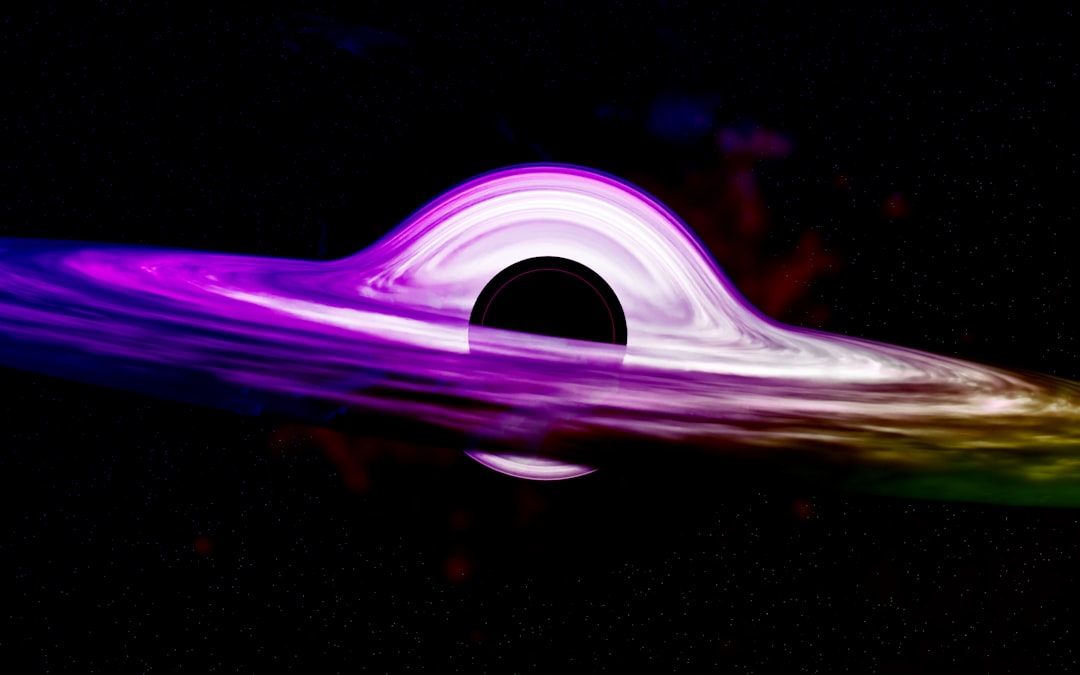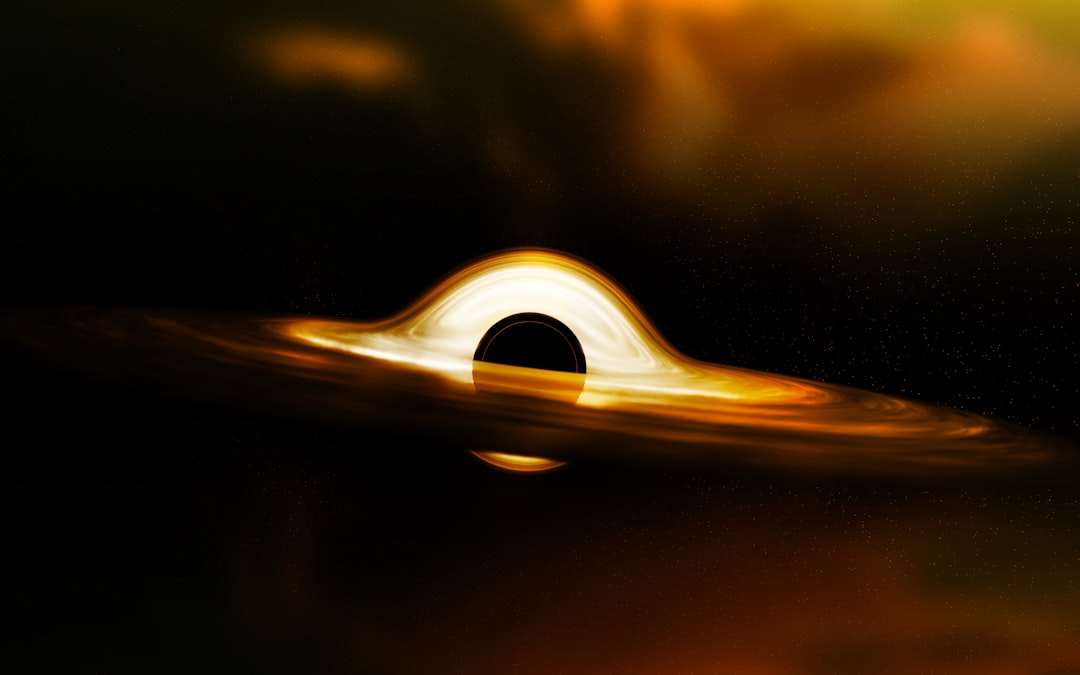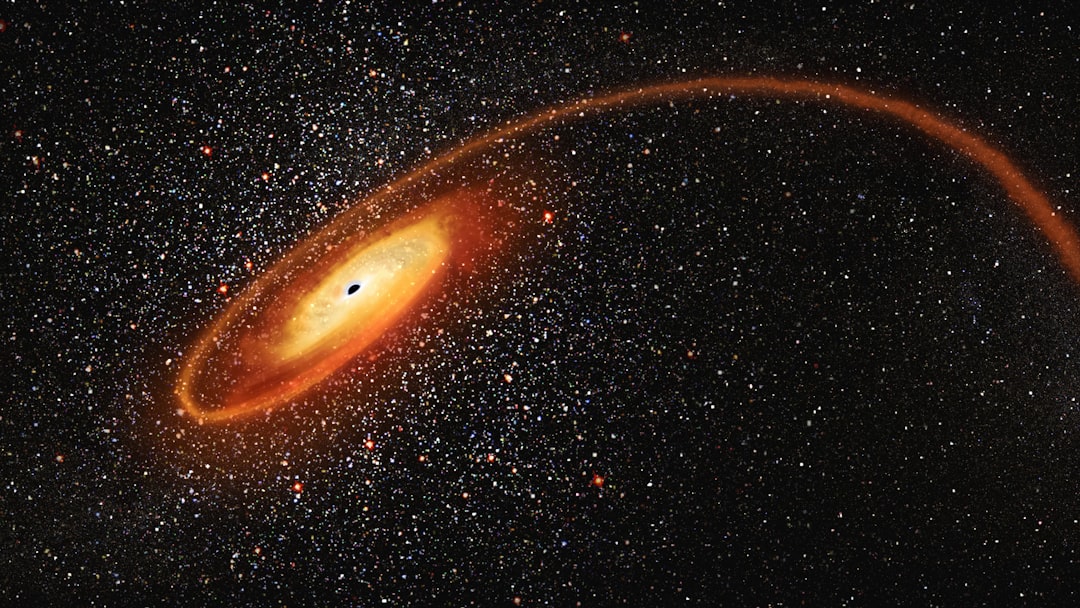
The James Webb Space Telescope (JWST) has revolutionized our understanding of the early universe since its launch, but some of its most puzzling discoveries may not be quite what they seem. Among the telescope's most perplexing findings has been the detection of what appeared to be overmassive black holes in galaxies that existed merely 2 billion years after the Big Bang—a cosmic era known as Cosmic Noon. These supermassive black holes appeared far too large for their host galaxies, defying our established models of black hole growth and galactic evolution.
However, groundbreaking new research published in The Astrophysical Journal suggests that these cosmic giants may be an optical illusion of sorts—not truly overmassive at all, but rather the result of observational bias in how we detect and measure distant black holes. The study, led by Madisyn Brooks, a PhD student in Physics at the University of Connecticut, employed sophisticated statistical techniques to reveal a more nuanced picture of black hole populations in the early universe.
"JWST has revealed an abundance of low-luminosity active galactic nuclei (AGN) at high redshifts (z > 3), pushing the limits of black hole science in the early Universe," the research team explains. Their work challenges the prevailing narrative that the early universe was populated by inexplicably massive black holes, instead suggesting that what we've been observing represents only the brightest, most extreme examples—statistical outliers that don't reflect the typical black hole population.
The Cosmic Puzzle: Understanding Black Hole Mass Relationships
To appreciate the significance of this research, we must first understand the fundamental relationship between black holes and their host galaxies. In the local universe—the cosmic neighborhood we can observe in detail—astronomers have established a remarkably consistent pattern: supermassive black holes lurking at the centers of galaxies typically possess about 0.1% of the mass contained in their galaxy's stellar bulge. This relationship, known as the MBH–M* relation (black hole mass to stellar mass relation), has been verified across thousands of nearby galaxies.
But when JWST peered into the distant universe, observing galaxies as they appeared billions of years ago, this relationship appeared to break down spectacularly. The telescope detected galaxies where the central black hole possessed a mass ratio of 1:10 or even 1:1 relative to the host galaxy's stellar mass. In other words, these black holes were 10 to 100 times more massive than they should be according to our understanding of cosmic evolution.
This discrepancy posed a serious theoretical challenge. Black holes grow primarily through two mechanisms: accreting matter from their surroundings and merging with other black holes. Both processes take time—and according to our models, there simply wasn't enough time in the early universe for black holes to grow so massive through conventional means. The universe at Cosmic Noon was only about 2 billion years old, compared to its current age of 13.8 billion years.
The Heavy Seed Hypothesis and Little Red Dots
The discovery of these apparently overmassive black holes spawned new theoretical frameworks to explain their existence. The most prominent hypothesis involved "heavy seeds"—the idea that black holes in the early universe formed differently than they do today, starting with much larger initial masses. This theory gained additional support from another JWST discovery: mysterious objects called Little Red Dots (LRDs).
These Little Red Dots, detected in several of JWST's extragalactic surveys, appeared to be compact, highly luminous objects that could represent an early phase of black hole formation. Scientists theorized that LRDs might be the heavy seeds that eventually grew into the overmassive black holes observed at Cosmic Noon. The hypothesis was elegant: if black holes could form with initial masses much larger than previously thought possible, it would solve the timing problem and explain how they grew so large so quickly.
However, Brooks and her colleagues recognized a critical flaw in this reasoning: selection bias. The JWST, despite its unprecedented sensitivity, can only detect the brightest active galactic nuclei at extreme distances. This means that our census of early universe black holes was inherently skewed toward the most luminous—and therefore likely the most massive—examples.
Revolutionary Methodology: Spectroscopic Stacking Analysis
To overcome this observational bias, the research team employed a sophisticated technique called spectroscopic stacking. Rather than examining individual galaxies one at a time, they combined spectroscopic data from approximately 2,000 galaxies drawn from four major JWST extragalactic surveys: CEERS (Cosmic Evolution Early Release Science), JADES (JWST Advanced Deep Extragalactic Survey), RUBIES, and GLASS (Grism Lens-Amplified Survey from Space).
The stacking technique works by grouping galaxies according to their luminosity and redshift (distance), then combining their spectra to create composite observations. This approach offers several crucial advantages:
- Enhanced Signal Detection: By averaging multiple observations, random noise is reduced while consistent signals are amplified, revealing features too faint to detect in individual galaxies
- Population Statistics: Rather than focusing on exceptional cases, stacking reveals the properties of typical galaxies at a given epoch
- Bias Mitigation: The technique naturally counteracts selection effects by including galaxies across the full range of observable properties
- Comprehensive Census: Stacking enables detection of black hole activity in "normal" galaxies that would otherwise remain invisible
"Our results indicate that individual detections of AGN are more likely to sample the upper envelope of the MBH–M* distribution, while stacking of 'normal' galaxies and searching for AGN signatures can overcome the selection bias of individual detections," the researchers explain in their paper.
Revelatory Findings: A More Modest Black Hole Population
The results of this comprehensive analysis paint a dramatically different picture of the early universe's black hole population. When examining the full galaxy population rather than just the brightest examples, the research team found that typical galaxies host black holes at most 10 times more massive than predicted by the local universe relationship—a far cry from the 100-fold discrepancies suggested by individual JWST detections.
This finding is illustrated compellingly in the study's data visualization, which plots black hole mass as a function of stellar mass across different cosmic epochs. The stacked observations (shown as red stars in their analysis) cluster much closer to the established local universe relationship (represented by a solid black line) than the individual overmassive black hole detections scattered in the upper regions of the plot. The grey squares representing local AGN (active galactic nuclei) demonstrate the well-established relationship that appears to extend, with modest evolution, into the early universe.
The research team's analysis of stacked spectra revealed detections of broad Hα emission—a telltale signature of active black hole accretion—in many galaxy stacks where individual observations showed no obvious signs of AGN activity. This confirms that black holes were indeed present and actively growing in typical early universe galaxies, but at more modest rates than the spectacular examples that dominated headlines.
Implications: No Need for Exotic Formation Scenarios
Perhaps most significantly, these findings suggest that the early universe's black holes can be explained through conventional formation mechanisms without invoking exotic heavy seed scenarios. The researchers found that their inferred black hole masses are "well explained by light stellar-remnant seeds undergoing moderate Eddington accretion."
The Eddington limit represents the maximum rate at which a black hole can accrete matter while maintaining equilibrium between the inward pull of gravity and the outward pressure of radiation. "Moderate Eddington accretion" means that early universe black holes grew at rates comparable to what we observe today—perhaps somewhat elevated, but not requiring fundamentally different physics.
This interpretation aligns with a more conservative understanding of black hole formation: they began as "light seeds" with masses ranging from tens to hundreds of solar masses (formed from the collapse of massive stars or small clusters), then grew steadily over cosmic time through gas accretion and occasional mergers. The apparent overmassiveness of individually detected black holes simply reflects the fact that we preferentially observe the rare, extreme examples rather than the typical population.
Broader Context: Refining Our Cosmic Timeline
This research exemplifies a crucial phase in the scientific process following major observational breakthroughs. When revolutionary instruments like JWST first reveal unexpected phenomena, initial interpretations often require refinement as more sophisticated analyses are applied. The apparent crisis of overmassive black holes may join other "cosmic tensions" that resolved themselves through careful statistical treatment and recognition of observational biases.
However, the story is far from over. While Brooks and colleagues have demonstrated that typical early universe galaxies host black holes more consistent with extrapolations from local relationships, the individually detected overmassive examples remain real and require explanation. These objects may represent rare but genuine outliers—perhaps galaxies that underwent unusually rapid growth through major mergers or experienced brief periods of super-Eddington accretion.
The research also highlights the importance of comprehensive surveys and statistical techniques in modern astronomy. As JWST continues its mission, accumulating deeper observations across larger areas of sky, astronomers will be able to apply similar stacking analyses to even earlier cosmic epochs, potentially reaching back to the first billion years after the Big Bang when the very first black holes formed.
Future Directions and Upcoming Observations
The findings from this study set the stage for several exciting avenues of future research. Upcoming JWST observing programs will target larger samples of high-redshift galaxies with deep spectroscopic observations, enabling more detailed stacking analyses across finer bins of galaxy properties. These observations will help determine whether the modest evolution in the black hole-galaxy mass relationship continues to even earlier times or if there exists a transition epoch where formation mechanisms fundamentally differed.
Additionally, next-generation facilities like the Extremely Large Telescope and the Nancy Grace Roman Space Telescope will provide complementary observations, offering higher spatial resolution and wider field coverage respectively. These capabilities will enable astronomers to better characterize the host galaxies of early universe black holes and understand the environmental conditions that influenced their growth.
The debate over early universe black holes also underscores the dynamic nature of modern astrophysics, where new observations continuously challenge and refine our theoretical frameworks. While the heavy seed hypothesis may not be necessary to explain typical black hole populations, it remains a viable mechanism for the most extreme cases. The coming years will likely see a synthesis of observational constraints and theoretical modeling that provides a more complete picture of how black holes and galaxies co-evolved across cosmic time.
As we continue to probe the distant universe with increasingly sophisticated tools and techniques, one thing becomes clear: the cosmos is both more orderly and more complex than our initial observations suggest. The apparent crisis of overmassive black holes may ultimately teach us as much about the challenges of astronomical observation as about the physics of the early universe itself.