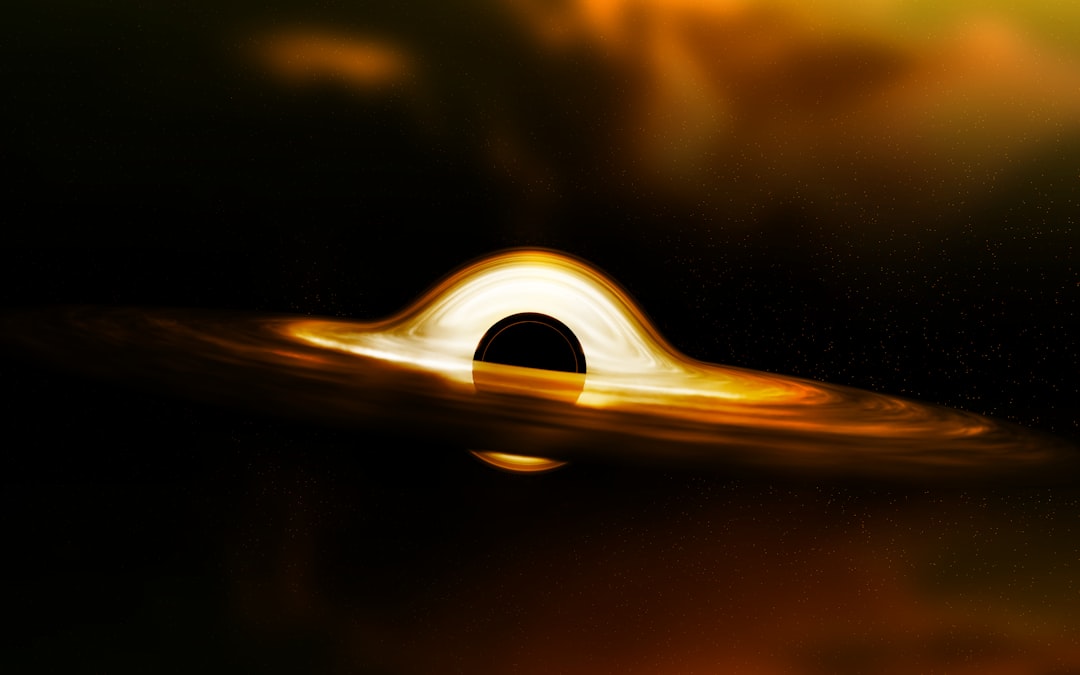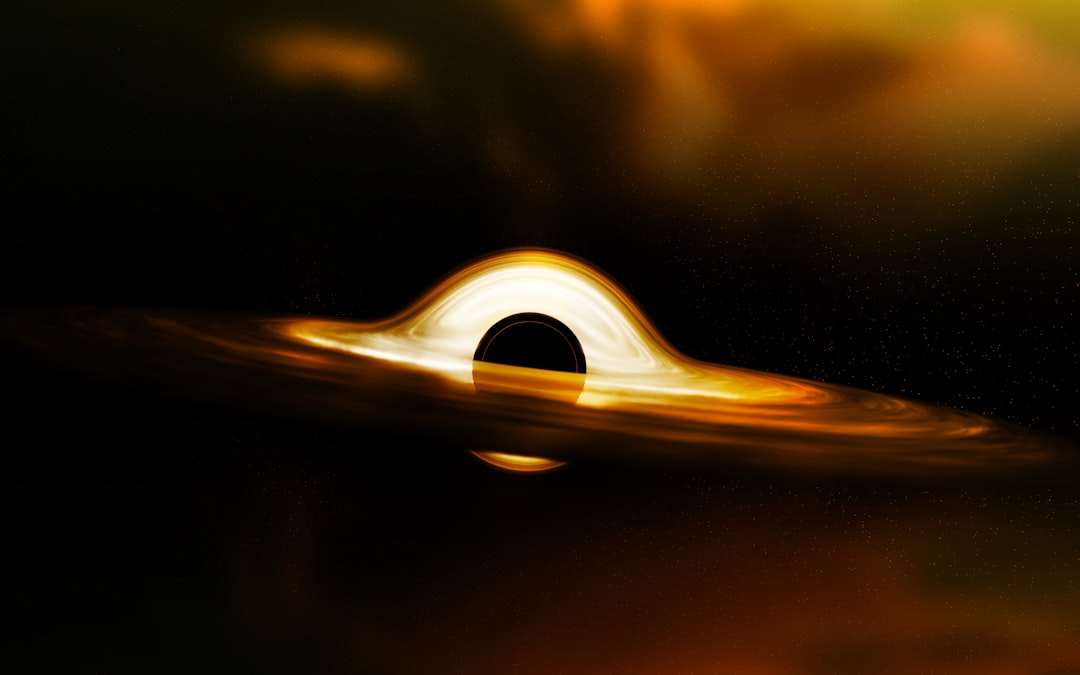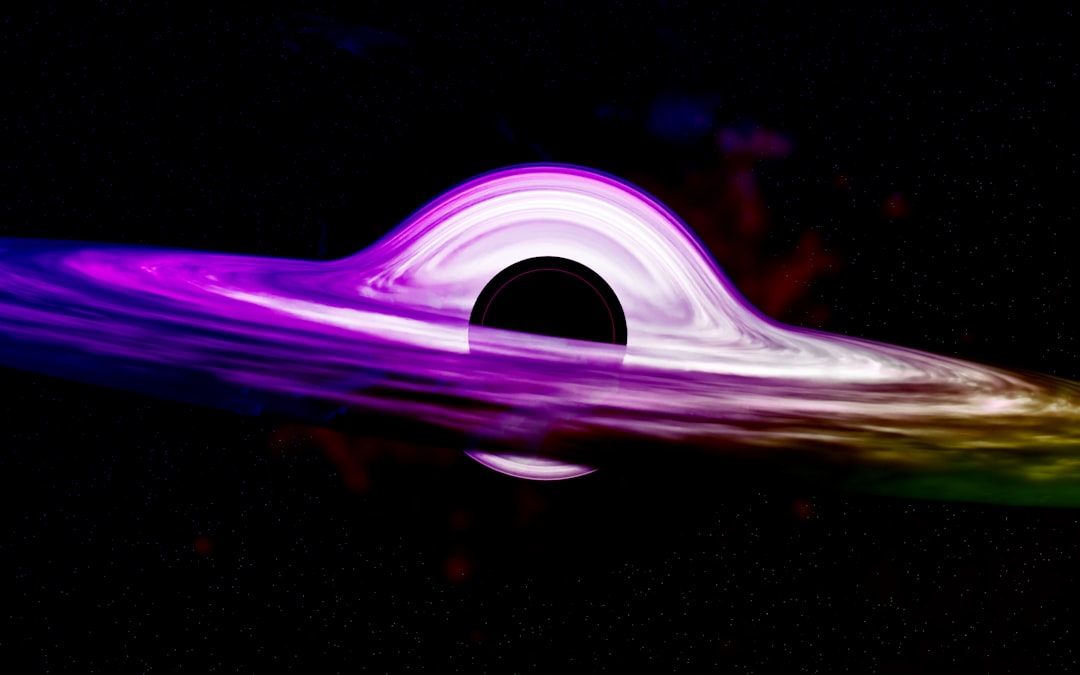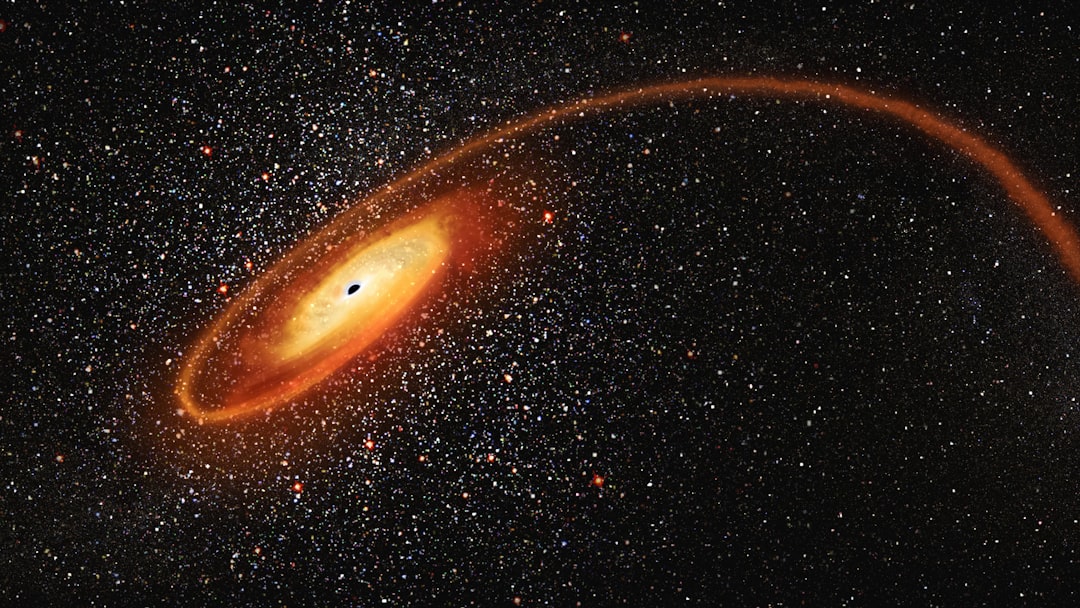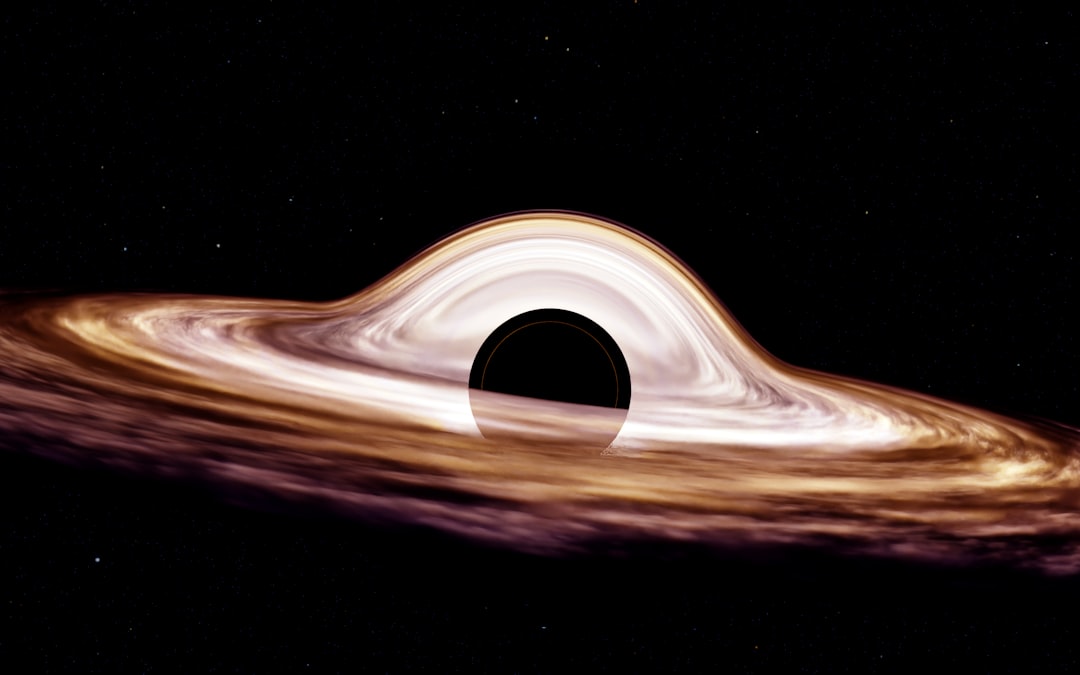
The cosmic fate of black holes has long captivated physicists and astronomers alike, presenting one of the most profound puzzles in modern astrophysics. While Einstein's general relativity suggests these gravitational titans exist eternally, quantum mechanics tells a radically different story—one where black holes can eventually evaporate and, remarkably, may even transform into something resembling their theoretical opposites: white holes. Recent groundbreaking research is reshaping our understanding of how these enigmatic objects evolve over cosmic timescales, with implications that could revolutionize our search for dark matter and exotic astronomical phenomena.
At the heart of this scientific revolution lies a fundamental tension between two pillars of modern physics. Classical general relativity depicts black holes as eternal prisons from which nothing, not even light, can escape once it crosses the infamous event horizon. However, when we incorporate the strange and probabilistic nature of quantum mechanics into our calculations, an entirely different picture emerges—one where black holes are dynamic, evolving entities with finite lifespans that may undergo dramatic transformations before their ultimate demise.
The Quantum Revolution in Black Hole Physics
The story of quantum black holes began in 1974 when renowned physicist Stephen Hawking made a startling discovery that would earn him lasting fame in the annals of science. Through meticulous theoretical calculations, Hawking demonstrated that quantum effects near the event horizon allow black holes to emit radiation—now known as Hawking radiation—through a process involving virtual particle pairs and quantum tunneling. This phenomenon occurs when quantum fluctuations near the event horizon create particle-antiparticle pairs, with one particle occasionally escaping while its partner falls into the black hole, resulting in a net loss of mass.
Hawking's original calculations yielded a deceptively simple formula for black hole lifetime: approximately 2 × 1067 M³ years, where M represents the black hole's mass in solar masses. To put this in perspective, a stellar-mass black hole weighing ten times our Sun's mass would require an incomprehensibly vast 2 × 1070 years to completely evaporate—far exceeding the current age of our Universe by a factor of 1060. For all practical purposes, typical astrophysical black holes discovered through gravitational wave observatories like LIGO are effectively immortal on cosmic timescales.
The Critical Limitation of Semi-Classical Approaches
However, Hawking's pioneering work contained an important caveat that physicists have grappled with for decades. His calculations relied on what's known as a semi-classical approximation—treating quantum effects as small perturbations on an otherwise classical spacetime geometry. This approach works admirably well for massive black holes, where quantum corrections remain negligible compared to the overwhelming gravitational effects. But as a black hole loses mass through Hawking radiation and shrinks, eventually reaching masses far below that of our Sun, this fundamental assumption breaks down catastrophically.
The breakdown becomes particularly significant when considering primordial black holes—hypothetical remnants from the early Universe that could have formed from density fluctuations in the first fractions of a second after the Big Bang. These exotic objects, if they exist, could have masses ranging from microscopic to planetary scales. Some theoretical models propose primordial black holes as compelling candidates for dark matter, the mysterious substance comprising approximately 85% of the Universe's matter content. Understanding their lifetimes and evolution becomes crucial not just for black hole physics, but for cosmology itself.
A New Framework for Black Hole Lifetimes
Enter a revolutionary new study that tackles this problem with mathematical rigor and physical insight. Published on the arXiv preprint server, researchers have developed a more robust framework for calculating the minimum lifetime of quantum black holes without relying on semi-classical approximations that break down at small masses. Their approach makes two key assumptions that elegantly sidestep some of the thorniest problems in quantum gravity while still yielding concrete predictions.
"By assuming that spacetime becomes asymptotically semi-classical far from the black hole, we can establish firm lower bounds on evaporation timescales without requiring a complete theory of quantum gravity," the research team explains in their groundbreaking paper.
The first assumption posits that spacetime is asymptotically semi-classical—meaning that regardless of how quantum-weird conditions become near the event horizon, classical physics reasserts itself at sufficient distances. This reasonable assumption allows physicists to maintain a connection to well-tested theories while exploring quantum extremes. The second assumption addresses the infamous black hole information paradox, suggesting that effects from quantum entanglement entropy gradually fade over time, providing a mechanism for information to escape the black hole's gravitational clutches.
The Surprisingly Elegant Result
What emerged from their calculations is a remarkably simple and beautiful formula: for a black hole with initial mass M, the minimum lifetime is at least M⁴/ℏ3/2, where ℏ represents the reduced Planck constant. This elegant mathematical expression provides a firm lower bound on how long any black hole must exist before completely evaporating, regardless of the specific details of quantum gravity theory. The simplicity of this result belies its profound implications for our understanding of quantum spacetime.
The research reveals that black hole evaporation proceeds through three distinct phases, each characterized by different physical processes. The first phase corresponds to standard Hawking radiation, where the semi-classical approximation remains valid and the black hole steadily loses mass through thermal emission. The second phase represents a transition period as quantum effects become increasingly important and the semi-classical description begins to fail. The third and final phase—the entanglement phase—requires a complete theory of quantum gravity to fully describe, which is why the researchers can only establish minimum rather than maximum lifetimes.
The White Hole Connection: A Cosmic Metamorphosis
Perhaps the most tantalizing implication of this research involves the possibility that small black holes could undergo a dramatic transformation into objects resembling white holes—theoretical time-reversed versions of black holes that expel rather than consume matter and energy. While white holes emerge naturally from the mathematical equations of general relativity, they've long been dismissed as purely theoretical constructs with no basis in physical reality. This new work suggests we may need to reconsider that dismissal.
According to the researchers' calculations, depending on the ultimate nature of quantum gravity, black holes could enter a metastable phase during their evolution where the redshift factor of their radiation becomes negative. In practical terms, this would make the object appear to push material away rather than attract it—precisely the defining characteristic of a white hole. For primordial black holes formed in the early Universe, this transformation could occur after approximately one billion years of standard Hawking radiation.
Observational Implications and the Hunt for White Holes
This theoretical possibility opens exciting new avenues for observational astronomy. If primordial black holes underwent this transformation in the early Universe, some fraction of them might exist today as white hole-like objects, potentially detectable through their unique emission signatures. These objects would represent a completely new class of astronomical phenomena, bridging the gap between black holes and their theoretical time-reversed counterparts.
- Distinctive Emission Signatures: White hole-like objects would exhibit unusual spectral characteristics, potentially appearing as sources that emit rather than absorb surrounding matter and radiation
- Dark Matter Implications: If primordial black holes constitute a significant fraction of dark matter, their transformation into white hole-like states could explain certain observational anomalies in galactic dynamics
- Gravitational Wave Signals: The transition phase between black hole and white hole states might produce distinctive gravitational wave signatures detectable by next-generation observatories
- Cosmic Ray Anomalies: White hole-like objects could contribute to unexplained features in the cosmic ray spectrum through their unique emission mechanisms
The Path Forward: Quantum Gravity and Observational Tests
Despite these exciting possibilities, significant uncertainties remain. The ultimate fate of evaporating black holes and the reality of white hole-like transformations depend critically on the correct theory of quantum gravity—a framework that successfully merges general relativity with quantum mechanics. Multiple approaches exist, from string theory to loop quantum gravity, each with different predictions for black hole behavior at quantum scales.
Current observational campaigns have yet to identify any confirmed white hole candidates, but this new theoretical work provides crucial guidance for future searches. Astronomers can now focus on specific observational signatures and energy ranges where these exotic objects might reveal themselves. The James Webb Space Telescope and upcoming missions like the Nancy Grace Roman Space Telescope possess the sensitivity to detect unusual emission sources that might represent white hole-like objects, should they exist.
Implications for Fundamental Physics
Beyond the immediate astronomical applications, this research touches on some of the deepest questions in theoretical physics. The black hole information paradox—the question of what happens to information that falls into a black hole—has vexed physicists since Hawking's original work. If black holes can transform into white holes or similar objects, this might provide a mechanism for information to eventually escape, preserving the fundamental quantum mechanical principle of information conservation.
The minimum lifetime calculations also have implications for our understanding of spacetime structure at the smallest scales. The fact that such a simple formula emerges from complex quantum considerations suggests deep underlying symmetries in nature that we're only beginning to appreciate. As physicists continue developing quantum gravity theories, constraints like these minimum lifetimes provide crucial experimental touchstones for testing theoretical predictions.
Conclusion: A New Era in Black Hole Physics
The revelation that black holes might not live forever—and could even transform into white hole-like objects—represents a paradigm shift in our understanding of these cosmic enigmas. While Hawking's original work established that quantum effects allow black holes to evaporate, this new research provides a more complete picture of that process, including minimum lifetime bounds and the possibility of exotic final states.
As observational astronomy continues advancing with increasingly powerful instruments, the search for white hole-like objects becomes more than just theoretical speculation—it becomes a concrete observational program with potentially revolutionary implications. Whether or not we ultimately discover these exotic objects, the journey toward understanding quantum black holes continues to push the boundaries of human knowledge, bridging the gap between the cosmic and quantum realms in ways Einstein could never have imagined.
The Universe, it seems, still has surprises in store for us, hidden in the quantum behavior of its most extreme objects. Until we develop a complete theory of quantum gravity and conduct systematic searches for white hole signatures, we cannot definitively rule out these remarkable possibilities. The next chapter in black hole physics is just beginning, and it promises to be as revolutionary as anything that came before.