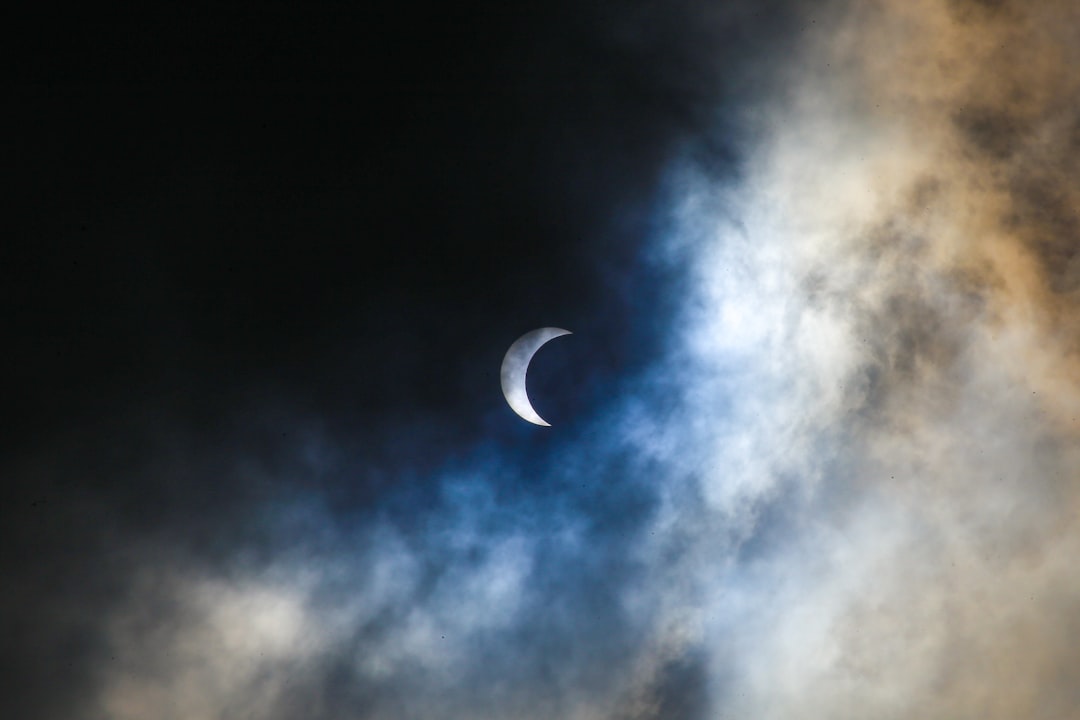
The April 2024 total solar eclipse provided more than just a spectacular celestial show—it offered scientists an unprecedented opportunity to unlock secrets of our Sun's mysterious outer atmosphere. A groundbreaking study from the University of Hawai'i Institute for Astronomy has successfully bridged the gap between ground-based eclipse observations and space-based solar monitoring, revealing how turbulent structures born deep within the solar corona can survive their journey across millions of miles of space, fundamentally influencing space weather throughout the inner solar system.
This research represents a significant milestone in solar physics, demonstrating for the first time that the violent, churning vortices that form in the Sun's corona don't simply dissipate as previously thought. Instead, these plasma instabilities maintain their coherence as they race outward, carrying energy and magnetic fields that can impact Earth's magnetosphere, satellite operations, and even power grids on our planet's surface.
The study, published in The Astrophysical Journal, combines decades of high-resolution eclipse photography with cutting-edge observations from NASA's Parker Solar Probe, creating an unprecedented chronicle of how energy transfers from the Sun's surface to the far reaches of the heliosphere. This work addresses one of the most perplexing questions in astrophysics: how does the Sun's influence extend so far into space, and what mechanisms drive the dynamic space weather that affects our technological civilization?
The Coronal Heating Paradox and Eclipse Science
At the heart of this research lies one of solar physics' greatest mysteries: the coronal heating problem. The Sun's visible surface, the photosphere, reaches temperatures of approximately 10,000 degrees Fahrenheit—hot enough to vaporize any known material. Yet paradoxically, the corona, the Sun's outer atmosphere extending millions of miles into space, blazes at a staggering 2 million degrees Fahrenheit or more. This violates our everyday experience that temperatures should decrease as you move away from a heat source.
"The science was triggered by the fact that plasma instabilities in general and turbulence in particular are likely to contribute to coronal heating and solar wind acceleration," explains Dr. Shadia Habbal, lead researcher at the Institute for Astronomy. "There were no observations of turbulence in the inner corona at the locus of the origination of the solar wind. Our work is based on total solar eclipse observations in white light."
Total solar eclipses provide a unique window into this phenomenon. During the brief moments of totality, when the Moon completely blocks the Sun's brilliant photosphere, the corona becomes visible to the naked eye—a pearly white halo extending far into space. While the corona is actually about twice as bright as a full Moon and capable of casting shadows during an eclipse, it's normally overwhelmed by the Sun's surface brightness, making eclipses invaluable for coronal research.
Tracking Vortex Rings Through the Inner Solar System
The research team focused on the prominence-corona transition region (PCTR), a poorly understood boundary where cool, dense solar prominences interact with the superhot coronal plasma. These prominences—vast clouds of relatively cool material suspended in the corona by magnetic fields—can be millions of degrees cooler than their surroundings, creating steep temperature gradients that spawn violent instabilities.
Using advanced image processing techniques pioneered by the late astrophotographer Miloslav Druckmüller, the team analyzed high-definition eclipse images spanning multiple decades. These images revealed something unexpected: vortex rings forming in the PCTR that exhibited remarkable longevity and coherence as they expanded outward into space.
"We had found in 2014 that there was a preponderance of plasma instabilities in different 'incarnations' originating from the immediate vicinity of prominences, which are the coolest and most dynamic structures in the corona," says Habbal. "When PSP/WISPR reported on what they called magnetic bubbles forming in-situ, I decided to show how what they observed were nothing other than the expansion of vortex rings, Kelvin-Helmholtz instabilities and Coronal Mass Ejections."
These vortex rings, similar in principle to smoke rings but composed of million-degree plasma and threaded with magnetic fields, represent Kelvin-Helmholtz instabilities—a phenomenon that occurs when two fluids moving at different speeds create shear forces. On Earth, these instabilities produce the distinctive wave patterns seen in clouds; in the solar corona, they create writhing, evolving structures that carry energy and momentum far from the Sun.
Bridging Ground and Space-Based Observations
The breakthrough came from combining eclipse observations with data from the WISPR (Wide-field Imager for Parker Solar Probe) instrument aboard NASA's Parker Solar Probe. Launched in 2018, Parker Solar Probe follows an elliptical orbit that brings it closer to the Sun than any previous spacecraft, providing an oblique viewing angle of structures streaming outward from the corona.
By correlating the evolution of structures seen during eclipses with those observed by WISPR farther from the Sun, the team created the first comprehensive tracking of these plasma instabilities from their birth in the inner corona to their journey through the inner heliosphere. The data revealed that these structures maintain their identity across vast distances, contradicting earlier assumptions that they would quickly dissipate.
Multi-Decade Eclipse Campaign
"We have been acquiring total solar eclipse observations since 1995," Habbal notes. "Our observations are all taken from the ground. At times when we were clouded out, we complemented our series of observations in white light only with images obtained by amateurs." This dedication has created an invaluable archive spanning nearly three decades of solar activity, capturing the Sun through different phases of its 11-year activity cycle.
The research methodology demonstrates the continuing scientific value of eclipse observations in the era of space-based solar observatories. While spacecraft like the Solar Dynamics Observatory provide continuous monitoring, eclipse observations offer unique advantages: high spatial resolution, the ability to observe the corona in natural white light, and coverage extending far into the outer corona where spacecraft instruments lose sensitivity.
Implications for Space Weather Prediction
Understanding how turbulent structures form and evolve in the solar corona has profound implications for space weather forecasting. These plasma instabilities don't just carry energy—they transport magnetic fields, accelerate particles, and can trigger or modulate larger eruptions like coronal mass ejections (CMEs). When these structures reach Earth, they can:
- Disrupt satellite operations: High-energy particles accelerated by coronal instabilities can damage sensitive electronics and solar panels on spacecraft
- Interfere with communications: Turbulent plasma structures affect radio wave propagation, impacting GPS accuracy and high-frequency communications
- Threaten power infrastructure: Rapid magnetic field changes can induce currents in long-distance power lines, potentially causing transformer damage or grid failures
- Pose radiation hazards: Astronauts and high-altitude aircraft passengers face increased radiation exposure during major space weather events
- Create spectacular auroras: On the positive side, these structures energize Earth's magnetosphere, producing beautiful auroral displays at high latitudes
By tracking how these structures evolve from the inner corona outward, scientists can improve models predicting when and how solar activity will affect Earth. This is increasingly critical as our technological civilization becomes more dependent on space-based infrastructure and vulnerable electronic systems.
Next-Generation Solar Observation Missions
The research comes at an opportune time, as several new missions are revolutionizing our ability to study the solar corona. The PUNCH (Polarimeter to Unify the Corona and Heliosphere) mission, launched in 2025, consists of four microsatellites that will create 3D maps of the corona and inner heliosphere, tracking structures as they evolve and propagate outward.
The European Space Agency's PROBA-3 mission, launched in 2024, takes a novel approach: two spacecraft flying in precise formation create an artificial eclipse, with one spacecraft casting a shadow on the other's coronagraph. This allows continuous observation of the inner corona without waiting for natural eclipses, though ground-based eclipse observations still offer superior spatial resolution and spectral coverage.
These missions, combined with continuing observations from Parker Solar Probe and the Solar Orbiter spacecraft, promise to transform our understanding of solar dynamics. The science has advanced to the point where researchers can now predict with remarkable accuracy how the corona will appear during upcoming eclipses, based on current solar activity and magnetic field configurations.
The August 2025 Eclipse: Another Scientific Opportunity
The next opportunity to observe the solar corona during totality arrives on August 12, 2025, when the Moon's shadow will sweep across Greenland, Iceland, the northern Atlantic Ocean, and Spain. For researchers like Habbal and her team, this represents another chance to capture high-resolution coronal images and continue their multi-decade study of solar activity.
"We try not to miss any eclipses," Habbal emphasizes. "These rare opportunities are always scientific gold mines." Each eclipse provides a snapshot of the Sun's corona at a specific moment in the solar cycle, and comparing observations across multiple eclipses reveals how coronal structure and dynamics change with solar activity levels.
The 2025 eclipse will occur during a period of high solar activity, as the Sun approaches the maximum of Solar Cycle 25. This timing should provide excellent opportunities to observe active regions, prominences, and the dynamic structures that this research has shown can survive far into the heliosphere.
Historical Context and Future Directions
Solar prominences have fascinated observers for centuries. The earliest written description appears in the Laurentian Codex, documenting the May 1, 1185 total solar eclipse, though eclipse watchers likely noticed these features much earlier. For most of human history, these observations remained purely descriptive. Only in the last century have scientists begun to understand the physical processes driving coronal phenomena.
This latest research represents a significant step forward in that understanding. By demonstrating that turbulent structures can maintain coherence across vast distances, the study challenges previous models of how the corona transfers energy to the solar wind and heliosphere. Future work will focus on:
- Determining what factors allow some structures to survive while others dissipate
- Understanding how these instabilities contribute to coronal heating and solar wind acceleration
- Developing predictive models that can forecast space weather based on coronal observations
- Exploring connections between small-scale turbulence and large-scale eruptions like CMEs
As our technological society becomes increasingly vulnerable to space weather effects, this fundamental research takes on practical importance. Understanding the Sun's behavior isn't just an academic exercise—it's essential for protecting critical infrastructure and ensuring the safety of astronauts and space-based systems that modern civilization depends upon.
The combination of dedicated eclipse observations, advanced space missions, and sophisticated analysis techniques is finally allowing scientists to piece together the complex puzzle of solar activity. Each eclipse, each spacecraft observation, and each new analysis adds another piece to our understanding of the dynamic star that makes life on Earth possible—and occasionally threatens the technology that life has created.