Hubble Solves a Mystery About the Milky Way's Early Years
It is a well-established scientific consensus that our galaxy, the Milky Way, grew to its current magnificent size through a long, violent history of consuming smaller galaxies — a process known as hierarchical galaxy formation. Some of those mergers are still actively unfolding today, including the ongoing absorption of the Canis Major Dwarf Galaxy, currently considered the nearest galactic neighbor to our own. Yet for decades, the deepest chapters of this merger history remained frustratingly out of reach. Now, groundbreaking new data from NASA's Hubble Space Telescope have delivered definitive evidence that a previously uncharacterized dwarf galaxy merged with the Milky Way during its earliest phases of evolution — pushing our understanding of galactic archaeology back to a time when the universe itself was still in its infancy.
An International Effort to Read the Galaxy's Oldest Fingerprints
The research was led by astronomers from the Osservatorio di Astrofisica e Scienza dello Spazio di Bologna (OAS), one of Italy's premier astrophysical research institutions. They were joined by an impressive international consortium of collaborators, including researchers from the Kapteyn Astronomical Institute, the Italian National Institute for Astrophysics (INAF), the Escola de Enxeñaría de Telecomunicación, the Instituto de Astrofísica de Canarias (IAC), Edinburgh University's Astrophysics Research Institute, the Space Telescope Science Institute (STScI), and multiple universities and observatories across Europe and North America. The results are reported in a landmark paper published in the prestigious journal Nature Astronomy.
Building a Galaxy, Brick by Brick
Today, the Milky Way measures approximately 200,000 light-years in diameter and is home to an estimated 200 billion stars. But this vast cosmic structure was not always so grand. Over billions of years, our galaxy grew through two complementary processes: the internal formation of new stars from collapsing clouds of dust and gas — predominantly within its sweeping spiral arms — and the external acquisition of stellar populations through mergers with other galaxies.
These galactic mergers are far more than simple additions of star counts. When galaxies collide, their immense gravitational forces compress interstellar gas clouds, triggering intense bursts of star formation that can dramatically reshape a galaxy's structure. The most recent significant merger in our galaxy's history — between the Milky Way and the Sagittarius Dwarf Galaxy — began over 6 billion years ago and continues to this day, with Sagittarius slowly being torn apart and its stars incorporated into the Milky Way's halo and disk.
"Our home is the Milky Way galaxy, but we do not know how our house was built. In this paper we discover where the first significant batch of bricks came from: a dwarf galaxy that we call LKH." — Davide Massari, First Researcher, OAS di Bologna
The Power of Globular Clusters as Cosmic Time Capsules
Scientists have made enormous strides in reconstructing the Milky Way's merger history thanks to transformative astronomical surveys, most notably the ESA's Gaia mission, which has mapped the positions and motions of nearly two billion stars with extraordinary precision. Yet the farther back in time scientists attempt to look, the more challenging and ambiguous the evidence becomes. The signatures of ancient mergers — characteristic streams of stars, disrupted orbits, chemical anomalies — can be eroded and obscured over billions of years of subsequent galactic evolution.
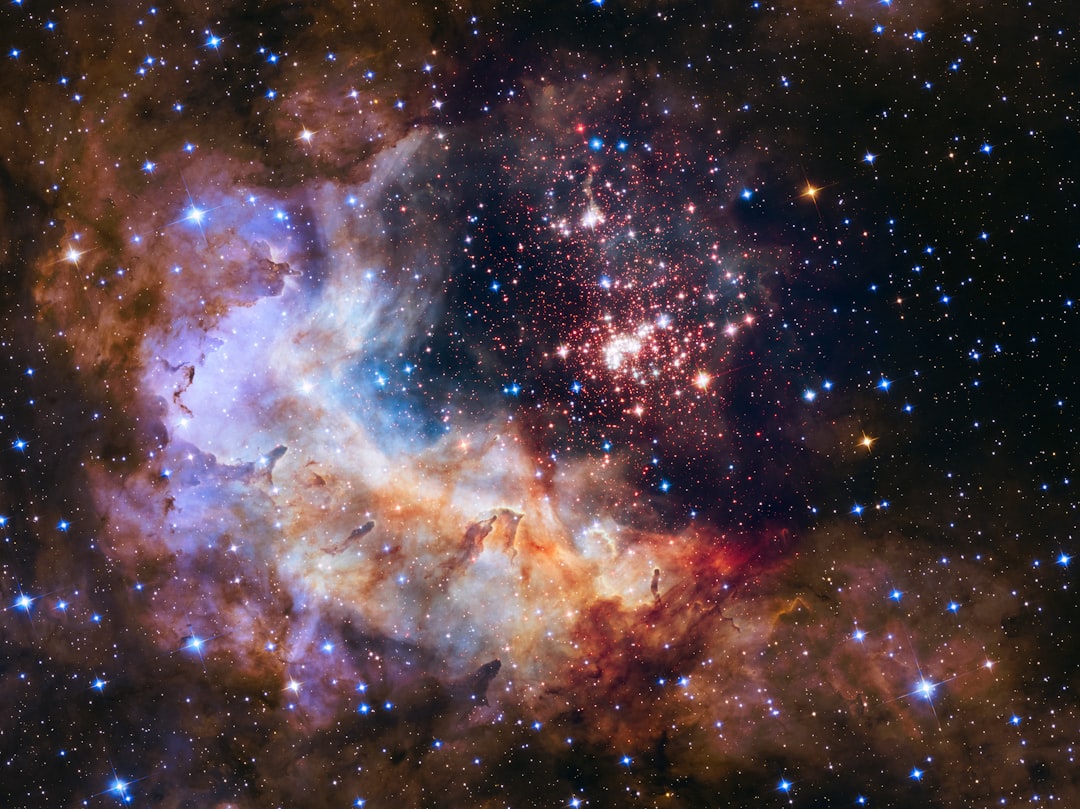
This is where globular clusters become invaluable. These ancient, densely packed spherical collections of stars — some containing hundreds of thousands of stars gravitationally bound together — are among the oldest surviving structures in the universe. Crucially, they preserve the chemical and age signatures of their birth environments with remarkable fidelity. Stars formed within a merging dwarf galaxy will carry distinct metallicity signatures (the abundance of elements heavier than hydrogen and helium) that differ from stars born within the Milky Way itself. By reading these cosmic fingerprints, astronomers can effectively reconstruct the galaxy's ancient merger history.
The team leveraged Hubble's unparalleled resolution and sensitivity to examine 39 globular clusters located approximately 20,000 light-years from the Galactic center — a region where evidence of the most ancient mergers is most likely to have been preserved, shielded from the most turbulent dynamics of the outer halo.
Discovering the Gaia-Sausage-Enceladus Merger — and Looking Beyond It
In recent years, astronomers identified one of the most significant events in the Milky Way's history: the merger with the Gaia-Sausage-Enceladus dwarf galaxy, which occurred approximately 10 billion years ago. This ancient collision left deep imprints on the structure of the Milky Way's stellar halo and inner disk, and is now recognized as a defining event in our galaxy's adolescence. Stars and globular clusters accreted during this merger display characteristic chemical and kinematic signatures that distinguish them from those born within the Milky Way.
But could there be an even earlier, more primordial merger hiding in the data? To answer this question, the research team applied Hubble's precision measurements to determine the precise age and heavy-element abundance of each of the 39 globular clusters in their sample. The results were striking: they identified a third distinct population of globular clusters in the inner regions of the galaxy — clusters that are older than those associated with the Gaia-Sausage-Enceladus merger, yet younger than the most ancient clusters formed within the primordial Milky Way itself.
This intermediate population pointed unmistakably to a separate, earlier merger event — one in which the Milky Way absorbed a dwarf galaxy with a stellar mass of approximately 500 million solar masses, a substantial fraction of the Milky Way's total mass at that early epoch in cosmic history.
Introducing LKH: The Milky Way's Earliest Known Merger Partner
The research team named this newly characterized dwarf galaxy Low-energy-Kraken-Heracles (LKH), a designation that pays homage to three earlier independent research efforts that had each separately suggested evidence for a major merger event deep in the Milky Way's past. The name represents a unification of those earlier theoretical threads, now confirmed by direct observational evidence.
The key to distinguishing LKH's globular clusters from the broader population lay in the extraordinary precision of Hubble's photometric capabilities. Said Chiara Zerbinati, a PhD candidate at the University of Bologna and a co-author on the study:
"Thanks to the high resolution and depth of Hubble imaging, we could measure the age and the metal content of these clusters with unprecedented precision. Coupled with measurements from Gaia, this made it possible to distinguish a population of globular clusters that are different from the others. These are the clusters that were born in LKH, and they tell us when that galaxy was devoured by ours, and how massive it was."
The synergy between Hubble's deep imaging capabilities and Gaia's precise astrometric measurements proved to be a particularly powerful combination. Where Gaia excels at measuring stellar motions across the sky, Hubble provides the depth and resolution needed to resolve individual stars in densely crowded globular clusters and measure subtle color differences that correspond to age and chemical composition differences.
Rewinding the Clock to 11.8 Billion Years Ago
The implications of this discovery are profound. These latest observations effectively extend our knowledge of the Milky Way's merger history to 11.8 billion years ago — just 2 billion years after the Big Bang — making LKH the earliest known significant merger event in our galaxy's documented history. At that extraordinary epoch, the universe was barely out of its cosmic "dark ages," and large-scale galactic structures were only just beginning to assemble from the primordial web of dark matter and gas.
The existence of a large, early merger of this magnitude has significant implications for our understanding of the Milky Way's formation and evolution. It challenges earlier theoretical models that treated the Milky Way's early stellar populations as purely internally formed, and underscores the importance of external accretion events even in the galaxy's very first chapters.
- The LKH merger occurred approximately 11.8 billion years ago, just 2 billion years after the Big Bang.
- LKH had an estimated stellar mass of ~500 million solar masses — substantial relative to the early Milky Way.
- Evidence was preserved in a third population of globular clusters with distinct ages and metallicities.
- The discovery extends the Milky Way's documented merger history by billions of years beyond the Gaia-Sausage-Enceladus event.
- The findings challenge models that assumed early Milky Way stars were formed exclusively within the galaxy itself.
"Some past studies have argued that the earliest phases of our galaxy's evolution were defined by stars born only in our galaxy. Here, we have shown that stars born in external galaxies also need to be considered." — Davide Massari, lead author
Rewriting the Recipe for Building a Spiral Galaxy
Beyond the specifics of LKH itself, this discovery contributes to a broader shift in how astronomers understand spiral galaxy formation. The classical picture of a galaxy like the Milky Way forming primarily through gradual internal star formation is being progressively replaced by a more dynamic, merger-driven narrative. In this revised view, even the inner regions of a mature, settled galaxy like ours bear the indelible imprints of ancient, violent collisions — a cosmic palimpsest written in the ages and chemical compositions of globular clusters billions of years old.
This finding also has implications for the study of dark matter and early universe structure formation. Dwarf galaxies like LKH are thought to inhabit relatively small dark matter halos, and their accretion onto larger galaxies is a key prediction of the standard Lambda Cold Dark Matter (ΛCDM) cosmological model. Confirming that such mergers occurred as early and as significantly as the LKH event suggests that hierarchical structure formation was already operating efficiently within the first two billion years of cosmic history.
The Road Ahead: Mapping All of the Milky Way's Ancient Collisions
The team has no intention of stopping with LKH. Their broader goal is to characterize all the significant merger events that shaped the Milky Way throughout its history — building a comprehensive galactic merger tree from the earliest epochs to the present day. This will require continued observations of globular clusters across the galaxy, many of which have never been studied in detail.
Fernando Aguado-Agelet, a co-author and researcher from the University of Vigo and the University of La Laguna in Spain, expressed optimism about what lies ahead:
"Hubble is observing globular clusters that have never been studied before, and this will help us characterize the merger events that are far back in time in the Milky Way galaxy's history."
Looking further into the future, the Nancy Grace Roman Space Telescope and the European Southern Observatory's Extremely Large Telescope (ELT) promise to push these investigations even deeper, potentially uncovering merger events from the universe's very first billion years. Combined with continued Gaia data releases and advances in stellar age-dating techniques, the next decade may finally allow astronomers to assemble a complete, detailed portrait of how our home galaxy was built — collision by ancient collision — from the raw material of the early universe.