JWST May Be Missing Water Hidden Deep Within Mini-Neptune Worlds
Sub-Neptune exoplanets — those rocky, gaseous worlds slightly smaller than our solar system's ice giant — have quietly risen to astronomical prominence over the past two decades. Now officially recognized as the most common type of planet in the Milky Way Galaxy, sub-Neptunes account for nearly 3,300 of the more than 6,300 confirmed exoplanets discovered to date. Yet despite their sheer abundance, these mysterious worlds remain among the least understood objects in planetary science — and a compelling new study suggests we may have been fundamentally misreading them all along.
A research team from the United States and Canada, led by scientists at the University of Chicago (UChicago), has published findings in The Astrophysical Journal suggesting that sub-Neptunes may be harboring far more water than their observable atmospheres reveal — water that could be effectively hidden from even the most powerful space telescopes currently in operation, including NASA's James Webb Space Telescope (JWST).
The Sub-Neptune Paradox: Common Yet Deeply Mysterious
One of the central frustrations of modern exoplanet science is what researchers sometimes call the "sub-Neptune paradox." These planets are extraordinarily common throughout the galaxy, yet we have no analog for them within our own solar system. The planets of our cosmic neighborhood leap from rocky super-Earths to ice giants like Uranus and Neptune, leaving a gap precisely where sub-Neptunes would reside. This absence makes comparative planetology — the practice of using known worlds to interpret unknown ones — exceedingly difficult.
Compounding this challenge is the nature of sub-Neptune atmospheres themselves. These worlds are enveloped in thick, chemically complex, and often hazy atmospheric layers that scatter and absorb incoming and outgoing light in ways that confound spectroscopic analysis. Even JWST, which represents the most advanced space observatory ever launched, struggles to peer through these atmospheric curtains to discern what lies beneath. The result is a class of planets defined more by what we don't know than by what we do.
"It's very possible these planets are hiding much more water than their atmospheres let on. It's an interesting question, both because water is so important for life as we know it, and because it signals we have to interpret the data coming in from new, powerful telescopes in a more nuanced way to really know what's going on." — Dr. Caroline Piaulet-Ghorayeb, Postdoctoral Researcher, University of Chicago, and Lead Author of the Study
TOI-270 d: A Sub-Neptune Under the Microscope
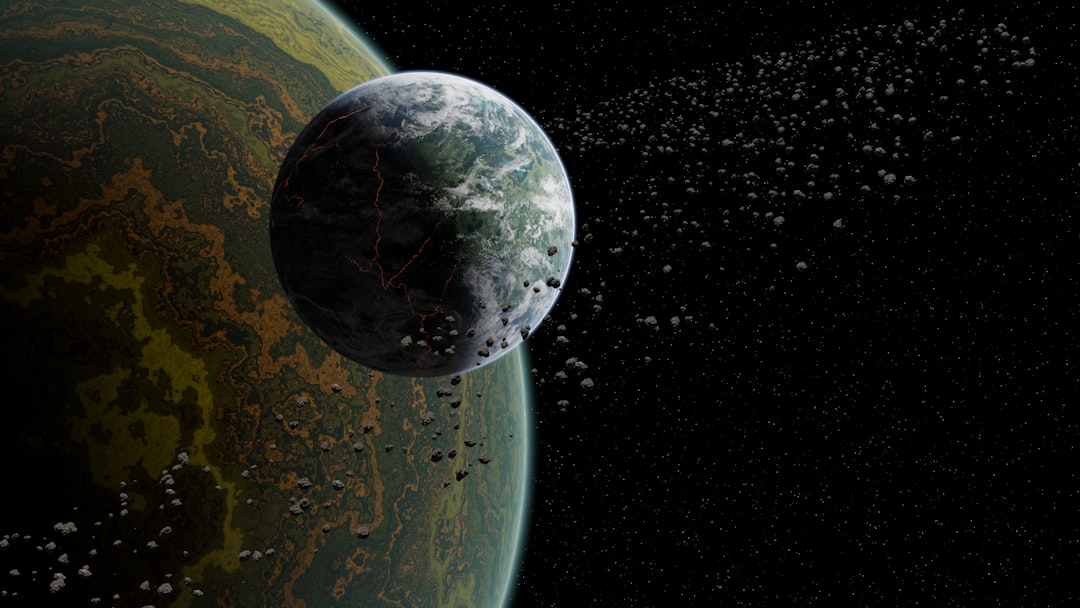
To probe these questions, the research team focused their computational investigation on TOI-270 d, a well-characterized sub-Neptune that has become something of a benchmark world for atmospheric studies. Discovered in 2019 and located approximately 73 light-years from Earth in the constellation Pictor, TOI-270 d occupies a privileged position in the exoplanet catalog: it is close enough to study in detail, yet exotic enough to challenge our theoretical frameworks.
Physically, TOI-270 d is a genuinely alien world. Its radius is approximately twice that of Earth, while its mass clocks in at roughly 4.2 times Earth's mass — placing it firmly in the sub-Neptune category. It completes a full orbit of its host star in just 11.4 days, circling a red dwarf star that is both smaller and cooler than our own Sun. Alongside its planetary siblings, TOI-270 b and TOI-270 c, it orbits within the interior of the star's habitable zone — the theoretical region where liquid water could potentially exist on a planetary surface under the right conditions. You can explore NASA's archive of confirmed exoplanet data at the NASA Exoplanet Archive.
What JWST Has Already Revealed
Prior observations of TOI-270 d by JWST had already yielded tantalizing clues about this world's atmospheric chemistry. The space telescope identified the signatures of carbon dioxide (CO₂), methane (CH₄), and hydrogen (H₂) within the planet's atmosphere. This particular chemical trio is scientifically significant: the simultaneous presence of carbon dioxide, methane, and hydrogen in specific ratios strongly implies the existence of water (H₂O) as a chemical participant in the atmospheric system.
However, the critical question of water's physical state — whether it exists as solid ice, liquid water, or gaseous steam — remained unresolved. Equally unclear were the precise thermodynamic and chemical conditions under which water and hydrogen might mix homogeneously throughout the planet's interior, or conversely, separate into distinct layers. These are not merely academic questions; the layered or well-mixed nature of a planet's interior has profound implications for its geological activity, potential habitability, and long-term evolution. Learn more about NASA's James Webb Space Telescope and its ongoing contributions to exoplanet science.
The New Model: Water Sinking Beneath a Hydrogen Veil
Using a sophisticated suite of computer models designed to simulate both the atmospheric dynamics and interior composition of sub-Neptunes, the UChicago-led team arrived at a striking conclusion. Rather than being uniformly distributed throughout the planet's atmosphere and interior — as prevailing models had long assumed — water on TOI-270 d may be gravitationally sinking beneath the hydrogen-dominated upper atmosphere, effectively concealing itself from external observation.
The mechanism driving this separation is a nuanced interplay between two key variables: temperature and the water-to-hydrogen ratio. The researchers found that TOI-270 d appears to contain a larger proportion of water than hydrogen by mass — and when this water-rich mixture is subjected to the planet's relatively warm surface temperatures of approximately 537 degrees Celsius (1,000 degrees Fahrenheit), the thermodynamic balance tips decisively toward phase separation. The denser, heavier water sinks below the lighter hydrogen, forming a layered interior structure rather than the well-mixed one previously assumed.
This layering has a critical observational consequence: the hydrogen-rich upper atmosphere acts as an opaque veil, shielding the underlying water-dominated layers from spectroscopic detection by telescopes like JWST. In other words, even our most advanced instruments are effectively being deceived by the planet's own atmospheric architecture — reading only the top layer of a far more complex, water-rich structure below.
Key Findings of the Study at a Glance
- Water abundance: TOI-270 d likely contains significantly more water than its observable atmosphere suggests, potentially rivaling or exceeding its hydrogen content by mass.
- Phase separation: At temperatures around 537°C (1,000°F), water and hydrogen separate into distinct layers rather than mixing homogeneously.
- Observational blindspot: JWST and similar telescopes primarily sample the hydrogen-rich upper atmosphere, missing the deeper water-dominated interior layers entirely.
- Revised planetary models: The study challenges the long-standing "well-mixed interior" hypothesis for sub-Neptunes, proposing instead a layered, differentiated interior structure.
- Broader implications: If TOI-270 d is representative of the sub-Neptune class as a whole, the total water content of this planetary population across the galaxy may be dramatically underestimated.
Challenging a Longstanding Paradigm
The implications of this research extend well beyond a single planet. For decades, planetary scientists have operated under models that assumed sub-Neptune interiors were largely well-mixed — a relatively uniform blend of gases and ices that could be inferred from surface-level atmospheric readings. This assumption underpinned not only our understanding of planetary formation and evolution, but also our assessments of where and how water — and by extension, life — might exist beyond our solar system.
If the layered interior model proposed by the UChicago team holds up to further scrutiny, it would necessitate a fundamental revision of sub-Neptune planetary models. The water inventories of these worlds, which are the most common type of planet in the galaxy, could be far greater than current estimates suggest. This has profound consequences for questions of planetary habitability, since water is universally recognized as a critical prerequisite for life as we know it. It also demands a more cautious, multi-layered approach to interpreting telescope data — one that accounts for the possibility that what we see may represent only a fraction of what is actually there.
For deeper context on how planetary atmospheres are studied through transmission spectroscopy and related techniques, the HubbleSite Exoplanet Resource provides an excellent scientific foundation, as does the European Space Agency's Exoplanet Science Portal.
The Next Generation of Telescopes: Peering Even Deeper
Dr. Piaulet-Ghorayeb's reference to "new, powerful telescopes" interpreting data more nuancedly is particularly timely, as the coming decade promises a remarkable expansion in humanity's observational capabilities. Several next-generation facilities — both space-based and ground-based — are poised to transform our understanding of worlds like TOI-270 d.
Perhaps most anticipated is NASA's Nancy Grace Roman Space Telescope, currently scheduled for launch on August 30, 2026. Roman's wide-field infrared capabilities, combined with a sophisticated coronagraph instrument designed to block stellar light, will enable it to directly image exoplanets in ways that have previously been impossible for most worlds. This direct imaging capability could, in principle, allow scientists to probe the spatial distribution of atmospheric components across a planet's disk rather than relying solely on disk-integrated spectroscopy.
On the ground, the European Southern Observatory's Extremely Large Telescope (ELT) — currently under active construction in the Atacama Desert of northern Chile — represents an equally transformative leap forward. With its 39-meter primary mirror, the ELT will collect more light than any optical telescope in history, enabling high-resolution spectroscopic studies of exoplanet atmospheres that could distinguish between layered and well-mixed interior scenarios. Scientific operations are currently anticipated to begin around December 2030. More details on this ambitious project can be found at the ESO Extremely Large Telescope official website.
Together with JWST and a suite of other planned missions, these instruments will constitute an unprecedented armada of observational power aimed squarely at unraveling the secrets of sub-Neptunes and the water they may be concealing.
Looking Ahead: Water, Worlds, and the Search for Life
The study of TOI-270 d serves as a powerful reminder of how much complexity can lurk behind seemingly straightforward astronomical measurements. What JWST detects in the upper atmosphere of a sub-Neptune may be only the tip of an iceberg — or, more precisely, the top of a vast, hidden ocean of water-rich material. As our models grow more sophisticated and our telescopes more powerful, the picture of these extraordinarily common yet deeply enigmatic worlds will only grow richer and more detailed.
The broader scientific community now faces the exciting challenge of reassessing existing sub-Neptune observations through this new theoretical lens, asking whether other well-studied exoplanets in this class might also be concealing layered, water-rich interiors that have gone undetected. The answer to that question — and the implications it carries for planetary habitability across the galaxy — promises to be one of the defining scientific narratives of the coming decade in astronomy.
In the words of the researchers themselves, understanding these hidden oceans is important not just as an intellectual exercise, but because water is the cornerstone of life as we know it. Every drop we find — or fail to find — on these distant worlds shapes our understanding of whether life's prerequisites are rare gifts or cosmic commonplaces scattered throughout the galaxy in abundance.