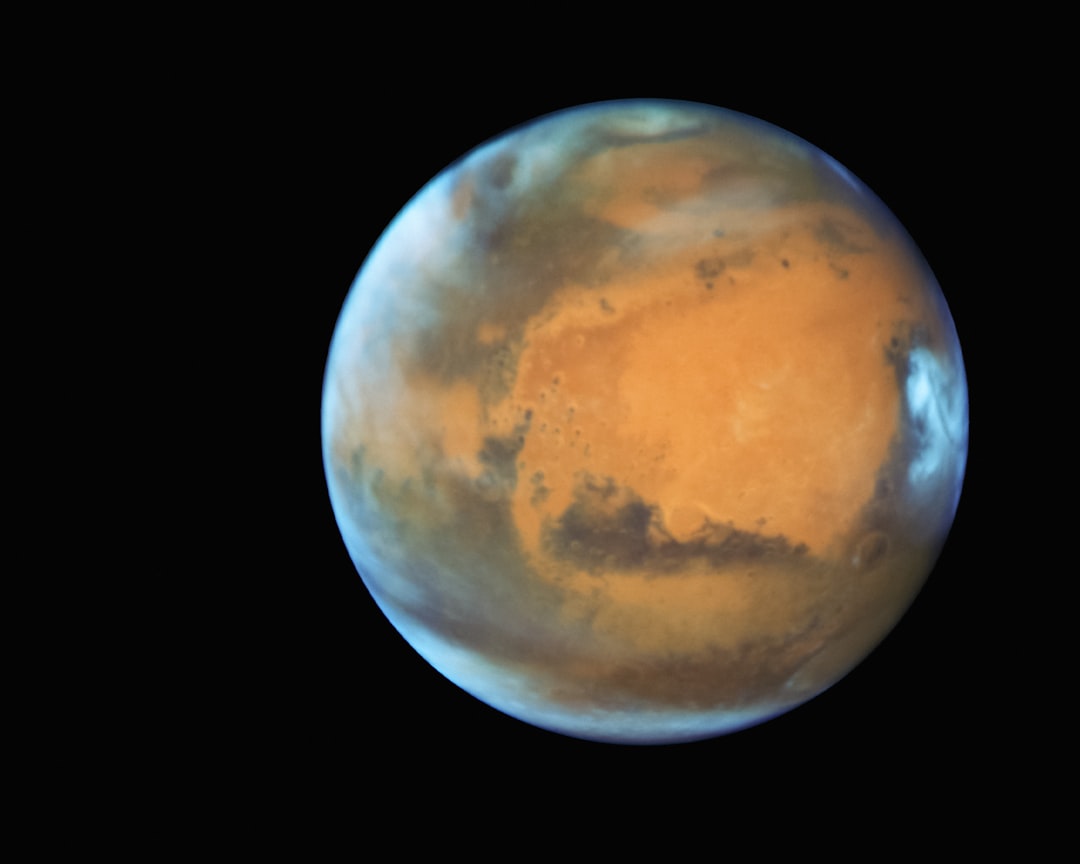
For more than two decades, the European Space Agency's Mars Express orbiter has been revolutionizing our understanding of the Red Planet's ancient history. Recent imagery from the spacecraft's High Resolution Stereo Camera (HRSC) has unveiled stunning new perspectives of Arabia Terra, one of Mars' most heavily cratered and scientifically significant regions. These remarkable images provide unprecedented insight into the planet's tumultuous past, revealing a landscape shaped by billions of years of cosmic bombardment, volcanic activity, and atmospheric erosion.
The newly released photographs showcase a remarkably preserved geological archive, offering scientists a window into Mars' formative years when the planet was still geologically active and possessed a protective magnetic field. According to researchers at the European Space Agency, these images were created using sophisticated data from the HRSC's digital terrain model combined with nadir and color channels, providing both topographical and compositional information about this ancient Martian landscape.
Arabia Terra: A Window into Mars' Ancient Past
Located in the planet's Southern Highlands, Arabia Terra represents one of the most extensively cratered terrains in our solar system. This vast plain serves as a geological time capsule, preserving evidence of events that occurred between 3.7 and 4.1 billion years ago during the Noachian period of Martian history. The region's exceptional age makes it contemporaneous with Earth's own Archean Eon, when life was first emerging in our planet's primordial oceans.
The extraordinary preservation of these impact craters tells a compelling story about Mars' geological evolution. During this ancient epoch, the planet's interior began cooling and solidifying, causing the dynamo effect that generated Mars' planetary magnetosphere to cease. This catastrophic loss of magnetic protection left the Martian atmosphere vulnerable to the relentless bombardment of solar wind, initiating the gradual atmospheric stripping process that continues to this day.
Crater Morphology and Preservation Mechanisms
The remarkable state of preservation observed in Arabia Terra's craters shares similarities with lunar crater preservation, though the mechanisms differ significantly. While the Moon's complete lack of atmosphere has kept its craters pristine, Mars' tenuous atmosphere—roughly 1% the density of Earth's—provides just enough protection from micrometeorite erosion while allowing larger impact features to remain largely intact over geological timescales.
Close examination of the imagery reveals fascinating variations in crater composition and fill material. Some craters contain dark volcanic deposits, while others are filled with lighter-colored sediments and distinctive rippling dune formations. This diversity suggests multiple depositional processes at work, including material ejected during the original impacts, sediments transported by Mars' powerful dust storms, and possibly even water-lain deposits from ancient Martian lakes or groundwater systems.
"The variety of materials we observe filling these ancient craters provides crucial evidence about the different geological and atmospheric processes that have shaped Mars over billions of years. Each crater tells its own unique story about the planet's environmental history."
Trouvelot Crater: A Case Study in Martian Geology
Among the featured craters, Trouvelot Crater stands out as a particularly intriguing example of Martian geological complexity. The crater's floor is covered with dark volcanic material, within which sits a prominent light-toned mound approximately 20 kilometers (12.5 miles) in length. This mound exhibits distinctive ridges and grooves that have captured the attention of planetary geologists studying Mars' aqueous history.
Adjacent to Trouvelot lies an older, more degraded impact basin whose western wall has completely collapsed, now buried beneath extensive deposits of dark rock. The fact that Trouvelot's well-defined rim cuts through this older structure provides clear evidence of the relative chronology of impact events, with Trouvelot representing a younger collision that occurred after the older basin had already undergone significant erosion and modification.
Barchan Dunes and Aeolian Processes on Mars
The dark material covering portions of these craters has been sculpted by Martian winds into characteristic barchan dunes—crescent-shaped formations that are among the most distinctive aeolian features in planetary geology. These dunes, which Mars Express has documented in numerous locations across the Northern Lowlands and the massive Tharsis volcanic province, provide valuable data about prevailing wind patterns and atmospheric circulation on ancient and modern Mars.
The composition of this dark material is particularly revealing. Spectroscopic analysis indicates it consists primarily of mafic rock—mineral-rich material similar to basalt that is strongly associated with volcanic activity on Earth. The presence of such material in impact craters suggests a complex interplay between impact processes and volcanism, with some material likely representing volcanic deposits that predated the impacts, while other portions may be impact-melted rock or ejecta that was subsequently redistributed by wind.
Key Observations from the Arabia Terra Imagery
- Crater Density: The exceptional concentration of impact craters confirms Arabia Terra's status as one of Mars' oldest preserved surfaces, dating to the planet's earliest geological period
- Material Diversity: The presence of both dark volcanic materials and light-toned sediments indicates multiple depositional episodes and varying geological processes
- Erosional Features: Collapsed crater walls and worn rims provide evidence of billions of years of wind-driven erosion and mass wasting
- Dune Formation: Extensive barchan dune fields demonstrate the ongoing influence of atmospheric processes in reshaping the Martian surface
- Stratigraphic Relationships: Cross-cutting relationships between craters like Trouvelot and older basins enable scientists to reconstruct the sequence of geological events
The Water Question: Hydrated Minerals and Ancient Aqueous Activity
Perhaps the most intriguing aspect of the light-toned mounds observed within Trouvelot and similar craters is their mineralogical composition. Spectroscopic data from Mars Express and other orbiters, including NASA's Mars Reconnaissance Orbiter, have detected hydrated minerals within these features—minerals that typically form in the presence of liquid water.
This discovery has sparked considerable scientific debate about the formation mechanisms of these enigmatic mounds. Several hypotheses have been proposed, each with different implications for Mars' hydrological history:
One possibility is that these mounds represent spring deposits formed when groundwater percolated upward through fractures in the crater floor, depositing minerals as the water evaporated. Alternatively, they could be remnants of sedimentary layers deposited in ancient crater lakes that once filled these basins during wetter periods of Martian history. A third hypothesis suggests they may be erosional remnants of more extensive sedimentary deposits that once covered the entire region.
The presence of ridges and grooves on these mounds adds another layer of complexity. These features could represent differential erosion of layered sediments, tectonic deformation, or even the influence of subsurface ice that has since sublimated away, leaving behind a distinctive textural signature.
Implications for Mars Exploration and Future Research
The detailed imagery provided by Mars Express continues to guide the selection of landing sites for future missions and helps prioritize targets for more detailed investigation. Arabia Terra has already been identified as a region of high scientific interest for potential future rover missions, particularly those focused on understanding Mars' ancient habitability and searching for biosignatures.
The combination of ancient age, diverse geological features, and evidence for past water activity makes this region an ideal location to search for preserved organic materials or other indicators of past microbial life. Future missions equipped with drilling capabilities could potentially access subsurface materials that have been protected from the harsh radiation environment at Mars' surface, where organic molecules would be better preserved.
As Mars Express continues its extended mission, now in its third decade of operation, it remains an invaluable asset for Martian science. The spacecraft's longevity and the accumulated wealth of data it has provided demonstrate the importance of long-term orbital reconnaissance in building our understanding of planetary geology and evolution. Each new image release adds another piece to the complex puzzle of Mars' geological history, bringing us closer to understanding how the Red Planet transformed from a potentially habitable world to the cold, dry desert we observe today.
The study of regions like Arabia Terra reminds us that planetary surfaces are not static landscapes but dynamic environments shaped by the interplay of impact processes, volcanism, tectonics, atmospheric circulation, and potentially hydrological activity over billions of years. As we continue to explore Mars through both orbital reconnaissance and surface missions, these ancient terrains will undoubtedly yield many more secrets about the planet's fascinating and complex history.