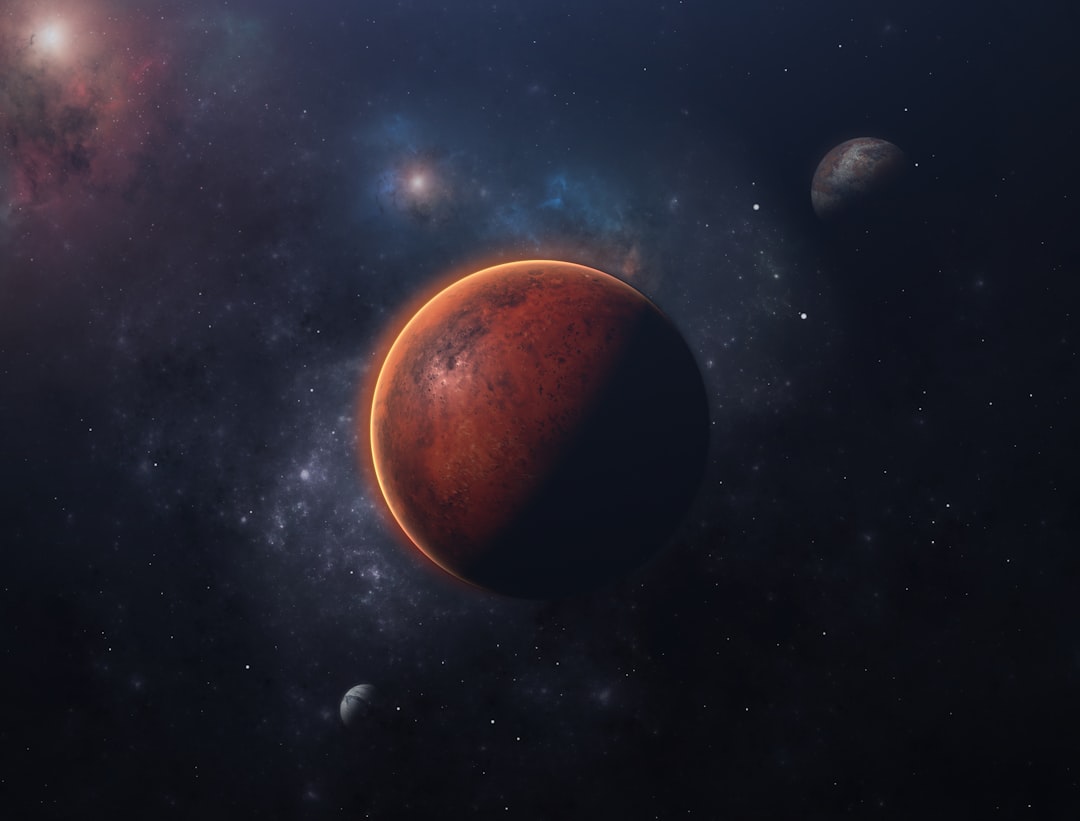
NASA's MAVEN Illuminates New Understanding of Auroras at Mars
NASA's Mars Atmosphere and Volatile Evolution (MAVEN) mission spent more than a decade orbiting the Red Planet, quietly revolutionizing our understanding of Martian atmospheric physics. Although contact with the orbiter was lost in December 2025 — and the mission was officially declared complete on June 3rd — the troves of data it collected continue to yield extraordinary scientific discoveries. Among the most captivating of these findings is a deeper understanding of Martian aurorae: shimmering curtains of light that dance above the Martian surface much as they do above Earth's polar regions, yet arise through a surprisingly intricate and fundamentally different set of conditions.
In a landmark study published on July 23rd in the journal Nature Communications, a team led by researchers from the University of California, Berkeley demonstrated that aurorae on Mars form through a process strikingly similar to that which generates the famous aurora borealis and aurora australis on Earth. Using data from several of MAVEN's onboard scientific instruments, they confirmed that the Dungey Cycle — the same electromagnetic mechanism that drives auroral activity on our own planet — also operates at Mars, albeit on a dramatically reduced, localized scale dictated by the unique nature of Mars' remnant magnetic fields.
Understanding the Dungey Cycle: The Engine Behind Auroras
To appreciate the significance of this discovery, it is essential to understand the Dungey Cycle itself. Named in honor of pioneering British space physicist James Dungey, who first described the process in 1961, the cycle elegantly explains how energy and plasma from the Sun are transferred into a planet's magnetosphere and ultimately into its upper atmosphere. Dungey's original insight — that magnetic field lines from the Sun and from Earth could "reconnect," allowing solar wind particles to penetrate and circulate through a planet's magnetic environment — was considered revolutionary at the time and remains a cornerstone of space plasma physics today.
In practice, the Dungey Cycle on Earth begins when the interplanetary magnetic field (IMF) carried by the solar wind approaches Earth's magnetosphere. Under the right conditions, solar magnetic field lines merge, or reconnect, with Earth's own field lines on the sunward side of the planet. This reconnection acts like a valve, opening a pathway for charged solar particles — primarily electrons and protons — to flow into Earth's magnetosphere. These particles are then carried by plasma flow around the planet toward the magnetotail, a long, comet-like extension of Earth's magnetic field stretching hundreds of thousands of kilometers into space on the night side of the planet. Here, a second reconnection event occurs, and the accelerated electrons are fired back toward Earth along magnetic field lines, funneled toward the polar regions, where they collide with atmospheric gases — primarily oxygen and nitrogen — to produce the spectacular light displays we know as auroras.
- Magnetic reconnection on the dayside allows solar wind energy to enter the magnetosphere.
- Plasma is transported through the magnetotail via large-scale circulation.
- A second reconnection event on the nightside accelerates electrons back toward the planet.
- Energized electrons collide with atmospheric atoms, producing auroral light emissions.
- The entire cycle continuously drives electrical currents and plasma circulation within the magnetosphere.
Mars: A Planet Without a Global Shield
The situation at Mars is profoundly different from Earth's. While Earth is protected by a robust, planet-wide magnetosphere generated by the churning of its liquid iron outer core — a process known as dynamo action — Mars lost its global magnetic field approximately 4 billion years ago. Geological evidence and planetary models suggest that the Martian core cooled and solidified far earlier in the planet's history, shutting down the dynamo that once sustained a global magnetic field. Without this protective shield, Mars became increasingly vulnerable to the relentless bombardment of the solar wind, which has steadily eroded much of the planet's once-thicker atmosphere over geological timescales — a process that MAVEN was specifically designed to study and quantify.
Yet Mars is not entirely magnetically inert. Ancient lava flows, which cooled in the presence of the planet's long-vanished global field, became permanently magnetized, locking the memory of that ancient field into the Martian crust. Today, these crustal magnetic fields create a patchwork of miniature magnetospheres scattered across the Martian surface, particularly concentrated in the heavily cratered southern highlands. These localized magnetic anomalies are far weaker and smaller than Earth's global magnetosphere — some spanning only a few hundred kilometers — but they are strong enough to interact meaningfully with the solar wind and the planet's ionosphere. MAVEN had previously observed highly localized auroras hovering above these crustal fields, but the precise physical mechanism driving their formation remained elusive — until now.
Mapping a Miniature Dungey Cycle
To reconstruct the full picture of what the research team has termed a "miniature Dungey-like cycle" at Mars, scientists drew upon measurements from three of MAVEN's specialized scientific instruments, each contributing a critical piece of the puzzle:
- Magnetometer (MAG): Precisely mapped the configuration and topology of Mars' crustal magnetic fields, identifying regions where reconnection events were likely occurring.
- Solar Wind Electron Analyzer (SWEA): Characterized the properties of electrons in the solar wind and ionosphere, allowing the team to identify populations of energized electrons associated with auroral processes.
- Suprathermal and Thermal Ion Composition (STATIC) instrument: Measured plasma flows within the Martian ionosphere, providing the crucial final piece of evidence needed to confirm that plasma was being circulated in a manner analogous to Earth's Dungey Cycle.
The combined data revealed a striking and coherent picture: magnetic reconnection events occurring at the boundaries of the crustal magnetic field regions were injecting solar wind electrons into the miniature magnetospheres, energizing them and channeling them downward into the Martian atmosphere to produce localized auroras. A corresponding return flow of ionospheric plasma completed the cycle, mirroring the large-scale circulation seen in Earth's global Dungey Cycle — but compressed into a tiny fraction of the spatial scale. The team's analysis also revealed a nested, double-loop structure of electric currents enveloping Mars from its dayside to its nightside, a finding with significant implications for our broader understanding of planetary electromagnetic environments.
"We knew that magnetic reconnection was happening at Mars but did not expect it to be like the Dungey cycle. We really pushed the limit of STATIC to get the data we needed. It was the final piece to the puzzle in understanding these localized auroras. I remember in graduate school discussing with my advisor how the cycling of crustal magnetic fields could work at Mars. It's incredible to be part of the team that found the answer to that question."
Implications for Space Weather and Future Missions to Mars
Beyond its intrinsic scientific elegance, this discovery carries significant practical implications. Space weather — the variable stream of energetic particles and electromagnetic radiation emanating from the Sun — poses one of the most formidable challenges to long-duration human spaceflight and robotic exploration beyond Earth's protective magnetosphere. Understanding precisely how space weather interacts with Mars' unusual magnetic environment is therefore critical to planning safe and successful missions to the Red Planet, both robotic and, eventually, crewed.
The crustal magnetic field regions that host these localized Dungey cycles could, in theory, offer partial refuge from solar energetic particle events — intense bursts of radiation associated with solar flares and coronal mass ejections that can be lethal to unshielded astronauts. Conversely, the aurora-generating reconnection events studied in this research also represent mechanisms by which atmospheric material can be lost to space, contributing to the long-term atmospheric evolution of Mars. As humanity looks toward eventual crewed missions to Mars — a goal pursued by both NASA's Moon to Mars program and private space enterprises — mapping and understanding these electromagnetic interactions becomes an indispensable prerequisite for ensuring crew safety and mission success.
Furthermore, the discovery that a Dungey-like cycle can operate not only at a global scale — as on Earth — but also at a highly localized, miniaturized scale at Mars opens up compelling new avenues of inquiry across the broader Solar System. Other bodies with localized or weak magnetic fields, such as Jupiter's moon Ganymede (the only moon in the Solar System known to possess its own magnetic field), certain asteroids, and even some exoplanets, may host analogous miniaturized electromagnetic cycles. This insight could fundamentally expand our framework for understanding how magnetic energy is transferred and dissipated in planetary environments across the cosmos.
"This is a remarkable result that changes how we think of Martian auroras and is another important step toward understanding why Mars and Earth have evolved so differently despite being governed by the same underlying physics. I am incredibly proud of our team's work on this discovery and excited to uncover new insights into the Red Planet and its evolution."
A Fitting Legacy for MAVEN
The MAVEN spacecraft, launched in November 2013 and arriving at Mars in September 2014, was always intended to be more than an orbiter — it was a dedicated atmospheric detective. Over the course of its operational lifetime, MAVEN answered fundamental questions about the rate of atmospheric loss at Mars, the role of solar storms in stripping away Martian atmosphere, and the history of liquid water on the planet's surface. Its discovery of several distinct types of Martian auroras — including discrete, diffuse, and proton auroras — reshaped scientific understanding of what these phenomena look like on an unmagnetized world. This final contribution, elucidating the miniature Dungey cycle, represents a crowning achievement: a discovery that ties together decades of space physics theory with observations at an entirely new class of planetary environment.
While MAVEN may have gone silent, its scientific voice continues to speak through the data it so diligently collected. As researchers continue to mine this archive of measurements, it seems certain that further discoveries await — each one deepening our appreciation of the dynamic, complex, and endlessly surprising relationship between the Sun, its magnetic field, and the planets it governs.
Key Takeaways
- The Dungey Cycle, long known to drive auroral activity on Earth, has now been confirmed to operate at Mars on a localized, miniaturized scale.
- Martian aurorae form above crustal magnetic field regions — remnants of an ancient global field that disappeared ~4 billion years ago.
- MAVEN's MAG, SWEA, and STATIC instruments provided the combined evidence necessary to confirm the miniature Dungey cycle.
- The finding has direct implications for space weather hazards facing future robotic and crewed missions to Mars.
- A Dungey-like mechanism operating at small scales suggests this process may occur on other bodies throughout the Solar System and beyond.
- Results were published in Nature Communications on July 23rd, led by Shaosui Xu of UC Berkeley.