Neutrons, Rotating Black Holes, and a Galactic PeVatron at the Center of the Milky Way
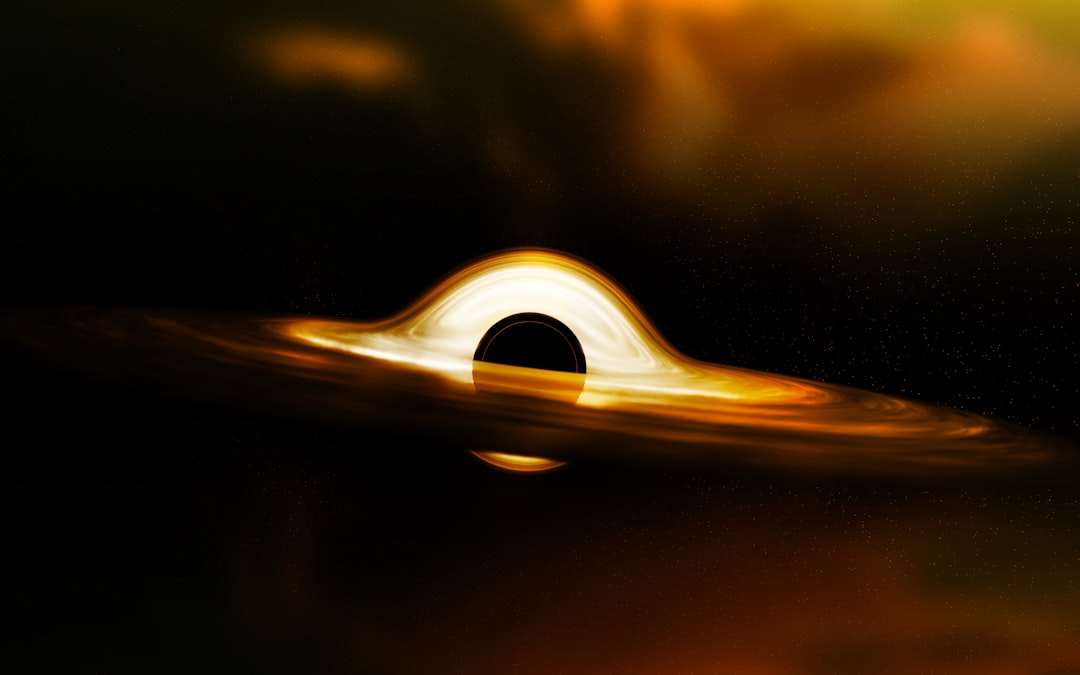
At the heart of our galaxy, roughly 26,000 light-years from Earth, lurks one of the most extraordinary objects in the known Universe: Sagittarius A* (Sgr A*), a supermassive black hole with a mass approximately four million times that of our Sun. Like all galactic centers harboring such giants, it is a place of almost incomprehensible violence — a crucible of superheated plasma, ferocious magnetic fields, and gravitational forces that warp the very fabric of spacetime. Now, a compelling new study suggests that this cosmic behemoth may be doing something even more remarkable than simply devouring matter. It may be acting as one of the most powerful natural particle accelerators in the galaxy, exploiting a quirk of rotating black hole physics first theorized over half a century ago.
Galactic black holes are, in a sense, the cosmic equivalent of mitochondria — the powerhouses of the Universe. The vast majority of the energy these supermassive black holes produce arises from the superheated plasma of their accretion disks, where infalling material interacts with tremendous magnetic fields, liberating enormous quantities of radiation and relativistic jets. But there exists a more direct, and in many ways more elegant, mechanism for extracting energy from a black hole — one that does not require any matter to fall in at all. It is known as the Penrose process, and a provocative new study now asks whether we might finally be on the verge of detecting its observational signature from the center of the Milky Way.
The Penrose Process: Stealing Energy from a Black Hole
First proposed by the British mathematical physicist Sir Roger Penrose in 1969 — work that contributed to his eventual Nobel Prize in Physics in 2020 — the Penrose process describes a theoretically rigorous mechanism by which energy can be extracted directly from a rotating black hole, technically known as a Kerr black hole. Crucially, this extraction decreases the black hole's total mass and angular momentum, making it one of the very few physical processes capable of causing a black hole to lose energy rather than gain it.
This stands in stark contrast to the conventional picture, in which black holes generate power as a by-product of consuming matter. In the standard paradigm, a black hole grows more massive as it feeds, and the energy radiated away comes from the gravitational potential energy of the infalling gas. The Penrose process, by contrast, taps directly into the rotational energy stored in the black hole's spin itself. The key to understanding how this is possible lies in a remarkable feature of rotating black holes: the ergosphere.
"The ergosphere is one of the most extraordinary regions in all of physics — a place where spacetime itself is dragged along so forcefully that nothing, not even light traveling backward, can remain stationary with respect to the distant universe."
As a black hole rotates, it does not simply sit inertly within spacetime. Instead, through a phenomenon predicted by Einstein's General Theory of Relativity known as frame dragging (or the Lense-Thirring effect), it physically drags the surrounding spacetime along with it, like a spinning ball submerged in honey. This frame-dragging effect is most powerful in the immediate vicinity of the black hole and gives rise to the ergosphere — an oblate, onion-shaped region outside the event horizon where the frame dragging becomes so extreme that no object can remain stationary relative to the distant stars. Even a spacecraft capable of approaching the speed of light could not resist the rotation of the local spacetime frame. Within the ergosphere, everything must co-rotate with the black hole, no matter what.
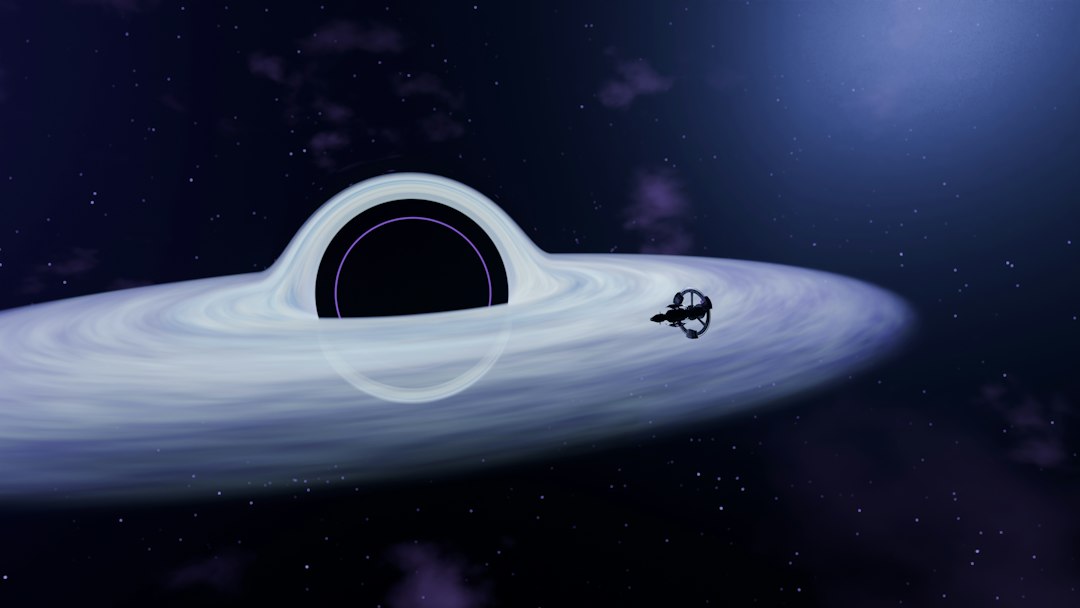
It is precisely this enforced rotation that creates the conditions for energy extraction. Imagine loading a spacecraft with unwanted cargo and venturing into the ergosphere. As the spacecraft is compelled to orbit the black hole, it releases the cargo on a specific trajectory that causes it to spiral inexorably into the black hole. Because of the strict conservation of energy — one of the most sacrosanct laws in all of physics — the spacecraft receives a compensating boost in kinetic energy. It can escape the ergosphere carrying more energy than it brought in. The black hole, meanwhile, absorbs what can be mathematically described as the "negative energy" of the discarded cargo, and in doing so, it loses a tiny fraction of its total mass-energy. The simple mechanical version of this process is not particularly efficient, but theoretical variations incorporating interactions with intense magnetic fields — the so-called Magnetic Penrose Process (MPP) — can, in principle, achieve efficiencies that dwarf conventional accretion, potentially accelerating charged particles to extraordinary energies.
Neutron Decay in the Ergosphere: A Natural Particle Accelerator
This is the central insight of a remarkable new paper posted to the arXiv preprint server by Marina Cermeño and colleagues. Rather than a hypothetical spacecraft, the authors consider a far more natural projectile: a single neutron drifting into the ergosphere of Sgr A*. The scenario is physically plausible because high-energy neutrons are produced in abundance by the violent astrophysical processes occurring near the galactic center, including cosmic ray interactions with interstellar gas and energetic phenomena associated with the black hole's own accretion environment.
Neutrons carry no net electric charge and are therefore immune to the deflecting influence of magnetic fields during their journey — meaning they can travel in straight lines directly toward the black hole, unlike charged particles that would be swept aside. Once a neutron enters the ergosphere, however, its fate becomes entangled with one of the fundamental processes of particle physics: beta decay. A free neutron is inherently unstable, with a mean lifetime of approximately 14.6 minutes. Given the right conditions, it will spontaneously decay into three particles: a proton, an electron, and an antineutrino.
Within the ergosphere of Sgr A*, this decay serves the same conceptual role as jettisoning cargo from the hypothetical spacecraft. The electron, directed onto a trajectory of negative energy that plunges into the black hole, effectively acts as the discarded mass. The proton, now carrying a large fraction of the system's total energy and endowed with an electric charge that allows it to couple to the powerful magnetic fields threading the ergosphere, receives an immense energy kick through the Magnetic Penrose Process. Because both the proton and the electron are electrically charged, they interact strongly with the ergospheric magnetic field, dramatically amplifying the efficiency of the energy transfer far beyond what the purely mechanical Penrose process could achieve.
PeV Energies and the Galactic PeVatron
Based on carefully constructed physical models and reasonable estimates for the trajectory and energy of incoming neutrons, the research team calculates that the MPP operating in the ergosphere of Sgr A* could generate protons with energies reaching the PeV scale — that is, peta-electronvolts, or 1015 electronvolts. To appreciate just how staggering this figure is, consider that the Large Hadron Collider (LHC) at CERN, the most powerful particle accelerator ever built by human hands, accelerates protons to energies of approximately 6.5 TeV — roughly a thousand times less energetic than the particles the authors predict could emerge from Sgr A*'s ergosphere.
This would formally qualify Sgr A* as a galactic PeVatron — a natural astrophysical source capable of accelerating particles to PeV energies. The existence of such sources has long been suspected by cosmic ray physicists, who have observed ultra-high-energy cosmic rays arriving at Earth and struggled to identify their origin. A PeVatron at the galactic center would be a landmark discovery, potentially resolving one of the longest-standing mysteries in high-energy astrophysics.
These ultra-energetic protons would not simply vanish after their creation. Escaping the ergosphere at velocities approaching the speed of light, they would collide with the dense clouds of molecular gas and diffuse interstellar medium surrounding the galactic center. These hadronic interactions — proton-on-proton collisions — would produce a cascade of secondary particles, most notably neutral pions that decay almost instantaneously into pairs of high-energy gamma rays. Critically, the authors predict that these gamma rays would carry a specific, identifiable spectral signature — a fingerprint in the energy spectrum that would distinguish them from gamma rays produced by other astrophysical mechanisms, such as inverse Compton scattering or synchrotron radiation from relativistic electrons.
Multi-Messenger Astronomy: Light, Neutrinos, and a New Window on Black Holes
Perhaps the most scientifically exciting aspect of this proposal is its potential as a multi-messenger astrophysical signal. The neutron decay within the ergosphere produces not only a proton but also an electron and an antineutrino. This means the MPP, if operating at the galactic center, should generate a flux of high-energy neutrinos — ghostly, nearly massless particles that interact so weakly with matter that they can traverse the entire galaxy without being absorbed or deflected. The simultaneous detection of both characteristic gamma rays and a corresponding neutrino flux from the direction of Sgr A* would constitute an extraordinarily powerful confirmation of the Magnetic Penrose Process, representing a triumph for the burgeoning field of multi-messenger astronomy that was so dramatically inaugurated by the detection of gravitational waves and electromagnetic radiation from the neutron star merger GW170817 in 2017.
- Ultra-high-energy protons (PeV scale) would be produced directly by the Magnetic Penrose Process and escape the ergosphere at near-relativistic speeds.
- High-energy gamma rays with a distinctive spectral fingerprint would be generated when these protons collide with surrounding interstellar gas.
- High-energy neutrinos would be produced as a by-product of neutron beta decay within the ergosphere, providing an independent observational channel.
- The simultaneous detection of both gamma ray and neutrino signals would constitute a robust multi-messenger confirmation of the Penrose process operating in nature.
- Detection would also provide the first indirect evidence that a black hole is losing mass through a non-accretion mechanism.
Can We Detect It? The Role of Next-Generation Observatories
The authors acknowledge a significant practical challenge: the predicted gamma ray and neutrino fluxes, while physically meaningful, are too faint to be detected by currently operational instruments. However, the situation is expected to change dramatically in the near future, thanks to a new generation of ambitious observational facilities.
On the gamma ray front, the High-Altitude Water Cherenkov (HAWC) Observatory, located on the slopes of the Sierra Negra volcano in Mexico at an altitude of 4,100 meters, has already demonstrated its capability to detect very-high-energy gamma rays from the galactic center region. Upgraded versions of HAWC, combined with the forthcoming Southern Wide-field Gamma-ray Observatory (SWGO) planned for the Southern Hemisphere, would provide significantly enhanced sensitivity to the PeV-scale gamma ray emission predicted by the study.
For neutrino detection, the primary instrument of hope is the IceCube Neutrino Observatory, embedded within a cubic kilometer of Antarctic ice at the Amundsen-Scott South Pole Station. IceCube has already made history by detecting high-energy astrophysical neutrinos from beyond our solar system, including a landmark 2022 detection of neutrino emission from the Seyfert galaxy NGC 1068. Its planned successor, IceCube-Gen2, would expand the instrumented volume by an order of magnitude, dramatically increasing the probability of detecting the neutrino flux predicted from the galactic center's MPP.
Additionally, the planned Cherenkov Telescope Array Observatory (CTAO) — a network of more than 60 telescopes spread across sites in Chile and the Canary Islands — will offer unprecedented sensitivity in the very-high-energy gamma ray regime and is specifically designed to probe the galactic center region with far greater resolution and sensitivity than any existing instrument.
Broader Implications: Rewriting Our Understanding of Black Holes
If confirmed, the detection of the Magnetic Penrose Process operating at the center of the Milky Way would be a watershed moment in astrophysics, carrying implications that extend far beyond the specifics of Sgr A*. It would represent the first direct observational evidence that rotating black holes can lose mass and angular momentum through a mechanism other than Hawking radiation — the theoretical quantum process proposed by Stephen Hawking in 1974, which is so extraordinarily faint that it is utterly undetectable for any stellar or supermassive black hole with current or foreseeable technology.
It would also lend powerful new support to the idea that supermassive black holes at galactic centers are significant contributors to the spectrum of ultra-high-energy cosmic rays observed at Earth — a question that has driven decades of theoretical and observational research. Furthermore, it would validate the theoretical framework of the Kerr metric — Einstein's general relativistic description of rotating spacetime — in one of the most extreme environments accessible to observational astronomy, complementing the stunning images of black hole shadows produced by the Event Horizon Telescope, which captured the first image of Sgr A*'s shadow in 2022.
The Universe, it seems, has been running its own particle accelerator at the center of our galaxy all along. We are only now beginning to build the instruments sophisticated enough to eavesdrop on it.
References
- Cermeño, Marina, et al. "Sgr A* as a Galactic PeVatron: Multimessenger Signatures of the Magnetic Penrose Process." arXiv preprint arXiv:2609.04051 (2026).
- Penrose, Roger, and Robert M. Floyd. "Extraction of rotational energy from a black hole." Nature Physical Science 229.6 (1971): 177–179.