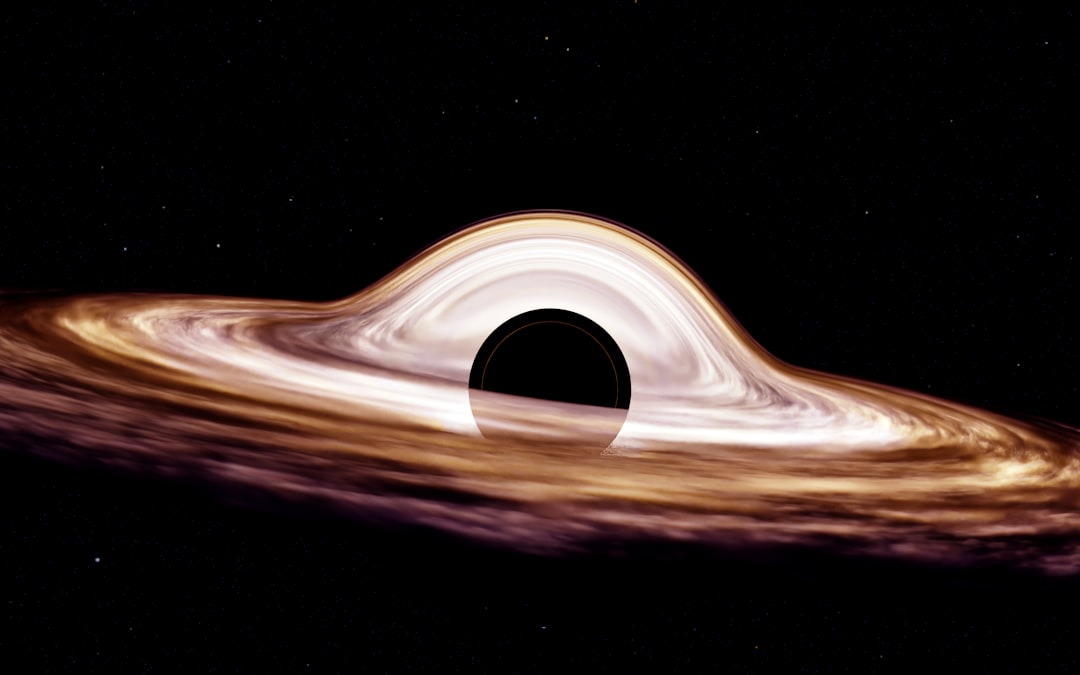
In a tantalizing development that could revolutionize our understanding of Einstein's General Relativity, astronomers have identified a promising millisecond pulsar candidate situated remarkably close to Sagittarius A*, the supermassive black hole lurking at the heart of our galaxy. This discovery, emerging from the Breakthrough Listen initiative, represents a potential breakthrough in one of astronomy's most perplexing mysteries: the conspicuous absence of pulsars in the densely populated galactic center region.
The candidate pulsar, designated BLPSR (Breakthrough Listen Pulsar), exhibits an extraordinarily rapid rotation period of just 8.19 milliseconds, placing it in the elite category of millisecond pulsars. What makes this discovery particularly significant is its proximity to our galaxy's central supermassive black hole—a location that would transform it into an unparalleled cosmic laboratory for testing the predictions of General Relativity in one of the universe's most extreme gravitational environments. However, the scientific community remains cautiously optimistic, as subsequent observation attempts have failed to redetect the signal, leaving its astrophysical nature unconfirmed.
Dr. Karen Perez, a recent PhD graduate from Columbia University who led this investigation, and her colleagues documented their findings in a comprehensive study published in The Astrophysical Journal. Their research utilized approximately 20 hours of high-sensitivity observations from the Green Bank Telescope in West Virginia, one of the world's premier radio astronomy facilities, to conduct the most thorough search yet for pulsars in the galactic center's notoriously challenging observational environment.
The Enigmatic Missing Pulsar Problem
The galactic center missing pulsar problem has frustrated astronomers for decades. Based on stellar population models and our understanding of stellar evolution, the region surrounding Sagittarius A* should be teeming with pulsars—those rapidly spinning neutron star remnants left behind after massive stars explode as supernovae. The galactic center hosts an extraordinary concentration of massive stars, many times denser than typical regions of our galaxy, which should logically produce a correspondingly rich population of these cosmic beacons.
Yet despite numerous dedicated surveys employing increasingly sophisticated detection techniques, only a handful of pulsars have been conclusively identified in this region. The six currently known pulsars near the galactic center all orbit at distances too great from the supermassive black hole to serve as useful probes of its gravitational influence. As the research team notes in their paper, none of these known pulsars lie within a parsec (approximately 3.26 light-years) of the black hole—the critical distance necessary for conducting meaningful tests of gravitational physics.
Several theories attempt to explain this conspicuous deficit. Interstellar scattering—the dispersal of radio waves by turbulent plasma in the galactic center—could obscure pulsar signals, rendering them undetectable with current technology. Additionally, the extreme orbital dynamics in this dense stellar environment might place pulsars in configurations that make them difficult to identify using standard search techniques. The Breakthrough Listen survey was specifically designed to overcome these observational challenges through enhanced sensitivity and sophisticated signal processing algorithms.
Breakthrough Listen's Deep Survey Methodology
The Breakthrough Listen Galactic Center Survey represents one of the most ambitious and sensitive searches ever conducted for radio pulsars in the Milky Way's central region. Operating at frequencies where pulsar emission is typically strongest, the survey analyzed data across multiple observation sessions, processing an enormous volume of radio frequency data to identify potential pulsar candidates.
The research team's analysis revealed 5,282 signal candidates that warranted detailed examination. Among this vast haystack of potential detections, BLPSR emerged as particularly intriguing. The candidate signal exhibited the characteristic periodic pattern expected from a millisecond pulsar, with a remarkably stable 8.19-millisecond pulse period maintained consistently throughout a one-hour observation scan. This consistency is crucial, as genuine pulsars maintain extraordinarily precise rotation rates, making them among the most accurate natural clocks in the universe.
However, the scientific process demands rigorous verification, and this is where BLPSR's status becomes complicated. Follow-up observations failed to redetect the signal, raising the possibility that the initial detection might have resulted from statistical noise or transient radio frequency interference rather than a genuine astrophysical source. As the researchers candidly acknowledge in their paper, "We remain highly skeptical of BLPSR and emphasize that a much stronger burden of proof is required before asserting its astrophysical origin."
Revolutionary Implications for Testing General Relativity
Should BLPSR's existence be confirmed through future observations, it would provide scientists with an unprecedented opportunity to conduct precision tests of General Relativity in an extreme gravitational regime. Pulsars function as extraordinarily precise cosmic clocks, emitting regular pulses of electromagnetic radiation with timing stability that rivals or exceeds human-made atomic clocks. Any gravitational influence from nearby massive objects introduces measurable anomalies in the arrival times of these pulses at Earth-based observatories.
"Any external influence on a pulsar, such as the gravitational pull of a massive object, would introduce anomalies in this steady arrival of pulses, which can be measured and modeled. In addition, when the pulses travel near a very massive object, they may be deflected and experience time delays due to the warping of space-time, as predicted by Einstein's General Theory of Relativity," explained Dr. Slavko Bogdanov, a research scientist at Columbia Astrophysics Laboratory and study co-author.
A pulsar orbiting in close proximity to Sagittarius A* would enable scientists to measure several exotic gravitational effects predicted by General Relativity with unprecedented precision. These include frame-dragging—the phenomenon where a massive rotating object literally drags the fabric of spacetime around with it—and tests of the no-hair theorem, which posits that black holes can be completely characterized by just three properties: mass, electric charge, and angular momentum.
The configuration would also allow precise measurements of gravitational time dilation, the slowing of time in strong gravitational fields, and the Shapiro delay—the additional time required for light (or radio waves) to traverse curved spacetime near a massive object. These measurements would provide critical tests of whether General Relativity accurately describes gravity in the extreme conditions near supermassive black holes, or whether modifications to Einstein's theory might be necessary.
Technical Challenges and Future Observational Strategies
The difficulty in detecting and confirming pulsars near the galactic center stems from multiple compounding factors. The region's dense concentration of ionized gas creates severe scattering effects that can broaden and distort pulsar signals, making them difficult to distinguish from background noise. Additionally, the galactic center is an extraordinarily bright radio source, producing intense background emission that can overwhelm faint pulsar signals.
The research team identified several key challenges that future surveys must address:
- Enhanced Sensitivity Requirements: Detecting pulsars in this environment requires radio telescopes with greater collecting area and more sophisticated signal processing capabilities than currently available instruments provide
- Scattering Mitigation Techniques: Advanced algorithms must be developed to compensate for the signal distortion caused by interstellar plasma, potentially including observations at higher radio frequencies where scattering effects are reduced
- Extended Observation Campaigns: Confirming weak pulsar candidates requires sustained monitoring over extended periods to distinguish genuine astrophysical signals from transient interference
- Multi-Wavelength Approaches: Coordinated observations across different electromagnetic wavelengths could help identify pulsar candidates that might be difficult to detect in radio alone
The Promise of Next-Generation Radio Astronomy
Looking toward the future, astronomers are optimistic that next-generation radio telescope facilities will finally crack the galactic center pulsar problem. The Square Kilometer Array (SKA), currently under construction across sites in South Africa and Australia, will represent a quantum leap in radio astronomy capabilities. With a total collecting area of approximately one square kilometer distributed across thousands of individual antennas, the SKA will possess sensitivity far exceeding any existing radio telescope.
The SKA's enhanced capabilities should enable the detection of significantly fainter pulsars and provide the sensitivity needed to overcome the observational challenges posed by the galactic center environment. Its ability to conduct rapid, wide-field surveys while simultaneously achieving high sensitivity makes it ideally suited for systematic searches that could finally reveal the expected pulsar population.
In the meantime, the Breakthrough Listen team has made their complete dataset publicly available, allowing researchers worldwide to apply alternative analysis techniques and search strategies. This open-science approach maximizes the probability that genuine pulsar signals might be identified through novel analytical methods.
Broader Scientific Significance and Future Prospects
The quest to identify and confirm pulsars near Sagittarius A* extends beyond simply testing General Relativity. Such discoveries would illuminate the formation and evolution of stellar populations in the galaxy's most extreme environment, providing insights into how stars and their remnants behave under conditions vastly different from those in the galactic disk where our Sun resides.
Understanding the pulsar population near the galactic center would also shed light on the history of star formation in this region and the mechanisms by which neutron stars might migrate toward or away from the supermassive black hole over cosmic time. These insights connect to fundamental questions about galactic dynamics and the co-evolution of supermassive black holes with their host galaxies.
"We're looking forward to what follow-up observations might reveal about this pulsar candidate. If confirmed, it could help us better understand both our own Galaxy, and General Relativity as a whole," said lead author Dr. Karen Perez.
The research team emphasizes that regardless of whether BLPSR is ultimately confirmed, their survey has established important constraints on the pulsar population and demonstrated the feasibility of conducting deep searches in this challenging environment. Each null result provides valuable information about the nature of the missing pulsar problem and guides the development of future observational strategies.
As astronomical technology continues advancing and new facilities like the SKA come online, the prospects for finally detecting the long-hypothesized pulsar population near our galaxy's heart grow increasingly promising. Whether BLPSR proves to be the breakthrough discovery scientists have sought or merely a tantalizing false alarm, the search continues—driven by the extraordinary scientific rewards that await confirmation of a pulsar orbiting in the gravitational maelstrom surrounding Sagittarius A*.
The coming years will likely prove decisive in resolving the galactic center missing pulsar problem. As the authors conclude in their paper, future surveys "will ultimately reveal the long-hypothesized pulsar population or further deepen the missing pulsar problem in the GC"—and either outcome promises to significantly advance our understanding of the universe's most extreme environments.