Preview to Totality: A Resource Guide to the August 12th Total Solar Eclipse
The celestial stage is nearly set. In just a matter of days, sky gazers, scientists, and dedicated umbraphiles — those who chase the Moon's shadow across the globe — will witness one of nature's most awe-inspiring spectacles: a total solar eclipse. This is not merely an astronomical curiosity; it is a precise, magnificent alignment of the Sun, Moon, and Earth that has captivated humanity since antiquity and continues to yield genuine scientific discoveries in the modern era. And on Wednesday, August 12th, 2026, it happens again — the only total solar eclipse of the year.
We published a recent comprehensive guide to this event, detailing the path of totality as it sweeps across Greenland, Iceland, the North Atlantic Ocean, and northeastern Spain. Now, with eclipse day imminent, it's time to take stock of all the key variables — weather, solar activity, potential auroras, and even the remote possibility of a sungrazing comet — that could shape the experience for millions of observers worldwide.
Understanding the Path of Totality
A total solar eclipse occurs when the Moon's umbra — the darkest, innermost part of its shadow — sweeps across Earth's surface. For observers standing within this narrow corridor, which is typically only 100 to 200 kilometers wide, the Moon appears to perfectly cover the solar disk, plunging the landscape into an eerie twilight for anywhere from a few seconds to several minutes. For the August 12th event, the path of totality carves a dramatic arc across high-latitude regions, making it one of the more challenging eclipses to observe from populated areas.
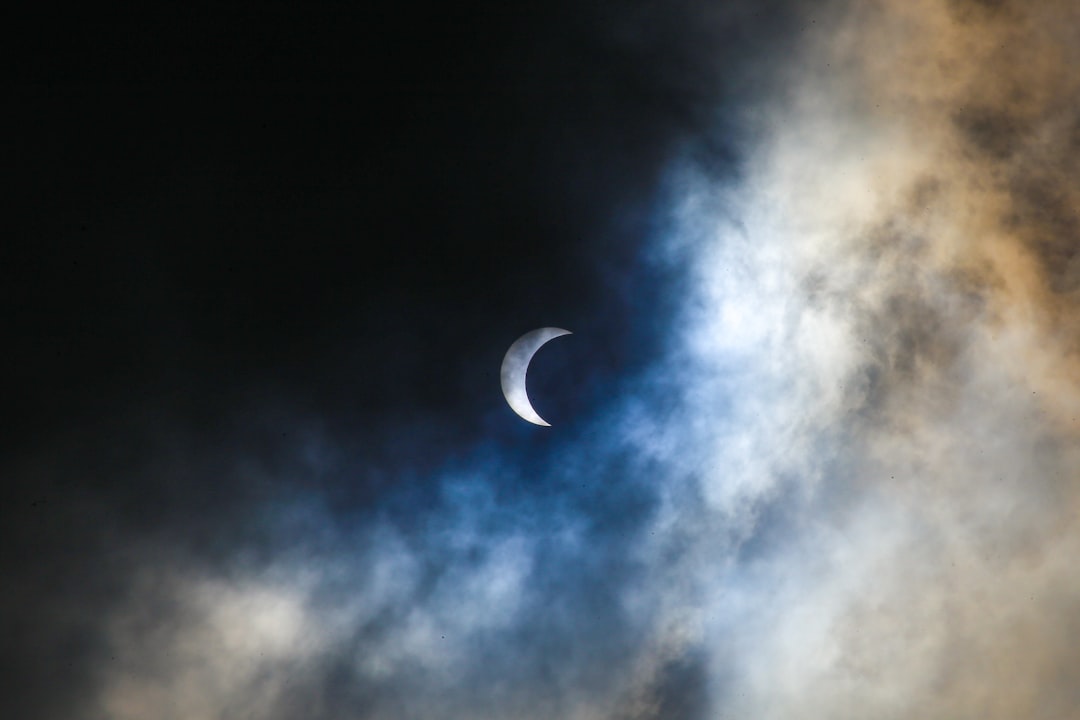
What makes this particular eclipse especially fascinating from a geometric standpoint is the behavior of its partial phases. Because the eclipse track passes over polar latitudes, the penumbral shadow — which produces partial eclipse views — drapes extensively across the North American continent, reaching as far west as Alaska. Observers across most of the United States and Canada will therefore have the opportunity to see at least a partial solar eclipse, even if they are thousands of miles from the path of totality.
"What's a bit mind-bending is how partial phases for this polar eclipse actually drape down across North America as far west as Alaska." — David Dickinson, Universe Today
For U.S. city-by-city details on the partial eclipse, resources such as NASA's Eclipse website and eclipse planning tools provide precise contact times, magnitudes, and altitude information. Remember: even a partial eclipse requires the use of certified ISO 12312-2 solar eclipse glasses to observe safely. Never look at the uneclipsed or partially eclipsed Sun with the naked eye.
The Weather Wildcard: Every Eclipse Chaser's Greatest Adversary
No factor causes more anxiety for dedicated eclipse chasers than cloud cover. The celestial mechanics are utterly reliable; the terrestrial atmosphere is anything but. History is rife with tales of observers who traveled thousands of miles only to have a rogue cloud bank obscure the moment of totality.
Veteran eclipse chaser and author David Dickinson recalls two contrasting experiences that perfectly illustrate this uncertainty: the near-miss in western North Carolina during the celebrated 2017 Great American Eclipse, where a threatening cloud bank arrived just hours after a promising clear dawn, and the surprisingly successful view from northern Maine during the April 2024 total solar eclipse — just one day after an unseasonable April snowstorm blanketed Aroostook County.
For the August 12th eclipse, long-range forecast models paint a mixed picture. Tools such as Pivotal Weather and the European Centre for Medium-Range Weather Forecasts (ECMWF), accessible through ESA's ECMWF page, are the go-to resources for eclipse meteorology. Current projections suggest that Iceland is likely to experience overcast skies during totality, while northeastern Spain — particularly the regions around Zaragoza and the Pyrenees foothills — is trending toward mostly clear conditions, making it the most favorable landmass along the path.
- Greenland: Remote and largely inaccessible, but historically prone to cloud cover in August.
- Iceland: Current models suggest overcast conditions — a significant concern for observers stationed there.
- North Atlantic: Cruise ships and aircraft can offer mobile viewing options if positioned correctly.
- Northern Spain: The most populated and accessible section of the path, with relatively favorable clear-sky prospects.
Experienced eclipse chasers often build mobility into their plans, remaining ready to drive hours if necessary to outflank a cloud bank. Renting a vehicle with a large fuel tank and pre-scouting alternate viewing sites along the path of totality is strongly advisable for anyone committed to seeing the event.
Wildfires in the Iberian Peninsula: An Additional Concern
Compounding the weather situation across Spain and southern France is the ongoing threat of wildfires, which have devastated portions of the Iberian Peninsula in recent weeks. These fires pose not only a direct safety risk to observers traveling to the region but can also generate sufficient smoke and haze to reduce eclipse visibility. Of particular note, NASA's Deep Space Network complex near Madrid narrowly survived encroaching fires on July 24th — a sobering reminder of the scale of the crisis. Observers planning to travel to Spain for the eclipse are urged to monitor the European Forest Fire Information System (EFFIS) for the latest wildfire maps and risk assessments across the Iberian peninsula.
The Solar Corona: Nature's Most Spectacular Light Show
The solar corona — the Sun's outermost atmospheric layer — is normally invisible against the brilliance of the solar disk. It is only during the precious minutes of totality that this ghostly, pearlescent halo becomes directly visible to the naked eye. The corona extends millions of kilometers into space and reaches temperatures exceeding one million degrees Celsius, a phenomenon that remains one of the central unsolved mysteries of solar physics — often referred to as the coronal heating problem.
The shape and structure of the corona is not static. It changes in lockstep with the solar activity cycle — the approximately 11-year rhythm of magnetic field build-up and release that governs sunspot counts, solar flares, and coronal mass ejections. Near solar minimum, the corona tends to display elegant, elongated streamers concentrated near the solar equator. Near solar maximum — which is where we find ourselves in 2026, coming off the peak of Solar Cycle 25 — the corona blooms outward in a more complex, symmetrical fashion, bristling with dynamic loops and plumes in all directions. Experienced umbraphiles can often identify which eclipse produced a particular corona photograph simply from its distinctive morphology.
Fortunately, modern computational tools now allow scientists to model the predicted appearance of the corona days before an eclipse. The COCONUT (COronal CONstraining UraniuM Transport) model, developed at KU Leuven in Belgium and supported by the European Space Agency, uses near-real-time solar magnetic field data to generate a predicted coronal structure. Checking the COCONUT model page in the days leading up to August 12th will give observers a useful preview of what to expect.
Solar Activity: Sunspots and the State of Solar Cycle 25
The partial phases of a total solar eclipse — the hour or more before and after totality during which the Moon progressively covers and uncovers the solar disk — offer excellent opportunities for sunspot observation, provided proper solar filters are used. Active sunspot regions appear as dark, magnetically intense patches on the photosphere and can dramatically enhance the visual interest of the partial phases as well as the chromospheric detail visible during totality.
As of early August 2026, the Sun remains notably active. Solar Cycle 25, which began in December 2019, reached or is nearing its peak, meaning the solar disk is likely to be adorned with multiple active regions. A crucial observational note: because the equatorial regions of the Sun rotate approximately once every 25 days, any sunspot group rotating into the Earth-facing hemisphere five to seven days before the eclipse will still be visible — and potentially well-placed — on eclipse day.
The best resource for monitoring current solar activity is NASA's Solar Dynamics Observatory (SDO), which provides continuous, high-resolution imagery of the Sun in multiple wavelengths. SDO's AIA (Atmospheric Imaging Assembly) instrument captures the solar atmosphere in extreme ultraviolet light, revealing active regions, coronal loops, and solar filaments in extraordinary detail.
Could Auroras Grace the Eclipse Sky?
Among the most extraordinary — and exceedingly rare — eclipse phenomena is the simultaneous appearance of the aurora borealis during totality. Because totality plunges the eclipse zone into near-darkness, observers at high latitudes could theoretically witness auroral displays painting the twilight horizon while the solar corona blazes overhead. The last time the path of totality crossed through the Arctic was during the 2015 total solar eclipse, which traversed the Faroe Islands and Svalbard. That event produced tantalizingly suggestive conditions, though confirmed naked-eye aurora sightings during totality remained elusive.
For August 12th, this possibility — while firmly in the realm of long shots — is not zero. Iceland and Greenland sit well within the auroral zone, and if a significant Coronal Mass Ejection (CME) were to depart the Sun on or around Sunday, August 9th, it could plausibly arrive at Earth's magnetosphere in the three-to-four day window that corresponds precisely with eclipse day. A strong geomagnetic storm in conjunction with high-latitude totality is the recipe for this unicorn phenomenon.
"If an Earth-directed Coronal Mass Ejection were to leave the Sun on or around Sunday, August 9th, it could arrive and impact Earth's space weather environment at exactly the right time." — David Dickinson
Monitor NOAA's Space Weather Prediction Center closely in the days leading up to the eclipse. Real-time solar wind data, geomagnetic storm watches, and CME arrival forecasts are all available there, and the site offers alert subscriptions for significant space weather events.
The Wild Card: Sungrazing Comets
Perhaps the most spectacular — and utterly unpredictable — eclipse bonus of all is the potential appearance of a sungrazing comet in the field of view during totality. These icy bodies, often members of the Kreutz sungrazer family (fragments of a much larger parent comet that shattered thousands of years ago), follow extremely tight orbits around the Sun that bring them within a few solar radii of the solar surface. Most are destroyed by solar tidal forces and radiation during perihelion passage. But occasionally, a larger, more robust fragment survives — or at least remains brilliant long enough to be captured.
The precedent from 2024 was extraordinary: images from the ESA/NASA Solar and Heliospheric Observatory (SOHO) revealed a sungrazing comet streaking through the LASCO coronagraph field just hours before the April 8th eclipse, briefly sparking hopes — ultimately unfulfilled — that it might be visible to totality observers in the United States. Nevertheless, it was a dramatic reminder that the Sun's immediate neighborhood can harbor surprises.
To monitor for any incoming icy interloper before August 12th, keep a close eye on:
- SOHO LASCO C2 and C3: The Solar and Heliospheric Observatory's real-time coronagraph imagery, which has discovered the vast majority of known sungrazing comets since 1996.
- NOAA CCOR-1: The Compact Coronagraph aboard the GOES-19 satellite, which provides a complementary coronagraphic view of the inner heliosphere.
- Citizen science networks: The Sungrazer Project, which coordinates amateur volunteers who scan LASCO images for previously undetected comets.
Watch It Live: Online Resources for Eclipse Day
If you are unable to travel to the path of totality, or if clouds intervene at your chosen site, all is not lost. Several world-class organizations will be providing live, high-quality webcasts of the eclipse:
- NASA's official eclipse broadcast — featuring commentary from scientists and real-time views from along the path of totality.
- ESA's live coverage — providing European perspectives and scientific commentary from Spain and other locations along the track.
- The Virtual Telescope Project — led by astrophysicist Gianluca Masi, offering remote telescope views and expert narration of the event as it unfolds.
Beyond live video, the hours and days following the eclipse will see a flood of stunning imagery from both ground-based observers and space assets. Satellites such as Hinode, SDO, SOHO, and potentially ESA's Solar Orbiter will all be observing the Sun contemporaneously, offering a remarkable multi-vantage-point scientific dataset.
Key Resources at a Glance
- Eclipse path maps and timing: NASA's Eclipse website (Goddard Space Flight Center)
- Current solar activity: NASA Solar Dynamics Observatory
- Space weather monitoring: NOAA Space Weather Prediction Center
- Coronal structure prediction: KU Leuven COCONUT Model
- Wildfire situation in Spain:
Frequently Asked Questions
Quick answers to common questions about this article
1 When and where is the August 2026 total solar eclipse happening?
The total solar eclipse occurs on Wednesday, August 12th, 2026. The path of totality sweeps across Greenland, Iceland, the North Atlantic Ocean, and northeastern Spain. It is the only total solar eclipse of the entire year, making it a rare and highly anticipated event for skywatchers worldwide.2 What is the path of totality and how wide is it?
The path of totality is the narrow corridor on Earth's surface where the Moon completely blocks the Sun. It typically stretches just 100 to 200 kilometers wide. Only observers standing within this zone experience true totality, where daylight gives way to an eerie twilight and stars may briefly become visible.3 Can I see the eclipse if I live in the United States?
Yes, most people across the U.S. and Canada can see a partial solar eclipse on August 12th, 2026. Because the eclipse track crosses polar latitudes, the Moon's outer penumbral shadow extends surprisingly far, reaching as west as Alaska. Check NASA's Eclipse website for exact times and coverage percentages for your city.4 Why do total solar eclipses happen at all?
Total solar eclipses occur because of a stunning cosmic coincidence — the Sun is roughly 400 times wider than the Moon, but also about 400 times farther away. This makes both objects appear nearly identical in size from Earth, allowing the Moon to occasionally block the Sun's disk almost perfectly during alignment.5 What is an umbraphile and why do people travel for eclipses?
An umbraphile is someone who passionately chases the Moon's shadow — known as the umbra — across the globe to experience totality. The phenomenon is so visually and emotionally overwhelming, with the solar corona blazing around a darkened sky, that many travelers book international trips specifically to stand within that narrow 100-to-200-kilometer corridor.6 Do I need special glasses to watch the solar eclipse?
Absolutely. Looking directly at the Sun during any partial phase can cause permanent eye damage or blindness. You must use eclipse glasses certified to the ISO 12312-2 international safety standard. Only during the brief moments of complete totality, when the Moon fully covers the Sun, is it safe to view without eye protection.Related Articles