SpaceX Rocket Stage Strikes the Moon: A Wake-Up Call for Cislunar Space Debris Management
In the early hours of Wednesday, August 5th, 2025, humanity's growing footprint in space left a permanent scar on the lunar surface. At 06:35 UTC (11:35 p.m. PDT; 2:35 a.m. EDT), a 13.8-meter (45-foot) long, 4,000 kg (approximately 9,000 lbs) spent upper stage — a remnant from a SpaceX Falcon 9 rocket — slammed into the Moon at roughly 8,700 km/h (5,400 mph), carving a fresh crater into the ancient lunar regolith. The event, while not entirely unexpected, has reignited urgent conversations among space agencies, scientists, and policymakers about the sustainability of humanity's rapidly expanding activities in cislunar space.
The Rocket Stage: Origins and Trajectory
The spent upper stage in question was a direct byproduct of a January 2025 launch that carried two significant lunar exploration payloads: Firefly Aerospace's Blue Ghost Mission 1 and ispace's HAKUTO-R M2 "Resilience" lander. Once its fuel was expended during the trans-lunar injection burn, the stage was left on a heliocentric orbit that slowly curved back toward the Earth-Moon system — a trajectory that made a lunar impact essentially inevitable.
This scenario is not unique. Spent upper stages from lunar missions often lack the fuel reserves necessary to perform a controlled disposal burn, whether that means a targeted lunar impact, a return to Earth's atmosphere for burnup, or insertion into a long-term stable heliocentric orbit. Instead, they drift through cislunar space, subject to the subtle but relentless gravitational perturbations of the Earth, Moon, and Sun, until they eventually collide with a planetary body or are nudged onto an escape trajectory. This is a well-understood engineering limitation — but one that is becoming increasingly consequential as launch cadence increases dramatically.
"As more rockets are sent to space and human activity increases in cislunar space, spent stages and debris will become a growing concern — one that must be addressed proactively, before crewed missions become a regular occurrence."
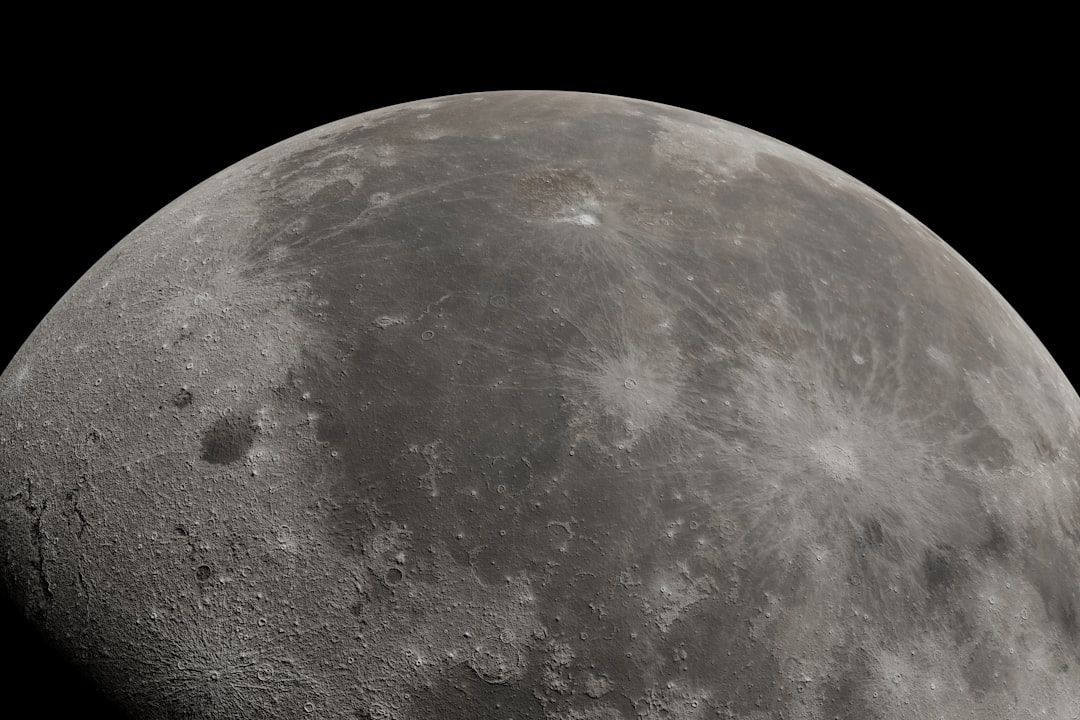
The stage struck the western lunar limb, near the historic Einstein Crater on the Moon's dayside. Einstein Crater, located at approximately 29°N, 88°W, sits in the rugged highlands of the lunar near side's western edge — a region not frequently targeted for scientific landings, but one whose geological record offers a detailed chronicle of the Moon's ancient bombardment history. Now, it will record a very modern impact as well.
The Impact: What Scientists Predicted and What Was Observed
Prior to the collision, planetary scientists modeled the expected outcome with considerable precision. Based on the mass, velocity, and angle of approach of the spent stage, researchers estimated the impact would excavate a crater measuring 20 to 27 meters (65 to 89 feet) in diameter and approximately 4 meters (12 to 13 feet) in depth. These predictions align well with established lunar cratering scaling laws, which relate impactor energy to the dimensions of the resulting crater in the Moon's low-gravity, airless environment.
The absence of a lunar atmosphere means that there is no atmospheric braking to slow incoming objects, and impact ejecta can travel extraordinary distances across the surface. The kinetic energy released upon impact — equivalent to several tons of TNT — was sufficient to launch a visible plume of pulverized regolith, dust, and volatiles high above the lunar surface.
Astronomers leveraging the European Southern Observatory's Very Large Telescope (VLT) in Paranal, Chile, were able to obtain spectroscopic data from the impact plume as it briefly rose above the lunar limb and was illuminated by sunlight. This spectral analysis revealed the chemical fingerprints of lithium and sodium being lofted from the subsurface regolith — a finding of genuine scientific interest. These elements, while present in lunar soils at trace levels, provide clues about the Moon's complex geological and space-weathering history. Sodium, in particular, is known to form part of the Moon's tenuous exosphere, and impact events are one of the primary mechanisms by which it is replenished.
Korean Lunar Orbiter Danuri Captures the Scene
The most detailed observational record of the event came from the Korean Pathfinder Lunar Orbiter (KPLO), affectionately known as Danuri — South Korea's first lunar spacecraft, developed by the Korea Aerospace Research Institute (KARI). Orbiting the Moon at an altitude of approximately 100 kilometers, Danuri was uniquely positioned to witness and document the collision.
"Danuri began observations about 30 minutes before the collision and, through orbit control, passed over the impact site multiple times, conducting a total of 8 imaging sessions. Through this observation, changes in the terrain around the impact site and traces of ejecta spread were confirmed." — Korea Aerospace Research Institute (KARI), August 6th, 2025
The imagery secured by Danuri — capturing both pre- and post-impact states of the surface — will allow geologists and planetary scientists to conduct a detailed comparative analysis of the terrain. Changes in surface albedo (reflectivity), the distribution pattern of excavated ejecta, and the precise dimensions of the resulting crater will all be measurable from orbit. Such data not only documents this specific impact but also contributes to the broader scientific database used to calibrate models of meteoroid and debris impacts on airless bodies throughout the solar system.
Additionally, NASA announced plans to conduct its own follow-up observations using the Lunar Reconnaissance Orbiter (LRO), in close collaboration with KARI. The LRO, which has been orbiting the Moon since 2009 with its powerful suite of imaging instruments, has previously documented over 200 fresh impact craters and has become the gold standard for lunar surface change detection. Its Lunar Reconnaissance Orbiter Camera (LROC) is capable of resolving features as small as 50 centimeters per pixel, making it ideally suited to capture fine structural detail of the new crater.
NASA's Meteoroid Environments Office at the agency's Marshall Space Flight Center also deployed ground-based telescope networks to image the impact flash and subsequent plume — data that will feed directly into models used to assess the hazard environment for future crewed missions operating on and around the Moon.
Not the First — But a Warning of Things to Come
It is important to note, as NASA Administrator Jared Isaacman highlighted in a widely shared post, that this is not the first time a human-made object has impacted the Moon unintentionally. Spent rocket stages, mission hardware, and defunct spacecraft have struck the lunar surface before. One notable example occurred in March 2022, when a spent rocket booster — initially misidentified as a SpaceX Falcon 9 stage but later attributed to a Chinese Long March 3C upper stage — crashed near the lunar far side, a result that was confirmed by LROC imaging from Arizona State University. That impact notably produced a double-crater — suggesting the booster had significant mass at both ends — and remains a subject of ongoing research.
The Moon's surface is also, of course, no stranger to impacts from entirely natural sources. Millions of years of meteoroid bombardment have shaped the heavily cratered landscape we observe today. Even now, the lunar surface experiences thousands of meteoroid strikes annually, a hazard that NASA's Meteoroid Environment Office actively models to protect both robotic and future crewed assets. However, the critical distinction is that natural meteoroid strikes are random and largely unpredictable, while human-made debris impacts — in principle — are preventable with better planning and policy.
The Growing Threat of Cislunar Debris
The August 5th impact serves as a timely and dramatic illustration of a problem that researchers have been quantifying with increasing urgency. A recent study by scientists at the Chinese Academy of Sciences (CAS) employed advanced debris propagation simulations to model the long-term behavior of spent stages and other hardware released into cislunar space. Their findings painted a concerning picture: as the number of missions to the Moon increases, the density of debris in cislunar space rises substantially, and the probability of collision with operational spacecraft — or with crewed surface installations — grows accordingly.
The implications extend well beyond aesthetics or the integrity of specific craters. As space agencies and commercial entities plan for permanent lunar outposts, propellant depots, and regular crewed surface operations under initiatives like NASA's Artemis program, the uncontrolled accumulation of debris in the Earth-Moon system presents genuine safety risks. A debris strike on a crewed habitat, a lunar surface vehicle, or a spacecraft in transit could be catastrophic.
- Spent upper stages from lunar injection burns frequently lack the propellant margins needed for controlled disposal.
- The cislunar orbital environment is far less well-characterized than low Earth orbit (LEO), where decades of tracking infrastructure have been built up.
- There is currently no internationally agreed-upon framework specifically governing debris mitigation in cislunar space, beyond general guidelines from the Inter-Agency Space Debris Coordination Committee (IADC).
- The Moon's proximity means that objects in unstable cislunar orbits can impact its surface within months or years, with limited warning in some cases.
- Chemical payloads released during impacts — such as residual propellants in spent stages — could potentially contaminate scientifically sensitive polar regions where water ice deposits are found.
Toward Better Stewardship of Cislunar Space
The scientific community and space agencies are beginning to grapple with these challenges. There is growing consensus that debris mitigation standards developed for low Earth orbit — such as the requirement to deorbit defunct satellites within 25 years — must be adapted and extended to cover cislunar operations. This is not a simple task: the orbital mechanics of cislunar space are far more complex than LEO, and the cost of performing end-of-life disposal burns on lunar mission hardware is non-trivial.
Nevertheless, potential solutions are being actively discussed. These include designing upper stages with sufficient propellant reserves for a final targeted impact in a scientifically benign region, developing dedicated cislunar space situational awareness (SSA) capabilities to track objects in the Earth-Moon system, and establishing international agreements that mandate responsible disposal practices for all lunar missions — commercial or governmental.
The August 5th impact, while resulting in no harm to any active mission and providing a valuable scientific dataset in its own right, stands as a stark symbol of the choices that face spacefaring nations at this pivotal moment. The Moon is no longer a remote and untouched wilderness visible only through telescopes. It is becoming a destination — and with that transition comes the same responsibilities of stewardship that apply to any frontier humanity chooses to explore and inhabit.
Key Facts at a Glance
- Impact Date & Time: August 5th, 2025, at 06:35 UTC
- Object: Spent SpaceX Falcon 9 upper stage, 13.8 m (45 ft) long, ~4,000 kg (~9,000 lbs)
- Launch Mission: Carried Firefly Blue Ghost Mission 1 and ispace HAKUTO-R M2 "Resilience" (January 2025)
- Impact Location: Western lunar limb, near Einstein Crater, dayside
- Impact Velocity: Approximately 8,700 km/h (5,400 mph)
- Estimated Crater Size: 20–27 meters (65–89 ft) diameter; ~4 meters (12–13 ft) depth
- Key Observers: ESO Very Large Telescope (spectroscopy), Korean Lunar Orbiter Danuri (imaging), NASA LRO (planned follow-up)
- Chemical Signatures Detected: Lithium and sodium in the impact plume