In the vast expanse of our cosmos, invisible messengers constantly bombard Earth from the deepest reaches of space, carrying with them secrets about the most violent and energetic processes in the Universe. Among these ultra-high-energy cosmic rays, one particle detected in May 2021 stands out as particularly extraordinary—the Amaterasu particle, named after the Japanese goddess of the sun. With an energy level that defies conventional astrophysical explanations, this cosmic bullet has challenged scientists to rethink their understanding of particle acceleration in the Universe. Now, groundbreaking research from the Max Planck Institute for Physics is bringing us closer to unraveling the enigma of where this extraordinary particle originated.
The Amaterasu particle represents the second-most energetic cosmic ray ever recorded, with an astounding energy measurement exceeding 240 exa-electronvolts (EeV). To put this in perspective, this single subatomic particle carried approximately 40 million times more energy than the most powerful particle collisions achieved in the Large Hadron Collider at CERN. The sheer magnitude of this energy poses a fundamental question: what cosmic phenomena could possibly accelerate matter to such extreme velocities, approaching the speed of light itself?
Decoding the Cosmic Ray Mystery
Cosmic rays serve as nature's own particle accelerators, providing astronomers with a unique window into the most extreme environments scattered throughout our galaxy and beyond. These charged particles—primarily consisting of protons and atomic nuclei stripped of their electrons—traverse the cosmos at relativistic speeds, carrying information about their birthplaces encoded in their trajectories and energy signatures. When these particles interact with Earth's atmosphere, they create cascading showers of secondary particles that can be detected by sophisticated ground-based observatories.
The international Telescope Array Project, operating an extensive network of detectors across the Utah desert, specializes in capturing these rare ultra-high-energy events. The facility consists of 507 surface detectors spread across 700 square kilometers, working in concert with fluorescence detectors that observe the faint ultraviolet light produced when cosmic rays strike atmospheric molecules. This dual-detection system allows scientists to reconstruct the energy, arrival direction, and composition of incoming cosmic rays with unprecedented precision.
Revolutionary Statistical Approaches to Source Identification
The challenge of tracing cosmic rays back to their sources has long vexed astrophysicists. Unlike photons, which travel in straight lines from their origin, charged cosmic ray particles are deflected by the tangled magnetic fields permeating our galaxy. These magnetic fields act like a cosmic fog, scrambling the particles' trajectories and obscuring their original direction. Traditional methods of source identification have struggled with this fundamental obstacle, often pointing toward seemingly empty regions of space.
Researchers Francesca Capel and Nadine Bourriche at the Max Planck Institute for Physics have pioneered an innovative approach that combines advanced computational simulations with modern statistical techniques known as Approximate Bayesian Computation (ABC). This methodology generates three-dimensional probability maps that account for cosmic ray propagation through the Milky Way's complex magnetic field structure, while simultaneously incorporating observational uncertainties and theoretical constraints.
"Our results suggest that, rather than originating in a low-density region of space like the Local Void, the Amaterasu particle is more likely to have been produced in a nearby star-forming galaxy such as M82," explained Nadine Bourriche, highlighting how their analysis challenges previous assumptions about the particle's origin.
The Local Void Paradox
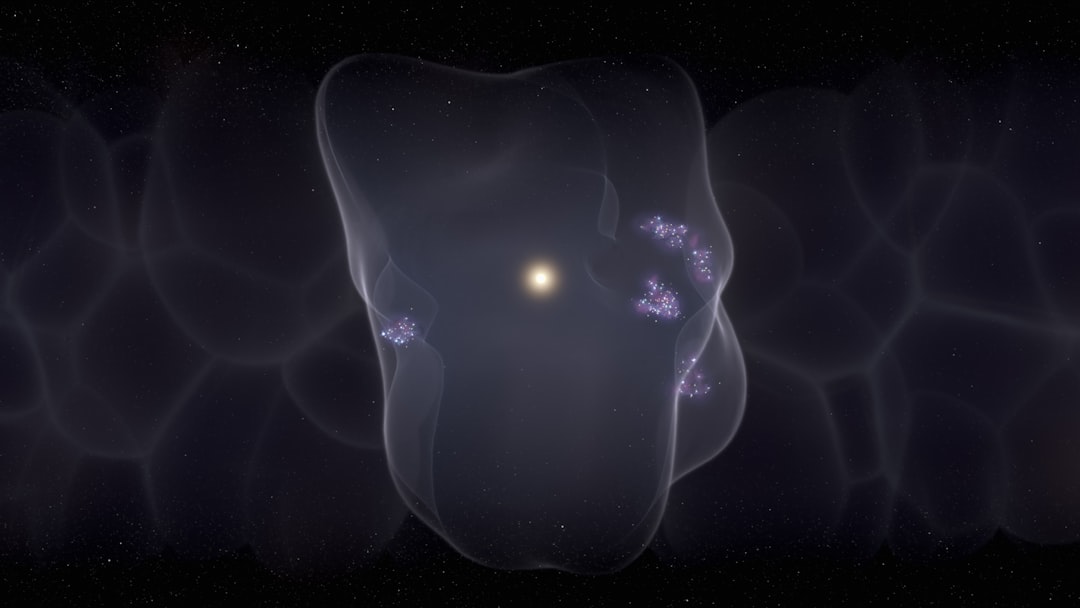
Initial trajectory reconstruction of the Amaterasu particle pointed toward the Local Void, an enormous underdense region of space spanning approximately 150 million light-years adjacent to our Local Group of galaxies. This cosmic desert contains remarkably few galaxies, stars, or other luminous matter—precisely the opposite of what astrophysicists would expect for the birthplace of such an energetic particle. The paradox deepened the mystery: how could one of the most powerful cosmic rays ever detected appear to originate from a region largely devoid of the extreme astrophysical engines required to produce it?
The Local Void represents one of the largest known underdense regions in our cosmic neighborhood. These voids form naturally in the large-scale structure of the Universe, where dark energy and cosmic expansion have stretched space, leaving behind vast regions with below-average matter density. While not completely empty, such voids contain far fewer galaxies and active cosmic ray sources compared to the denser filaments and clusters that define the cosmic web.
M82: A Stellar Forge of Cosmic Proportions
The new analysis by Capel and Bourriche identifies a far more plausible candidate: Messier 82, also known as the Cigar Galaxy. Located approximately 12 million light-years from Earth in the constellation Ursa Major, M82 is classified as a starburst galaxy—a cosmic environment undergoing an extraordinary episode of star formation at rates hundreds of times faster than our own Milky Way. This galactic powerhouse produces new stars so rapidly that its core blazes with the light of millions of young, massive stars.
What makes M82 particularly compelling as a source for ultra-high-energy cosmic rays is its powerful galactic wind. The intense star formation drives supersonic outflows of gas and magnetic fields perpendicular to the galaxy's disk, creating a bipolar wind structure visible in multiple wavelengths. These winds, powered by supernova explosions and stellar radiation pressure, could potentially serve as natural particle accelerators. The Chandra X-ray Observatory has revealed that M82's superwind extends thousands of light-years into intergalactic space, carrying with it shock waves and magnetic turbulence capable of energizing particles to extreme velocities.
Particle Acceleration Mechanisms
Several theoretical mechanisms could explain how environments like M82 accelerate particles to such phenomenal energies:
- First-order Fermi acceleration: Particles gain energy by repeatedly crossing shock fronts in the galactic wind, bouncing between converging magnetic field regions like a ball between two approaching walls
- Magnetic reconnection events: When magnetic field lines break and reconnect in the turbulent environment, they can release enormous amounts of stored magnetic energy directly into particle acceleration
- Stochastic acceleration: Random interactions with magnetic turbulence gradually boost particle energies through a cosmic game of pinball
- Supernova remnant acceleration: The expanding shock waves from multiple supernovae in the starburst region could work in concert to accelerate particles to ultra-high energies
Implications for Cosmic Ray Astrophysics
The methodological advances demonstrated by this research extend far beyond solving the Amaterasu mystery. By successfully combining physics-based simulations with Bayesian statistical inference, Capel and Bourriche have created a template for investigating other ultra-high-energy cosmic ray events. Their approach addresses a fundamental challenge in the field: how to extract maximum scientific value from limited observational data while properly accounting for uncertainties in both measurements and theoretical models.
"Exploring ultra-high-energy cosmic rays helps us to better understand how the Universe can accelerate matter to such energies, and also to identify environments where we can study the behavior of matter in such extreme conditions," noted Francesca Capel, who leads the Astrophysical Messengers research group. "Our goal is to develop advanced statistical analysis methods to exploit the available data to its full potential and gain a deeper understanding of the possible sources of these energetic particles."
The research, published in The Astrophysical Journal under the title "Beyond the Local Void: A Data-driven Search for the Origins of the Amaterasu Particle," represents a significant step toward understanding the most energetic processes in our Universe. As next-generation cosmic ray observatories come online, including upgrades to existing facilities and new international collaborations, the analytical framework developed by Capel and Bourriche will prove invaluable for interpreting the flood of new data.
Future Directions and Unanswered Questions
Despite this progress, numerous questions remain about ultra-high-energy cosmic rays and their sources. The Amaterasu particle's exact composition—whether it was a proton, light nucleus, or heavy iron nucleus—still influences interpretations of its origin and the acceleration mechanisms involved. Different particle types would require different amounts of energy and different magnetic field configurations to reach the observed energy levels, potentially pointing to distinct source populations.
The European Southern Observatory and other major astronomical facilities continue to study M82 and similar starburst galaxies across multiple wavelengths, seeking to understand their role as cosmic particle accelerators. Future observations may reveal whether M82 produces a steady stream of ultra-high-energy particles or if the Amaterasu event represents a rare, transient phenomenon.
Additionally, the relationship between cosmic ray sources and other astrophysical messengers—neutrinos, gamma rays, and gravitational waves—remains an active area of investigation. Multi-messenger astronomy, which combines observations across these different channels, promises to provide a more complete picture of the extreme environments that forge the Universe's most energetic particles. As our detection capabilities improve and our theoretical models become more sophisticated, the cosmic ray sky will gradually come into sharper focus, revealing the locations and mechanisms of nature's most powerful particle accelerators.
The Amaterasu particle, like its namesake goddess emerging from her celestial cave to illuminate the world, continues to shed light on the hidden processes that shape our cosmos. Through the dedicated work of researchers like Capel and Bourriche, we move closer to understanding how the Universe achieves what our most advanced technology can only dream of—accelerating matter to energies that push the very boundaries of physics itself.