The Asteroid That May Be Three Worlds: Unraveling the Mysteries of (44) Nysa
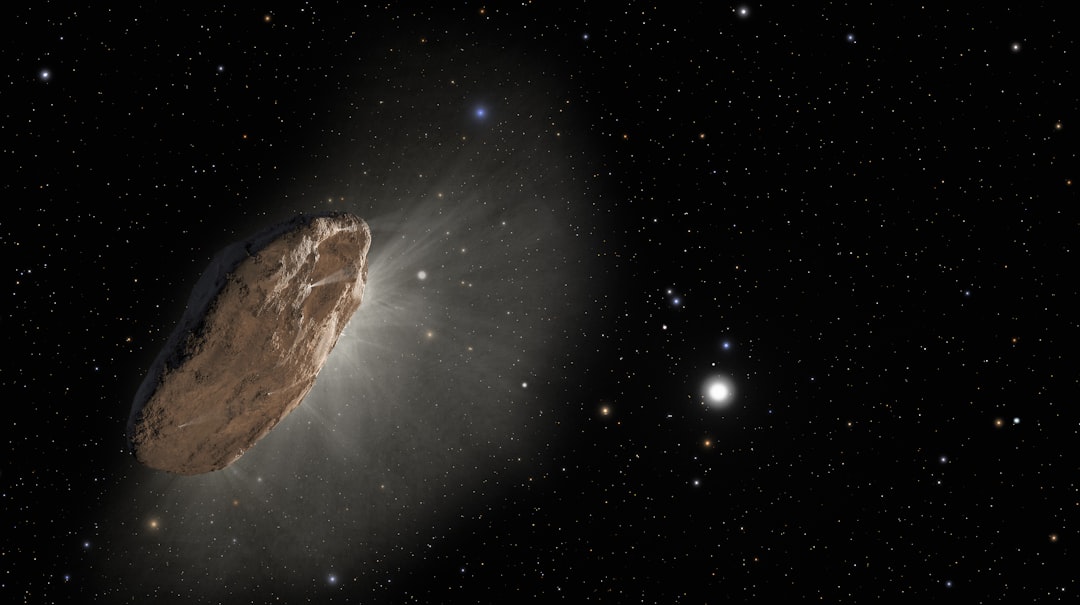
What shape is an asteroid? For (44) Nysa, the honest answer — until very recently — was that nobody truly knew. It is one of the brightest and largest E-type asteroids in the main asteroid belt, a distinctive class whose surfaces are rich in enstatite, a magnesium silicate mineral that reflects sunlight with unusual efficiency. That high albedo, combined with Nysa's peculiar light curve, has made it a favourite target for planetary scientists for well over a century. Successive observations hinted that it was dramatically elongated, perhaps even two separate lumps fused together, but the picture stayed frustratingly blurred — a tantalising enigma just beyond the resolving power of available telescopes.
Now, an international team led by Kate Minker at Lowell Observatory has brought two of the world's most powerful ground-based instruments to bear on the problem: SHARK-VIS on the Large Binocular Telescope (LBT) in Arizona, and SPHERE/ZIMPOL on the Very Large Telescope (VLT) in Chile, operated by the European Southern Observatory. Equipped with cutting-edge adaptive optics systems that dynamically correct for atmospheric turbulence in real time, and supported by purpose-built image-processing pipelines to sharpen the raw data further, the team has produced the finest resolved images of Nysa ever obtained. Minker describes them as approaching spacecraft quality — a remarkable achievement accomplished entirely from the ground, across hundreds of millions of kilometres of space.
Reading the Landscape: Valleys, Necks, and Contact Bodies
What those extraordinary images reveal is both striking and deeply puzzling: two prominent valleys wrapping around Nysa's circumference like the grooves on a misshapen gourd. The team interprets these depressions not as simple impact craters or erosional features, but as necks — the pinched, constricted joints where gravitationally bound bodies have come to rest gently against one another over geological time. The implication is startling: Nysa may be composed of three distinct lobes, softly welded into a single, lumbering whole.
This morphology would place Nysa in extraordinarily rare company. Science has encountered contact binaries before — bodies formed when two objects drift together slowly enough to stick rather than shatter in a violent collision. Comet 67P/Churyumov–Gerasimenko, famously explored by the ESA Rosetta mission, has the silhouette of a rubber duck: two lobes connected by a narrow neck. The Kuiper Belt object Arrokoth, photographed up close by NASA's New Horizons spacecraft in January 2019, resembles a flattened cosmic snowman — two reddish lobes that drifted together in the deep cold of the outer Solar System with almost imperceptible gentleness. Both of these are contact binaries: two pieces fused into one. Nysa, if the interpretation holds, would be something entirely new — a contact trinary, the first of its kind ever identified anywhere in the Solar System.
"Either Nysa is the Solar System's first confirmed contact trinary, or it is a single body so catastrophically battered that it merely resembles three — and either outcome would be, in itself, without known precedent."
How Do Contact Multiples Form?
The formation of contact binaries like Arrokoth is believed to involve the gentle inward spiral of two objects within a shared cloud of material during the earliest epochs of Solar System history — a process called pebble accretion or streaming instability, where concentrations of solid particles collapse gravitationally and co-accrete without destructive collisions. For a contact trinary to exist, a third body would need to have been incorporated into this delicate dance, either during the original accretion phase or through a subsequent low-velocity capture event. Alternatively, a larger parent body could have been partially disrupted and re-accumulated into three components. The precise pathway remains an open and deeply exciting question.
The team is careful to acknowledge an alternative interpretation: Nysa could be a single, monolithic body so deeply battered by billions of years of impacts that it merely resembles three lobes. But this scenario would also be unprecedented — nothing else currently known in the Solar System displays this precise morphology from purely impact-driven reshaping. Either way, as the researchers note, Nysa is profoundly peculiar, and its study promises to reshape our understanding of how small bodies are assembled and survive.
A Moon in the Glare: The Key to Unlocking Nysa's Secrets
This is where Nysa's newly discovered moon enters the story with decisive scientific weight. Borrowing high-contrast imaging techniques originally developed for direct imaging of exoplanets — an approach designed to pull faint signals out of the overwhelming glare of a nearby bright source — the team extracted a faint, previously unknown speck from Nysa's brilliance. This satellite, now formally designated S/2026 (44) 1, is approximately one kilometre across and orbits at a distance of at least 170 kilometres from Nysa's centre. Crucially, it was detected independently in two separate observing runs, ruling out instrumental artefacts and cementing its reality.
Small moons around asteroids have turned out to be surprisingly common — NASA's Lucy spacecraft famously discovered that the small asteroid Dinkinesh harboured its own satellite, Selam, during a flyby in November 2023. Each such moon is a gift to planetary scientists, because a moon in a stable orbit is a natural gravimeter. By precisely tracking the orbital period and semi-major axis of S/2026 (44) 1, researchers can apply Kepler's Third Law to derive Nysa's total mass with high accuracy. Combined with the volume now measurable from the resolved images, this yields a direct measurement of bulk density — and density is precisely the diagnostic that distinguishes a loosely gravitationally bound rubble pile (a porous reassembly of collision debris, with bulk density well below that of solid rock) from a coherent, consolidated body.
- Low bulk density (typically below ~2 g/cm³) would suggest a rubble pile structure — multiple fragments held together by gravity rather than material strength — consistent with the contact trinary hypothesis.
- Higher bulk density closer to that of solid enstatite (~3.2 g/cm³) would point toward a more consolidated body, possibly favouring the heavily battered single-body interpretation.
- The orbital eccentricity and inclination of the moon may further constrain the tidal history of the system and the timeline of any merger events.
- The moon itself, if it can be further characterised, may preserve a record of the same formation event that shaped Nysa's lobed structure.
In this sense, the argument about what Nysa truly is may ultimately be settled not by the spectacular images that launched the investigation, but by the patient, precise tracking of that tiny speck of light orbiting beside it.
E-Type Asteroids and the Architecture of the Early Solar System
Beyond the immediate fascination of Nysa's shape and its newly found companion, there is a deeper, longer game being played here. E-type asteroids are enigmatic objects. Their surfaces, dominated by enstatite and related minerals, are unlike the more common carbonaceous or stony-iron asteroid classes, and they may represent some of the most thermally processed material in the main belt — remnants of bodies that were once melted and differentiated, or perhaps pristine primitive fragments from the innermost regions of the protoplanetary disk that never grew large enough to melt at all.
Either origin would make E-types extraordinarily valuable cosmochemical witnesses. The enstatite chondrite meteorites, which geochemists believe originated from E-type parent bodies, share a striking isotopic kinship with Earth itself — their oxygen, chromium, and titanium isotope ratios are closer to terrestrial values than those of almost any other meteorite class. This has led some researchers to propose that enstatite-rich material from the inner Solar System contributed significantly to Earth's bulk composition. Understanding how Nysa was assembled — whether it is a pristine primordial aggregate, a shattered and re-accreted fragment of a once-differentiated world, or something else entirely — is therefore not merely a question about one unusual asteroid. It is a question about the very building blocks of the terrestrial planets, and about how our own world came to be.
For now, Nysa stands as one of the Solar System's most compelling open puzzles: a brilliant, lopsided world — or worlds — tumbling through the main belt, holding its secrets just a little closer than our instruments can quite reach. With improved observational campaigns, refined orbital modelling of its new moon, and the tantalising prospect of a future dedicated flyby mission, (44) Nysa may soon rewrite textbooks on how complex small bodies form, survive, and endure across the age of the Solar System. The asteroid that may be three worlds is only just beginning to reveal itself.
Source: Minker et al., "Asteroid (44) Nysa May Be the First-Known Three-Lobed World," submitted for peer review, 2026. Observations conducted with SHARK-VIS/LBT and SPHERE/ZIMPOL/VLT.