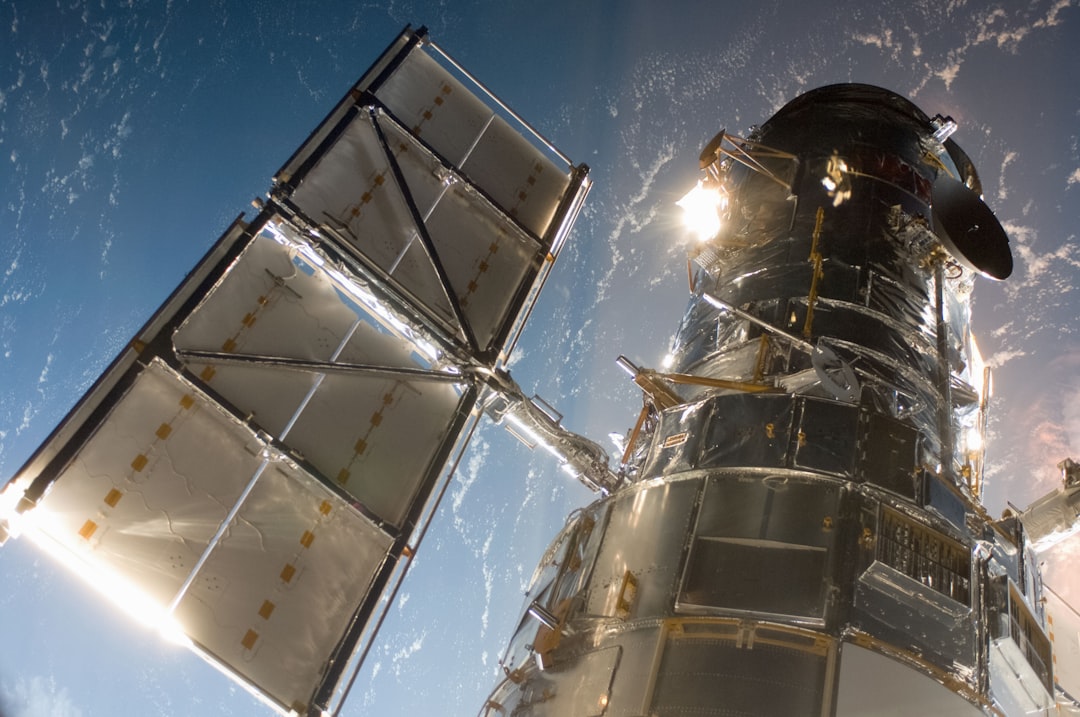
When someone asks me what originally got me interested in space exploration, my answer is always the same - the Hubble Deep Field. That image, taken in 1995, came out when I was in middle school, and had an everlasting impact on my sense of place in the universe. It’s since been improved upon by various other images, and even last week the Hubble team released yet another jaw-dropping image of the galaxy cluster MACS0329-0211 which recaptures some of the magic of that original image, and still provides the same sense of scale that never seems to truly fade once you come to terms with it. While the original Hubble Deep Field was a blind experiment to see what lay in a seemingly empty patch of sky, this new image comes from the targeted Cluster Lensing and Supernova survey with Hubble (CLASH) program, focusing on the dynamics of a specific massive galaxy cluster. The original Hubble Deep Field was a sort of experiment. The spacecraft operators pointed the spacecraft’s Wide Field and Planetary Camera 2 (which had recently been repaired) at a seemingly empty patch of sky about 1/13th the size of the full Moon in the constellation Ursa Major. They left the shutter open for more than 100 hours, taking 342 separate exposures. But the resulting image has completely changed astronomy. Instead of seeing “empty” space, the image showed there were over 3,000 galaxies at various stages of evolution. This was all in a space that made up 0.0000035% of the night sky. And these were full-on galaxies roughly the size of our own, not some dwarf galaxies that were attached to the Milky Way itself. If that statistic doesn’t give a sense of scale of the universe I’m not sure what would. The original Hubble Deep Field Image. Credit - NASA, Robert Williams, and the Hubble Deep Field Team (STScI) Since then the telescope has repeated that trick to prove it's not a fluke. In 1998, it completed the Hubble Deep Field South, with similarly striking results. But perhaps the most famous follow-on was the Hubble Ultra Deep Field. It looked at an even smaller fraction of the sky (roughly the size of a grain of sand held at arm’s length - approximately 1/26,000,000th) and found 10,000 galaxies. It required 800 different exposures taken over 400 orbits around Earth in 2003-2004, and was eventually released on March 9th, 2004. There have likely been thousands of papers written referencing these images over the last few decades. So given their success, it might not come as a surprise that the Hubble Team is still creating similar imagery every chance they get. This latest round is of galaxy cluster MACS0329-0211. Named after the MAssive Cluster Survey, which found the cluster, it became more famous around the early 2010s and was targeted by Hubble’s Cluster Lensing and Supernova survey with Hubble (CLASH) program in 2011 due to its massive X-ray source. This latest image is more than just a pretty picture, though. It contains some interesting scientific data. There are more than 1,700 galaxies in and around MACS0329-0211, some of which are “feeding” on the outer edges, moving about in chaotic patterns. The aftermath of that feeding can be seen in the “Ghost Light” that glows between the galaxies themselves. Astronomers believe that is the remnants of dwarf galaxies that were ripped apart by the larger galaxies in the area. *The Hubble Ultra Deep Field Image. Credit - NASA, ESA, and S. Beckwith (STScI) and the HUDF Team* Researchers had focused on this particular cluster as part of an observational program of X-ray bright galaxy clusters, which MACS0329-0211 is a great example of. Data was collected by the Advanced Camera for Surveys and the Wide Field Camera 3, which gathered visible and infrared light from the cluster. While this particular image has yet to have any scientific papers published about it, it is another great example of what makes Hubble such an effective ambassador for space exploration. As long as it maintains its ability to turn its sensors toward these distant, chaotic corners of the universe, it will keep reminding us that, while our place in the cosmos might be tiny, there’s a whole great lot of it for us to explore. Learn More: NASA - Hubble Sees Swarm of Galaxies UT - Webb Revists Hubble's Classic Ultra Deep Field UT - The New and Improved Hubble Ultra Deep Field UT - Long Ago and Far, Far Away... Hubble Discovers Most Distant Galaxy Yet!