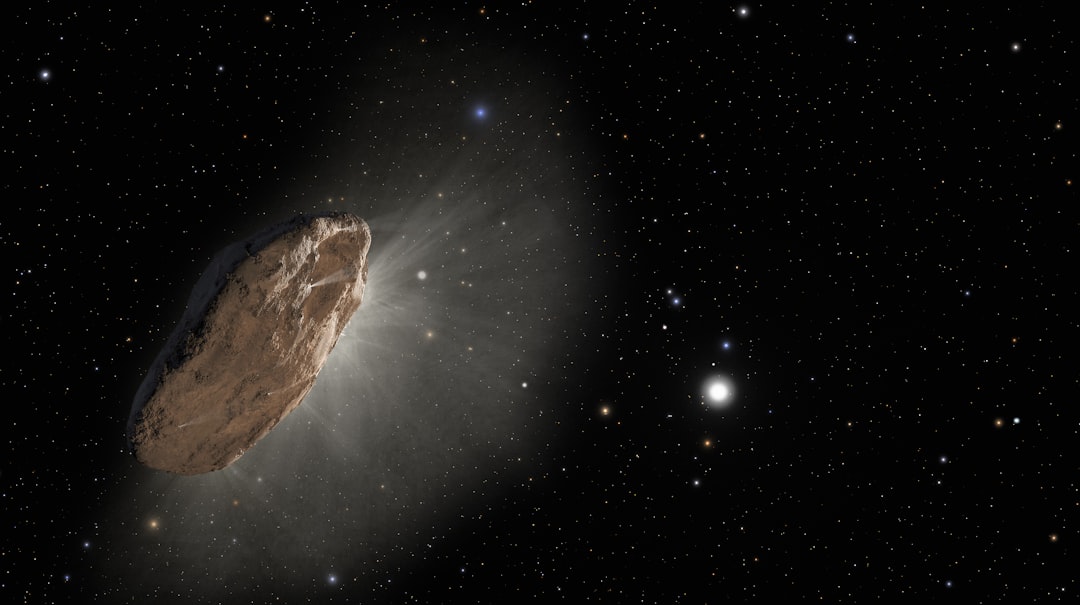
The Vera Rubin Observatory Finds Its First Dwarf Planet Candidate
In a landmark moment for planetary science, the Vera C. Rubin Observatory (VRO) has identified its first dwarf planet candidate — a distant, icy world catalogued as 2026 ED138 (hereafter ED138). Orbiting far beyond Pluto in the frigid outer reaches of our Solar System, ED138, if confirmed, would rank among the largest dwarf planets ever discovered beyond Neptune. Its detection, made even before the observatory's primary scientific mission officially commenced, underscores the extraordinary promise of this revolutionary facility and opens a new chapter in humanity's exploration of the outer Solar System.
A Discovery at the Edge of the Solar System
ED138 resides in a remote and poorly understood region of space — the realm of Trans-Neptunian Objects (TNOs) — where the Sun appears as little more than a brilliant star and temperatures hover near absolute zero. At approximately 46 astronomical units (AU) from the Sun — one AU being the mean Earth-Sun distance of about 150 million kilometers — ED138 orbits slightly farther out than Pluto, which averages roughly 40 AU. To put that into perspective, a ray of sunlight takes around 6.4 hours to reach ED138, compared to just 8 minutes to reach Earth.
This remote neighborhood is home to some of the Solar System's most intriguing worlds, including the recognized dwarf planets Makemake, Haumea, and Eris. These distant bodies are not mere cosmic debris — they are ancient relics, preserving chemical and orbital signatures from the earliest epochs of Solar System formation, more than 4.5 billion years ago.
The discovery was credited to Dr. Matthew Holman, a senior astrophysicist at the Center for Astrophysics | Harvard & Smithsonian (CfA) and a member of the Rubin Observatory team. Holman specializes in developing and refining the sophisticated algorithms that power Rubin's ability to detect faint, slowly moving objects against the star-studded backdrop of the night sky. He found ED138 on October 13, 2026, while processing data gathered earlier in the year — data collected even before the observatory's formal decade-long survey had begun.
"My first reaction was one of excited disbelief. Objects like this are very rare, so I immediately started checking whether I or the code had done something wrong."
— Dr. Matthew Holman, Senior Astrophysicist, CfA & Rubin Observatory Team Member
How Rubin Found What Others Missed
The Vera C. Rubin Observatory, perched atop Cerro Pachón in the Chilean Andes, represents a quantum leap in ground-based astronomical survey capability. Its centerpiece, the Simonyi Survey Telescope, is equipped with an 8.4-meter primary mirror and the world's largest digital camera — a staggering 3,200-megapixel instrument capable of imaging an area of sky roughly 40 times the size of the full Moon in a single exposure. This extraordinary combination of wide field of view and light-gathering power allows Rubin to repeatedly image the entire southern sky to unprecedented depths.
Traditional telescope surveys have been hampered by a fundamental trade-off: telescopes with large fields of view tend to sacrifice sensitivity, while those built for depth sacrifice sky coverage. Rubin elegantly sidesteps this dilemma. By revisiting the same patches of sky every few nights and stacking images over time, the observatory's algorithms can detect objects so faint they would be invisible to virtually any other ground-based facility. This makes it uniquely suited to discovering slow-moving, dimly lit bodies in the outer Solar System — objects that drift only imperceptibly against the background of distant stars over a single night.
After Holman's initial detection, Dr. Mario Jurić, a faculty member at the University of Washington and Rubin's Solar System Lead Scientist, combed through VRO's catalogued data and uncovered 20 additional detections of the same object. In total, the Simonyi Survey Telescope detected ED138 30 times across 20 separate nights between March 4th and July 11th. Crucially, additional detections were also found in archival images from the Dark Energy Camera (DECam), tracing the object's movement as far back as 2016. This ten-year arc of observational data allowed astronomers to construct a detailed and reliable orbital solution for ED138.
"Rubin is giving us an unprecedented capacity to explore the sky through a combination of speed, depth, and precision. And the discovery is just the beginning: once we identify a new object, we can search back months, and sometimes even decades, finding it in images where nobody knew to look. This ability to both discover and 'precover' objects is transforming how quickly and accurately we can determine their orbits and understand the distant Solar System."
— Dr. Mario Jurić, Solar System Lead Scientist, Vera C. Rubin Observatory
What Makes ED138 a Dwarf Planet Candidate?
Not every Trans-Neptunian Object earns the title of dwarf planet. According to the International Astronomical Union (IAU) — the body responsible for planetary classification — a dwarf planet must satisfy two primary criteria: it must orbit the Sun, and it must have sufficient mass for its self-gravity to overcome rigid body forces, pulling it into a roughly spherical shape. This threshold is known as hydrostatic equilibrium.
For icy bodies in the outer Solar System, this threshold is generally reached at diameters of roughly 400–600 kilometers or more, depending on the object's composition. Based on its observed albedo (reflectivity), distance, and apparent brightness, astronomers estimate ED138's diameter to lie between 600 and 1,500 kilometers. At these sizes, icy objects are gravitationally compelled into spherical shapes, making dwarf planet status highly plausible — though formal confirmation awaits further observations and analysis.
For context, Pluto itself has a diameter of approximately 2,377 km, while Eris measures about 2,326 km. Even at the lower bound of ED138's estimated size range, it would be a substantial world by the standards of the outer Solar System.
Key Characteristics of ED138 at a Glance
- Designation: 2026 ED138
- Current Distance from Sun: ~46 astronomical units (AU)
- Estimated Diameter: 600–1,500 km
- Orbital Inclination: ~25 degrees from the ecliptic plane
- Classification: Trans-Neptunian Object (TNO); Hot-Classical Kuiper Belt Object candidate
- Observational Arc: ~10 years (2016–2026)
- Number of Detections: 30 detections across 20 nights (plus archival data)
- Discovery Credit: Dr. Matthew Holman, CfA / Rubin Observatory
Where Does ED138 Fit in the Trans-Neptunian Taxonomy?
The Solar System beyond Neptune is a surprisingly rich and complex landscape, divided into distinct dynamical populations based on the shapes, sizes, and gravitational influences that govern their orbits. Understanding where ED138 fits requires a brief tour of this remote territory.
The Kuiper Belt
The Kuiper Belt extends roughly from 30 to 50 AU and is the most populated region of the outer Solar System. It contains hundreds of thousands of icy bodies, including Pluto, Makemake, and Haumea. ED138's current distance of ~46 AU places it squarely within this zone. However, its orbital inclination of about 25 degrees from the Solar System's plane — the ecliptic — marks it as a hot-classical Kuiper Belt Object. In this context, "hot" does not refer to temperature (these objects are extraordinarily cold), but to the dynamical history of the orbit. A high inclination suggests that ED138's orbit was stirred up and perturbed — most likely by gravitational interactions with Neptune during an early, turbulent epoch of Solar System evolution.
Scattered Disk Objects
Beyond the classical Kuiper Belt lies the scattered disk, populated by objects with highly elliptical and often steeply inclined orbits. These bodies, including the massive dwarf planet Eris and Gonggong, experienced strong gravitational scattering events with Neptune in the past and may still be weakly influenced by it today. Their orbits carry the fingerprints of a more chaotic early Solar System.
Detached Objects and Sednoids
Even more puzzling are the detached objects — TNOs whose orbits are so remote that Neptune's gravity cannot explain their current configuration. The most famous of these is Sedna, discovered in 2003, whose closest approach to the Sun (its perihelion) is an extraordinary ~76 AU — far beyond Neptune's reach. Sedna and a tiny cohort of similarly extreme worlds are sometimes classified as Sednoids, or Inner Oort Cloud Objects. With semi-major axes exceeding roughly 250 AU, they represent the most dynamically extreme population of known Solar System bodies, and their origins remain deeply mysterious.
The Broader Scientific Significance: Fossils of Solar System Formation
It would be easy to dismiss distant, icy worlds as trivial compared to the dramatic discoveries of Earth-like exoplanets or the detection of gravitational waves. But that would be a profound mistake. TNOs like ED138 are, in essence, frozen time capsules — primitive bodies that have changed relatively little since the Solar System's birth. Their orbits, compositions, and size distribution encode critical information about the physical and dynamical processes that shaped our planetary neighborhood over 4.5 billion years.
Consider what these objects tell us about Neptune's migration. In the leading theoretical framework — the Nice Model and its successors — the giant planets did not form in their current positions. Instead, Neptune is thought to have migrated significantly outward during the Solar System's early history, sweeping up and scattering the primordial population of icy planetesimals as it went. Objects like Pluto and Orcus, locked in orbital resonances with Neptune, are the surviving witnesses to this migration. They are, in a very real sense, planetary fossils.
The Kuiper Belt's surprisingly low total mass — estimated at less than 10% of Earth's mass — adds another layer to this story. Dynamical models suggest the region would need to have been far more massive in the past to allow these objects to grow through accretion. The implication is that most of the original material was ejected outward or inward through gravitational scattering — a violent early history that left only a sparse, stirred-up remnant population behind.
Then there is the enduring mystery of Planet Nine — a hypothetical, as-yet-undetected massive planet proposed to explain the peculiar orbital clustering of the most extreme Trans-Neptunian Objects (ETNOs). If Planet Nine exists, it would be a world several times Earth's mass lurking hundreds of AU from the Sun, herding distant TNOs into their anomalous orbits through gravitational shepherding. Every new TNO discovered at extreme distances, including the Sednoids, adds a data point to this unresolved and hotly debated puzzle.
"If confirmed as a dwarf planet, ED138 would join a very small family of worlds. Rubin will image the whole southern sky again and again for ten years, so any others hiding in the places earlier surveys skipped are now within reach."
— Dr. Matthew Holman, CfA & Rubin Observatory Team Member
Rubin's Revolutionary Role: The Legacy Survey of Space and Time
ED138's discovery is, remarkably, just a preview of what is to come. The VRO's formal scientific program — the Legacy Survey of Space and Time (LSST) — is a decade-long, all-sky survey that will observe the southern sky repeatedly, building up an unprecedented archive of roughly 20 billion catalogued astronomical objects. The LSST is expected to discover tens of thousands of new TNOs, potentially multiplying the known population many times over, and to detect thousands of near-Earth asteroids, supernovae, variable stars, and gravitational lens events simultaneously.
The combination of Rubin's survey power with its sophisticated "precovery" capability — the ability to retroactively identify newly discovered objects in years' worth of archival images — dramatically accelerates the process of orbit determination. What might once have taken decades of patient observation can now be accomplished in months. ED138 itself exemplifies this perfectly: by linking current detections to DECam archival images from 2016, astronomers immediately had a ten-year baseline from which to compute a robust orbit.
"Rubin Observatory's super power is the ability to clearly capture movement and change among a vast number of objects and phenomena that humans have never seen before. That power greatly extends our ability to reveal and understand new things about our Solar System, the Milky Way, and billions of other galaxies across the Universe."
— Edward Ajhar, NSF Program Director for Rubin Observatory
The societal investment in Rubin is already paying dividends. Alongside ED138, the observatory has already catalogued more than 11,000 new asteroids — all before its primary survey mission officially began. To help the public and researchers alike visualize these discoveries in context, the VRO's Education and Public Outreach team has developed OrbitViewer, an interactive tool that lets users explore the orbits of Solar System bodies in three dimensions and appreciate the vast, structured complexity of our cosmic neighborhood.
"Rubin Observatory's unique strengths make it an incredible tool for investigating a wide range of astrophysical phenomena, from dark energy to the discovery of this dwarf planet candidate."
— Kathy Turner, DOE Program Manager for Rubin Observatory
What Comes Next for ED138?
The measurements currently available for ED138 — its distance, brightness, albedo, and orbital parameters — are preliminary, and will be refined as additional observations accumulate. Follow-up observations from other facilities, including space-based infrared telescopes like the James Webb Space Telescope (JWST), could provide crucial constraints on the object's true diameter, surface composition, and thermal properties. Spectroscopic data, in particular, could reveal whether ED138's surface is