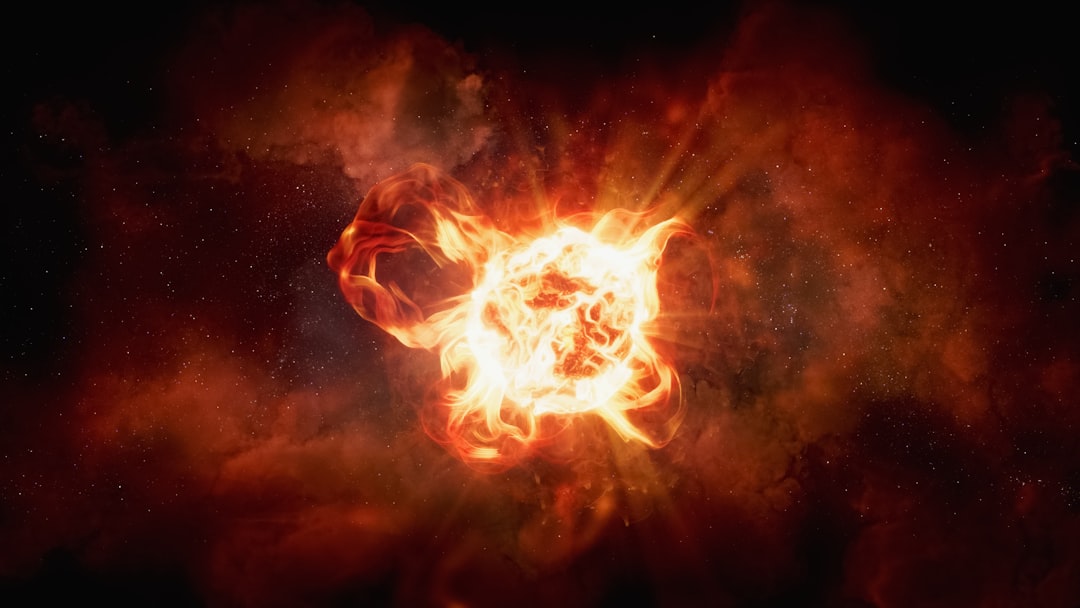
On July 2, 2025, astronomers monitoring the cosmos for fleeting cosmic explosions encountered something that defied every established pattern in their decades-long catalog of celestial violence. While gamma-ray bursts typically flash across the universe in mere seconds—brilliant, catastrophic, and ephemeral—this particular event stretched across seven hours, pulsed in three distinct episodes throughout an entire day, and left behind an afterglow that persisted for months. Designated GRB 250702B, this extraordinary phenomenon has become the longest gamma-ray burst ever documented, challenging our fundamental understanding of the most energetic explosions the universe can produce.
The detection, made by NASA's Fermi Gamma-ray Space Telescope, immediately captured the attention of the global astronomical community. In a field where researchers have catalogued approximately 15,000 gamma-ray bursts since their serendipitous discovery in 1973, GRB 250702B stands as a singular anomaly. Its duration alone places it in a category of one, but the repeating nature of its emissions—something previously thought impossible for genuine gamma-ray bursts—has sparked an intense scientific investigation that continues to yield fascinating possibilities about the hidden machinery of our universe.
Understanding the Cosmic Violence of Gamma-Ray Bursts
To appreciate the extraordinary nature of GRB 250702B, one must first understand what makes gamma-ray bursts the most violent phenomena in the known universe. These cataclysmic events release more energy in a few seconds than our Sun will emit over its entire ten-billion-year lifetime. The gamma radiation they produce—the highest-energy form of electromagnetic radiation—can only be generated under the most extreme physical conditions imaginable.
Traditional gamma-ray bursts fall into two well-established categories, each associated with specific cosmic catastrophes. Short-duration bursts, lasting less than two seconds, typically arise from the collision of two neutron stars or the merger of a neutron star with a black hole. These compact object mergers create conditions so extreme that they forge heavy elements like gold and platinum while simultaneously launching jets of particles at nearly the speed of light. Long-duration bursts, extending from two seconds to perhaps a few minutes, are generally linked to the deaths of massive stars—specifically, hypernovae or collapsars, where a star at least 20 times the mass of our Sun collapses directly into a black hole.
Both scenarios share a crucial characteristic: they are one-time, irreversible events. Once the neutron stars merge or the massive star collapses, the event is over. The burst may have a fading afterglow as the ejected material interacts with surrounding gas, but the primary emission doesn't repeat. This is precisely why GRB 250702B has proven so perplexing to researchers worldwide.
The Unprecedented Behavior of GRB 250702B
The anomalous nature of this event becomes clear when examining its temporal structure. Analysis published in Monthly Notices of the Royal Astronomical Society reveals that Fermi's detectors registered three distinct triggers spread across approximately 24 hours, with the primary emission phase lasting an unprecedented seven hours. The spacing between these bursts showed a quasi-regular pattern, suggesting an underlying physical mechanism that could operate repeatedly rather than catastrophically destroying itself in a single event.
"This is certainly an outburst unlike any other we've seen in the past 50 years of gamma-ray burst astronomy," noted a member of the detection team. "We're not just talking about a longer burst—we're talking about a fundamentally different type of event that challenges our classification schemes."
The afterglow of GRB 250702B proved equally remarkable. While typical gamma-ray bursts fade within days or weeks, follow-up observations revealed that this event's afterglow remained detectable for months, allowing astronomers to pinpoint its location with exceptional precision. The source was traced to a position approximately 5.7 kiloparsecs (about 18,600 light-years) from the center of its host galaxy—a detail that would prove crucial in developing theoretical explanations.
The Missing Link: Intermediate-Mass Black Holes
The leading explanation for GRB 250702B involves one of astronomy's most elusive objects: intermediate-mass black holes (IMBHs). The universe's black holes exist in a peculiar distribution. At the lower end of the mass spectrum, we find stellar-mass black holes ranging from about 5 to 100 solar masses, formed from the collapse of individual massive stars. At the opposite extreme lurk the supermassive black holes that anchor the centers of galaxies, with masses ranging from millions to billions of times that of our Sun.
Between these two populations should exist a third category: intermediate-mass black holes with masses between roughly 100 and 100,000 solar masses. Theoretical models of black hole formation and galactic evolution strongly suggest these objects should be common, perhaps forming from the merger of stellar-mass black holes in dense star clusters or representing the seeds from which supermassive black holes grew in the early universe. Yet despite decades of searching, confirmed detections of IMBHs remain frustratingly rare.
The challenge lies in detection methodology. Stellar-mass black holes reveal themselves through X-ray emissions as they consume material from companion stars, while supermassive black holes can be detected through their gravitational influence on stars orbiting near galactic centers. IMBHs, potentially isolated in the outskirts of galaxies or within globular clusters, have proven far more difficult to identify conclusively.
A Star Torn Apart: The Tidal Disruption Event Model
The research team investigating GRB 250702B has proposed a compelling scenario: the event represents a tidal disruption event (TDE) involving an intermediate-mass black hole and an ordinary star similar to our Sun. When a star ventures too close to a black hole, the differential gravitational force—or tidal force—across the star's diameter can exceed the star's own gravity holding it together. At this critical distance, known as the tidal disruption radius, the star is literally torn apart.
In a typical TDE involving a supermassive black hole, the disruption is usually complete and occurs in a single catastrophic encounter. However, the researchers propose that GRB 250702B resulted from a more gradual process they term a "milli-tidal disruption event." In this scenario, the star wasn't immediately destroyed but instead was partially stripped of material across multiple close passes around the IMBH. Each periapsis passage—the point of closest approach—would remove a portion of the star's outer layers while leaving the core intact to continue its orbit.
This model elegantly explains several key features of the observation:
- Extended Duration: Rather than a single catastrophic disruption, the seven-hour primary emission phase represents the continuous accretion of stellar material onto the black hole during multiple orbital passages
- Repeating Bursts: The three distinct triggers correspond to specific periapsis passages where fresh stellar material was stripped and rapidly accreted, producing intense bursts of emission
- Quasi-Regular Spacing: The timing between bursts reflects the orbital period of the partially disrupted star, providing indirect evidence for the system's dynamics
- Prolonged Afterglow: The extended afterglow results from continued accretion of the disrupted stellar debris, which forms an accretion disk that gradually feeds material onto the black hole over months
The Relativistic Jet Mechanism
The actual production of gamma rays in this scenario involves one of the most extreme physical processes in astrophysics: the formation of a relativistic jet. As stellar material spirals inward toward the IMBH, it forms an accretion disk—a swirling disk of superheated matter reaching temperatures of millions of degrees. Under the right conditions, particularly when the accretion rate is very high and the black hole is rapidly spinning, the system can launch narrow jets of particles perpendicular to the accretion disk.
These jets consist of electrons, positrons, and photons accelerated to velocities exceeding 99.9% the speed of light. The extreme velocities produce relativistic beaming, where the jet's radiation is focused into a narrow cone in its direction of travel—much like how a flashlight beam is more intense when pointed directly at you than when viewed from the side. This beaming effect means we can only detect the gamma-ray burst if one of the jets happens to be pointing nearly directly at Earth, suggesting that many similar events likely occur throughout the universe but remain undetected because their jets point elsewhere.
Location, Location, Location: The Galactic Context
The spatial location of GRB 250702B provides crucial supporting evidence for the IMBH interpretation. At approximately 5.7 kiloparsecs from its host galaxy's center, the source occupies a region that's neither in the dense galactic core nor in the sparse outer halo. This intermediate location is precisely where theoretical models predict wandering IMBHs might be found.
These black holes could have formed in several ways. One possibility involves runaway stellar collisions in dense globular clusters—ancient, spherical collections of hundreds of thousands of stars. In the crowded cores of these clusters, stars can collide and merge repeatedly, building up increasingly massive objects that eventually collapse into intermediate-mass black holes. These IMBHs might then be ejected from their birth clusters through gravitational interactions, becoming wanderers in the galactic suburbs.
Alternatively, IMBHs might represent primordial black holes that formed in the early universe and served as seeds for galaxy formation, or they could be the remnants of the first generation of massive stars that formed when the universe was less than a billion years old. Regardless of their origin, their location away from galactic centers makes them challenging to detect through traditional methods that rely on observing their gravitational influence on nearby stars.
Alternative Explanations and Ongoing Mysteries
While the IMBH tidal disruption model presents a compelling explanation for GRB 250702B, the scientific process demands consideration of alternative scenarios. Several competing models remain under active investigation, each with its own strengths and challenges.
One alternative proposes that the event might represent an extreme form of magnetar activity. Magnetars are neutron stars with magnetic fields trillions of times stronger than Earth's, and they're known to produce occasional giant flares. However, the duration and energy output of GRB 250702B far exceed even the most powerful magnetar flares on record, making this explanation problematic.
Another possibility involves a supermassive black hole at the galaxy's center producing an unusual accretion event, with the apparent offset location resulting from measurement uncertainties or peculiar jet geometry. However, detailed analysis of the host galaxy's structure and the precision of the location measurement make this scenario increasingly unlikely.
Some researchers have also suggested that the event might represent a new class of ultra-long gamma-ray bursts produced by the collapse of an extraordinarily massive star with unusual internal structure. While previous ultra-long GRBs have been detected with durations up to a few hours, none have shown the repeating behavior characteristic of GRB 250702B.
The Path Forward: Future Observations and Confirmation
Definitively confirming the nature of GRB 250702B will require additional observations and theoretical work. NASA's James Webb Space Telescope could potentially detect the afterglow at infrared wavelengths, providing information about the temperature and composition of the emitting material. Ground-based observatories might detect ongoing variability in the source, offering clues about whether material continues to be accreted onto the proposed IMBH.
Future gravitational wave observatories, including the planned Laser Interferometer Space Antenna (LISA), might detect similar events through the gravitational waves produced during the tidal disruption process itself. The combination of electromagnetic and gravitational wave observations would provide unprecedented insight into these extreme events.
Perhaps most importantly, the detection of additional events similar to GRB 250702B would help establish whether this represents a truly new class of cosmic phenomena or a unique outlier. Statistical analysis of multiple events could reveal patterns in their properties, locations, and host galaxy characteristics that would either support or challenge the IMBH interpretation.
Implications for Astrophysics and Cosmology
If the IMBH tidal disruption interpretation proves correct, GRB 250702B would represent a watershed moment in multiple areas of astrophysics. Most significantly, it would provide the first confirmed detection of a relativistic jet produced by an intermediate-mass black hole—a phenomenon predicted by theory but never before observed.
This discovery would also open a new window for detecting and studying the elusive IMBH population. Rather than relying on subtle gravitational effects or hoping to catch them in the act of accreting material quietly, astronomers could use gamma-ray observatories to identify these objects through their most dramatic interactions with stars. Each detection would provide valuable information about the IMBH's mass, spin, and environment.
The event also has implications for understanding stellar dynamics in galactic environments. The rate at which stars encounter black holes closely enough for tidal disruption depends on the density of stars and the population of black holes in different galactic regions. Detecting and characterizing these events helps constrain models of how stars and compact objects are distributed throughout galaxies.
Furthermore, the detection of such events contributes to our understanding of how matter behaves under the most extreme conditions of gravity, temperature, and density. The physics of accretion disks, jet formation, and particle acceleration in the vicinity of black holes remains an active area of research, and each new observation provides crucial tests of theoretical models.
A New Era of Multi-Messenger Astronomy
GRB 250702B exemplifies the power of modern multi-messenger astronomy, where cosmic events are studied across multiple channels of information. The initial detection came through gamma rays, but follow-up observations have spanned the electromagnetic spectrum from radio waves to X-rays. Future events might be detected through gravitational waves, neutrinos, or cosmic rays, each messenger providing unique information about the underlying physical processes.
The rapid response capabilities of modern astronomy proved crucial in this case. Within hours of Fermi's detection, observatories around the world were alerted and began pointing their instruments at the source location. This coordinated response allowed astronomers to capture the event's evolution in unprecedented detail, from the initial gamma-ray emission through the developing afterglow.
As we enter an era with increasingly sophisticated observatories—from space-based platforms like the James Webb Space Telescope to next-generation ground-based facilities like the Extremely Large Telescope—our ability to detect and characterize exotic cosmic events will only improve. Events like GRB 250702B remind us that the universe still holds surprises, and that our theoretical frameworks, while powerful, must remain flexible enough to accommodate genuinely new phenomena.
The seven-hour explosion that nobody could explain has become a catalyst for advancing our understanding of black holes, stellar dynamics, and the most energetic processes in the cosmos. Whether the IMBH interpretation ultimately proves correct or whether another explanation emerges, GRB 250702B has already secured its place as one of the most significant astronomical discoveries of the 2020s. In the grand tradition of scientific inquiry, the questions it raises may prove even more valuable than the answers it provides, driving the next generation of research into the hidden machinery of our universe.