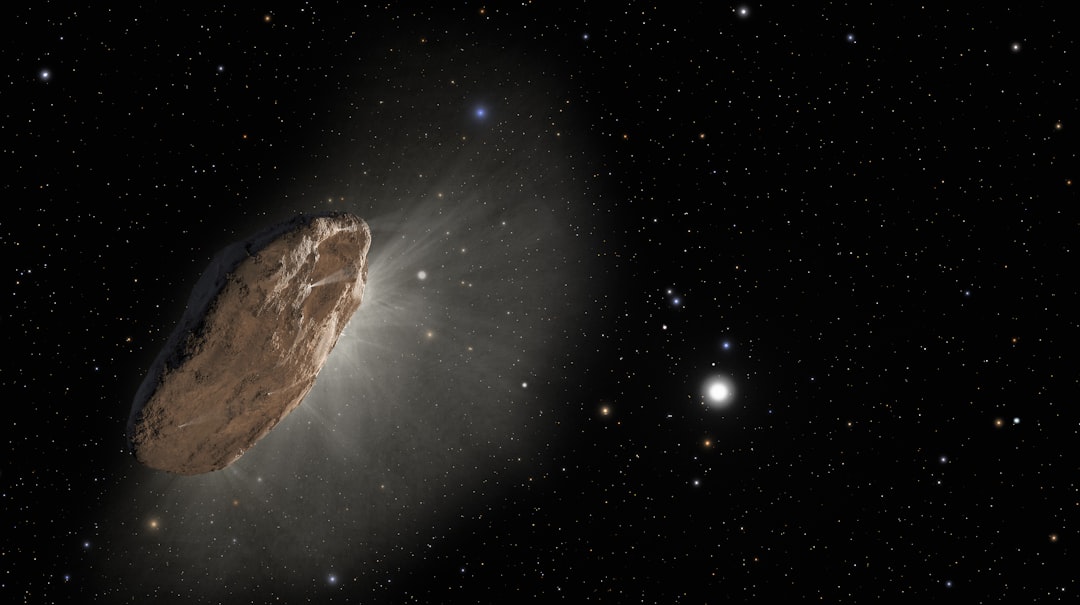
In a groundbreaking revelation that extends far beyond the initial success metrics, NASA's Double Asteroid Redirection Test (DART) has achieved something unprecedented in human history: altering the orbital path of a celestial body around our Sun. While the mission's primary objective—demonstrating humanity's ability to deflect potentially hazardous asteroids—was already confirmed successful in September 2022, new research published in Science Advances reveals that the spacecraft's kinetic impact produced ripple effects throughout the Didymos-Dimorphos binary system, fundamentally changing how both asteroids travel through our solar system.
The implications of this discovery reach far beyond the immediate technical achievement. For the first time in the 4.6-billion-year history of our solar system, a human-made object has demonstrably altered the heliocentric orbit of natural celestial bodies. This milestone represents not just a validation of planetary defense strategies, but a profound moment in humanity's relationship with the cosmos—we are no longer merely passive observers of celestial mechanics, but active participants capable of reshaping orbital dynamics on a solar system scale.
According to the international research team's meticulous analysis, the 770-day orbital period of the Didymos system around the Sun shifted by a fraction of a second following DART's impact. While this may seem infinitesimal, the precision required to detect such a change—and the long-term implications for planetary defense—cannot be overstated. The mission has transformed from a successful technology demonstration into a comprehensive case study of how kinetic impactors can protect Earth from catastrophic asteroid collisions.
The Mechanics of a Historic Impact
When the DART spacecraft slammed into Dimorphos at approximately 14,000 miles per hour on September 26, 2022, it delivered a precisely calculated blow to the 530-foot-wide moonlet orbiting the larger asteroid Didymos. The Italian Space Agency's LICIACube, which had separated from DART just days before impact, captured spectacular images of the collision's aftermath: a massive plume of rocky debris erupting from the impact site and streaming into space like a cosmic fountain.
Initial observations confirmed that Dimorphos's orbital period around Didymos had been shortened by 33 minutes—far exceeding the mission's minimum success threshold of 73 seconds. However, the true complexity of the impact's effects only became apparent through months of painstaking follow-up observations. The debris cloud itself, composed of countless fragments of pulverized rock and dust, carried significant momentum away from the asteroid system, creating what scientists call a momentum enhancement factor.
This enhancement factor proved to be approximately two, meaning the escaping debris effectively doubled the momentum transfer from the spacecraft's direct impact alone. Think of it like a rocket engine: the DART impact was the initial explosion, but the ejected material acted as propellant, providing additional thrust that amplified the orbital change. This phenomenon is crucial for future planetary defense planning, as it means kinetic impactors can be even more effective than simple momentum transfer calculations would suggest.
Unprecedented Precision: Measuring Infinitesimal Changes
Detecting the subtle shift in Didymos's solar orbit required extraordinary precision and innovative observational techniques. The research team, led by scientists from NASA's Jet Propulsion Laboratory and the University of Illinois Urbana-Champaign, employed a multi-faceted approach combining radar observations, optical tracking, and a particularly elegant technique called stellar occultation.
Stellar occultations occur when an asteroid passes in front of a distant star from Earth's perspective, briefly blocking its light. By precisely timing these events from multiple locations on Earth, astronomers can calculate the asteroid's position, shape, and velocity with remarkable accuracy. However, this method presents significant challenges: observers must be in exactly the right location at the right time, weather conditions must cooperate, and the timing must be measured to fractions of a second.
"When combined with years of existing ground-based observations, these stellar occultation observations became key in helping us calculate how DART had changed Didymos' orbit. This work is highly weather-dependent and often requires travel to remote regions with no guarantee of success. This result would not have been possible without the dedication of dozens of volunteer occultation observers around the world," explained Steve Chesley, senior research scientist at JPL and study co-lead.
Between October 2022 and March 2025, a dedicated network of volunteer astronomers spanning the globe recorded 22 successful stellar occultations of Didymos. These citizen scientists traveled to remote locations, set up sophisticated timing equipment, and waited in darkness for the brief moment when Didymos would cross in front of a background star. Their collective efforts enabled the research team to measure the asteroid's orbital velocity change of just 11.7 microns per second—equivalent to 1.7 inches per hour.
Binary Dynamics: How One Impact Affected Two Asteroids
The Didymos-Dimorphos system exemplifies what astronomers call a binary asteroid—two bodies gravitationally bound together, orbiting around their common center of mass. This configuration is more common in the asteroid belt than once thought, with approximately 15% of near-Earth asteroids existing in binary or multiple systems. Understanding how these systems respond to external forces is crucial for developing effective planetary defense strategies.
When DART impacted Dimorphos, the momentum transfer didn't just affect the smaller moonlet—it influenced the entire binary system. Because both asteroids orbit their shared center of mass, which in turn orbits the Sun, any change to one component necessarily affects the other. This gravitational coupling meant that the impact's effects propagated throughout the system, ultimately altering the pair's collective path around our star by 0.15 seconds per orbit.
Lead author Rahil Makadia from the University of Illinois Urbana-Champaign emphasized the long-term significance of this seemingly tiny change: "The change in the binary system's orbital speed was about 11.7 microns per second, or 1.7 inches per hour. Over time, such a small change in an asteroid's motion can make the difference between a hazardous object hitting or missing our planet."
Unlocking Asteroid Composition Secrets
The detailed observations required to track Didymos's orbital changes yielded an unexpected bonus: precise measurements of both asteroids' densities. The data revealed that Dimorphos is slightly less dense than Didymos, supporting the prevailing theory about the moonlet's formation. Scientists believe Dimorphos originated from rocky debris shed by a rapidly rotating Didymos, material that gradually coalesced into what's known as a "rubble pile" asteroid—a loosely consolidated collection of rocks and boulders held together primarily by gravity rather than internal cohesion.
This structural understanding has profound implications for planetary defense. Rubble pile asteroids respond differently to kinetic impacts than solid, monolithic bodies. The DART mission's success with Dimorphos provides valuable data about how such structures react to high-velocity collisions, information that will inform the design of future deflection missions.
Validating Planetary Defense Strategies
Thomas Statler, NASA's lead scientist for Solar System small bodies, contextualized the achievement in a recent NASA press release:
"This is a tiny change to the orbit, but given enough time, even a tiny change can grow to a significant deflection. The team's amazingly precise measurement again validates kinetic impact as a technique for defending Earth against asteroid hazards and shows how a binary asteroid might be deflected by impacting just one member of the pair."
The DART mission has provided empirical validation for what was previously theoretical modeling. The kinetic impactor method—using a spacecraft's momentum to alter an asteroid's trajectory—is now a proven technology rather than an untested concept. This is particularly important because, unlike the dramatic nuclear explosions depicted in Hollywood films, kinetic impactors offer a more controllable and predictable means of deflecting potentially hazardous objects.
However, the success of this approach depends critically on early detection. A kinetic impactor requires years or even decades of warning time to be effective—the earlier an asteroid's trajectory is altered, the smaller the required deflection to ensure it misses Earth. This is where NASA's upcoming Near-Earth Object (NEO) Surveyor mission becomes essential.
The Future of Planetary Defense
The NEO Surveyor represents the next generation of asteroid detection capabilities. Scheduled for launch in the late 2020s, this space-based infrared telescope will be the first mission specifically designed for planetary defense. Operating from a stable orbit around the Sun-Earth L1 Lagrange point, NEO Surveyor will scan the sky for asteroids and comets that could pose collision threats to our planet, with particular emphasis on detecting objects that approach Earth from the direction of the Sun—a blind spot for ground-based telescopes.
The mission aims to discover at least two-thirds of all near-Earth objects larger than 140 meters in diameter—the size threshold at which an impact could cause regional devastation. By providing decades of warning time, NEO Surveyor will enable missions like DART to deflect threatening asteroids long before they become imminent hazards.
Key Achievements and Implications
- First Human-Altered Solar Orbit: DART represents humanity's first successful modification of a celestial body's heliocentric orbit, marking a new era in our relationship with the solar system
- Momentum Enhancement Validation: The discovery that ejected debris doubled the impact's effectiveness provides crucial data for designing future deflection missions with optimal efficiency
- Binary System Dynamics: Demonstrating that impacting one member of a binary asteroid system affects both bodies offers new strategic options for planetary defense scenarios
- Citizen Science Success: The critical role played by volunteer astronomers in measuring orbital changes highlights the value of global collaboration in planetary defense efforts
- Rubble Pile Confirmation: Density measurements supporting Dimorphos's rubble pile structure provide essential information about how common asteroid types respond to kinetic impacts
A New Chapter in Cosmic Stewardship
Both NASA and the European Space Agency have confirmed that the modifications to Didymos's orbit pose no threat to Earth—the asteroid system remains safely distant from our planet. However, the mission's success extends far beyond this particular asteroid pair. DART has demonstrated that humanity possesses both the technology and the precision to protect our planet from cosmic threats that have shaped Earth's history for billions of years.
The dinosaurs had no space program. When a 10-kilometer asteroid struck the Yucatan Peninsula 66 million years ago, triggering a mass extinction event, life on Earth had no defense against such catastrophic impacts. Today, thanks to missions like DART and future systems like NEO Surveyor, humanity is developing the capability to detect and deflect potentially hazardous asteroids, ensuring that we need not share the dinosaurs' fate.
As we continue to refine our planetary defense capabilities, the lessons learned from DART—about momentum enhancement, binary system dynamics, and the incredible precision of modern astrometry—will inform the design of future missions. The slight shift in Didymos's solar orbit, measured with such painstaking accuracy by dedicated scientists and volunteer astronomers worldwide, represents more than a technical achievement. It symbolizes humanity's growing ability to safeguard our planetary home and ensure the continuation of life on Earth for generations to come.