This Giant Planet Survived the Death of its Star — and May Reveal the Fate of Our Solar System
Every star in the universe carries within it the seeds of its own destruction. Nuclear fusion, the engine that powers stars for billions of years, must eventually exhaust its fuel. When that happens, the consequences for any orbiting planets can be profound — and often fatal. Yet astronomers have now discovered compelling evidence that some worlds are remarkably resilient, capable of surviving the violent twilight of their host stars and emerging, against all odds, on the other side. The story of WD 1856 b is one of the most dramatic survival tales in the history of planetary science.
When Stars Die: A Tale of Two Endings
The manner in which a star meets its end depends almost entirely on its mass. At the upper extreme, stars many times more massive than our Sun detonate in catastrophic thermonuclear explosions known as supernovae. The shockwaves from these events radiate outward with enough energy to obliterate any planets in their vicinity, stripping atmospheres and vaporizing rocky bodies in an instant. For any civilization orbiting such a star, the end would be not just swift, but total.
Our own Sun, however, is destined for a more gradual demise — though no less dramatic in its implications. With a mass roughly halfway between the minimum needed to sustain fusion and the threshold required for a supernova, the Sun belongs to the vast majority of stars that will end their lives as white dwarfs. As its hydrogen fuel is depleted over the next approximately five billion years, the Sun will first swell into a red giant, expanding to perhaps 100 to 200 times its current radius. During this bloated phase, it will almost certainly consume Mercury and Venus, and may extend far enough to engulf Earth itself. Astronomers remain divided on Earth's precise fate, as complex tidal interactions make the outcome genuinely uncertain.
Should Earth survive engulfment, it would find itself in a radically transformed solar system. The Sun would shed its outer layers into space, forming a glowing shell of ionized gas called a planetary nebula — one of the most visually spectacular phenomena in the cosmos. At the center of this fading halo would remain the Sun's hot, compressed core: a white dwarf roughly the size of Earth but containing approximately half the Sun's original mass. Earth would then orbit this stellar remnant, basking in fading warmth that would gradually diminish over trillions of years.
"We're used to looking back in time when we use telescopes, but this is the first time we have been able to look forward to what might happen to the outer planets around the remnant of a Sun-like star. It's like using a time machine to peer into the distant future of our Solar System." — Ryan MacDonald, University of St. Andrews
Introducing WD 1856 b: The Oddball Survivor
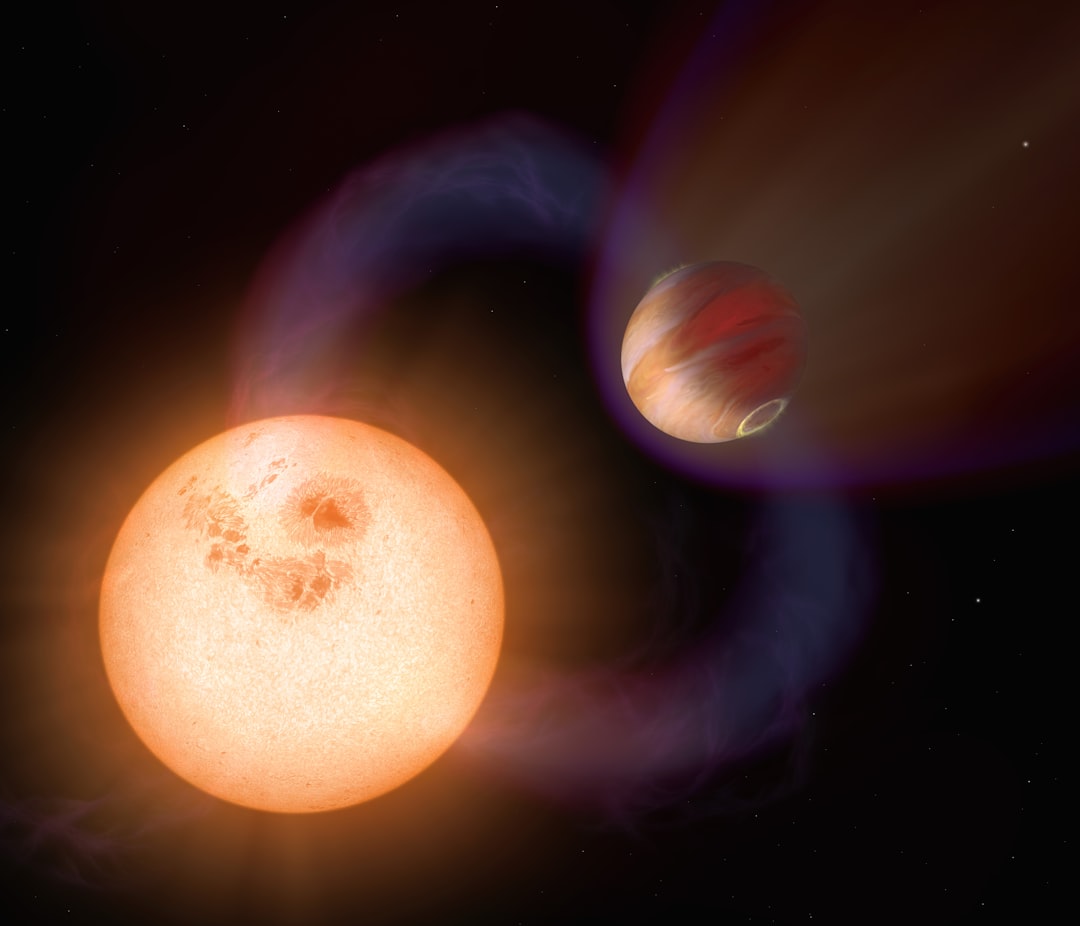
Against this cosmic backdrop, the discovery of WD 1856 b stands as a landmark moment in planetary science. Located approximately 80 light-years from Earth in the constellation Draco, this giant exoplanet was first identified in 2019 by NASA's Transiting Exoplanet Survey Satellite (TESS). Its host star, WD 1856+534, is a white dwarf estimated to be around 5.8 billion years old with approximately half the mass of the Sun — in other words, a stellar remnant remarkably similar to what our own Sun will one day become.
What makes WD 1856 b so extraordinary is not merely its existence, but where it exists. The planet has a radius approximately 10 times larger than Earth's — comparable in size to Jupiter — yet it orbits its tiny white dwarf host at a distance of just 0.02 astronomical units (AU). For context, Mercury orbits our Sun at about 0.39 AU. WD 1856 b's orbital period is a dizzying 1.4 Earth days, roughly 60 times shorter than Mercury's year. It is, by any measure, an extreme world in an extreme location.
"The planet is quite the oddball," said Ryan MacDonald, a lecturer in extrasolar planets at the University of St. Andrews and lead author of the new research. "It's about the size of Jupiter, but the white dwarf it orbits is the size of Earth, so the planet is seven times larger than its star."
This size disparity alone makes the system visually and scientifically remarkable — a behemoth planet dwarfing the stellar remnant it orbits. But the deeper scientific puzzle is one of survival and migration: how did a Jupiter-sized planet end up in such a tight orbit around a white dwarf without being destroyed?
The Mystery of Survival: Two Competing Theories
When WD 1856's progenitor star expanded into a red giant billions of years ago, the inner reaches of its planetary system would have been catastrophically reshaped. Any planet occupying an orbit like WD 1856 b's current position would have been engulfed and almost certainly destroyed. This raises an unavoidable question: did WD 1856 b form here, migrate here, or somehow survive direct engulfment?
Astronomers have ruled out one possibility with reasonable confidence. Some white dwarfs are surrounded by debris disks — rings of rocky material left over from planets that were destroyed during the red giant phase. In some cases, researchers have speculated that new planets could form from this debris. However, the debris disks observed around white dwarfs are far too low in mass to assemble a planet the size of Jupiter. Planet formation from a white dwarf debris disk is not a viable explanation for WD 1856 b.
That leaves two main theories, as outlined by Christopher O'Connor, a study co-author from Northwestern University's Center for Interdisciplinary Exploration and Research in Astrophysics (CIERA):
- Engulfment and survival: The planet may have been swallowed by the star during its red giant phase and somehow survived — a scenario that would require extraordinary resilience and implies violent tidal heating during transit through the stellar envelope.
- Post-main-sequence inward migration: The planet may have originally orbited at a safe distance during the star's red giant phase, then migrated inward after the white dwarf formed. Crucially, WD 1856 is actually a triple star system, with two red dwarf companions whose gravitational influence could have perturbed WD 1856 b's orbit, nudging it progressively inward through a mechanism known as Kozai-Lidov oscillations.
"The big question is how WD1856b ended up where it is today," said O'Connor. "The white dwarf is part of a triple star system, and the outer companion stars could have influenced WD1856b's orbit."
Disentangling these two possibilities required more than orbital mechanics — it required peering directly into the planet's atmosphere.
JWST Unlocks the Planet's Atmospheric Secrets
The new research, published in the journal Nature and titled "Aerosols and hydrocarbons in the atmosphere of a white dwarf planet," represents the most detailed characterization yet of WD 1856 b. The team used the James Webb Space Telescope (JWST) to obtain transmission spectroscopy of the planet as it passed in front of its host star, employing the telescope's NIRSpec instrument to analyze how starlight filtered through the planet's atmosphere. This technique reveals the chemical fingerprints of atmospheric gases with extraordinary precision.
The findings were striking on multiple fronts. Most immediately, the researchers measured the planet's atmospheric temperature and found it to be dramatically higher than expected. Based on the current luminosity of the white dwarf, WD 1856 b's equilibrium temperature — the temperature it should reach from starlight alone — ought to be around 160 Kelvin (approximately -113°C). Instead, JWST measured temperatures between 390 and 412 Kelvin (roughly 117–139°C). The planet is running far hotter than its stellar heating can account for.
This excess heat is a critical clue. According to the authors, it is consistent with a scenario in which WD 1856 b underwent a migration-related reheating event — significant tidal heating generated as the planet spiraled inward through the white dwarf's gravitational field. Their cooling models place this migration event 3.0 to 5.5 billion years into the white dwarf's lifetime, consistent with the system's current age and the planet's tightly circularized 0.02 AU orbit.
"On the basis of cooling models, these results indicate that WD 1856 b underwent a migration-related reheating event 3.0–5.5 Gyr into the white dwarf phase, consistent with post-main-sequence tidal evolution to the present-day 0.02-au circular orbit." — MacDonald et al., Nature, 2026
Methane in the Atmosphere: A Chemical Clue to Origins
Perhaps the most scientifically consequential discovery was the detection of abundant methane (CH₄) in WD 1856 b's atmosphere. JWST's NIRSpec instrument revealed multiple clear methane absorption features, along with a tentative detection of ethane (C₂H₆). The methane abundance was measured at approximately 7% by volume — a remarkably high concentration that speaks volumes about where this planet originally formed.
In planetary formation theory, the chemical composition of a planet's atmosphere carries a record of its birthplace within the protoplanetary disk. Methane is a carbon-bearing molecule that forms efficiently in the cold, outer regions of planetary systems, beyond what are known as the water ice line and the carbon monoxide ice line — the distances from a star at which those molecules freeze out of the gas phase. A carbon-enriched hydrogen atmosphere containing 7% methane strongly implies that WD 1856 b did not form in its current location. Rather, it formed in the cold outer reaches of its original planetary system, accumulating carbon-rich ices, before subsequently migrating inward to its present orbit.
This chemical signature is consistent with what we observe in the giant planets of our own Solar System. Jupiter, for example, has an atmosphere enriched in carbon relative to solar abundances, thought to reflect the accretion of carbon-bearing ices beyond the solar system's ice lines during its formation. WD 1856 b's atmospheric composition mirrors this story, but tells it around a star that has already completed its entire main-sequence lifetime — offering a glimpse of what the outer solar system might look like billions of years from now.
Implications for Habitability and the Long-Term Future
Beyond the immediate scientific intrigue of WD 1856 b itself, these findings carry profound implications for one of astronomy's most fundamental questions: can planets orbiting white dwarfs be habitable? White dwarfs do not generate energy through nuclear fusion — that phase of their existence is over. But they retain enormous amounts of residual thermal energy from their former lives as main-sequence stars, and they radiate this heat gradually over timescales measured in trillions of years.
A planet in the right orbital range around a white dwarf could, in principle, receive sufficient warmth to maintain liquid water on its surface — the conventional prerequisite for life as we know it. WD 1856 b itself is far too close and far too hot for this to be the case, but its very existence demonstrates that giant planets can survive the post-main-sequence transition and achieve stable orbits around white dwarfs. If Jupiter-sized worlds can make this journey, smaller, rockier planets might too.
Key takeaways from this research include:
- Planets can survive the red giant phase of their host stars and remain intact as white dwarf companions.
- Tidal migration driven by companion stars in multi-star systems can move giant planets into tight white dwarf orbits long after the main-sequence phase ends.
- The atmospheric composition of white dwarf planets preserves a chemical record of their formation history, detectable with JWST transmission spectroscopy.
- The excess thermal emission from WD 1856 b provides direct evidence of migration-induced tidal heating, constraining the timeline of the planet's inward journey.
- The discovery widens the potential parameter space for habitable worlds in post-main-sequence stellar systems.
"Our findings have bearing on the long-term fate of our solar system," said O'Connor. "In roughly five billion years, our Sun will die, and we don't know precisely what will happen to the planets at that time. The fact that planets can survive into that final stage of the stellar life cycle really widens the range of possibilities for where and when habitable planets might exist in the universe."
JWST as a Time Machine — Looking Forward, Not Back
The James Webb Space Telescope has justifiably earned fame for its ability to peer into the deepest reaches of the early universe, detecting the light of the first galaxies that formed just hundreds of millions of years after the Big Bang. But this research highlights a fundamentally different and equally powerful application of JWST's capabilities: as a tool for understanding the future, not just the past.
By probing the atmosphere of a planet that has already navigated the death of its star, JWST is effectively showing us a scenario our own Solar System will eventually face. The NIRSpec instrument's high-resolution spectroscopy, capable of detecting molecular absorption features at parts-per-million sensitivity, makes it uniquely suited to characterizing the atmospheres of exoplanets orbiting faint host stars like white dwarfs — a class of targets that would have been almost entirely inaccessible to previous generations of space telescopes.
As the authors note, several additional planet candidates have recently been identified orbiting white dwarfs, suggesting that WD 1856 b is not an isolated curiosity but perhaps the first well-characterized member of an emerging new class of planetary systems. Each new detection will add to our understanding of how planetary systems evolve and survive — or fail to — across stellar lifetimes spanning billions of years.
A New Window on Planetary Destiny
The story of WD 1856 b is ultimately a story about persistence. In a universe where stellar evolution repeatedly reshapes and destroys planetary systems, this giant world endured — forming far from its star in the cold outer disk, surviving or circumventing its star's swollen red giant phase, migrating inward under the gravitational tutelage of companion stars, and arriving in its current extraordinary orbit still chemically intact, its atmosphere bearing the unmistakable fingerprints of its distant origins.
For astronomers, the planet represents a rare and precious opportunity: a fully formed, spectroscopically accessible giant planet orbiting a stellar remnant, offering direct insight into the post-main