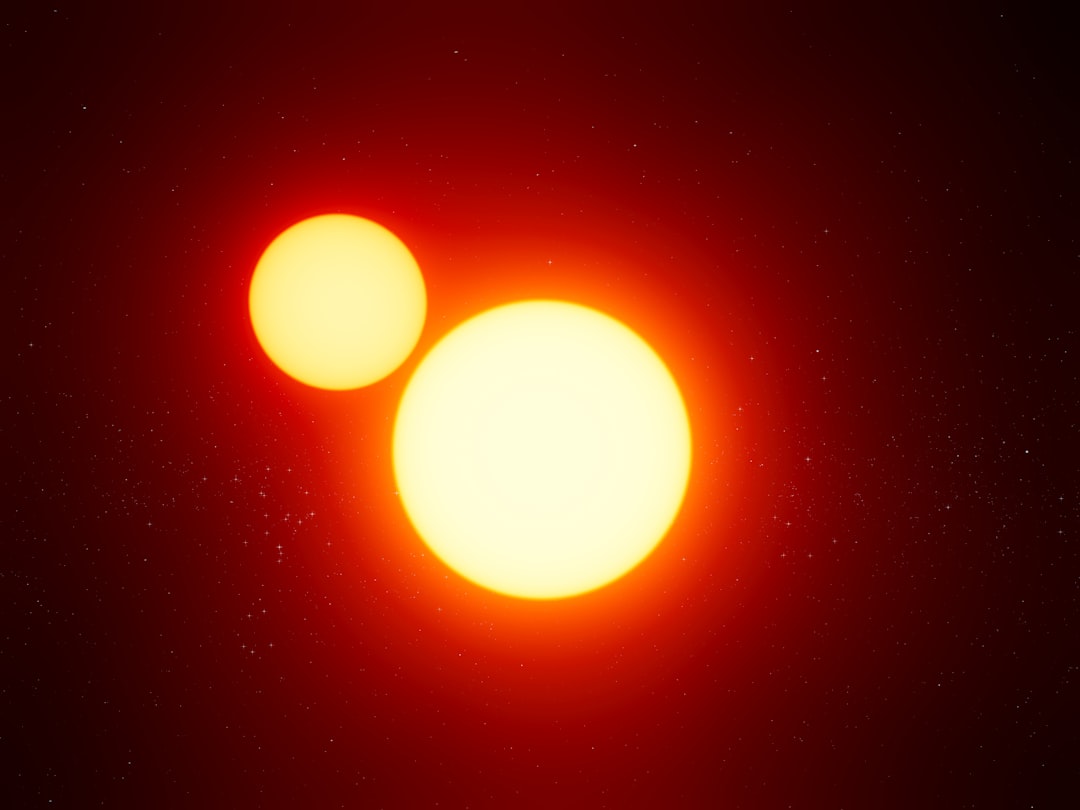
First-Ever Real-Time Observation of a Stellar Merger Inside a Common Envelope Stuns Astronomers
In a landmark achievement for observational astrophysics, astronomers have witnessed — for the very first time — the complete lifecycle of a common envelope evolution (CEE) event, from its quiet onset through to a catastrophic stellar merger and eruption. The discovery, centered on a transient object in our neighboring Andromeda Galaxy known as AT 2025abao (affectionately nicknamed "Bao"), is reshaping our understanding of one of the most consequential — and elusive — processes in stellar physics. The findings are published in Nature in a paper titled "An inspiral of a star inside a common envelope with its giant companion," led by Viraj Karambelkar, a NASA Hubble Fellow at Columbia University in New York.
The Cosmic Dance of Binary Stars
To appreciate the significance of this discovery, it helps to understand just how common binary star systems are. Up to 40% of all stars in the Milky Way are thought to exist in binary or multi-star systems, though precise estimates continue to evolve as surveys improve. Even Sirius, the brightest star in Earth's night sky, is in fact a binary system — Sirius A, a dazzling main-sequence star, paired with Sirius B, a white dwarf. Many of the most dramatic events in astrophysics — from Type Ia supernovae to the formation of neutron star binaries capable of producing gravitational waves — trace their origins back to the complex interplay between two stars locked in mutual gravitational embrace.
Yet for all their abundance and importance, binary stars can evolve through stages that remain deeply mysterious. Among the least understood of these is the phenomenon of common envelope evolution, a critical phase in which two orbiting stars become engulfed within a single, shared cocoon of gas. Understanding how and why this happens — and what results from it — is one of the central open problems in stellar astrophysics.
What Is Common Envelope Evolution?
The story of a common envelope (CE) begins with an inequality. No two stars in a binary system age at exactly the same rate; the more massive star evolves faster, eventually leaving the main sequence and swelling into a giant. As it expands, it overflows its Roche lobe — the teardrop-shaped region of gravitational influence within which a star can retain its own material. Once a star expands beyond this boundary, its outer layers begin streaming toward its companion under gravity, initiating a process of mass transfer that can rapidly become unstable.
When mass transfer turns runaway, the companion star cannot absorb the infalling material quickly enough. Instead, gas accumulates and spreads outward, eventually enveloping both stars in a common envelope of loosely bound, convective gas. Inside this shared cocoon, both stars continue to orbit one another — but their motion is now resisted by the drag of the surrounding gas. This drag bleeds away the orbital energy of the two stars, causing them to spiral inward toward each other in a process called the inspiral.
"The formation of compact stellar binaries requires rapid orbital tightening of their progenitor binary stars. This is theorized to happen via Common Envelope Evolution, when the stars orbit in a loosely bound, shared convective envelope, triggering an inspiral due to frictional drag." — Karambelkar et al., Nature
The eventual fate of the system hinges on a critical race: can the common envelope be ejected — blown away by energy released during the inspiral — before the two stars spiral close enough to merge? If the CE is ejected in time, the two stars survive as a compact binary, their orbits dramatically tightened. These compact binaries serve as the progenitors of some of the most exotic objects in the universe, including cataclysmic variables, X-ray binaries, and potentially the double neutron star systems whose mergers produce gravitational waves detected by facilities like LIGO. But if the CE is not ejected in time, the relentless drag forces the stars to merge — culminating in a spectacular explosion known as a luminous red nova (LRN).
The Rarity and Difficulty of Catching a Merger
Despite the profound astrophysical importance of CEE, astronomers have struggled enormously to observe it directly. The problem is twofold. First, these events are intrinsically rare; only a few dozen luminous red novae have ever been catalogued across the observable universe. Second, they are almost completely unpredictable. A binary system can spend thousands — sometimes millions — of years in a quiescent state before the conditions for a common envelope interaction are triggered. The precursor signatures are subtle and easily missed unless one happens to be monitoring the right star at the right time.
As a result, most of what astronomers know about CEE has come from painstaking forensic astrophysics: examining the aftermath of events that occurred years, decades, or even millennia before powerful enough telescopes existed to study them. Reconstructing a stellar merger from its cold remnants — using simulations and theoretical models to reverse-engineer what must have happened — is an inherently uncertain enterprise. The absence of direct, real-time observational data has left major gaps in our theoretical understanding, particularly regarding the efficiency of the CE ejection process and the timescales involved in the inspiral.
This is precisely what makes the discovery of AT 2025abao so extraordinary.
Introducing "Bao": A Stellar Drama Seven Years in the Making
The story of Bao began not with a bang, but with a whisper. Archival observations stretching back to 2018 showed AT 2025abao, located in the Andromeda Galaxy (M31) approximately 2.5 million light-years from Earth, quietly and gradually brightening in optical wavelengths. For years, this subtle brightening attracted attention but no definitive explanation. It was only when the brightening continued — and was accompanied by increasingly unusual spectral behavior — that astronomers realized something truly momentous might be unfolding.
"Stellar mergers are very, very difficult to observe in real time because they are hard to predict," said lead author Karambelkar. "However, we noticed something unusual was going on in 2023 and continued to monitor the system to see what it would do. Then, in 2025, it erupted! Webb observed Bao only 47 days after the stars' eruption peaked, the earliest ever follow-up of an event like this. The telescope's data helped us characterize what the system looked like before, during, and immediately after the merger, which is absolutely mind-blowing."
The timeline of events is remarkable in its detail. Between 2018 and early 2025, the system brightened steadily in optical light — a subtle but telling precursor. Then optical brightness faded while infrared emission continued to increase, a classic hallmark of expanding, cooling ejecta. The climax came in October 2025: the system erupted, brightening by a factor of 100 times in the r-band over just 25 days, with its photospheric temperature spiking to approximately 8,000 Kelvin. This was followed by an approximately 80-day plateau phase during which the system cooled to around 3,000 Kelvin — squarely within the temperature range expected for a luminous red nova.
The James Webb Space Telescope (JWST) observed AT 2025abao just 47 days after the eruption peaked, making it the earliest-ever follow-up observation of a CEE merger event. The telescope's extraordinary infrared sensitivity and spatial resolution allowed astronomers to characterize the system's dust environment, stellar photosphere, and ejecta geometry in unprecedented detail.
The Cast of Characters: Big Bao and Little Bao
Combining archival data, spectroscopy from multiple telescopes, and sophisticated computer simulations, the team was able to reconstruct the nature of both stars involved in the merger. The results were striking.
The primary star — dubbed "Big Bao" by the research team — was identified as a highly evolved Asymptotic Giant Branch (AGB) star: a stellar behemoth with a mass roughly seven times that of the Sun, a radius approximately 350 times larger, and a luminosity an astonishing 18,000 times greater than our own star. AGB stars represent a late evolutionary stage in which a star has exhausted the hydrogen and helium fuel in its core and swells to enormous proportions, developing a deep convective outer envelope — precisely the extended, loosely bound structure that classical CEE theory predicts as the initiating condition for common envelope formation.
"It was an absolute beast of a star, completely outshining its companion in the data." — Karel Temmink, Ph.D. student, Radboud University
The companion — "Little Bao" — was far more modest: approximately 0.7 solar masses, roughly one-tenth the mass of its giant partner, with a significantly smaller radius and much lower luminosity. Likely a main-sequence star not unlike our own Sun in size (though somewhat less massive), Little Bao was almost entirely invisible in the observational data, hidden in the overwhelming glare of its enormous companion.
When Big Bao swelled beyond its Roche lobe and engulfed Little Bao in a common envelope, drag forces began inexorably drawing the two together. What happened next was startlingly swift. Where other known CE binary systems have spiralled inward over thousands of orbits before merging, the Bao system completed the entire inspiral in just seven orbits — approximately seven years. The speed of this merger is itself scientifically significant, suggesting that the efficiency of energy transfer from the spiralling companion to the envelope may be considerably higher in systems with extended, convective AGB envelopes than in those with more compact primaries.
The Role of SPHEREx and Multi-Telescope Observations
A remarkable aspect of this discovery is the breadth of telescope resources brought to bear on a single transient. The event had been monitored for years before its climax, providing an unusually rich baseline of archival data. But a serendipitous observation proved particularly valuable: in July 2025, as the system underwent rapid optical fading, it was captured by the SPHEREx near-infrared space observatory during its first all-sky survey. This chance observation provided a precise snapshot of the stellar photosphere at a critical juncture in the merger process, enabling the team to determine key physical parameters including the temperatures and luminosities of both stars.
"In July 2025, the source was serendipitously observed during its rapid optical fading by the first sky survey of the SPHEREx mission, providing a precise glimpse of the stellar photosphere during this phase," the researchers state in their paper. The SPHEREx data, combined with spectroscopy from ground-based facilities and photometry spanning seven years, gave the team an end-to-end picture of the system that is entirely without precedent in the study of common envelope evolution.
Co-author Kishalay De, an assistant professor at Columbia University, explained the physical interpretation of the precursor brightening: "When a companion star begins to interact with the outer surface of the primary star, it produces a subtle effect — a slow brightening, which we clearly saw in Bao's data. As the companion continues its orbit, it keeps peeling off the primary star's outer layers, and that gas flows away into the surrounding space."
Meanwhile, co-author Nadia Blagorodnova, an associate professor at the University of Barcelona, was struck by the speed of the final eruption: "We thought an outburst from such an extended star would take years. One day, its brightness started rising and within a week, it peaked!"
Why This Event Is Scientifically Unique
AT 2025abao does not simply add another entry to the catalog of luminous red novae — it fundamentally changes what astronomers know about common envelope evolution. The key distinction lies in the nature of the primary star.
All previously known LRN progenitor systems have featured main-sequence primary stars — stars still fusing hydrogen in their cores, with relatively compact structures. But classical CEE theory, as originally formulated, predicts that the archetypal common envelope event should involve a highly evolved AGB giant as the primary — exactly the kind of star Big Bao turned out to be. Despite this theoretical prediction, no such system had ever been directly observed in a CEE merger event — until now.
"AT 2025abao provides the first view of a classical CEE progenitor system continuously monitored from its onset through its culmination." — Karambelkar et al., Nature
This distinction has profound implications. AGB stars have extended, convective envelopes with very different physical properties from the more compact envelopes of main-sequence stars. The dynamics of the inspiral — how quickly orbital energy is deposited into the envelope, how efficiently the envelope is ultimately ejected — may differ substantially between the two types of system. By observing a true AGB-based CEE event from beginning to end, astronomers have gained their first direct empirical window into the physics that classical theory was designed to describe.
The geometry of the post-merger ejecta also revealed important structural information. JWST observations showed that gas from the ejected common envelope expanded freely at the poles of the remnant system, while being constrained at the equator by previously shed material from the primary's AGB wind — material that had accumulated over hundreds of years before the merger itself. This aspherical geometry is a critical diagnostic for models of how CE ejection proceeds and what the resulting compact object will look like as it evolves.
Simulations: Bridging Theory and Observation
Even with an extraordinary wealth of observational data, interpreting a CEE event requires the complementary power of hydrodynamic simulations. The team, led on the modeling side by Ph.D. student Karel Temmink at Radboud University in Nijmegen, Netherlands, ran a series of simulations exploring different models of common envelope evolution until they found one whose predicted observational signatures — particularly the infrared dust emission seen by JWST — matched the data. This iterative modeling approach allowed the team to infer the masses and radii of both stars with confidence that would not have been possible from observations alone.
The importance of simulations in CEE research extends well beyond this single event. The efficiency parameter of common envelope ejection — usually denoted α in theoretical models — is one of the most uncertain quantities in binary stellar evolution. Depending on how efficiently orbital energy is converted into kinetic energy of the envelope, the predicted outcomes of CEE range from tightly bound compact binaries to full stellar mergers. Observations like those of AT 2025abao provide the first genuine empirical anchor for these models in the AGB primary regime, with the potential to dramatically tighten constraints on α for this class of system.
For further background on how the European Space Agency and NASA's Hubble Space Telescope