What's It Like to Travel Near the Speed of Light? Part 2: The Warped View
(This is Part 2 of a series on what it's like to travel near the speed of light. Read Part 1 first.)
Let's start with perspective. It's strange enough on its own, but it's also gentle enough to absorb — which makes it good groundwork for the heavier stuff coming later. Perspective, after all, is the lens through which all of physics ultimately reveals itself, and nowhere does it warp more dramatically than when you push your velocity toward the ultimate cosmic speed limit: the speed of light, approximately 299,792 kilometers per second in a vacuum.
The Umbrella Analogy: When Motion Changes Everything
Have you ever walked in the rain holding an umbrella? You hold it straight overhead because the rain is falling from directly above, and presumably you'd like to stay dry. But then you realize you're late, or you're just sick of being out in it, and you start to hurry. Suddenly the rain isn't hitting you from directly above anymore. It's coming from above and a little bit in front — not because the wind picked up, and not because the rain started falling at an angle, but because your interaction with the rain has changed. You're moving into it, so the point where you and the rain meet has shifted to mostly above, but a little bit in front.
So you tilt the umbrella forward a bit and keep sloshing along.
The physics with light isn't exactly the same, because relativity is relativity, but the gist carries over in a surprisingly useful way. This phenomenon — the apparent shift in the direction of incoming radiation due to an observer's motion — is known in physics as aberration of light, first observed astronomically by James Bradley in 1727 when he noticed that starlight appeared to arrive at a slight angle depending on Earth's orbital velocity. It was one of the earliest observational confirmations that light travels at a finite speed. At the modest velocities of everyday life, the effect is barely noticeable. But push your speed toward a significant fraction of c — the speed of light — and aberration stops being a footnote and starts being the dominant feature of your entire reality.
A Universe Squeezed into a Cone
As you move through space, you are surrounded by light: sunlight, starlight, the cosmic microwave background (CMB), the thermal glow of planets and interstellar dust, the occasional high-energy gamma ray from some distant supernova. The usual suspects. That light arrives from every direction, more or less uniformly — assuming you aren't parked right next to a star. But the moment you start moving, the meeting point between you and the light shifts. Instead of arriving from all around, it now seems to come from all around and a little bit in front.
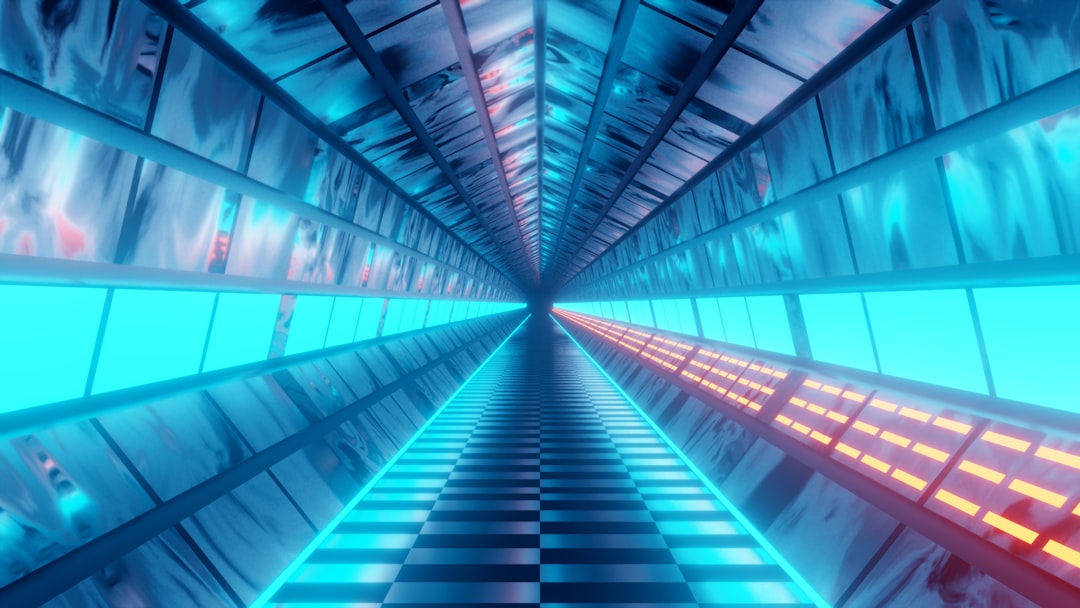
So the view behind you grows dark, and the rest of the universe — which would normally surround you evenly — gets squeezed forward into a cone beside and ahead of you. This effect is called relativistic beaming, sometimes referred to as the headlight effect, and it is a direct consequence of Einstein's special theory of relativity. The faster you go, the more extreme the compression. At 10% of the speed of light, the effect is subtle. At 90% of the speed of light, the entire visible universe has collapsed into a tight, blazing disk around your forward direction. And at velocities approaching lightspeed itself, the compression becomes catastrophic: every scrap of light from the entire universe is crammed into a single, blinding disk hanging directly in front of your face, with total blackness everywhere else.
"The entire universe distorted, focused, compressed, and energized into a single point in front of you — like a laser-powered fist of light aimed square at your face as you approach the speed of light."
This is not a trick of imagination. It is a mathematically precise prediction of Einstein's Special Theory of Relativity, confirmed through numerous experiments and observations. The relativistic aberration formula tells us exactly how the apparent angle of incoming light shifts as a function of velocity, and the results are unambiguous: the universe warps around you as you accelerate.
The Doppler Effect: When the Universe Turns Blue — Then Deadly
The compression of the visual field is only part of the story. There's a second effect operating simultaneously, and it's arguably more dangerous: the relativistic Doppler effect.
You're already familiar with the classical Doppler effect. It's why an ambulance siren sounds higher-pitched as it approaches you and lower-pitched as it recedes. Sound waves get compressed when the source is moving toward you, raising the frequency, and stretched when it's moving away, lowering it. Light obeys the same fundamental principle, but with a relativistic twist — because light always travels at c relative to any observer, the formula must be modified to account for time dilation, one of the most famous and well-tested consequences of special relativity.
The result: as you race toward a source of light — or, equivalently, as light races toward you while you travel headlong into it — the wavelength of that light gets compressed. It blueshifts. Radio waves climb to microwaves, microwaves climb to infrared, infrared climbs to visible light, and visible light climbs to ultraviolet, then to X-rays, then to gamma rays. The gentle, low-energy starlight and the whisper-quiet cosmic microwave background radiation — the faint afterglow of the Big Bang, detectable even today at a temperature of just 2.7 Kelvin — get dragged violently up the electromagnetic spectrum into forms of radiation that would be intensely lethal to any biological organism, and catastrophically damaging to any spacecraft material we can currently engineer.
- At 10% of lightspeed: Mild blueshifting; starlight shifts slightly toward the blue end of the visible spectrum. The effect is aesthetically striking but not yet dangerous.
- At 50% of lightspeed: Significant blueshifting; much of the infrared background climbs into visible and ultraviolet wavelengths. The forward hemisphere begins to glow with unusual intensity.
- At 90% of lightspeed: The CMB blueshifts into the X-ray regime. The forward cone is now a source of ionizing radiation. Unshielded biological life would not survive prolonged exposure.
- At 99% of lightspeed: The forward disk blazes with gamma radiation. The radiation environment would be among the most hostile in the known universe.
- Approaching 100% of lightspeed: All electromagnetic energy in the observable universe is compressed into a single forward point of theoretically infinite energy density. The engineering challenge is, to put it mildly, unsolved.
Physicists studying the practical implications of relativistic travel have noted that the interstellar medium itself — the sparse fog of hydrogen atoms and dust particles drifting between the stars — becomes an additional hazard at relativistic speeds. Each hydrogen atom, struck at 99% of lightspeed, hits with the energy of a cosmic ray particle. A spacecraft traveling at such velocities would face a constant, furious bombardment from what is, at rest, effectively empty space.
Relative Motion and the Democracy of Reference Frames
Here is where the story deepens in a philosophically important way, and it's worth pausing on it. Everything described above — the aberration, the beaming, the blinding forward cone of compressed and blueshifted radiation — is not a property of the universe. It is a property of your perspective.
Not one photon out there is behaving any differently. The universe hasn't changed. Only your relationship to it has changed, and near lightspeed, that relationship bends your view of everything outside quite severely.
This is the bedrock of special relativity: there is no preferred frame of reference for observers moving at constant velocity. This principle — first articulated by Galileo Galilei and later formalized by Albert Einstein in his landmark 1905 paper, On the Electrodynamics of Moving Bodies — means that the laws of physics look the same to every non-accelerating observer, regardless of how fast they're moving relative to anything else. Drop you inside a giant sphere of lightbulbs floating in empty space and switch them on. You get the exact same Doppler shift and the same compression into a searing cone of pain whether you are the one moving toward one side of the sphere, or whether you are sitting still and the sphere is contracting around you. What matters is the relative motion between you and the light source — nothing more, nothing less.
This is a deeply counterintuitive idea, but it has been experimentally confirmed to extraordinary precision. From the Michelson-Morley experiment of 1887 to modern measurements of particle lifetimes in particle accelerators at CERN, where muons created at nearly the speed of light survive far longer than they should according to classical physics — because time itself slows for them — the evidence is overwhelming. Relative motion is real. Absolute motion through some universal ether is not.
The Twist: Acceleration Changes Everything
So let's add a twist, because that's the sort of thing we enjoy doing around here. The twist is called acceleration, and it does something critical to our neat and tidy picture of swappable reference frames.
With plain coasting — constant-velocity motion — reference frames are interchangeable. You cannot say you're moving in any absolute sense, only that you're moving or stationary relative to other things. There is no experiment you can run, sealed inside a perfectly smooth spaceship cabin, to prove you're the one in motion. But you absolutely can know that you're accelerating. You can drop a ball and watch it fall in an unexpected direction. You can swing a pendulum and watch it trace odd arcs. You can feel yourself pressed back into your seat as the engines fire.
This distinction — between inertial motion (constant velocity) and non-inertial motion (acceleration) — is one of the most profound in all of physics. It formed the bridge Einstein used to cross from special relativity to general relativity, through what he called the principle of equivalence: the observation that the sensation of gravitational pull and the sensation of acceleration are, locally, physically indistinguishable. Stand on the surface of the Earth, or stand on the floor of a rocket accelerating at 9.8 meters per second squared through empty space — your body cannot tell the difference. This equivalence, the foundation of general relativity, hints at the profound geometric nature of gravity itself.
You can know, locally, all by yourself in the privacy of your own spaceship cabin, whether you're accelerating. And that acceleration doesn't break relativity — but it does hand you a brand new perspective on the universe. It changes things in a way that no amount of steady coasting ever could.
"Acceleration gives you a horizon."
That single sentence carries more physical content than it might first appear to. A horizon in relativistic physics isn't just something you can't see past — it's something that fundamentally, causally, seals off one portion of the universe from another. It's a boundary beyond which information cannot travel fast enough to reach you, not because anything is stopping it, but because the geometry of spacetime itself, shaped by your accelerating motion, has drawn a curtain between you and a portion of reality.
What Comes Next
In Part 3, that horizon takes shape in full detail. A simple, seemingly innocent, endless push on the throttle — a constant acceleration maintained over a long enough time — quietly seals off a whole chunk of the universe from you forever. The mechanism is elegant, the consequences are strange, and the mathematics behind it connects directly to some of the deepest ideas in modern physics, including Hawking radiation, black hole thermodynamics, and the Unruh effect — the remarkable prediction that an accelerating observer will perceive the vacuum of space itself as a warm thermal bath of particles, while an inertial observer perceives nothing at all.
We are, in other words, only getting started.
- Key concept introduced: Relativistic aberration and the headlight effect
- Key concept introduced: Relativistic Doppler blueshift and its hazardous consequences at high velocity
- Key concept introduced: The principle of no preferred inertial reference frame
- Key concept introduced: The fundamental distinction between inertial and accelerated motion
- Coming in Part 3: The Rindler horizon and the permanent isolation of spacetime regions through acceleration