A New Discovery is Re-Drawing the Map of the Milky Way
Among the most fundamental questions in modern astrophysics is deceptively simple: what does our own galaxy actually look like? Despite living inside the Milky Way, astronomers have long struggled to map its true structure with precision. Now, a landmark new study is challenging one of the most enduring features on that map — and in doing so, is rewriting our understanding of how and where stars are born in our galactic home.
The Engine of Galaxies: Star Formation
Star formation is a galaxy's most foundational process. By studying how star-forming gas moves, where it is compressed, and in which regions of a galaxy new stars ignite, astronomers can decode a galaxy's past, present, and future. In a barred spiral galaxy like the Milky Way, star formation is predominantly concentrated in the sweeping spiral arms, where vast clouds of gas and dust are funneled and compressed by density waves — propagating pressure patterns that ripple through the galactic disk like sound waves through air.
The central bar of a barred spiral galaxy tells a very different story. For decades, astronomers have understood the bar as a comparatively quiet, even hostile, environment for star birth. Shear forces, streaming motions, and powerful shocks conspire to make the gas there highly turbulent — conditions that generally inhibit the gravitational collapse needed to form new stars. NASA's galaxy research programs have long recognized this suppression of star formation in galactic bars as a near-universal phenomenon among barred spiral galaxies in the nearby universe.
Yet recent research has revealed nuance in this picture: while star formation in bars is indeed suppressed throughout most of their length, it can concentrate at the bar ends, where gas is funneled into the spiral arms. The question of precisely what drives star formation — and what prevents it — in and around galactic bars remains one of the most debated topics in galactic astronomy.
Our Galaxy's Hidden Heart
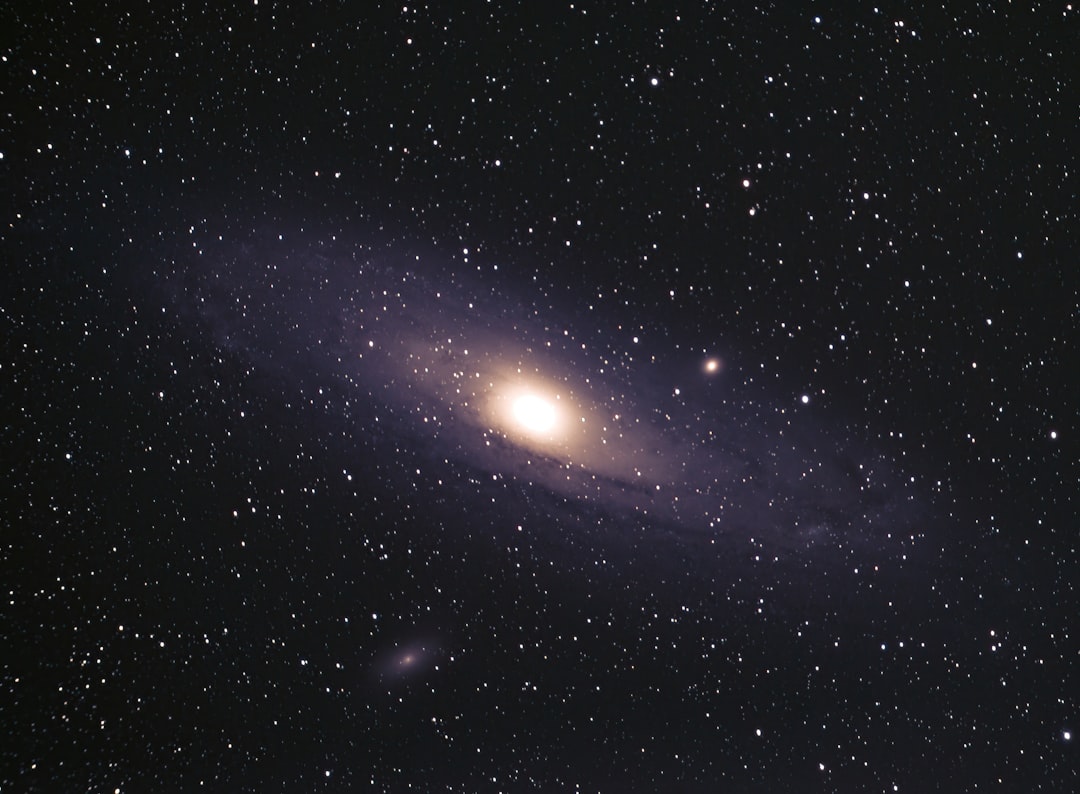
The Milky Way is a quintessential barred spiral galaxy, and astronomers have studied it intensely to understand the distribution of star formation across its structure. But our position inside the galaxy creates a profound observational challenge. We cannot step outside and photograph our galaxy the way we can image Andromeda or the Whirlpool Galaxy. Instead, we peer outward through layers of gas, dust, and billions of intervening stars, making it extraordinarily difficult to map our own galactic backyard.
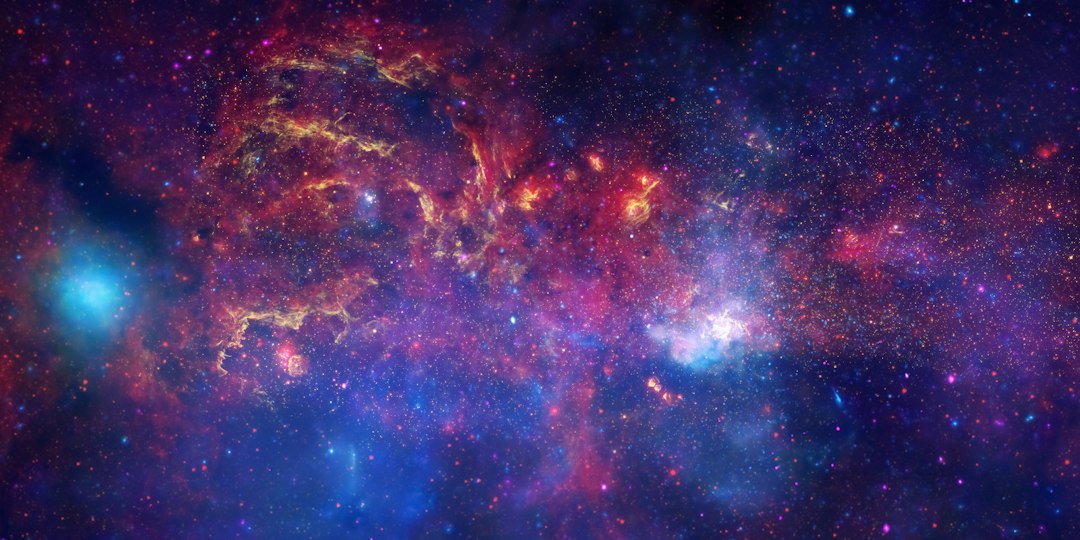
Nowhere is this challenge more acute than in the direction of the Galactic center. Dense clouds of interstellar dust absorb and scatter visible light so efficiently that our optical telescopes are essentially blind to the inner regions of the Milky Way. Astronomers must rely instead on radio waves, infrared light, and other wavelengths that can pierce the obscuring dust — each with its own biases and limitations.
"The Galactic bar cannot be easily observed because of a combination of our position in the Galaxy and dust obscuring our view. As a result, the bar's properties have been highly debated." — Dr. Hilary Davis, University of Sydney
Prior estimates of the bar's length alone have ranged wildly, from as little as 3,000 to as much as 16,000 light-years. Its rotation period has been estimated anywhere between 102 and 246 million years. These enormous uncertainties underscore just how difficult it has been to characterize a structure that sits at the very heart of our galaxy.
The Norma Arm: A Spiral Arm in Question
The Milky Way is commonly depicted as having four major spiral arms: the Perseus arm, the Sagittarius–Carina arm, the Scutum–Centaurus arm, and the Norma–outer arm. These arms, studded with young blue stars, glowing nebulae, and stellar nurseries, are the most visually striking features of spiral galaxies when observed from outside. The Norma arm lies closest to the galaxy's center, winding near the ends of the central bar — placing it in one of the most observationally challenging regions of the sky.
In past research, astronomers used astrophysical masers — natural, coherent microwave emissions produced by molecules such as water and methanol in the vicinity of young massive stars — to trace the Norma arm's location and structure. Masers act as bright, pinpoint radio beacons that can be detected across the obscuring dust of the galactic plane, making them invaluable tools for mapping star-forming regions. The prevailing interpretation was that these masers resided along the Norma spiral arm, confirming its existence and position.
But a bold new study is now challenging that interpretation head-on, with potentially sweeping consequences for how we understand the structure of our entire galaxy. The research, titled "The nature of the Norma arm as a bar-driven star-forming shock front," has been published in the prestigious journal Nature Astronomy. It was led by Dr. Hilary Davis from the University of Sydney's School of Physics and Sydney Institute for Astronomy, with collaborators from Australia and Sweden.
A Vast Structure Hiding in Plain Sight
The research team discovered an unusual and previously unappreciated structure in the Milky Way's central region: a vast, rotating collection of stars within the central bar that is generating powerful shock fronts in the surrounding gas. These shock fronts — essentially giant, galaxy-scale pressure waves driven by the bar's rotation — are compressing gas along their leading edges so intensely that they are triggering the formation of new stars on a massive scale.
This is extraordinary. Rather than merely suppressing star formation as bars are generally thought to do, this structure appears to be actively driving it — along what are known as bar dust lanes, the dark streaks of compressed gas and dust that sweep along the leading edges of galactic bars and are visible in many nearby barred galaxies observed by telescopes like the Hubble Space Telescope.
"At its heart, star formation is a process we understand from everyday physics. Forces set matter in motion. In this case gas is compressed, and that compression can create the conditions for new stars to be born on a massive scale." — Dr. Hilary Davis
The critical insight of the new study is that the masers previously attributed to the Norma spiral arm are not tracing a spiral arm at all. Instead, the researchers argue, those masers are tracing star formation along the bar's shock front — a dust lane driven by the dynamics of the central bar. What looked like a spiral arm from our embedded vantage point is, according to this new analysis, the leading edge of a bar-driven shock wave.
Simulations Illuminate the Hidden Structure
Reaching this conclusion required more than observational data alone. The team deployed large-scale astrophysical simulations run on powerful supercomputers — simulations that model the evolution of an entire galaxy's gas dynamics over billions of years. By comparing the predicted positions of shock fronts in these simulated galaxies against the actual observed positions of the Norma masers, the researchers found a compelling alignment: the masers lined up not with a predicted spiral arm, but with the bar's shock front.
This approach represents a powerful new methodology in galactic astronomy — using the predictive power of computational models to reinterpret ambiguous observational data. The European Southern Observatory and similar institutions have increasingly advocated for this combination of simulation and observation to decode the structure of the Milky Way.
The key to the association lies in the extreme youth of the star-forming regions traced by the masers. As the authors explain:
"The Norma masers trace very young (≪1 Myr) star-forming regions that are still close to the gas clouds in which they formed because they have not had sufficient time to migrate away. Hence, the association of Norma masers with the Galactic bar shock front suggests that star formation is occurring along the Galactic bar dust lane."
Because these stellar nurseries are so freshly minted — less than one million years old, compared to the Sun's 4.6 billion years — they haven't had time to drift from their birthplaces. They remain embedded in the very gas clouds that created them, making them faithful tracers of where the compression and shock fronts are actively operating right now.
Redefining the Milky Way's Bar
Beyond redrawing the spiral arm map, this research places the tightest constraints yet on the physical properties of the Galactic bar itself. By matching the observed maser positions to their simulated shock front models, the team derived a precise set of bar parameters:
- Semimajor half-length (a): approximately 4.3 ± 0.2 kiloparsecs (~14,000 light-years), giving a full end-to-end length of roughly 28,000 light-years
- Semiminor half-length (b): approximately 2.3 ± 0.2 kiloparsecs (~7,500 light-years), giving a full width of roughly 15,000 light-years
- Inclination angle (ϕ): approximately 20 degrees from our line of sight
- Pattern speed (Ωp): no greater than 40 km s⁻¹ kpc⁻¹, corresponding to a full rotation period of approximately 154 million years
These values fall within the previously accepted — though extremely wide — ranges, but they represent a significant tightening of those constraints. The bar is revealed to be long, slow, and star-forming: a phrase the authors use as a kind of summary verdict on this previously enigmatic structure. Its rotation is on the slower end of estimates, which is physically significant because a slower pattern speed allows more time for gas to pile up and compress along the bar's leading edges, potentially explaining why star formation is occurring there at all.
An Unusual Galaxy in a Universe of Barred Spirals
The implications extend beyond mere cartography. If the Milky Way's bar is genuinely capable of sustaining significant star formation along its shock fronts, it sets our galaxy apart from many of its cosmic neighbors. Observations of other nearby barred spiral galaxies — studies conducted with observatories like the Atacama Large Millimeter/submillimeter Array (ALMA) — have generally shown that bars suppress star formation throughout most of their extent, funneling gas inward toward the galactic nucleus or outward toward the spiral arms, but rarely forming stars in situ along their length.
"In most similar galaxies, star formation very commonly occurs along spiral arms. What's extraordinary is seeing this happen in a different region of our Galaxy, where shocks are usually so strong that star formation is often suppressed." — Dr. Hilary Davis
The discovery raises a fascinating question: is the Milky Way genuinely unusual among barred spiral galaxies, or have astronomers been underestimating the star-forming potential of galactic bars because the nearby galaxies we study most closely happen not to exhibit this behavior? The answer will require a systematic survey of bar dust lanes and shock fronts in a much larger sample of barred spirals — a compelling agenda for the next generation of radio and millimeter-wave observatories.
Broader Implications for Galactic Structure
The potential reclassification of at least part of the Norma arm from a genuine spiral arm to a bar-driven shock feature is not merely a semantic distinction — it touches on some of the deepest questions about how the Milky Way is organized and how its structure has evolved over cosmic time. The number, nature, and origin of the Milky Way's spiral arms have been debated for generations, with different observational methods yielding different pictures.
Some models favor a grand-design two-armed spiral, with the other apparent arms being secondary features or fragments. Others support four roughly symmetric arms. The question of whether the Norma arm is truly an independent, long-lived spiral arm — or an artifact of the bar's gravitational and hydrodynamic influence — has profound implications for which of these models is correct. As the authors note, their findings "raise questions about the Galaxy's spiral structure and suggests that the Galactic bar is long, slow and star-forming," warranting further investigation.
Future missions and surveys — including continued observations by ESA's Gaia spacecraft, which is building the most precise three-dimensional map of the Milky Way ever constructed — will be instrumental in testing and refining the picture painted by this new study. Combined with the next generation of large-scale galaxy simulations and ever-more-sensitive radio telescopes, we are entering a golden era for understanding the true nature of our galactic home.
"By comparing a new generation of large-scale computerised galaxy simulations, evolving over billions of years, against a more limited set of observations, we now have a stronger understanding of the bar and star formation processes in the Milky Way." — Dr. Hilary Davis
Key Takeaways
- A new study published in Nature Astronomy suggests that masers previously used to trace the Norma spiral arm are actually tracing star formation along a bar-driven shock front in the Milky Way's central bar.
- The Milky Way's central bar may be actively forming stars along its leading shock fronts — a phenomenon uncommon in the bars of other nearby spiral galaxies.
- The research provides the tightest constraints yet on the bar's physical properties: a full length of ~28,000 light-years, a width of ~15,000 light-years, an inclination of ~20 degrees, and a rotation period of ~154 million years.
- The study used advanced large-scale astrophysical simulations combined with maser observations to arrive at its conclusions, representing a powerful new methodology for galactic cartography.
- The findings suggest the Milky Way may be structurally unusual among barred spiral galaxies, and call for a reassessment of how we define and count the galaxy's spiral arms.
- Future observations, particularly from ESA's Gaia mission and next-generation radio observatories, will be critical for confirming and extending these results.
In the end, this discovery is a powerful reminder that even the most familiar landscape — our own galaxy, the backdrop to every human civilization that has ever looked up at the night sky — still holds profound secrets waiting to be uncovered. The Milky Way, it turns out, may be stranger and more dynamic than we ever imagined.