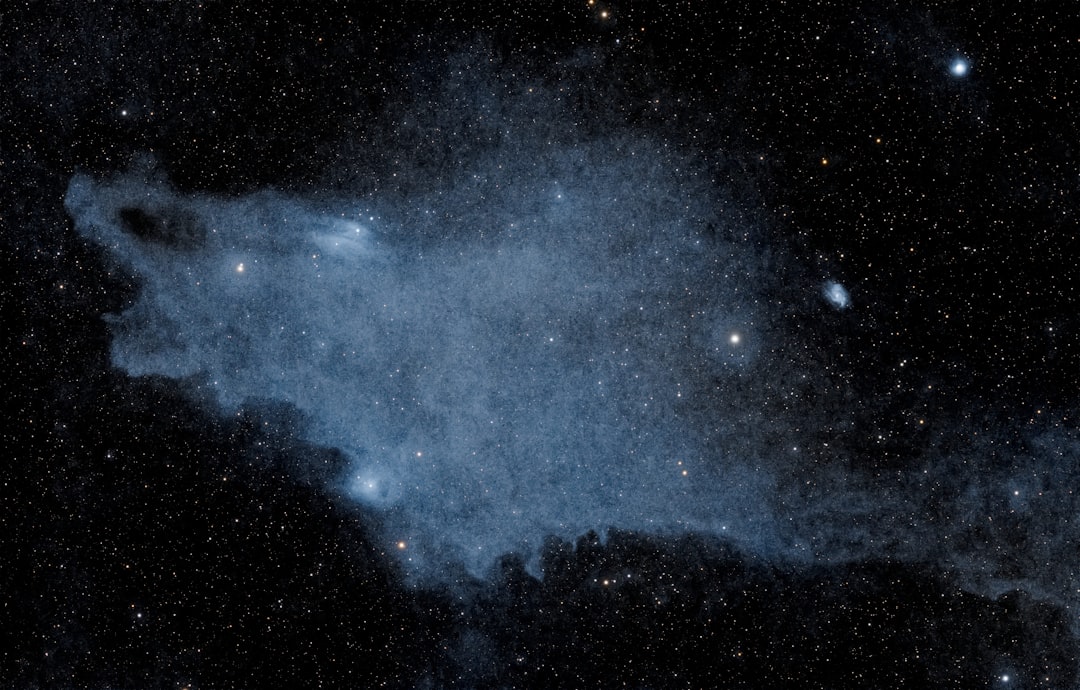
The celestial dance between our galaxy's nearest neighbors has revealed a dramatic new chapter in their cosmic story. Groundbreaking research utilizing over a decade of infrared observations has uncovered that the Small Magellanic Cloud (SMC) is undergoing a profound transformation—actively expanding outward under the relentless gravitational influence of its larger companion, the Large Magellanic Cloud (LMC). This discovery, detailed in a research letter soon to be published in Astronomy and Astrophysics, fundamentally challenges our understanding of how these dwarf galaxies interact and evolve.
The findings emerge from the VISTA Survey of the Magellanic Clouds (VMC), which has meticulously tracked the individual motions of millions of stars across both galaxies. What astronomers discovered goes far beyond simple gravitational interactions—the SMC is in a state of dynamic disequilibrium, with stars streaming outward at approximately 17 kilometers per second. This expansion reaches even into the galaxy's central regions, painting a picture of a dwarf galaxy being systematically pulled apart by tidal forces from its massive neighbor.
Lead author Sreepriya Vijayasree, a doctoral student at the Leibniz Institute for Astrophysics Potsdam, and her team have produced the most detailed kinematic maps of the SMC to date. Their work reveals that traditional models treating the SMC as a simple rotating disk are woefully inadequate—instead, this galaxy is a complex, churning structure dominated by gravitational disturbances accumulated over billions of years of cosmic encounters.
The Magellanic Clouds: A Turbulent Galactic Partnership
The Magellanic Clouds have captivated astronomers for centuries, visible to the naked eye from the Southern Hemisphere as luminous patches against the night sky. These irregular dwarf galaxies serve as the Milky Way's most prominent satellite companions, offering scientists a unique laboratory for studying galactic interactions and stellar evolution. The LMC, with a mass approximately one-tenth that of our galaxy, dwarfs its smaller companion—the SMC contains roughly one-seventh the stellar mass of the LMC.
Previous research has established that both clouds are engaged in a complex gravitational relationship with the Milky Way itself, with studies from NASA's Hubble Space Telescope suggesting they will eventually merge with our galaxy in several billion years. However, the immediate drama unfolds between the two clouds themselves. Astronomers have long known about the Magellanic Bridge—a vast stream of neutral hydrogen gas connecting the two galaxies—and have observed active star formation within this tenuous structure. Yet the full extent of their gravitational tango has remained elusive until now.
What makes these interactions particularly significant is their accessibility for detailed study. At distances of approximately 200,000 light-years (LMC) and 210,000 light-years (SMC), these galaxies are close enough that modern telescopes can resolve individual stars, enabling the kind of detailed kinematic analysis that would be impossible for more distant galactic systems.
Infrared Eyes Reveal Hidden Motions
The breakthrough came through the VISTA telescope in Chile, the world's largest survey telescope dedicated to near-infrared observations. While Earth's atmosphere blocks most infrared radiation, specific wavelength windows allow ground-based infrared astronomy, and VISTA exploits these openings with remarkable precision. The telescope's VIRCAM camera can image a patch of sky twice the size of the full Moon in a single exposure, making it ideal for surveying vast regions like the Magellanic Clouds.
Professor Dr. Maria-Rosa Cioni, VISTA's principal investigator, emphasized the survey's transformative capabilities:
"The VMC survey was designed to map the Magellanic Clouds in unprecedented detail in infrared light, allowing astronomers to peer through dust and study stellar populations spanning a wide range of ages. The latest VMC data release extends the observational time baseline to as much as 11 years, enabling much more precise measurements of stellar motions than earlier studies."
The key to this research lies in measuring proper motions—the apparent movement of stars across the sky over time. By revisiting the same stellar fields repeatedly over 6 to 11 years, the VMC team achieved a threefold improvement in precision compared to previous studies. This extended baseline is crucial because stellar motions are incredibly subtle; even relatively rapid motions translate to minuscule angular changes when viewed from Earth.
Unraveling the Complexity of Stellar Kinematics
The analytical challenge facing the research team was formidable. The SMC has an overall bulk systemic motion—essentially how the galaxy moves as a coherent unit through space. But individual stars also possess their own motions, called residual proper motions, which reveal the internal dynamics of the galaxy. To see these internal movements clearly, researchers had to mathematically subtract the SMC's bulk motion from their observations.
The team employed a sophisticated two-step process. First, they constructed a residual velocity map by removing the systemic motion. Then, they fitted and removed a linear velocity gradient from this residual field, producing what they call a "gradient-corrected residual map." This final map emphasizes small-scale kinematic substructures—the subtle patterns of motion that reveal the gravitational forces at work within the galaxy.
Dr. Florian Niederhofer from the Leibniz Institute for Astrophysics Potsdam, a study co-author, described the moment of discovery:
"When I saw the results for the first time, I was really amazed by the quality of the measured stellar motions. By combining observations that have been taken over a time baseline of more than a decade, we were able to map the internal kinematics of the Small Magellanic Cloud with a level of detail that is outstanding for observations from the ground."
A Galaxy Being Pulled Apart: The Expansion Discovery
The resulting maps revealed something unprecedented: a coherent pattern of expansion along the south-east and north-west directions, extending throughout the entire SMC structure. This expansion signature appears even in the galaxy's central regions, where astronomers would traditionally expect to find the most gravitationally stable stellar populations. The pattern is consistent with LMC-induced tidal stretching—the larger galaxy's gravity is literally pulling the SMC apart.
Vijayasree explained the significance of these findings:
"The results reveal large-scale tidal expansion throughout the Small Magellanic Cloud galaxy and challenge long-standing assumptions that the Small Magellanic Cloud behaves like a rotating disk. The study shows that the internal motions of stars in the Small Magellanic Cloud are dominated not by orderly rotation, but by gravitational disturbances caused by repeated encounters with the LMC over billions of years."
The measured expansion velocity of approximately 17 kilometers per second might seem modest compared to cosmic speeds—after all, Earth orbits the Sun at about 30 km/s. However, this velocity becomes highly significant when considered against the SMC's relatively low mass. Estimates suggest the SMC's escape velocity could be as low as 60 km/s, meaning stars are already moving outward at nearly one-third of the speed needed to escape the galaxy entirely.
Different Stellar Populations Tell Different Stories
One of the most intriguing aspects of the research involves how different stellar populations within the SMC exhibit distinct kinematic patterns. Older red giant stars show a pronounced northward motion, suggesting they originated from a much earlier gravitational interaction between the clouds. This discovery provides a kind of archaeological record, with different stellar age groups preserving evidence of different epochs in the clouds' tumultuous history.
This finding aligns with broader research on galactic archaeology, a field that uses stellar populations to reconstruct the formation and interaction histories of galaxies. Studies using data from ESA's Gaia mission have similarly revealed complex formation histories in other nearby dwarf galaxies, demonstrating that these small systems often have surprisingly dynamic pasts.
Implications for Galactic Evolution and Future Research
The research carries profound implications for our understanding of dwarf galaxy evolution and gravitational interactions. The findings demonstrate that simple rotating-disk models—long used to describe galactic dynamics—are fundamentally inadequate for systems undergoing strong tidal interactions. As the researchers note in their paper: "The dynamics of the SMC are highly complex, as confirmed by multiple studies, including the present work. Recent analyses have highlighted that simple rotating-disk models are insufficient to capture the observed kinematics."
This complexity extends to questions about the SMC's long-term fate. If the expansion continues, the galaxy could gradually lose stars to tidal stripping, with stellar material being pulled away to join the Magellanic Bridge or dispersed into the intergalactic medium. Over billions of years, this process could fundamentally alter the SMC's structure, potentially transforming it from a dwarf galaxy into a more diffuse stellar stream.
The research also has implications for understanding galaxy interactions throughout cosmic history. During the universe's early epochs, galactic encounters were far more common than today, and many of the galaxies we observe likely underwent similar tidal interactions. By studying the Magellanic Clouds in such detail, astronomers gain insights into processes that shaped galaxy evolution across cosmic time.
Future Observational Campaigns
The VMC survey continues to collect data, and future observations will further refine our understanding of the Magellanic Clouds' dynamics. Complementary observations from space-based facilities like the James Webb Space Telescope can provide additional perspectives, particularly in studying the stellar populations and star formation occurring in the Magellanic Bridge.
Additionally, upcoming facilities like the Vera C. Rubin Observatory will revolutionize time-domain astronomy, enabling even more precise proper motion measurements across vast stellar populations. These next-generation surveys will allow astronomers to track the Magellanic Clouds' evolution in unprecedented detail, potentially revealing additional kinematic substructures and refining models of their interaction history.
Key Takeaways from the Research
- Unprecedented Precision: The study achieved a threefold improvement in proper motion measurements compared to previous work, thanks to an extended 6-11 year observational baseline from the VISTA telescope
- Pervasive Expansion: The SMC exhibits coherent expansion throughout its entire structure, including central regions, at approximately 17 km/s along the southeast-northwest axis
- Tidal Disruption: The expansion pattern is consistent with gravitational tidal forces from the Large Magellanic Cloud, challenging traditional rotating-disk models of the SMC
- Complex Stellar Populations: Different age groups of stars show distinct kinematic patterns, with older red giants displaying northward motion indicative of ancient interactions
- Dynamic Disequilibrium: The SMC is far from gravitational equilibrium, with its internal motions dominated by tidal disturbances rather than orderly rotation
This research represents a significant advance in our understanding of the Magellanic Clouds and galactic interactions more broadly. By revealing the SMC's expansion and complex internal dynamics, astronomers have demonstrated that even our nearest galactic neighbors harbor surprises and continue to challenge our theoretical frameworks. As observational capabilities continue to improve and datasets extend across longer timescales, we can expect even more detailed insights into the gravitational ballet occurring in our cosmic backyard—a drama that will ultimately culminate in the merger of all three galaxies billions of years hence.