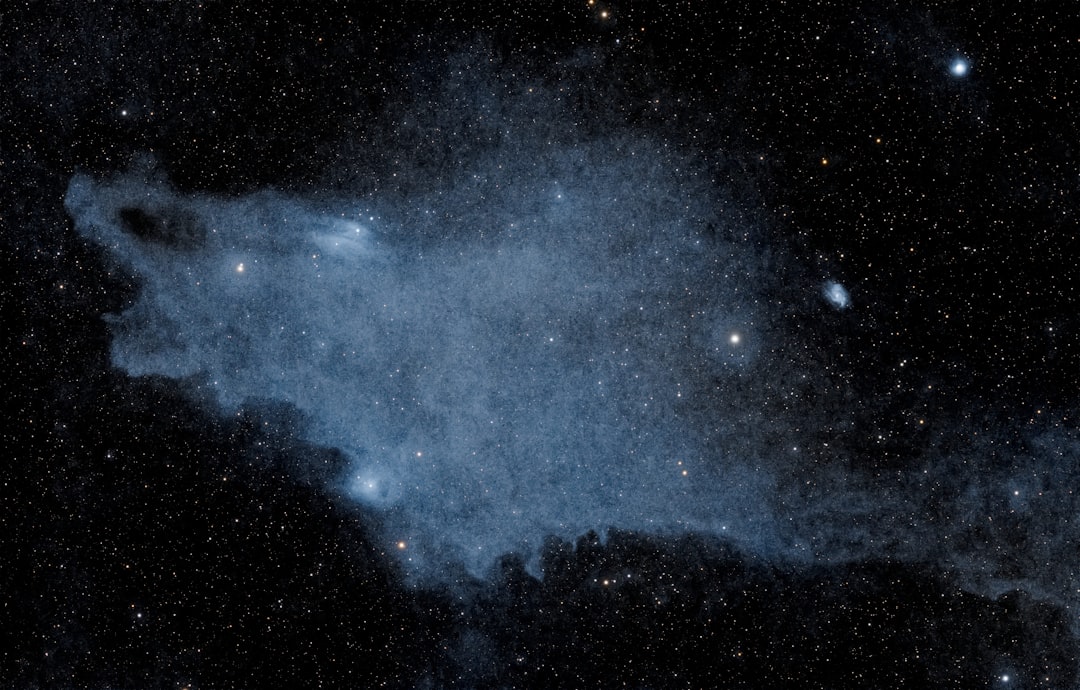
The Large Magellanic Cloud (LMC), our galaxy's most massive satellite companion, has become the focal point of one of astronomy's most intriguing debates. At stake is a fundamental question that could reshape our understanding of galactic evolution: Is this dwarf galaxy's current approach to the Milky Way its first encounter, or has it passed through our cosmic neighborhood before? The answer carries profound implications for how we understand the gravitational choreography that shapes our galactic home.
Recent research by astrophysicists Scott Lucchini, Jiwon Jesse Han, Sapna Mishra, and Andrew J. Fox, along with their collaborators, presents compelling new evidence in this ongoing scientific controversy. Their work, currently available as a pre-print on arXiv, employs sophisticated hydrodynamic simulations to argue that the LMC is indeed making its maiden voyage past the Milky Way—a conclusion that challenges alternative theories and adds a fascinating new chapter to our understanding of galactic dynamics.
Understanding why this matters requires appreciating the scale of what's at stake. The LMC isn't just any satellite galaxy—it contains roughly 30 billion solar masses of material and measures about 14,000 light-years across. When an object of this magnitude interacts with our galaxy, it doesn't just pass by quietly. Its gravitational influence creates ripples throughout the Milky Way's structure, potentially triggering star formation, disturbing stellar orbits, and reshaping the distribution of dark matter in ways that echo through billions of years of cosmic history.
The Historical Context of a Galactic Controversy
For decades, astronomers have grappled with determining the orbital trajectory of the Large Magellanic Cloud. Traditional approaches relied on collisionless N-body simulations—sophisticated computational models that track the gravitational interactions of millions of particles representing stars and dark matter. These models provided valuable insights but left crucial questions unanswered, particularly regarding the LMC's past encounters with our galaxy.
The debate entered a new phase in 2024 when physicist Eugene Vasiliev published groundbreaking research that challenged prevailing assumptions. Vasiliev's work, based on detailed dynamical modeling, suggested a provocative scenario: the LMC might have first passed within approximately 100 kiloparsecs (about 326,000 light-years) of the Milky Way some 6 to 8 billion years ago. This "second-pass" hypothesis hinged on a critical assumption about the nature of our galaxy's dark matter halo.
According to NASA's research on dark matter, these invisible halos constitute the majority of a galaxy's mass and extend far beyond the visible stellar disk. Vasiliev proposed that if the Milky Way's dark matter halo exhibits anisotropic properties—meaning dark matter particles move preferentially in certain directions rather than randomly—the LMC's current velocity and position would align perfectly with a second passage scenario. This elegant explanation reignited scientific interest and divided the astronomical community into competing camps.
Tracing Cosmic Breadcrumbs: The Hypervelocity Star Investigation
Lucchini and his team initially approached the problem through an innovative lens: hypervelocity stars. These stellar speedsters, ejected from the LMC's central region by gravitational interactions with its supermassive black hole, serve as cosmic tracers of the galaxy's past trajectory. Like breadcrumbs marking a path through the universe, these stars should reveal where the LMC has been.
The research team's first paper meticulously traced the trajectories of these high-velocity stellar objects, employing sophisticated orbital integration techniques. However, their findings proved frustratingly ambiguous. The stellar dynamics of these hypervelocity stars appeared consistent with both first-pass and second-pass models. As Lucchini and his colleagues candidly acknowledged, this approach failed to provide the definitive answer the scientific community sought.
"The hypervelocity stars told us where the LMC could have been, but not where it actually was. We needed a completely different approach—one that could distinguish between these scenarios with greater certainty," explains the research team in their methodology discussion.
A Revolutionary Approach: Hydrodynamic Simulations Enter the Arena
Recognizing the limitations of their stellar dynamics approach, the research team pivoted to an entirely different methodology: hydrodynamic simulations. This represented a significant departure from traditional collisionless models, incorporating the behavior of gas—the diffuse material that permeates the space between galaxies and plays a crucial role in galactic evolution.
The team employed GIZMO, a sophisticated simulation package that combines rigid analytical models of dark matter with "live" gas particles. These particles represent the circumgalactic medium—the vast reservoirs of warm and hot gas that surround galaxies like invisible atmospheres. By simulating both the LMC and Milky Way with this hybrid approach, the researchers could track how gas behaves during different encounter scenarios.
The methodology involved several crucial steps. First, they created detailed models of both galaxies, incorporating observational constraints on their masses, sizes, and dark matter distributions. Then they ran multiple simulations representing different orbital histories—including both first-pass and second-pass scenarios. Finally, using specialized software called Trident, they generated synthetic observational data that mimicked what telescopes would actually detect when observing these simulated systems in ultraviolet wavelengths.
The Critical Evidence: Gas Absorption Signatures
The breakthrough came when the team compared their simulated data to real observations from the Hubble Space Telescope's Cosmic Origins Spectrograph. Specifically, they analyzed Carbon IV and Hydrogen II absorption features in the spectra of distant quasars—brilliant beacons of light located far beyond the LMC that shine through the intervening gas.
When gas clouds lie between Earth and these quasars, they absorb specific wavelengths of light, creating distinctive signatures that reveal the gas's velocity, density, and ionization state. These absorption lines serve as forensic evidence, preserving a record of the gas's recent history and interactions.
The results proved remarkably conclusive. The first-pass simulation beautifully reproduced the observed velocity profiles and column densities measured in actual quasar spectra. The match extended across multiple absorption features and viewing angles, suggesting the model captured the fundamental physics correctly.
In stark contrast, the second-pass model failed to match observations in a critical way. If the LMC had previously "swum" through the Milky Way's gaseous halo billions of years ago, it would have experienced significant ram pressure stripping—a process where the pressure of moving through dense gas strips away the galaxy's own gas corona. This would result in a much smaller, more compact gas envelope around the LMC today than what observations actually reveal.
Understanding the Limitations: Scientific Honesty in Action
Despite their compelling results, Lucchini and colleagues demonstrate admirable scientific rigor by acknowledging their study's limitations. Two significant simplifications were necessary to make the simulations computationally tractable:
- Exclusion of the Small Magellanic Cloud: The LMC's smaller companion galaxy was omitted from simulations, despite contributing the majority of neutral hydrogen gas to the Magellanic Stream—the vast trail of gas both galaxies leave in their wake. This simplification could significantly affect the overall gas distribution and dynamics.
- Simplified Corona Model: The simulations employed a single-phase warm-hot gas model for the circumgalactic medium, whereas reality involves a complex, multi-phase structure with gas at vastly different temperatures and densities. This simplification was necessary to reduce computational demands but may miss important physical processes.
- Limited Resolution: Even with powerful computing resources, the simulations cannot resolve small-scale structures and turbulence that might affect gas dynamics in subtle but important ways.
These caveats don't invalidate the findings but rather highlight areas where future research with greater computational resources could refine and strengthen the conclusions.
The Plot Thickens: Competing Evidence Emerges
Science rarely provides simple answers, and the LMC debate proves no exception. Just weeks before Lucchini's hydrodynamic papers appeared, an independent research team utilizing the Subaru Hyper Suprime-Cam published intriguing observations that appear to support Vasiliev's second-passage hypothesis.
This team discovered tidal debris—streams of stars torn from their parent galaxy by gravitational forces—located approximately 30 kiloparsecs from the Milky Way's center. The spatial distribution and kinematics of these stellar streams align well with predictions from second-passage models, suggesting a previous close encounter may have occurred.
The discovery highlights a fundamental challenge in astrophysics: different lines of evidence can sometimes point toward contradictory conclusions. The gas dynamics favor a first passage, while stellar archaeology suggests a second passage. Reconciling these observations will require either identifying flaws in one or both analyses or developing more sophisticated models that can accommodate all available data.
Future Prospects: New Missions and Observational Strategies
The resolution of this debate will likely require new observational capabilities and innovative approaches. Several upcoming missions promise to provide crucial data:
NASA's Aspera mission, currently in development, will conduct detailed ultraviolet spectroscopy of the circumgalactic medium around nearby galaxies, including the LMC. This mission will provide unprecedented detail about the morphology, kinematics, and ionization state of gas in the Magellanic system, potentially settling questions about its interaction history with the Milky Way.
Additionally, the European Space Agency's Gaia mission continues to revolutionize our understanding of stellar motions in the Milky Way and its satellites. Future data releases will provide increasingly precise measurements of stellar velocities and positions, constraining orbital models with ever-greater accuracy.
Ground-based facilities are also contributing. Next-generation telescopes like the Extremely Large Telescope and the Thirty Meter Telescope will enable detailed spectroscopic studies of individual stars in the LMC's outer regions, potentially revealing kinematic signatures of past encounters.
Why This Matters: Implications for Galactic Evolution
Beyond the intrinsic fascination of solving this cosmic mystery, determining whether this is the LMC's first or second passage has profound implications for understanding galactic evolution more broadly.
If this is indeed a first passage, it means we're witnessing a relatively rare event—the initial stages of a satellite galaxy's incorporation into a larger system. This provides a unique laboratory for studying how galaxies merge and interact, processes that have shaped cosmic structure throughout the universe's history. The ongoing interaction will continue to evolve, potentially leading to the LMC's eventual merger with the Milky Way billions of years from now.
Conversely, if this is a second passage, it would demonstrate that satellite galaxies can survive multiple close encounters with their hosts, maintaining their identity despite severe gravitational and hydrodynamic stresses. This resilience would inform models of galaxy formation and evolution, particularly regarding the survival and properties of satellite systems around large galaxies throughout the cosmos.
The debate also touches on fundamental questions about dark matter. Different passage scenarios imply different dark matter halo properties, potentially providing constraints on the nature of this mysterious substance that comprises 85% of the universe's matter but remains directly undetectable.
The Scientific Process in Action
The LMC passage debate exemplifies how modern astrophysics advances through the interplay of theory, simulation, and observation. Multiple research groups employing different methodologies arrive at competing conclusions, driving the field forward through constructive scientific discourse.
As new data becomes available and computational capabilities expand, the community will continue refining models and testing predictions. The ultimate resolution may come from an unexpected direction—perhaps a novel observational technique or a theoretical insight that reconciles seemingly contradictory evidence.
For now, the question remains tantalizingly open: Is the Large Magellanic Cloud a first-time visitor to our galactic neighborhood, or are we witnessing a cosmic reunion billions of years in the making? The answer, when it finally emerges, will deepen our understanding not just of our own galaxy's history, but of the fundamental processes that govern the evolution of galaxies throughout the universe.
As astronomical observations become ever more precise and computational models more sophisticated, we edge closer to solving this galactic mystery. The ongoing debate serves as a reminder that even our closest cosmic neighbors still harbor secrets waiting to be revealed, and that the universe continues to surprise and challenge our understanding at every scale.