Astronomers Measure the Long Reach of a Quasar's Powerful Winds
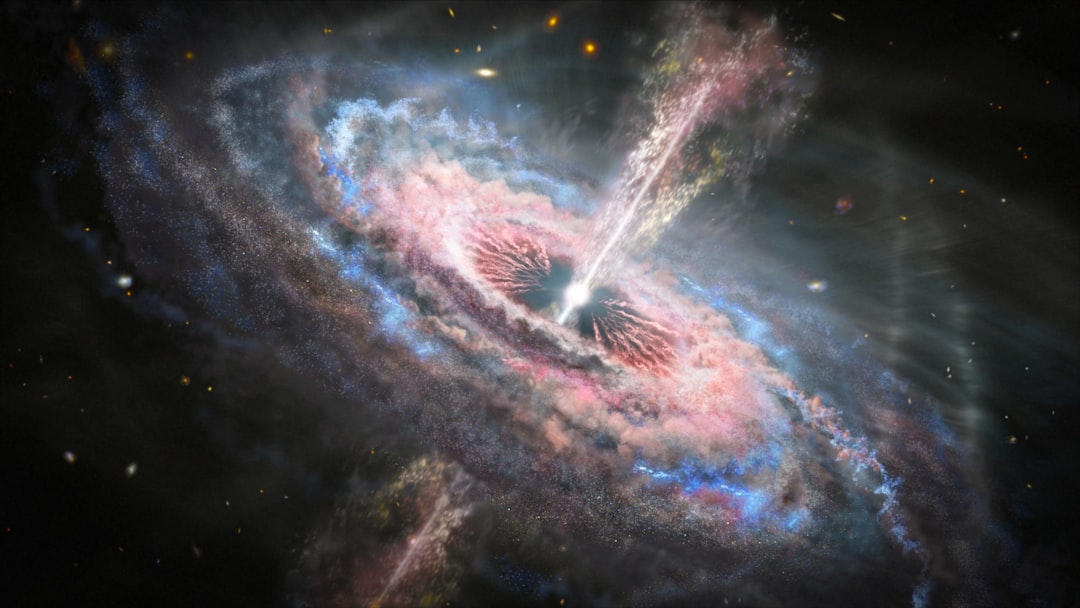
There are a number of cosmic phenomena in the Universe capable of dramatically altering — or even extinguishing — life as we know it. For now, and for Earth, a catastrophic blast from our own galaxy's supermassive black hole is not an immediate threat. That's not to say that Sagittarius A*, the four-million-solar-mass behemoth lurking at the Milky Way's core, is entirely benign. Should it ever reawaken and unleash powerful winds, the consequences for our galaxy could be profound. Evidence even suggests it may have powered a quasar in the distant past — and could conceivably do so again in the far future.
To understand what such an awakening might look like, astronomers have turned their attention to a living example: the remarkably energetic quasar H1821+643. A multinational research team from Tohoku University, Tokyo Metropolitan University, and Kanazawa University in Japan undertook a detailed study of this quasar and its sweeping influence on the cosmic environment around it. What they discovered has fundamentally reshaped our understanding of just how far a black hole's reach can extend.
About Quasar H1821+643
Located approximately 3.4 billion light-years from Earth in the direction of the constellation Draco, H1821+643 is no ordinary quasar. It resides at the heart of a massive galaxy cluster, where its central supermassive black hole is engaged in a voracious feeding frenzy. As material spirals inward toward the black hole's event horizon, it forms a superheated accretion disk that releases enormous quantities of energy — making the quasar one of the most luminous objects in its cosmic neighborhood.
This feeding process doesn't just illuminate the surrounding region; it also drives extraordinarily powerful outflows and winds that interact with the hot, diffuse gas cloud — known as the intracluster medium (ICM) — enveloping the galaxy cluster. This gas cloud, heated to tens of millions of degrees, glows brilliantly in X-ray wavelengths, making it a prime target for high-energy space observatories.
"Black holes are largely known for sucking matter in, but they also eject gas in the form of powerful winds. These winds were thought to be contained within the galaxy, but our study revealed that the force is immensely more powerful than previously understood."
To probe the dynamics of this turbulent gas, the research team employed the XRISM (X-Ray Imaging and Spectroscopy Mission) satellite, a cutting-edge observatory jointly developed by JAXA and NASA. Using XRISM's remarkably sensitive spectrometers, the team was able to construct detailed spectra of the hot gas cloud and, critically, map its complex motions by tracking the signatures of ionized iron — a powerful diagnostic tool that reveals velocity structures within the plasma.
A Shockwave of Astonishing Power
What the astronomers found exceeded all expectations. The high-temperature gas cloud surrounding the quasar is not static — it is in constant, vigorous motion, churned by the relentless energy injected by the quasar's winds. This turbulence disperses the gas across an extraordinarily wide region of space, well beyond the boundaries of the host galaxy itself.
In the most extreme regions measured, the gas flow extends to a staggering distance of approximately 300,000 light-years — roughly three times the estimated diameter of the Milky Way Galaxy. To put that into perspective, our entire galaxy, with its hundreds of billions of stars, would fit inside this energetic outflow region three times over. The total energy transported is equivalent to several billion supernova explosions — a figure that staggers the imagination.
"For the first time, we have shown that black holes influence the broader cosmic environment through a shock wave of astonishing power. Black holes are key drivers of gas flows and motion in space, transporting vast amounts of energy to different regions of the cosmos."
This phenomenon — known as quasar-mode feedback — represents one of the most energetic and far-reaching processes in the known Universe. The shock wave driven by the quasar's winds propagates outward through the cluster environment, heating the surrounding gas and suppressing the formation of new stars not just within the host galaxy, but across the broader galaxy cluster environment. This discovery marks the first time such feedback has been observationally confirmed to reach so far beyond a galaxy's boundaries.
Why This Discovery Matters: The Role of Quasars in Cosmic Evolution
Quasars represent the most luminous persistent objects in the observable Universe. More than a million are currently catalogued, each powered by a supermassive black hole actively accreting material. Their combined influence on the cosmos is immeasurable — shaping the formation and evolution of galaxies across billions of years of cosmic history. The European Space Agency's Webb Space Telescope has been instrumental in observing some of the most distant quasars ever detected, pushing our knowledge of these objects back to within the first billion years of the Universe's existence.
Quasars predominantly populated the early Universe, when galaxies were younger and their central black holes had abundant material to consume. The light we receive from the most distant quasars serves as a cosmic time capsule, encoding information about galaxy formation and evolution during an era when the Universe was barely a fraction of its current age. Current models of galaxy evolution suggest that most, if not all, massive galaxies passed through a quasar phase at some point in their development — a fiery adolescence driven by the insatiable appetite of their embedded supermassive black holes.
- Quasars can outshine their entire host galaxies by factors of hundreds to thousands
- The supermassive black holes powering quasars can have masses ranging from millions to tens of billions of solar masses
- Quasar winds can travel at a significant fraction of the speed of light
- The energy output of a single bright quasar can exceed that of a trillion stars
- Quasar-mode feedback is now considered a key mechanism in regulating star formation rates across cosmic time
The Dual Nature of Quasar Feedback
The relationship between quasars and star formation is nuanced and bidirectional. On one hand, the ferocious winds driven by quasar activity can heat and disperse the cold molecular gas that would otherwise collapse to form new stars — effectively quenching star formation across large volumes of space. This is believed to be a primary mechanism by which massive galaxies transition from active, star-forming systems to the "red and dead" elliptical galaxies we observe in the present-day Universe.
On the other hand, as quasars draw surrounding material inward along their accretion flows, the compression and turbulence created can paradoxically trigger star formation in certain regions, causing gas clouds to fragment and collapse under elevated pressures. This positive feedback mechanism adds another layer of complexity to our understanding of how quasars shape their cosmic neighborhoods. NASA's Hubble Space Telescope has provided striking visual evidence of quasar winds propelling hundreds of solar masses of material outward into galactic disks each year, snowplowing into surrounding gas and dust.
The discovery of H1821+643's extended outflow also has significant implications for our understanding of galaxy cluster evolution. Galaxy clusters are the largest gravitationally bound structures in the Universe, and the intracluster medium that permeates them contains more ordinary matter than all the cluster's galaxies combined. When a quasar's energy penetrates this vast reservoir of gas, it can alter the thermodynamic state of the entire cluster — affecting everything from the rate of galaxy mergers to the long-term cooling of the ICM.
Could the Milky Way Have Been a Quasar?
The implications of this research extend closer to home — quite literally. There is compelling evidence that Sagittarius A*, our own galaxy's central black hole, was significantly more active in the geological and astronomical past. The mysterious Fermi Bubbles — two enormous lobes of gamma-ray and X-ray emitting gas extending roughly 25,000 light-years above and below the galactic plane — may be the faded remnants of a past episode of intense activity, possibly occurring six million years ago or more. Observations conducted using NASA's Hubble Space Telescope have detected evidence of a powerful ultraviolet light flash from Sgr A* that illuminated distant gas clouds known as the Magellanic Stream roughly 3.5 million years ago.
Whether this past activity was energetic enough to formally classify the Milky Way as a quasar remains an open question — one that researchers are actively debating. But even at a fraction of the intensity observed in H1821+643, such outbursts could leave lasting fingerprints on the structure and composition of gas throughout our galactic neighborhood. The detection of a diffuse, warm-hot gas halo surrounding the Milky Way may itself be a legacy of past energetic episodes from Sagittarius A*.
Future Investigations: The Multi-Messenger Frontier
The study of H1821+643 marks a pivotal milestone, but researchers view it as a beginning rather than an endpoint. Satoshi Yamada and his colleagues are eager to push further, leveraging the emerging era of multi-messenger astronomy — combining observations across the electromagnetic spectrum with gravitational wave data and neutrino detections to build a complete picture of quasar activity and its cosmic consequences.
Since quasars radiate across essentially the entire electromagnetic spectrum — from radio waves through infrared, optical, ultraviolet, X-rays, and gamma rays — each observational window reveals a distinct physical process occurring within and around these extraordinary objects. Future observations with facilities such as the ESA's Athena X-ray Observatory, currently in development, promise to provide even higher-resolution spectroscopic maps of quasar-driven outflows, potentially revealing the precise mechanisms by which energy is transferred from the black hole to the surrounding cluster environment.
Additionally, next-generation radio telescope arrays and space-based infrared observatories will allow astronomers to trace the cold molecular gas component of quasar outflows — the phase most directly linked to the suppression or triggering of star formation. Together, these multi-wavelength campaigns will transform our understanding of how the most powerful engines in the Universe have sculpted the cosmic landscape over billions of years.
Key Takeaways
- The quasar H1821+643, located 3.4 billion light-years away, drives energetic winds extending 300,000 light-years — three times the Milky Way's diameter
- The XRISM satellite revealed vigorous turbulence in the surrounding hot gas by tracking ionized iron signatures
- The total energy transported rivals several billion supernova explosions
- This represents the first direct observational evidence of quasar-mode feedback reaching so far beyond a host galaxy's boundaries
- The findings have major implications for models of galaxy cluster evolution and the regulation of star formation on cosmic scales
- Our own galaxy's central black hole, Sagittarius A*, may have exhibited similar behavior millions of years ago
The universe's most extreme objects continue to surprise us. In measuring the extraordinary reach of H1821+643's powerful winds, astronomers have not only rewritten the rulebook on quasar feedback — they have opened a new chapter in our understanding of how black holes, those most dramatic of cosmic actors, have shaped the large-scale structure of the Universe itself. As observational tools grow ever more powerful and precise, the secrets of these ancient, luminous giants will continue to illuminate the story of our cosmos.