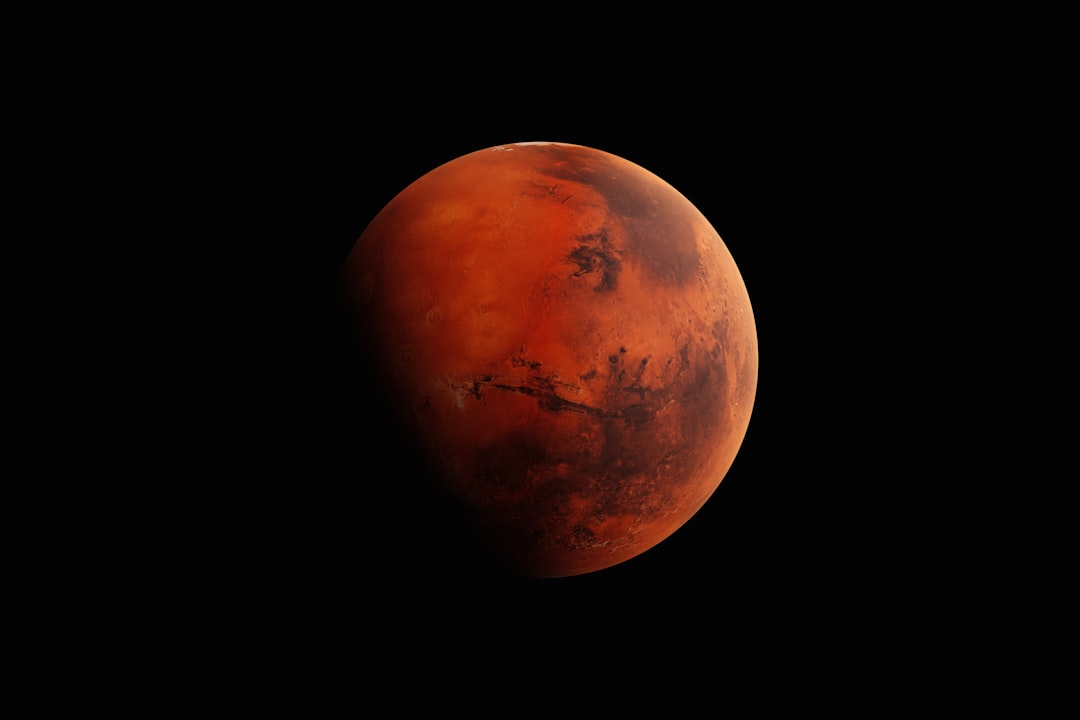
The quest to establish a sustainable human presence on Mars hinges on our ability to locate and utilize the Red Planet's natural resources—a strategy known as In-situ Resource Utilization (ISRU). However, identifying these critical resources from orbit has long been hampered by the limitations of aging spacecraft instruments. Now, researchers at Curtin University in Australia have developed an innovative solution that combines decades-old thermal data with modern machine learning techniques to create unprecedented high-resolution temperature maps of the Martian surface. This breakthrough, presented at the International Astronautical Congress, could revolutionize how we identify landing sites, locate water ice deposits, and plan future human missions to Mars.
The challenge of mapping Mars from orbit presents a fundamental dilemma for mission planners. While sending rovers to investigate specific locations provides invaluable ground-truth data, these mobile laboratories are extraordinarily expensive and can only explore limited areas during their operational lifetimes. Orbital reconnaissance offers a cost-effective alternative for surveying vast swaths of the Martian landscape, but the thermal imaging instruments currently in operation date back to the early 2000s, producing frustratingly blurry images that lack the detail needed for confident mission planning. The new data fusion technique bridges this gap by leveraging artificial intelligence to enhance the resolution of thermal maps by nearly an order of magnitude.
Understanding Thermal Inertia: Mars' Hidden Signature
At the heart of this breakthrough lies a physical property called thermal inertia (TI), which measures how resistant a material is to temperature changes when exposed to varying solar radiation. This characteristic serves as a powerful diagnostic tool for understanding the composition and structure of the Martian surface. When the Sun sets on Mars—where surface temperatures can plummet from a relatively balmy 20°C (68°F) during the day to a bone-chilling -73°C (-100°F) at night—different materials respond in dramatically different ways.
Fine dust particles and loose sand, which dominate much of the Martian landscape, have low thermal inertia. These materials heat up quickly under the Sun's rays but lose that warmth rapidly after sunset, appearing as dark, cool regions in infrared imagery. Conversely, exposed bedrock and large boulders possess high thermal inertia, absorbing heat slowly during the day and radiating it well into the Martian night, creating bright hotspots in thermal images. By mapping these temperature variations across the planet, scientists can infer crucial information about surface properties including grain size distribution, rock abundance, the presence of subsurface water ice, and even the suitability of potential landing sites for future missions.
According to researchers at NASA's Mars Exploration Program, thermal inertia measurements have become essential for understanding the geological history and current surface processes shaping the Red Planet. However, the utility of these measurements depends entirely on their spatial resolution—the ability to distinguish between neighboring features on the ground.
The Resolution Bottleneck: Aging Instruments in Martian Orbit
The primary workhorse for Martian thermal mapping has been the Thermal Emission Imaging System (THEMIS), an infrared camera aboard NASA's Mars Odyssey spacecraft, which launched in 2001. Despite its longevity and reliability—Mars Odyssey holds the record as the longest-operating spacecraft at Mars—THEMIS suffers from relatively coarse spatial resolution, averaging approximately 100 meters per pixel. While adequate for broad regional surveys, this resolution proves insufficient for detailed mission planning. At 100-meter resolution, a boulder field scattered across sandy terrain might appear identical to a solid bedrock outcrop, yet these scenarios present vastly different challenges for landing spacecraft or deploying heavy equipment.
A more modern alternative exists in the form of the Compact Reconnaissance Imaging Spectrometer for Mars (CRISM), carried by the Mars Reconnaissance Orbiter since 2005. CRISM boasts an impressive spatial resolution of just 12 meters per pixel—more than eight times sharper than THEMIS. However, CRISM is a hyperspectral instrument designed to identify mineral compositions through visible and near-infrared wavelengths. While exceptionally valuable for geological mapping, CRISM doesn't directly measure temperature or thermal properties like its older counterpart.
"The challenge we faced was clear: we had high-resolution visual data from CRISM and comprehensive thermal data from THEMIS, but they existed in separate domains. Our data fusion approach allows us to combine the strengths of both instruments, effectively creating a new dataset that neither could produce alone," explained the research team in their presentation.
Machine Learning Meets Planetary Science: The Data Fusion Breakthrough
The Curtin University team employed a sophisticated technique called data fusion, which has already proven successful for Earth observation satellites but had never been systematically applied to Martian orbital data. The methodology represents an elegant solution to the resolution mismatch between instruments, using machine learning to discover hidden correlations between visual spectral signatures and thermal properties.
The process began by deliberately degrading CRISM's sharp 12-meter resolution data, averaging it down to match THEMIS's coarser 100-meter scale. This created a training dataset where both visual and thermal information existed at the same resolution. The researchers then employed an Extra Trees Regressor—a type of ensemble machine learning algorithm known for its robustness and ability to capture complex, non-linear relationships in data. This model was trained to identify patterns linking specific spectral characteristics visible in CRISM imagery with corresponding thermal inertia values measured by THEMIS.
The innovation lies in what happened next. Once the algorithm learned these relationships at coarse resolution, the researchers granted it access to CRISM's full 12-meter resolution data. The trained model could then predict what the thermal properties should look like at this much finer scale, based on the detailed spectral information now available. To ensure accuracy, the team implemented a hybrid approach combining automated machine learning predictions with manual refinement, smoothing mathematical residuals and ensuring the final high-resolution thermal map remained consistent with the original THEMIS observations.
Validation at Gale Crater: Where Curiosity Roams
The researchers strategically chose Gale Crater as their test site—the 154-kilometer-wide impact basin where NASA's Curiosity rover has been exploring since August 2012. This selection proved crucial for validation purposes. Gale Crater represents one of the most thoroughly studied locations on Mars, with years of ground-truth data from Curiosity's instruments providing an independent check on the accuracy of orbital observations. The Curiosity rover's extensive dataset includes detailed measurements of rock types, grain sizes, and surface properties that can be directly compared with the enhanced thermal maps.
The results exceeded expectations. The downscaled thermal maps achieved extremely high accuracy rates when validated against the original THEMIS data, effectively bypassing the physical limitations of the decades-old sensor. Features that appeared as indistinct blobs in standard THEMIS imagery emerged with crisp detail in the enhanced maps, revealing boulder distributions, bedrock exposures, and subtle variations in surface materials that were previously invisible.
Applications for Future Mars Exploration
The practical implications of this enhanced thermal mapping capability extend across multiple aspects of Mars exploration and eventual human settlement:
- Landing Site Selection: High-resolution thermal maps enable mission planners to identify safe landing zones with greater confidence, distinguishing between hazardous boulder fields and smooth terrain suitable for spacecraft touchdown and deployment of surface assets.
- Water Ice Prospecting: Subsurface water ice deposits exhibit distinctive thermal signatures. Enhanced resolution allows scientists to pinpoint smaller ice deposits that might have been overlooked in coarser surveys, critical for identifying ISRU resources for future human missions.
- Construction Planning: Understanding the distribution of bedrock versus loose regolith informs decisions about where to establish habitats, deploy solar panels, or excavate subsurface shelters for radiation protection.
- Resource Extraction: Identifying concentrations of specific minerals or rock types guides prospecting efforts for materials needed for manufacturing, construction, and life support systems.
- Geological Science: Finer thermal mapping reveals subtle geological features and processes, advancing our understanding of Martian climate history, volcanic activity, and surface evolution.
Challenges and Future Directions
Despite its impressive results, the current technique faces important limitations that researchers acknowledge must be addressed. The machine learning model was trained specifically on Gale Crater's unique geological characteristics—its particular mix of sedimentary rocks, ancient lake deposits, and wind-blown materials. Applying the same model to other Martian regions with different geological histories would likely produce inaccurate results.
The paper's authors note that the model would require localized retraining for each distinct geological province on Mars. This presents a chicken-and-egg problem: ideally, you'd want ground-truth data from rovers to validate and train the model, but most of Mars lacks such detailed surface observations. The researchers suggest that careful selection of training regions with well-understood geology, combined with cross-validation techniques, could extend the method's applicability across broader areas of the planet.
Looking forward, the European Space Agency's ExoMars Trace Gas Orbiter and future missions could provide additional datasets to refine and expand this data fusion approach. As new instruments with improved capabilities reach Mars orbit, the technique could be adapted to incorporate their data streams, continuously improving the resolution and accuracy of planetary surface characterization.
A New Era of Planetary Reconnaissance
This breakthrough demonstrates how artificial intelligence and machine learning can breathe new life into aging space infrastructure. Rather than waiting decades for next-generation instruments to reach Mars, researchers have found ways to extract dramatically more information from existing data. The approach represents a cost-effective strategy for maximizing the scientific and practical value of orbital assets that have already exceeded their design lifetimes.
For future Mars explorers—whether robotic or human—these enhanced thermal maps will prove invaluable. They transform our view of the Red Planet from a blurry patchwork of uncertain terrain into a detailed landscape where resources can be located, hazards can be identified, and mission success can be planned with unprecedented confidence. As we move closer to establishing a permanent human presence on Mars, tools like this data fusion technique will be essential for "living off the land" and building a sustainable outpost on another world.
The research presented at the International Astronautical Congress represents more than just a technical achievement in image processing. It exemplifies a broader trend in planetary science: the creative application of modern computational techniques to legacy datasets, unlocking insights that the original instrument designers could never have imagined. As machine learning algorithms grow more sophisticated and our archive of Martian orbital data continues to expand, we can expect even more dramatic improvements in our ability to understand and prepare for humanity's next giant leap—the journey to Mars.
For researchers and mission planners working with data from NASA's Jet Propulsion Laboratory and other space agencies worldwide, this technique offers a template for similar enhancements across other planetary datasets, potentially revolutionizing how we explore not just Mars, but the entire solar system.