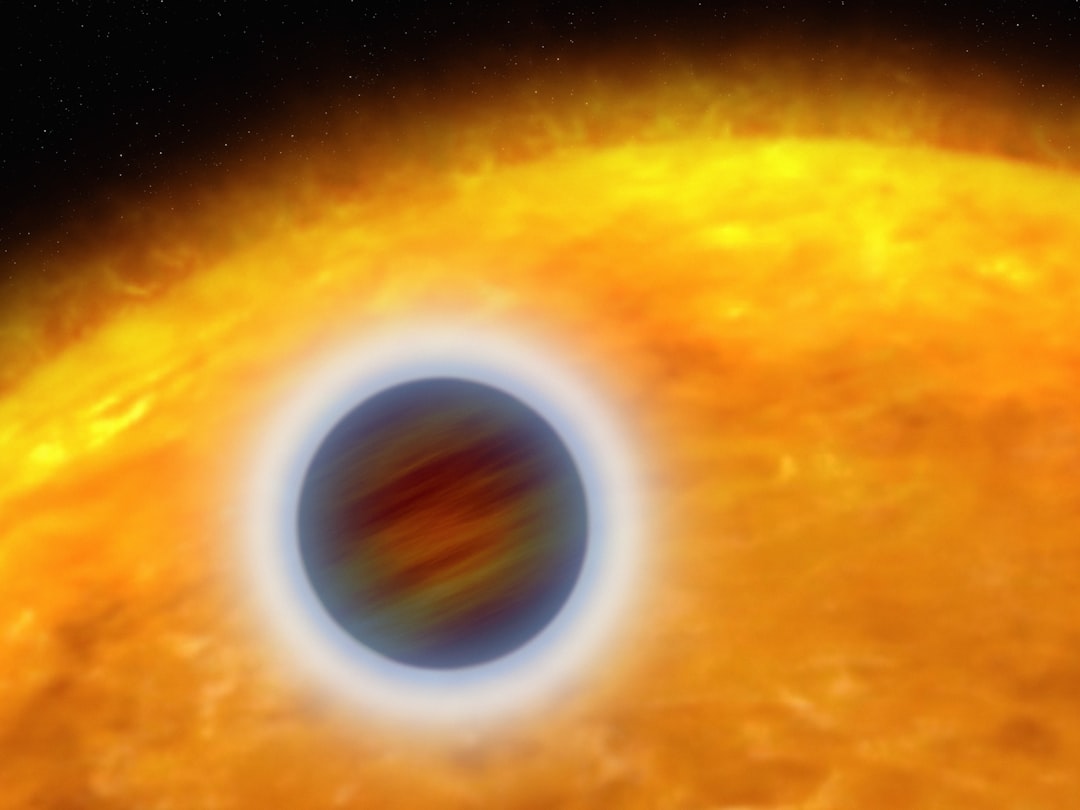
In a groundbreaking spectroscopic study, astronomers have uncovered compelling evidence that validates a fundamental assumption about planetary system formation: the chemical fingerprints of exoplanets mirror those of their parent stars. Using the advanced capabilities of the Gemini South telescope in Chile, a research team led by Arizona State University graduate student Jorge Antonio Sanchez has measured the atmospheric composition of WASP-189b, an ultra-hot Jupiter orbiting the young A-type star HR 5599, revealing a remarkable chemical concordance between planet and star.
The observations, conducted using the Immersion Grating Infrared Spectrograph (IGRINS) on loan from McDonald Observatory in Texas, represent a significant milestone in exoplanetary science. For the first time, researchers have simultaneously measured the abundances of magnesium and silicon—two critical rock-forming elements—in both an ultra-hot Jupiter's atmosphere and its host star, finding them to be strikingly similar. This discovery provides crucial observational validation for theoretical models of how planetary systems emerge from their primordial birth clouds.
The implications extend far beyond this single system. By establishing this chemical link, scientists have gained a powerful new tool for understanding terrestrial planet formation, atmospheric evolution, and even the potential habitability of distant worlds. As the search for Earth-like planets intensifies, understanding the elemental composition of stellar systems becomes increasingly vital to identifying worlds where life might take hold.
A Scorching Laboratory in Space
WASP-189b is no ordinary exoplanet. First detected in 2018 and subsequently characterized by the European Space Agency's CHEOPS satellite in 2020, this gas giant pushes the boundaries of planetary extremes. With approximately twice the mass of Jupiter, it hurtles through space in an unusual polar orbit, completing one revolution around its host star every mere 2.7 days. This proximity to HR 5599 subjects the planet to intense stellar radiation, heating its atmosphere to a blistering 3,354 Kelvin (3,080°C or 5,577°F)—temperatures comparable to the surface of our own Sun.
These extreme conditions transform WASP-189b into what scientists call an "ultra-hot Jupiter," a class of exoplanets where conventional atmospheric chemistry breaks down. At such temperatures, materials that would typically form solid rocks or minerals on cooler worlds exist instead as vaporized metals and volatile elements suspended in the atmosphere. Iron, magnesium, silicon, and other heavy elements float freely in gaseous form, creating a unique laboratory for studying planetary composition.
This unusual state makes WASP-189b an ideal target for spectroscopic analysis. When starlight passes through the planet's atmosphere during transit, different elements absorb specific wavelengths of light, creating distinctive spectral signatures that astronomers can decode. The rich metallic atmosphere of ultra-hot Jupiters produces particularly clear signals, allowing researchers to identify and measure elemental abundances with unprecedented precision.
Validating the Cosmic Connection
The significance of Sanchez's findings lies in their confirmation of a long-held theoretical framework for planetary system formation. According to this model, stars and their planetary companions originate from the same primordial cloud of gas and dust, known as a molecular cloud or stellar nebula. As this cloud collapses under its own gravity, it forms a rotating disk with a dense protostar at its center.
"WASP-189b gives us a much-needed observational anchor in our understanding of terrestrial planet formation since it offers a measurable quantity that validates the presumed resemblance of stellar composition and the proportion of rocky material around host stars used to form planets," explained Sanchez.
The central protostar eventually ignites nuclear fusion, becoming a main-sequence star that fuses hydrogen into helium. Crucially, any heavier elements present in the star's outer layers—such as carbon, oxygen, magnesium, silicon, and iron—must have originated from the original molecular cloud, not from the star's own fusion processes. Our Sun exemplifies this principle: despite being primarily a hydrogen-fusion furnace, it contains trace amounts of metals and heavy elements inherited from its birth cloud approximately 4.6 billion years ago.
Meanwhile, in the surrounding protoplanetary disk, planets begin their formation journey. Rocky terrestrial planets accumulate through the gradual accretion of dust grains containing heavy elements, while gas and ice giants sweep up vast quantities of hydrogen and helium along with frozen volatiles. Regardless of their final composition, all planets draw their raw materials from the same reservoir that fed their parent star. This shared origin should, in theory, create a chemical kinship between star and planet—exactly what the Gemini South observations have now confirmed.
Advanced Spectroscopic Techniques Reveal Hidden Chemistry
The research team's methodology demonstrates the growing sophistication of ground-based exoplanet characterization. Using high-resolution infrared spectroscopy, the IGRINS instrument captured detailed spectra of both HR 5599 and WASP-189b during the planet's transit across the stellar disk. This technique, known as transmission spectroscopy, analyzes how the planet's atmosphere filters starlight, revealing the chemical composition of atmospheric gases.
The measurements focused specifically on the magnesium-to-silicon ratio, a critical indicator of rocky material composition. In terrestrial planets and rocky cores, this ratio determines fundamental properties such as mantle composition, volcanic activity potential, and even magnetic field generation. By finding similar ratios in both the star's photosphere and the planet's atmosphere, the researchers established a direct compositional link between the two objects.
This achievement required overcoming significant technical challenges. Earth's own atmosphere absorbs much of the infrared light that carries these chemical signatures, necessitating sophisticated data processing techniques to separate terrestrial interference from genuine exoplanetary signals. The success of this study demonstrates that ground-based observatories can compete with space-based facilities for certain types of atmospheric characterization, particularly when studying bright, hot targets like WASP-189b.
Implications for Rocky Planet Formation and Habitability
While WASP-189b itself is far too hot to support life as we know it, the study's findings carry profound implications for astrobiology and the search for habitable worlds. By establishing that stellar composition accurately reflects the elemental inventory available for planet formation, astronomers can now use relatively simple stellar spectroscopy to infer the likely composition of rocky planets in a given system—even when those planets are too small or distant to characterize directly.
This capability becomes particularly important when evaluating potential habitability. Earth's rocky composition plays multiple crucial roles in sustaining life: it generates our protective magnetic field through dynamo action in the iron-rich core, drives plate tectonics that recycle nutrients and regulate climate over geological timescales, and provides essential elements for biochemistry. Understanding whether distant rocky planets possess similar compositions helps scientists prioritize targets for detailed habitability studies.
The research also sheds light on how atmospheric chemistry evolves in different planetary environments. The presence of vaporized rock-forming elements in WASP-189b's atmosphere reveals processes of atmospheric mixing and chemical cycling that may operate in modified forms on cooler worlds. On hot rocky planets orbiting in their star's habitable zone, for instance, similar vaporization processes might occur on the day side, with condensation on the night side creating exotic weather patterns and mineral clouds.
Building a Framework for Comparative Planetology
The study opens new avenues for comparative studies across diverse planetary systems. By measuring elemental abundances in multiple ultra-hot Jupiters and comparing them to their host stars, astronomers can test whether the chemical concordance observed in the WASP-189 system represents a universal pattern or varies with stellar type, system age, or planetary migration history.
Some key questions that future observations might address include:
- Stellar Type Dependence: Do planets around different stellar classes (M-dwarfs, G-type stars, A-type stars) show consistent compositional matches with their hosts, or do formation processes vary?
- Migration Effects: Hot Jupiters likely migrated inward from more distant orbits. Does this migration alter their atmospheric composition compared to their initial formation composition?
- Atmospheric Escape: At extreme temperatures, do lighter elements preferentially escape to space, altering the planet's elemental ratios over time?
- Formation Location: Can we use compositional measurements to determine where in the protoplanetary disk a given planet originally formed?
Next-Generation Observations and Future Prospects
The success of this study points toward an exciting future for exoplanet atmospheric characterization. As study co-author Michael Line, Associate Professor at Arizona State University, noted:
"Our study demonstrates the capability of ground-based, high-resolution spectrographs to constrain critical species like magnesium and silicon, which are two elemental building blocks from which rocky planets form. This advancing capability opens an entirely new dimension in our study of exoplanet atmospheres."
The coming decade will see unprecedented advances in this field. The James Webb Space Telescope, already revolutionizing exoplanet science, offers complementary capabilities for studying atmospheric composition across a broad wavelength range. Meanwhile, next-generation ground-based facilities like the Extremely Large Telescope will provide even higher resolution and sensitivity for detecting subtle chemical signatures.
Future multi-wavelength campaigns combining space and ground-based observations will enable comprehensive chemical inventories of exoplanet atmospheres. Beyond magnesium and silicon, researchers aim to measure abundances of carbon, oxygen, nitrogen, and other biologically relevant elements. These measurements will help construct detailed models of planetary formation, evolution, and habitability potential across the galaxy.
Expanding the Sample of Characterized Worlds
The WASP-189b study represents just the beginning of systematic compositional surveys. Astronomers have identified hundreds of ultra-hot Jupiters suitable for similar analysis, each offering a unique window into planetary chemistry. By studying planets around stars of different ages, masses, and metallicities, researchers can map out how stellar properties influence planetary composition and atmospheric structure.
Particularly exciting are upcoming observations of smaller, cooler planets where rocky surfaces might exist beneath thick atmospheres. While current technology limits detailed characterization to the largest, hottest worlds, improving instruments will eventually enable similar studies of super-Earths and mini-Neptunes—planet types absent from our Solar System but common throughout the galaxy. Understanding how stellar composition influences these intermediate-mass worlds will be crucial for assessing their habitability potential.
A New Chapter in Understanding Planetary Origins
The Gemini South observations of WASP-189b and HR 5599 mark a significant milestone in humanity's quest to understand how planetary systems form and evolve. By confirming the chemical link between stars and their planets, this research validates fundamental assumptions underlying planet formation theory while demonstrating powerful new observational techniques for characterizing distant worlds.
As astronomers continue to refine these methods and apply them to ever-larger samples of exoplanets, we move closer to answering profound questions about our place in the cosmos: How common are planetary systems like our own? What conditions are necessary for life to emerge? And are we alone in the universe? The chemical fingerprints revealed in studies like this one provide essential clues for addressing these timeless questions, one spectrum at a time.
For researchers and space enthusiasts following these developments, the WASP-189b study exemplifies how modern astronomy combines cutting-edge technology, theoretical insight, and careful observation to unlock the secrets of distant worlds. As our observational capabilities continue to advance, we can expect many more such discoveries that deepen our understanding of the diverse planetary systems populating our galaxy and the fundamental processes that shaped them—and us.