For Trans-Neptunian Objects, The Past Is Written On Their Surface
The formation of our solar system, roughly 4.6 billion years ago, was a process of staggering complexity. From a swirling disk of gas and dust emerged a remarkable variety of worlds — scorched rocky planets, colossal gas giants, icy dwarfs, and countless small bodies that still bear the fingerprints of their ancient origins. Two foundational principles govern what we know about this primordial era of planetary science.
The first is that where a body forms has a profound effect on its composition. The snow line — the critical distance from the Sun beyond which temperatures are cold enough for water ice and other volatile compounds to condense — acted as a great dividing line in the early solar system. Beyond it, the ice giants Uranus and Neptune accumulated vast envelopes of icy material. Closer to the Sun, fierce solar winds stripped nascent worlds like Earth and Venus of their primordial hydrogen and helium, leaving behind the denser, rockier bodies we know today.
The second principle is equally important: where a body forms is not necessarily where it stays. The early solar system was a dynamic, turbulent environment where gravitational interactions between massive objects could send worlds on dramatic journeys across the planetary disk. Jupiter and Saturn, for instance, are believed to have migrated inward during their formation before settling into their current orbits — a process described by the influential Grand Tack hypothesis. This planetary reshuffling had cascading consequences, ultimately triggering the Late Heavy Bombardment approximately 4 billion years ago, a period when Earth and other inner planets were subjected to a ferocious barrage of asteroid and comet impacts. Evidence of this era is still preserved in the ancient, heavily cratered surfaces of the Moon.
Small Bodies, Big Questions
For decades, the prevailing view in planetary science held that while large planetary bodies largely preserve their original compositions, small solar system bodies are far more vulnerable to change. Tossed about by the gravitational influence of giant planets, these diminutive objects were thought to migrate dramatically, collide frequently, and, in doing so, gradually erase the chemical and physical record of their origins. This assumption made small bodies seem like unreliable witnesses to the solar system's early history.
Now, two landmark new studies challenge this long-held assumption — and they do so by turning their attention to one of the most remote and enigmatic populations of objects in our solar system: the Trans-Neptunian Objects (TNOs).
"The history of their origin is still written in their coloring — even for the smallest Trans-Neptunian Objects ever studied."
What Are Trans-Neptunian Objects?
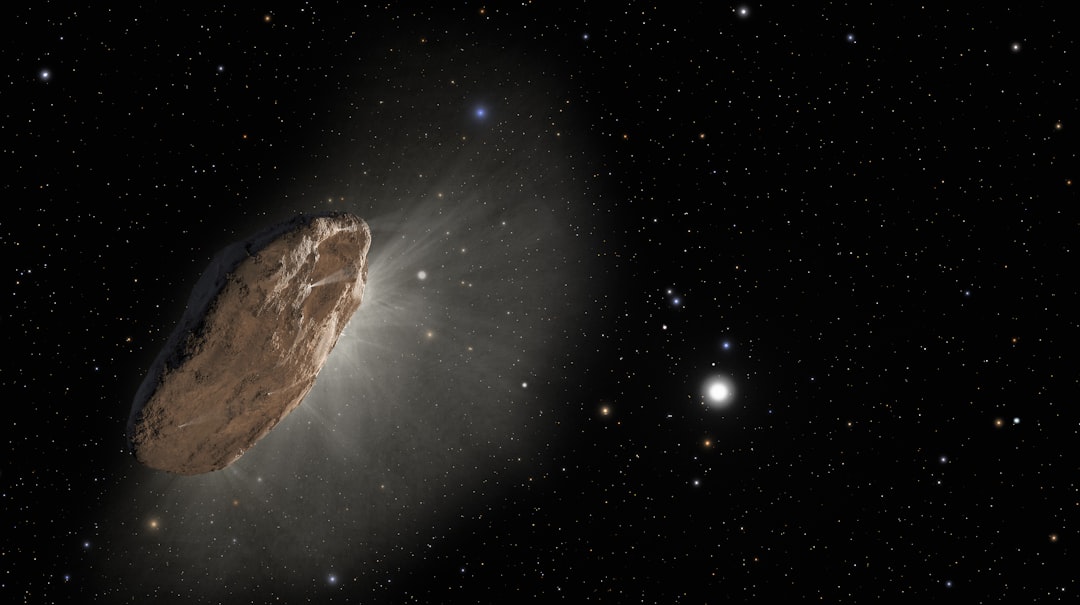
Trans-Neptunian Objects are a diverse population of small bodies that orbit the Sun at distances beyond Neptune, more than 30 astronomical units (AU) from our star. This vast, frigid region of the solar system — encompassing the Kuiper Belt, the scattered disk, and the distant Oort Cloud — is home to hundreds of thousands of objects ranging from tiny, sub-kilometer chunks of ice and rock to dwarf planets of considerable size. Famous TNOs include Pluto, Eris, Makemake, and Haumea, each offering a unique window into the outer solar system.
Because of their immense distance from the Sun and their typically small size, TNOs are extraordinarily faint and challenging to study. Even the most powerful ground-based telescopes have struggled to characterize anything beyond the largest members of this population. The James Webb Space Telescope (JWST), with its unprecedented infrared sensitivity, has now changed that calculus dramatically — allowing astronomers to probe the properties of TNOs far smaller and fainter than ever before.
Two Populations With Two Very Different Histories
TNOs are broadly divided into two dynamically distinct populations, and understanding the difference between them is key to interpreting the new findings.
- Cold Classical TNOs formed near their present locations, at the outer edge of the solar system. Their orbits are generally nearly circular and aligned with the orbital plane of the planets — a hallmark of objects that have experienced relatively little gravitational disturbance. The large dwarf planet Makemake is one of the most prominent members of this group.
- Hot TNOs (also called dynamically excited TNOs) formed in the region between the present orbits of Uranus and Neptune. During the era of planetary migration, they were gravitationally scattered outward to the distant solar system. Their orbits are characteristically elliptical and highly inclined relative to the orbital plane. Eris, the most massive known dwarf planet, belongs to this category.
Statistically, these two populations are relatively straightforward to distinguish through their orbital dynamics. But their surfaces tell an even more compelling story. Cold TNOs tend to display a distinctly reddish surface coloring, the result of organic-rich material — known as tholins — formed over billions of years of exposure to cosmic radiation. Hot TNOs, by contrast, show a broader and more varied palette of surface colors, reflecting their more turbulent and diverse histories.
JWST and Hubble Reveal the Smallest TNOs Ever Studied
The two new studies, both published in The Astronomical Journal, leverage the extraordinary capabilities of the James Webb Space Telescope — and in one case, data from the venerable Hubble Space Telescope — to push the study of TNOs into entirely new territory.
The first study, led by Marielle R. Eduardo et al., examines the luminosity function of ultrafaint TNOs detected by JWST — essentially, a census of how many TNOs exist at different brightness levels. This is a powerful tool for understanding the size distribution of the TNO population. The second study, by Anastasia N. Morgan et al., combines deep imaging from both JWST and Hubble to characterize the smallest known TNOs in detail, probing their surface properties and colors at scales previously inaccessible to astronomers.
Together, these studies reach a striking conclusion: the color distinction between cold and hot TNOs persists even among the very smallest members of each population. Despite billions of years of collisions, gravitational nudges, and cosmic radiation bombardment, the smallest TNOs still carry the chemical signature of where they were born. The past, it turns out, is indeed written on their surfaces.
Similar Collision Histories, Preserved Origins
Perhaps equally significant is what the studies reveal about the size distributions of the two TNO populations. Using JWST's deep imaging data, the researchers found that the size distributions of hot and cold TNOs are remarkably similar — a finding that carries important implications for our understanding of solar system evolution.
If hot TNOs had experienced a dramatically more violent history of collisions — as might be expected given their turbulent migration from the inner solar system — we would expect their size distribution to look quite different from their more placid cold counterparts. The fact that both populations show comparable size distributions suggests that the process of driving hot TNOs to the outer solar system was not as catastrophically violent as previously assumed. The migration, while dramatic in scope, was apparently gentle enough to preserve the primordial surface chemistry of even the smallest bodies.
This finding has profound implications for planetary formation models. It suggests that the gravitational scattering mechanisms responsible for transporting hot TNOs outward were relatively smooth — perhaps more consistent with a gradual migration than a sudden, cataclysmic reshuffling. It also reinforces the idea that small bodies can be reliable recorders of solar system history, overturning the older assumption that frequent collisions would inevitably erase their original compositions.
A Surprising Deficit of Small TNOs
The studies also uncover a significant and puzzling discrepancy: there appear to be fewer small TNOs than current planetary formation models predict. This so-called size distribution deficit at the small end of the TNO population is potentially a crucial clue to understanding both why the surface compositions are so well preserved and how these small bodies came to exist in the first place.
If fewer small TNOs exist than models suggest, it could mean that collisional grinding — the process by which larger bodies are broken into progressively smaller fragments over time — has been less efficient in the outer solar system than previously thought. Alternatively, it could point to gaps in our understanding of how planetesimals initially formed in the primordial solar nebula. The European Space Agency's ongoing research into the Kuiper Belt and future missions may help resolve this question.
What is clear is that this deficit also helps explain the remarkable preservation of TNO surface compositions. With fewer small bodies undergoing frequent catastrophic collisions, there has simply been less opportunity for the original surface chemistry to be overwritten. The outer solar system, it seems, is a far quieter and more pristine archive of planetary history than we had imagined.
The Broader Significance: Reading the Solar System's History
These discoveries carry significance that extends well beyond the study of TNOs themselves. The outer solar system has long been considered a kind of cosmic time capsule — a region where the low temperatures, vast distances, and relative scarcity of gravitational disturbances have preserved material in something close to its primordial state. The new findings powerfully reinforce this view, suggesting that even the smallest, most collision-prone members of the TNO population retain meaningful information about the conditions that prevailed 4.6 billion years ago.
For researchers studying the formation and evolution of the solar system, this has transformative implications. It means that future surveys of the TNO population — including those enabled by the Vera C. Rubin Observatory's Legacy Survey of Space and Time (LSST), expected to discover tens of thousands of new TNOs — may yield an unprecedented wealth of information about the solar system's earliest chapter.
- Surface colors of TNOs preserve the chemical record of where they formed, even after billions of years.
- Size distributions of hot and cold TNOs are similar, indicating comparable collision rates and a relatively gentle migration history.
- Fewer small TNOs exist than models predict, challenging current theories of planetesimal formation.
- JWST's infrared sensitivity has opened a new era of TNO science, enabling the study of objects far smaller and fainter than previously possible.
- Small bodies may be more reliable recorders of solar system history than previously assumed.
Looking Ahead: More Stories Yet to Tell
There remain many more small TNOs waiting to be discovered, cataloged, and interrogated. Each new object found at the solar system's frozen frontier carries within it a fragment of a 4.6-billion-year-old story — a story of formation, migration, collision, and survival in one of the most extreme environments in the known universe. The more we learn to read the surfaces of these ancient, icy wanderers, the more clearly we can reconstruct the dramatic events of our solar system's infancy.
As the authors of these studies have shown, what is past is not merely past — it is prologue to discoveries yet to come.
References
- Morgan, Anastasia N., et al. "Combined JWST and HST Deep Imaging to Characterize the Smallest Known Trans-Neptunian Objects." The Astronomical Journal 172.4 (2026): 188.
- Eduardo, Marielle R., et al. "The Luminosity Function of Ultrafaint Trans-Neptunian Objects Detected by JWST." The Astronomical Journal 172.4 (2026): 187.