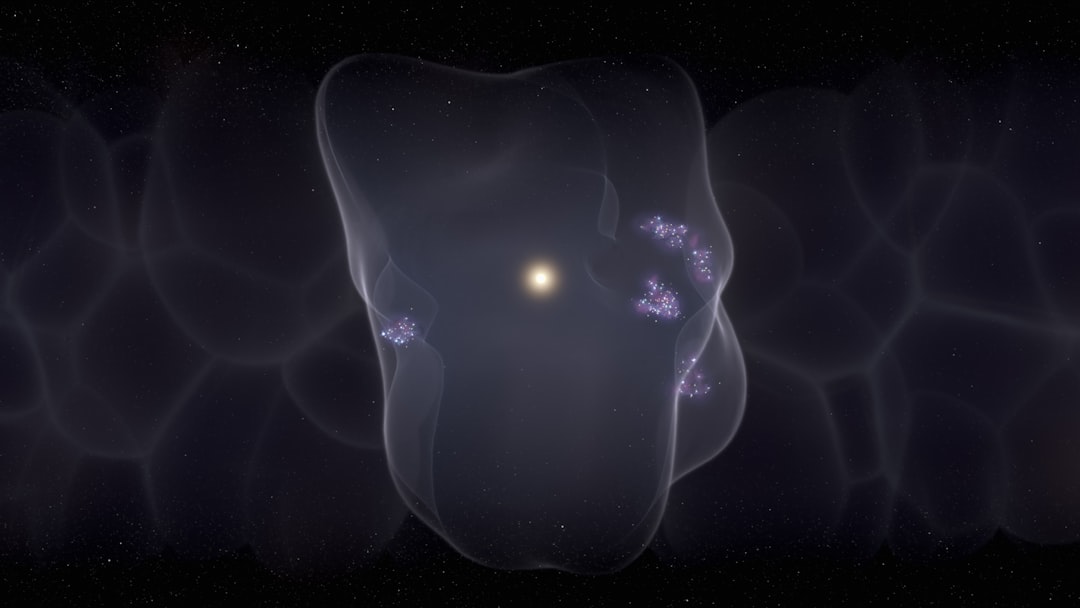
Astronomy's Decades-Long Quest To Understand Cosmic Topology
Imagine boarding a starship and setting course in a single, unwavering direction — traveling for hundreds of thousands, even millions of light years, fully expecting to carve an eternal, straight line through the infinite cosmos. Now imagine, after all that journeying, arriving back where you started. This is not the premise of a science fiction novel. It is one of the genuinely possible — and scientifically investigated — consequences of cosmic topology, the study of the global shape and connectivity of the universe at its largest scales.
For most of modern cosmology, the prevailing paradigm has held that we inhabit a spatially flat, infinite universe — one that stretches endlessly in every direction without boundary or repetition. Yet a growing body of theoretical and observational work suggests this assumption may be incomplete. Cosmic topology challenges us to ask not merely how the universe is curved locally, but how it is fundamentally connected on the grandest scales imaginable.
"In some cases, there is an actual physical and straight path that can take you back to where you started, but not to when you started." — Andrew Jaffe, Professor of Cosmology and Astrophysics, Imperial College London
As Professor Andrew Jaffe of Imperial College London explains, a universe with non-trivial topology could contain closed spatial loops — paths through space that, if followed long enough, curve back to their origin. This is fundamentally different from a so-called closed timelike curve, which would return a traveler not just to the same location but to the same moment in time — the stuff of time machines and grandfather paradoxes. A topologically closed universe, by contrast, is merely one in which space itself wraps around, like the surface of a sphere but in three dimensions.
What Is Cosmic Topology?
To understand cosmic topology, it helps to distinguish between two separate geometric questions about the universe: its curvature and its topology. Curvature — whether the universe is flat, positively curved like a sphere, or negatively curved like a saddle — is a local geometric property, one that Einstein's general theory of relativity elegantly addresses. Topology, on the other hand, is a global property. It describes how the different regions of the universe are connected to one another at the largest scales.
A simple analogy: a flat piece of paper and a cylinder made by rolling that paper both have the same local geometry — they are both locally flat — but they have radically different topologies. On the flat paper, two parallel lines never meet. On the cylinder, a traveler moving in one direction eventually returns to the starting point. Our universe could, in principle, be locally flat (as observations strongly suggest) while still being globally finite and multiply connected — like a vast three-dimensional analogue of that cylinder.
As the authors of a landmark 2026 paper published in Nature Astronomy note, topology is characterized by the possible existence and properties of unshrinkable closed loops — if you could travel far enough in some direction along such a loop, you would return to your starting point. The existence of such paths would have profound observational consequences that astronomers are now beginning to have the tools to test.
The Cosmic Microwave Background: Our Window to the Early Universe
The primary observational tool in the search for cosmic topology is the Cosmic Microwave Background (CMB) — the faint afterglow of radiation left over from the early universe. Approximately 380,000 years after the Big Bang, the universe had cooled enough for electrons and protons to combine into neutral hydrogen atoms, an epoch known as recombination. At this moment, the universe became transparent, and photons streamed freely for the first time. Those ancient photons, now stretched by billions of years of cosmic expansion into the microwave portion of the electromagnetic spectrum, constitute the CMB we observe today.
The CMB effectively forms a spherical shell around us — the last scattering surface — representing the furthest back in cosmic time that electromagnetic observations can currently penetrate. Its precise temperature fluctuations, on the order of one part in 100,000, encode an extraordinary wealth of information about the early universe's composition, geometry, and, potentially, its topology. NASA's Wilkinson Microwave Anisotropy Probe (WMAP) and the ESA's Planck satellite have mapped these fluctuations with extraordinary precision, providing the primary datasets that cosmologists use to search for topological signatures.
Cosmologists have been observing the CMB since the 1960s, but only since the early 2000s have instruments achieved sufficient sensitivity to detect the subtle, large-scale patterns that topological signatures would produce. As Jaffe, author of the 2025 book "The Random Universe: How Models and Probability Help Us Make Sense of the Cosmos," explains, the modern era of cosmic topology research began in the late 1990s, with major advances coinciding with WMAP data in the mid-2000s and even higher-quality measurements in the 2010s.
"Cosmic topology would imprint subtle signatures on the cosmic microwave background and on the three-dimensional distribution of matter, potentially breaking homogeneity at the largest scales." — Nature Astronomy, 2026
Telltale Signatures: Circles in the Sky
So what would cosmic topology actually look like? If the universe has a non-trivial topology — if space wraps back on itself in some direction — then the same physical region of space would be visible from multiple directions on the sky. This would produce matching patterns at different locations in the CMB, most famously in the form of pairs of circles with statistically identical temperature fluctuation patterns, a phenomenon known as the "circles-in-the-sky" signature, first proposed by Neil Cornish, David Spergel, and Glenn Starkman in the late 1990s.
As Jaffe explains, the existence of such "identifications" means that two areas of the sky that appear to be far apart might in fact be the same physical location observed from different directions. In the simplest case, this produces repeated patterns: for the CMB, it might manifest as a circle on one side of the sky bearing exactly the same pattern as a circle far away from it. The absence of such matching circles — or their confirmed detection — would provide direct evidence about the universe's topology.
To illustrate this concept, Jaffe invokes the analogy of a three-dimensional torus — the geometric shape resembling a doughnut. Just as an ant walking in a straight line around the tube of a doughnut would eventually return to its starting point, a photon traveling through a toroidal universe would, after sufficient distance, pass through the same region of space it had already traversed. The observable consequence would be that circle on one side of the CMB sky matching a circle on the opposite side — a cosmic fingerprint of a closed, repeating universe.
- Flat torus topology: Space wraps around in all three spatial dimensions, like a three-dimensional version of the classic arcade game Pac-Man — exit one side, enter the other.
- Spherical topology: Like the surface of a sphere, but in three dimensions; a traveler moving in any direction eventually returns to the start.
- Hyperbolic topology: Negatively curved space that can also possess non-trivial global connectivity despite its local saddle-like geometry.
- Matched circle pairs: The most sought-after observational signature — pairs of circles in the CMB sky with statistically identical temperature patterns.
- Low CMB quadrupole: The unexpected suppression of large-scale CMB fluctuations observed by both WMAP and Planck may hint at a finite universe size.
COMPACT: A Collaboration Built for the Cosmic Scale
In recognition of the scientific importance and complexity of this challenge, Jaffe and a group of international colleagues have established COMPACT — the Collaboration for Observations, Models and Predictions of Anomalies and Cosmic Topology. Now comprising approximately twenty international scientists, COMPACT is dedicated to developing the rigorous mathematical frameworks and observational strategies needed to detect or constrain cosmic topology.
"Our work with COMPACT has started to put these results into the full mathematical theory and details of the possible topologies that could describe our Universe," says Jaffe. This includes going beyond simple pattern-matching in the CMB to develop sophisticated statistical tools capable of extracting topological information from noisy, incomplete datasets — a formidable challenge given that the very signals being sought are intrinsically subtle and exist at the boundary of observable scales.
The collaboration also addresses a fundamental limitation of CMB-based topology searches: the CMB is a two-dimensional surface (the last scattering sphere), and topological signatures imprinted on it represent a projection of an underlying three-dimensional structure. Certain topologies may be invisible or ambiguous when viewed only through the CMB, demanding complementary three-dimensional data to resolve the degeneracies.
Beyond the CMB: Mapping the Three-Dimensional Universe
Expanding the search for cosmic topology beyond the two-dimensional CMB surface to the full three-dimensional distribution of matter in the universe represents a critical next frontier. A comprehensive three-dimensional map of galaxies, galaxy clusters, and the cosmic web — the vast filamentary structure of gas and dark matter stretching across billions of light years — would provide far richer topological information than the CMB alone.
The logic is compelling: if the universe has a non-trivial topology, then the same galaxy clusters, superclusters, or large-scale structures should appear at multiple locations in the sky — "topological twins" separated by the characteristic scale of the universe's repeating structure. Identifying such pairs across the full three-dimensional galaxy distribution would provide a smoking-gun signature of topology that is far harder to dismiss as a statistical artifact than matched CMB circles.
Major ongoing and forthcoming galaxy surveys are poised to make this vision a reality. ESA's Euclid mission, launched in 2023, is mapping the three-dimensional distribution of billions of galaxies across more than a third of the sky, probing cosmic structure to unprecedented depth and precision. Similarly, the Dark Energy Spectroscopic Instrument (DESI) is building the largest three-dimensional map of the universe ever assembled, measuring the spectra and positions of tens of millions of galaxies and quasars.
"A proper three-dimensional map of that matter would give us even more information about the topology of the Universe — possibly all the information that we could ever have," says Jaffe. This three-dimensional approach also opens up the possibility of searching for topological signatures in the clustering statistics of galaxies, the distribution of baryon acoustic oscillations, and even the velocities of galaxies influenced by large-scale gravitational fields — each providing an independent and complementary probe of the universe's global shape.
The Observational Horizon: A Fundamental Limitation
There is, however, a sobering constraint that haunts this entire enterprise: the cosmic horizon. Because the universe has a finite age — approximately 13.8 billion years — and because light travels at a finite speed, there is an absolute limit to how far we can observe, regardless of the power of our instruments. The observable universe, a sphere roughly 46 billion light years in radius (accounting for cosmic expansion), represents the absolute boundary of our observational reach.
For cosmic topology to be detectable, the characteristic scale of the universe's topological structure — essentially, the size of the "fundamental domain," the smallest repeating unit of space — must be small enough that its signatures fall within our observable horizon. If the topology exists at scales vastly larger than our observable universe, it would leave no detectable imprint on any observation we could ever make, rendering it empirically unknowable.
"We need to know the Universe's size: if it's too big — much larger than the distance to the CMB sphere — we won't be able to detect it," says Jaffe. This creates a peculiar asymmetry in the scientific enterprise: if we detect topology, we will have made one of the most profound discoveries in the history of science. If we fail to detect it, we cannot know whether the universe is truly infinite, or simply so large that its finite topology lies beyond our cosmic horizon — forever beyond reach.
Anomalies That Hint at Something Larger
Intriguingly, certain well-documented anomalies in the CMB data may already be whispering hints of non-trivial topology. The most discussed is the low CMB quadrupole — an unexpected suppression of large-angle temperature fluctuations first noticed by the COBE satellite and confirmed by both WMAP and Planck. In an infinite, featureless universe, fluctuations should exist on all scales with roughly equal power. The observed deficit of power at the largest angular scales is precisely what a finite universe, with a topology scale comparable to or smaller than the observable universe, would predict: there is simply no "room" for fluctuations larger than the universe itself.
While this anomaly alone is not conclusive evidence for cosmic topology — its statistical significance remains debated — it represents a persistent, reproducible feature of our best CMB datasets that has resisted conventional explanations. Combined with other large-scale CMB anomalies, including the hemispherical power asymmetry and the so-called cold spot, it motivates serious, sustained investigation of the topological hypothesis.
Cosmological Fortune and the Road Ahead
The authors of the 2026 Nature Astronomy paper take an optimistic — if appropriately cautious — view of the prospects for detecting cosmic topology in the coming decade. We may be fortunate, they write, and the evidence for cosmic topology may already be sitting in existing data, awaiting extraction by sufficiently sophisticated analysis tools. Alternatively, the decisive evidence may be collected over the coming years through next-generation CMB observations and large-scale galaxy surveys.
Next-generation CMB experiments, including the CMB-S4 project — a ground-based array of ultra-sensitive telescopes planned to map the CMB with unprecedented resolution and sensitivity — promise to push the search for topological signatures to new limits. Combined with the three-dimensional galaxy maps from Euclid and DESI, and potential future space-based CMB missions, the coming decade may finally provide the observational power needed to either detect cosmic topology or place definitive constraints on the universe's fundamental shape.
The quest for cosmic topology is, at its heart, one of the most audacious endeavors in the history of science: an attempt to determine not just what the universe contains, but what it fundamentally is — its shape, its boundaries, and the nature of its deepest connectivity. Whether the answer turns out to be an infinite, featureless expanse or a vast, intricately folded structure that wraps back on itself in ways that would confound any starship navigator, the journey toward that answer is already reshaping our understanding of the cosmos.
"The goal is to try to see those repeating patterns, by looking at as much of the Universe as possible." — Andrew Jaffe, Imperial College London
Key Takeaways
- Cosmic topology investigates the global shape and connectivity of the universe, independent of its local curvature.