In a groundbreaking new study, researchers have harnessed the power of machine learning to dramatically expand the number of known quasars acting as strong gravitational lenses. These exceptionally rare cosmic phenomena, in which a massive foreground galaxy bends the light from a more distant background galaxy around itself, provide a unique window into the co-evolution of supermassive black holes and their host galaxies across billions of years of cosmic history. The innovative approach, developed by a team led by Everett McArthur, has more than doubled the sample of these valuable systems in a single search, opening up new avenues for probing the mysteries of the universe.
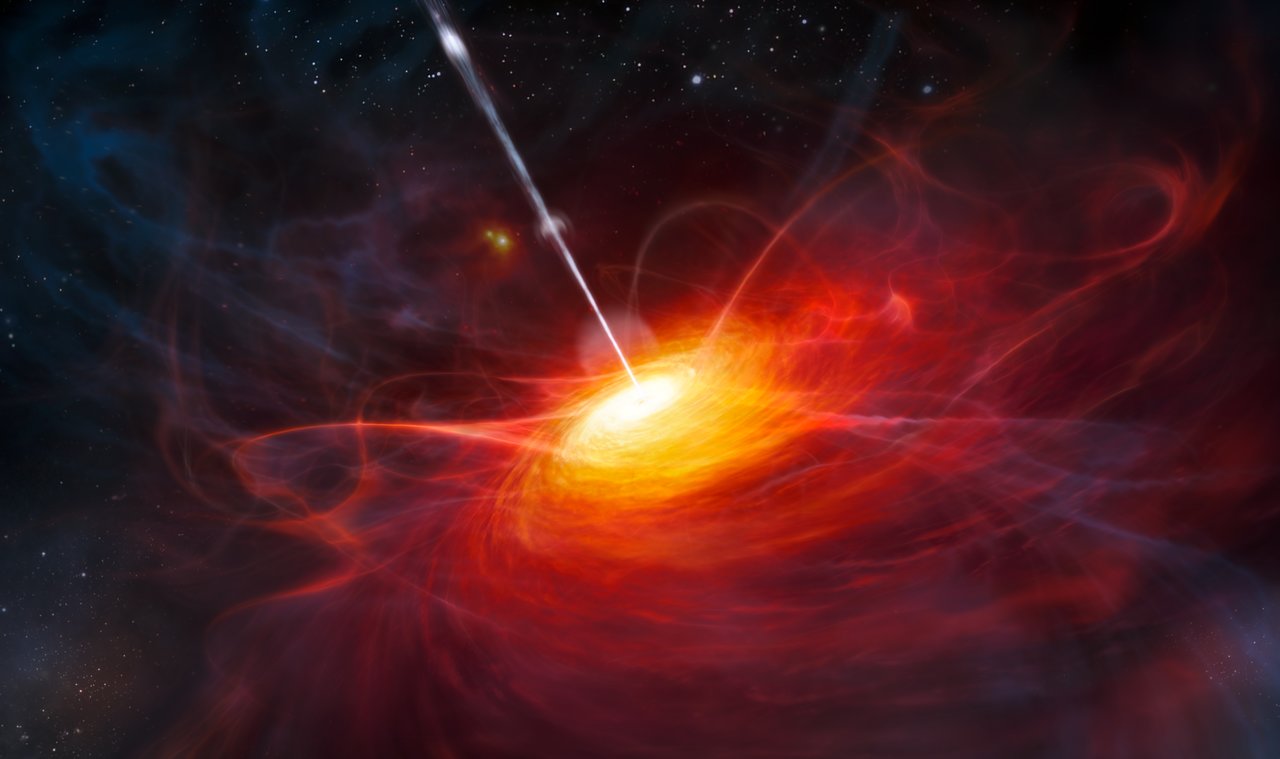
Out of the nearly 300,000 quasars cataloged in the Sloan Digital Sky Survey (SDSS), only a dozen gravitationally lensed quasar candidates had been previously identified, with just three confirmed. The scarcity of these systems belies their immense scientific value. Quasars, the luminous cores of active galaxies powered by supermassive black holes, typically outshine their host galaxies by a factor of a thousand or more, making it nearly impossible to directly measure the mass of the galaxy itself. Gravitational lensing offers a rare workaround - the characteristic angular size of the lensed background galaxy's distorted images provides a direct probe of the host galaxy's mass.
Harnessing Machine Learning to Uncover Cosmic Needles in a Haystack
McArthur and colleagues recognized that traditional methods of identifying lensed quasars, which rely on spotting the subtle distorted images of the background galaxy, face an uphill battle. From the ground, the brilliant glare of the foreground quasar typically drowns out these faint features. Instead, they turned to spectroscopy, training a sophisticated neural network to search for the telltale spectral fingerprints of higher-redshift background galaxies imprinted on the light of foreground quasars.
The researchers constructed a training set of realistic mock lenses by combining actual spectra of quasars from the Dark Energy Spectroscopic Instrument (DESI) with spectra of higher-redshift emission-line galaxies. By feeding the neural network approximately 3,000 of these synthetic lenses along with 30,000 ordinary quasar spectra, they taught it to distinguish even the faintest background galaxy signatures from the complex spectral features of the quasars themselves.
"Machine learning was really the key to unlocking this discovery. By training the neural network on realistic simulated data, we were able to dramatically boost its sensitivity to the subtle signals of background lensed galaxies, which would be nearly impossible to spot by eye." - Everett McArthur
Striking Gold in DESI's First Data Release
Applying their neural network to the immense dataset of DESI's first public data release, which spans over 812,000 quasars at redshifts between 0.03 and 1.8, the researchers struck gold. The algorithm flagged seven high-quality quasar lens candidates, each displaying the unmistakable spectral signature of a more distant galaxy - a strong oxygen doublet emission line at a substantially higher redshift than the foreground quasar.

Four of the newly discovered systems even exhibit additional spectral features originating from the background galaxy, such as hydrogen beta and oxygen III emission lines. As a testament to the algorithm's prowess, it successfully recovered the sole previously confirmed quasar lens that fell within DESI's sky coverage.
The implications of this expanded sample are far-reaching. With each new quasar lens system, astronomers gain another valuable data point for charting the intertwined evolution of galaxies and their central supermassive black holes over cosmic time. The quasars' Einstein radii, a measure of how strongly the background galaxies' light is distorted, provide a direct probe of the foreground host galaxies' masses at the moments when we observe them.
A Glimpse into Cosmic Evolution
Quasars represent a key evolutionary phase in the lifecycle of most massive galaxies, a period of rapid growth during which the supermassive black hole at a galaxy's core is accreting matter at a prodigious rate. This process, which can outshine the combined light of the galaxy's hundreds of billions of stars, is thought to play a critical role in regulating star formation and shaping the galaxy's long-term evolution.
Yet despite decades of study, the details of how quasars and their host galaxies co-evolve remain poorly understood. Conventional techniques struggle to disentangle the light of the host galaxy from the overwhelming glare of the quasar itself, making it challenging to study the properties of the galaxy and its central black hole simultaneously.
Gravitationally lensed quasars neatly sidestep this limitation by providing a independent measure of the host galaxy's mass through the Einstein radius of the lensed background galaxy's images. By combining these mass measurements with spectroscopic observations of the quasars themselves, astronomers can paint a detailed picture of the relationship between supermassive black holes and their host galaxies at different cosmic epochs.
"Each quasar lens system is like a cosmic laboratory, letting us study the interplay between some of the most extreme objects in the universe - supermassive black holes and entire galaxies - at moments billions of years in the past. With this expanded sample, we can start to piece together how these objects evolved in lockstep over the history of the universe." - Study co-author
Paving the Way for Future Discoveries
As powerful as this initial search has been, it represents just the tip of the iceberg in terms of DESI's ultimate potential for discovering gravitationally lensed quasars. The instrument's five-year mission is only just beginning, and as it continues to amass spectra of millions of galaxies and quasars, the opportunities for discovery will only multiply.
Moreover, the novel machine learning techniques pioneered in this study need not be limited to DESI data alone. With a growing array of powerful spectroscopic surveys on the horizon, from SDSS-V to the Nancy Grace Roman Space Telescope, the potential for applying similar algorithms to reveal lensed quasars in other datasets is immense. As astronomers continue to push the boundaries of what's possible with machine learning in the era of big data astronomy, the future of quasar lens studies looks brighter than ever.