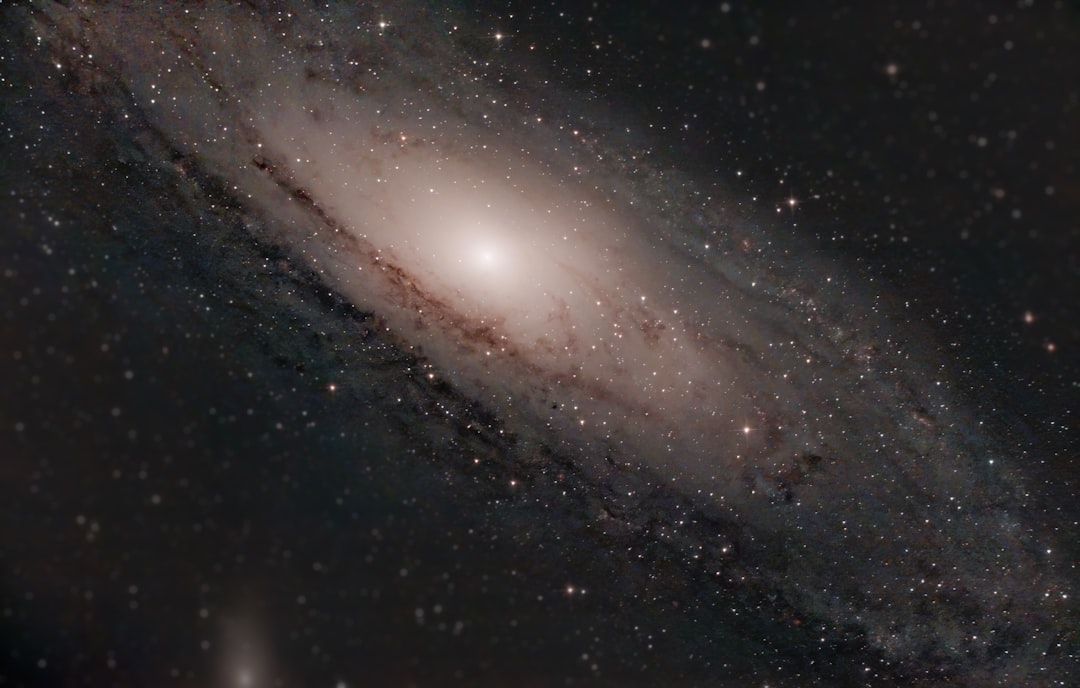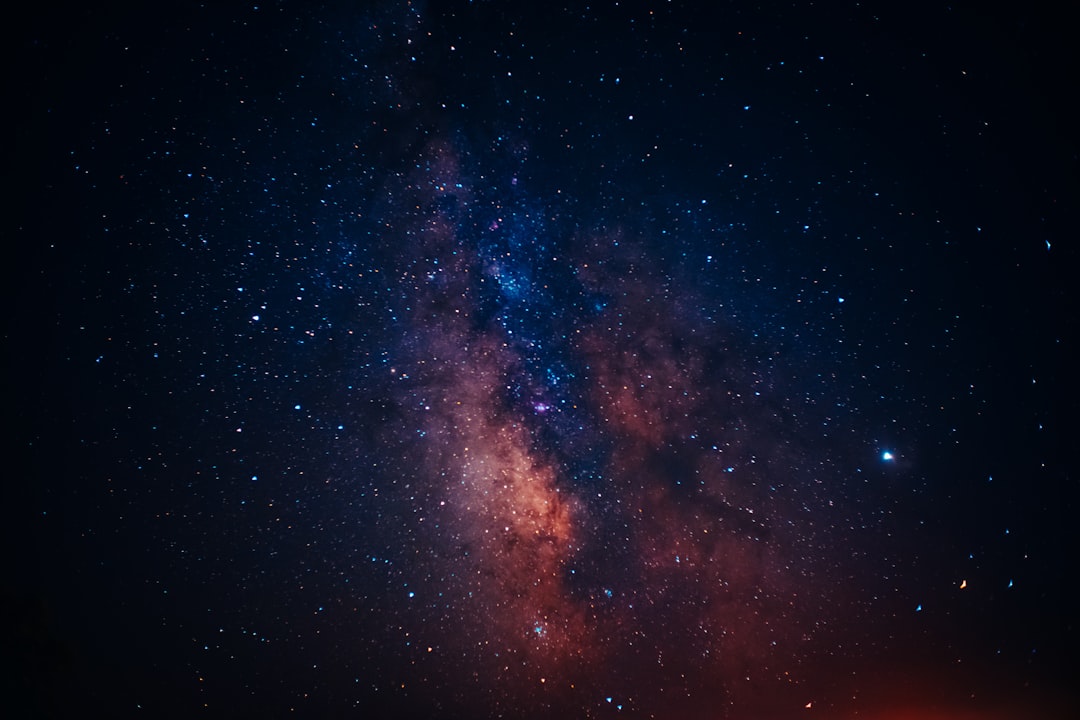
The Milky Way galaxy is about to reveal one of its most fundamental secrets through an unexpected messenger: the collective whisper of gravitational waves emanating from millions of stellar corpses locked in their final cosmic dance. While astronomers have long studied our galaxy's rotation through optical telescopes and radio surveys, a groundbreaking analysis by researchers in Paris has revealed that the Laser Interferometer Space Antenna (LISA) will capture something extraordinary—the rotational signature of our entire galaxy encoded in the fabric of spacetime itself.
This revelation addresses a critical oversight in how scientists have been preparing to interpret LISA's observations. The mission, scheduled for launch in the mid-2030s as a joint venture between ESA and NASA, will detect gravitational waves from countless pairs of white dwarfs spiraling toward merger throughout the Milky Way. These signals merge into what astronomers call the "galactic foreground"—a persistent hum of spacetime ripples. What the new research demonstrates is that ignoring the galaxy's 230-kilometer-per-second rotation when analyzing this hum could introduce systematic errors comparable to the instrument's measurement precision, potentially corrupting our understanding of stellar populations and galactic structure.
Understanding the Cosmic Symphony: LISA's Mission to Hear Spacetime
The Laser Interferometer Space Antenna represents one of the most ambitious scientific instruments ever conceived. Unlike ground-based gravitational wave detectors such as LIGO, which detect high-frequency signals from colliding black holes and neutron stars, LISA operates in an entirely different regime. The mission consists of three spacecraft flying in a triangular formation separated by 2.5 million kilometers—roughly six times the Earth-Moon distance. Laser beams bouncing between these spacecraft will measure distance changes smaller than the width of an atom, detecting the stretching and squeezing of spacetime as gravitational waves pass through.
What makes LISA particularly suited to studying the Milky Way is its sensitivity to low-frequency gravitational waves—those with periods ranging from seconds to hours. This is precisely the frequency range where millions of compact binary systems within our galaxy emit their signals. These systems, predominantly pairs of white dwarfs but also including neutron stars and stellar-mass black holes, orbit each other with periods ranging from minutes to hours. As they spiral inward, losing energy to gravitational radiation, they generate ripples in spacetime that propagate outward at the speed of light.
"The galactic foreground is not noise—it's a rich information source about our galaxy's structure and stellar populations. But to extract that information accurately, we must account for every physical effect that shapes the signal, including the galaxy's rotation," explains the theoretical framework underlying the Paris team's analysis.
The Doppler Effect Meets Gravitational Wave Astronomy
The key insight from the new research centers on a phenomenon familiar from everyday experience but rarely considered in the context of gravitational wave backgrounds: the Doppler effect. When an ambulance approaches with its siren blaring, the sound waves compress, raising the pitch; as it recedes, the waves stretch, lowering the pitch. This same principle applies to all wave phenomena, including light (causing the redshift of distant galaxies) and gravitational waves.
Within the Milky Way, stars orbit the galactic center at velocities that vary with distance from the core but typically reach around 230 kilometers per second in the solar neighborhood. Binary systems participate in this grand rotation, and their motion affects the gravitational waves they emit. When a binary system moves toward Earth, its gravitational wave signal gets compressed to slightly higher frequencies; when moving away, the signal stretches to lower frequencies. This frequency shift might seem trivial—after all, 230 km/s is less than 0.1% of the speed of light—but LISA's extraordinary precision makes even such small effects measurable and, crucially, significant for accurate data interpretation.
The Paris researchers developed the first complete mathematical framework describing how the rotational Doppler effect modulates the galactic gravitational wave background. Their analysis revealed that this effect creates a distinctive directional pattern across the sky. Looking toward the galactic center, where stellar density peaks, observers see a strong signal with frequency shifts determined by whether the rotation carries stars toward or away from us. Looking toward the galactic anticenter or perpendicular to the galactic plane produces different frequency patterns. This directional variation—what astronomers call anisotropy—carries information about both the galaxy's structure and its dynamics.
Quantifying the Impact on LISA Observations
To assess the practical importance of their theoretical discovery, the research team performed detailed statistical simulations of LISA data analysis. They asked a deceptively simple question: what happens if scientists analyzing LISA data use models that assume a non-rotating galaxy? The answer, obtained through two independent statistical approaches, proved sobering. Neglecting the rotational Doppler effect introduces systematic biases in estimating key parameters of the galactic binary population, including:
- Binary population size: The total number of compact binaries in the galaxy could be misestimated by amounts comparable to LISA's statistical uncertainties, potentially skewing our understanding of stellar evolution and white dwarf formation rates
- Mass distribution: The characteristic masses of white dwarfs in binary systems might be incorrectly inferred, affecting theories of stellar evolution and Type Ia supernova progenitors
- Spatial distribution: The three-dimensional arrangement of binaries throughout the galaxy could be mischaracterized, impacting models of galactic structure
- Frequency spectrum: The shape of the gravitational wave background spectrum encodes information about orbital period distributions, which could be corrupted if rotation is ignored
A New Window on Dark Matter's Hidden Architecture
Beyond correcting a potential source of systematic error, the rotational Doppler effect opens an entirely new observational possibility: using gravitational waves to measure galactic rotation independently of traditional electromagnetic observations. This prospect carries profound implications for one of astronomy's most pressing mysteries—the nature and distribution of dark matter.
Currently, astronomers infer the Milky Way's rotation curve—how orbital velocity varies with distance from the galactic center—primarily through optical and radio observations of stars and gas clouds. These measurements reveal that stars orbit far faster than visible matter alone could explain, providing some of the strongest evidence for dark matter halos surrounding galaxies. However, these traditional methods face limitations: dust obscures parts of the galaxy, distance measurements carry uncertainties, and complex stellar motions complicate the analysis.
LISA's gravitational wave observations offer a complementary approach. The rotational modulation of the galactic foreground directly encodes information about how fast different parts of the galaxy rotate. Since gravitational waves pass through dust unimpeded and carry precise frequency information, they could provide an independent check on rotation curve measurements. Discrepancies between gravitational wave and electromagnetic rotation measurements might reveal new physics or refine our understanding of dark matter distribution.
The Paris team's analysis demonstrates that this measurement is theoretically feasible, though extracting rotation information from the complex gravitational wave background will require sophisticated data analysis techniques. The payoff could be substantial: a new probe of the dark matter scaffolding that shapes our galaxy's structure and evolution.
Implementing the Solution: Updated Analysis Templates
Fortunately, incorporating the rotational Doppler effect into LISA data analysis proves relatively straightforward. The correction requires no new unknown parameters—the Milky Way's rotation has been measured extensively through conventional astronomy. What's needed is updating the theoretical templates that LISA analysts will use to model the expected gravitational wave background.
These templates are mathematical descriptions of the signal LISA should observe given various assumptions about the galaxy's binary population, structure, and dynamics. The Paris researchers have provided the necessary formulas to include rotational effects in these templates. When LISA begins operations, analysts can incorporate these corrections from the start, avoiding the systematic biases that would otherwise arise.
The work also highlights the importance of careful theoretical preparation for major observational missions. LISA will observe a cosmos we've never seen through gravitational wave eyes, detecting signals from sources ranging from galactic binaries to supermassive black hole mergers billions of light-years away. Extracting maximum scientific value from these observations requires understanding every physical effect that shapes the signals, no matter how subtle. The rotational Doppler effect exemplifies how even well-known physics can have overlooked consequences when applied to new observational regimes.
Broader Implications for Gravitational Wave Astronomy
This research represents part of a larger effort to prepare for the gravitational wave astronomy revolution that LISA will catalyze. While LIGO and its partners have already transformed our understanding of stellar-mass black holes and neutron stars, LISA will open entirely new windows on the universe. The mission's science targets include:
- Supermassive black hole mergers: Collisions between the million- to billion-solar-mass black holes at galaxy centers, observable across cosmic time
- Extreme mass ratio inspirals: Small compact objects spiraling into supermassive black holes, providing exquisite tests of general relativity in strong gravitational fields
- Galactic binaries: Thousands of individual systems resolved above the background, plus the collective foreground from millions more
- Stochastic backgrounds: Potentially including signals from the early universe, phase transitions, or exotic physics beyond the Standard Model
Each of these science cases requires careful theoretical modeling to interpret observations correctly. The rotational Doppler work demonstrates how attention to detail in these models can prevent systematic errors and unlock new measurement capabilities.
Looking Toward LISA's Launch and Beyond
With LISA's launch anticipated in the mid-2030s, the mission remains roughly a decade away. This timeline might seem distant, but preparing to analyze LISA data is a massive undertaking requiring years of work. The LISA Data Challenges, organized by the mission's science team, have been testing analysis algorithms and pipelines for years, using simulated data to ensure the community is ready when real observations begin.
The rotational Doppler analysis will be incorporated into these preparations, becoming part of the standard toolkit for modeling the galactic foreground. As LISA accumulates observations over its planned four-year mission (with possible extensions), the rotational signature will become increasingly apparent in the data. Eventually, LISA might achieve the tantalizing goal of independently measuring galactic rotation through gravitational waves alone—a measurement that would have seemed like science fiction just decades ago.
This research also exemplifies how modern astronomy increasingly relies on combining multiple observational approaches. The Milky Way's rotation, first revealed through optical spectroscopy of stars, then refined through radio observations of gas and masers, will eventually be probed through the completely different physics of gravitational waves. Each approach has unique strengths and systematic uncertainties; together, they provide a more complete and reliable picture than any single method could achieve.
As we stand on the threshold of the gravitational wave astronomy era, work like this Paris team's analysis reminds us that the universe still holds surprises. Even in our own galaxy, which astronomers have studied for centuries, new ways of looking—or in this case, listening—continue to reveal hidden layers of complexity and opportunity. The Milky Way's rotation, encoded in the hum of spacetime itself, awaits LISA's launch to tell its story.