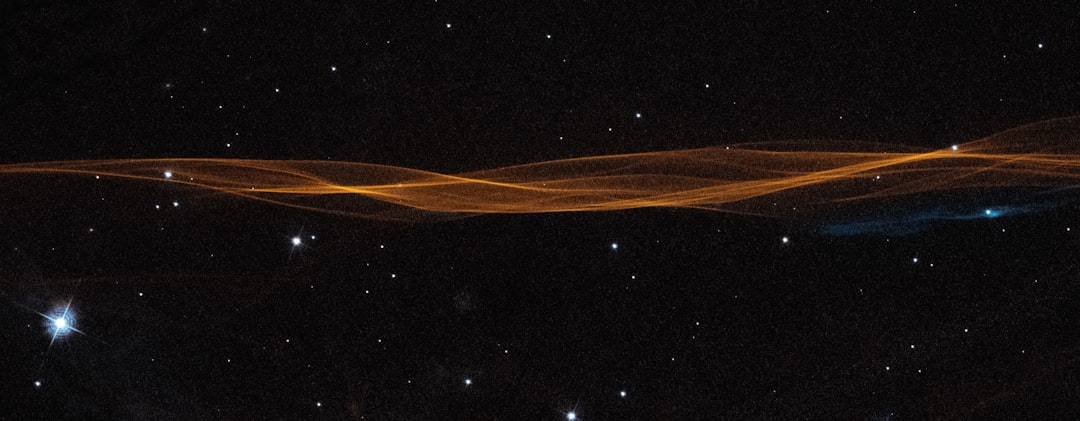
When a massive star reaches the end of its life, it doesn't simply fade away—it orchestrates one of nature's most spectacular cosmic performances. In mere seconds, a Type Ia supernova unleashes such tremendous energy that it can briefly outshine the combined light of hundreds of billions of stars in its host galaxy. Yet despite their spectacular nature, astronomers have been forced to discard 99% of the data collected from these cosmic beacons—until now.
These stellar explosions serve as far more than celestial fireworks. They function as cosmic measuring sticks that have fundamentally shaped our understanding of the universe's expansion and the mysterious force known as dark energy. A groundbreaking new approach developed by researchers at the International School for Advanced Studies (SISSA) in Trieste and the University of Barcelona promises to revolutionize how we extract information from these distant detonations, potentially unlocking answers to some of cosmology's most pressing questions.
The Power and Challenge of Stellar Standard Candles
Type Ia supernovae occupy a unique position in the astronomer's toolkit. Unlike their more chaotic cousins—core-collapse supernovae that result from massive stars exhausting their nuclear fuel—Type Ia events occur when white dwarf stars in binary systems accumulate matter from companion stars until they reach a critical threshold. This consistency in their formation mechanism means they explode with remarkably uniform intrinsic brightness, earning them the designation of standard candles.
The principle behind using these explosions as distance indicators mirrors a surprisingly everyday concept. Imagine standing on a coastline at night, observing lighthouses dotting the shore. If you know each lighthouse emits the same amount of light, you can calculate your distance from each one simply by measuring how bright or dim it appears from your vantage point. NASA's observations have demonstrated that Type Ia supernovae function as cosmic lighthouses, allowing astronomers to map distances across billions of light-years with unprecedented accuracy.
This capability led to one of the most startling discoveries in modern physics: the universe's expansion is accelerating, driven by the enigmatic force we call dark energy. The 2011 Nobel Prize in Physics recognized this breakthrough, which fundamentally relied on precise distance measurements from Type Ia supernovae.
The Contamination Problem: When Cosmic Signals Get Muddy
However, extracting clean distance measurements from supernova observations presents formidable challenges. The light traveling across cosmic distances doesn't arrive pristine and unchanged. Instead, it passes through vast clouds of interstellar dust that scatter and absorb certain wavelengths preferentially, much like Earth's atmosphere reddens sunlight at sunset. The chemical composition and age of the progenitor star also introduce variations, as does the environment within the host galaxy itself.
Traditional approaches to disentangling these competing influences have relied heavily on spectroscopic analysis—breaking light into its component wavelengths to create detailed rainbow-like spectra. This technique provides rich information about the physical conditions and chemical makeup of the explosion and its surroundings. The catch? Spectroscopy requires substantial telescope time and can only be performed on the brightest, most accessible targets.
"The spectroscopic bottleneck has been astronomy's Achilles heel in the era of big data. We can detect thousands of supernovae, but we could only deeply analyze a tiny fraction of them. It's like having a library of 100,000 books but only being able to read 1,000 of them," explains Dr. Maria Rodriguez, a cosmologist at the European Southern Observatory who was not involved in the study.
This limitation has become increasingly acute with the commissioning of next-generation survey telescopes. The Vera Rubin Observatory in Chile, which recently began operations, represents a quantum leap in discovery capability. Equipped with the world's largest digital camera—a staggering 3.2 gigapixels—this facility will scan the entire visible sky every few nights, expected to identify more than 100,000 Type Ia supernovae annually.
CIGaRS: An AI-Powered Revolution in Cosmic Measurement
Enter CIGaRS, an acronym for Cosmological Inference from Galactic Redshift Surveys, a sophisticated new methodology that leverages artificial intelligence to extract maximum information from photometric data alone. Unlike spectroscopy, photometry measures brightness through broad filters—essentially taking precise measurements in several color bands rather than analyzing the full spectrum.
The innovation lies in CIGaRS' holistic approach. Rather than correcting for dust, stellar age, chemical composition, and galactic environment sequentially—each step introducing its own uncertainties—the system employs neural networks trained to disentangle all these factors simultaneously. This unified model draws on our understanding of galaxy evolution, stellar physics, and dust properties to reconstruct the true intrinsic brightness of each supernova from photometric observations alone.
The research team, whose findings appear in recent publications available through arXiv astrophysics preprints, tested their methodology on simulated catalogs containing up to 16,000 supernovae—roughly equivalent to one month of Vera Rubin Observatory operations. The results proved remarkable: CIGaRS achieved cosmological measurements four times more precise than traditional methods that rely on the small spectroscopic fraction.
Technical Innovation Behind the Breakthrough
The neural network architecture underlying CIGaRS represents years of development in machine learning applications to astronomy. The system was trained on millions of simulated supernovae, learning to recognize subtle patterns in how different physical effects manifest in photometric data. Key to its success is the incorporation of Bayesian inference techniques, which properly account for uncertainties and allow the system to express confidence levels in its measurements.
Unlike simple pattern-matching algorithms, CIGaRS embeds physical models of stellar evolution, dust extinction laws, and cosmological distance relationships directly into its framework. This physics-informed approach ensures that the AI's conclusions remain grounded in established scientific principles while exploiting machine learning's power to identify complex correlations in high-dimensional data.
Implications for Dark Energy Research and Cosmology
The practical impact of this advancement cannot be overstated. In cosmology, where competing theories about the nature of dark energy often differ by only fractions of a percent in their predictions, measurement precision directly translates to discriminatory power between models. A fourfold improvement in precision could mean the difference between merely constraining dark energy's properties and definitively ruling out entire classes of theoretical explanations.
Consider the equation of state parameter w, which characterizes how dark energy's density evolves as the universe expands. Current observations constrain this value to within roughly 5% of -1, the value predicted if dark energy is Einstein's cosmological constant. Future surveys using CIGaRS could potentially narrow this uncertainty to 1% or better, testing whether dark energy is truly constant or varies over cosmic time—a distinction with profound implications for fundamental physics.
The methodology also promises to enhance our understanding of cosmic expansion history across different epochs. By efficiently analyzing supernovae at various distances—and therefore at different times in cosmic history—astronomers can trace how the universe's expansion rate has changed over billions of years. This cosmic timeline provides crucial tests of general relativity on the largest scales and constraints on alternative theories of gravity.
Looking Toward the Future of Time-Domain Astronomy
The advent of CIGaRS arrives at a pivotal moment for astronomy. Beyond the Vera Rubin Observatory, upcoming missions like the ESA's Euclid space telescope and NASA's Nancy Grace Roman Space Telescope will discover thousands of additional supernovae, many at unprecedented distances. These facilities will probe cosmic epochs when the universe was less than half its current age, offering windows into conditions that shaped galaxy formation and the emergence of large-scale structure.
The synergy between these observatories and advanced analysis techniques like CIGaRS creates exciting possibilities:
- Precision cosmology: Constraining dark energy properties and testing general relativity with unprecedented accuracy across cosmic time
- Galaxy evolution insights: Using supernovae as probes of their host galaxies' star formation histories, chemical enrichment, and dust content
- Transient classification: Rapidly identifying unusual supernovae that deviate from standard behavior, potentially revealing new physical phenomena
- Real-time cosmology: Incorporating new supernova discoveries into cosmological analyses within days rather than years, enabling adaptive observing strategies
- Multi-messenger astronomy: Combining supernova observations with gravitational wave detections and neutrino signals for comprehensive understanding of stellar explosions
Challenges and Future Refinements
Despite its impressive performance, CIGaRS represents the beginning rather than the end of this research avenue. The team acknowledges several areas requiring continued development. Training datasets must expand to encompass rarer supernova subtypes and extreme environmental conditions. The neural networks require validation against real observational data as Vera Rubin's supernova catalog grows. And systematic uncertainties in photometric calibration—the precise measurement of brightness—must be rigorously characterized to avoid introducing biases.
Additionally, the astronomical community must address questions about interpretability and trust in AI-driven scientific conclusions. While CIGaRS' physics-informed architecture provides some transparency, understanding exactly how the neural network reaches specific conclusions remains challenging. Developing methods to visualize and validate the AI's decision-making process will be crucial for broad acceptance within the research community.
A New Era of Cosmic Discovery
The transformation from discarding 99% of supernova data to utilizing virtually all of it represents more than a technical achievement—it exemplifies how artificial intelligence is reshaping observational astronomy. As our telescopes grow more powerful and our datasets more voluminous, traditional analysis approaches increasingly struggle to keep pace. CIGaRS demonstrates that thoughtfully designed AI systems, grounded in physical understanding and rigorous validation, can unlock information previously considered inaccessible.
This breakthrough arrives as humanity stands on the threshold of answering fundamental questions about our universe's composition, history, and ultimate fate. The nature of dark energy—whether it represents Einstein's cosmological constant, a dynamical field pervading space, or perhaps a signal that our understanding of gravity requires modification—remains one of physics' deepest mysteries. Every improvement in measurement precision brings us closer to resolution.
As the Vera Rubin Observatory begins its systematic survey of the night sky, capturing the explosive deaths of stars across cosmic time, methods like CIGaRS ensure that each photon carries maximum information. In the grand endeavor to understand our universe, we can no longer afford to waste data. The cosmos is speaking; now, finally, we're learning to listen with full attention.