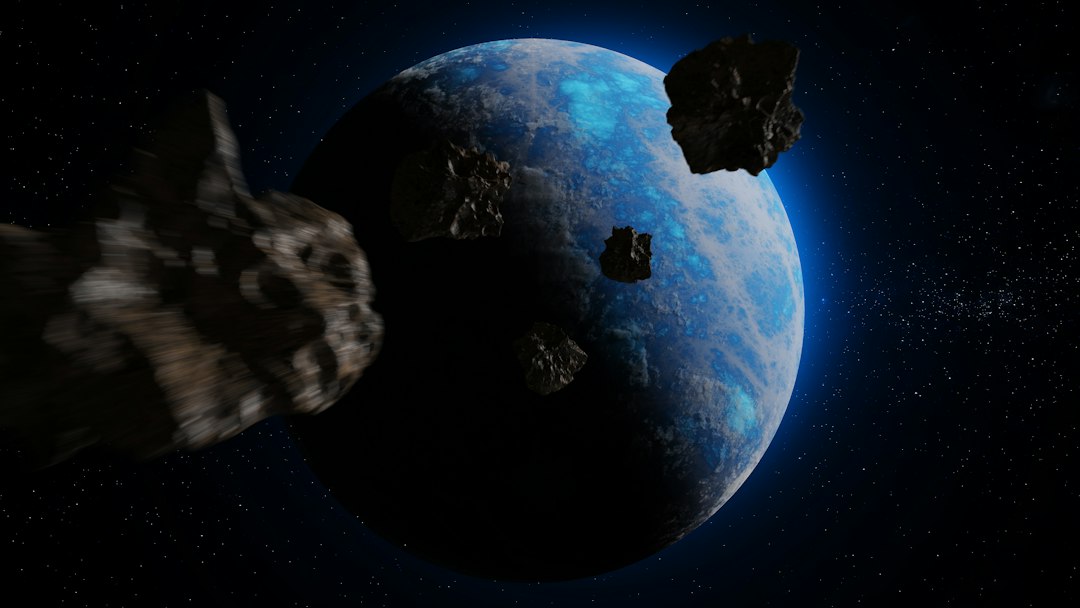
How Diffractive Solar Sails Could Stop a Killer Asteroid at 100 km/s
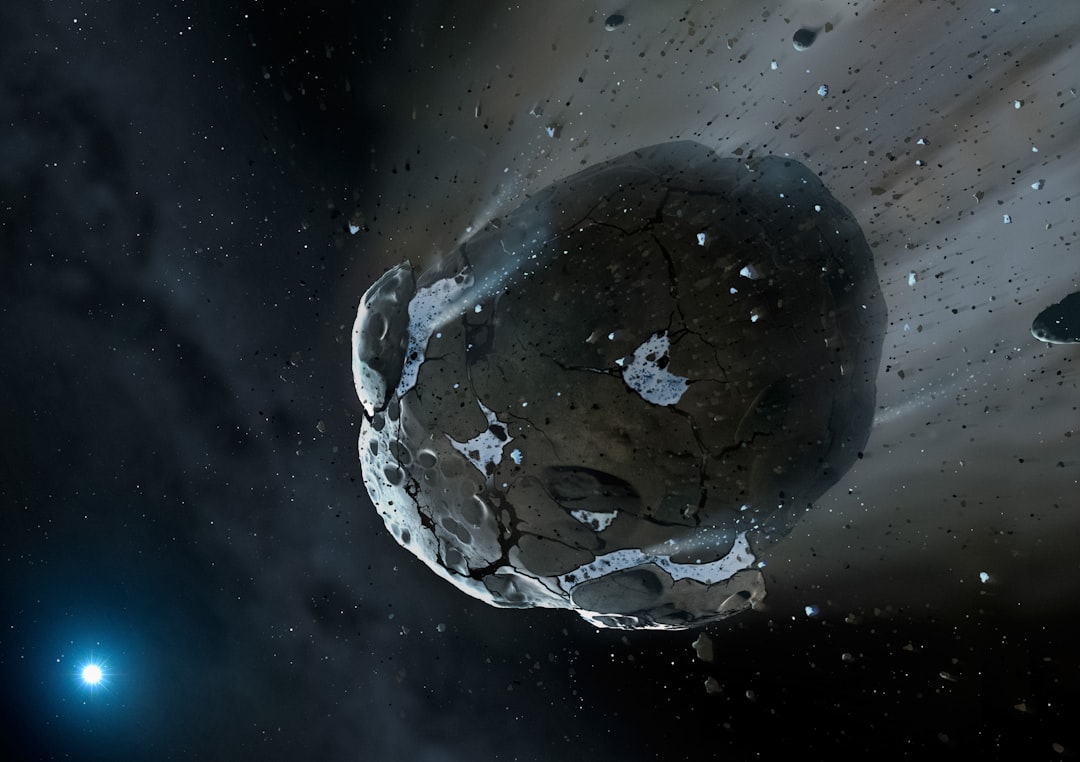
Asteroids don't come with a warning label announcing their potential to one day strike Earth. While no known asteroid is currently on a confirmed collision course with our planet, astronomers are discovering thousands of new near-Earth objects (NEOs) every year, and the statistical certainty of a future impact threat remains very real. The solar system is a dynamic, complex environment, and gravitational perturbations from Jupiter and other massive bodies can nudge asteroid trajectories in unpredictable ways over long timescales. Humanity's first serious answer to this challenge came in the form of NASA's landmark DART (Double Asteroid Redirection Test) mission, which successfully demonstrated that a spacecraft could alter an asteroid's orbit using a technique known as a kinetic impactor — essentially a massive, precision-guided projectile. But DART also revealed the inherent limitations of that approach. Now, researchers at Beihang University are proposing a bold upgrade: a novel diffractive solar sail that could deflect a potentially hazardous asteroid by intercepting it head-on at a staggering 100 km/s.
The Physics of Planetary Defense: Why Speed Is Everything
Deflecting an asteroid using a kinetic impactor ultimately comes down to one fundamental physical principle: kinetic energy transfer. The more energy an impactor delivers to an asteroid, the more that asteroid's trajectory changes. This relationship is governed by the classical kinetic energy equation, KE = ½mv², which tells us that energy scales with the square of velocity. In practical terms, this means doubling the speed of an impactor doesn't just double the energy delivered — it quadruples it. Tripling the speed increases energy by a factor of nine. The implications for planetary defense are profound.
NASA's DART spacecraft impacted its target, Dimorphos — the smaller moonlet of the binary asteroid system Didymos — at approximately 6.1 km/s in September 2022. While this was an impressive and historically significant achievement, that speed was fundamentally constrained by the geometry of the mission: DART was launched from Earth and traveled in the same direction as its target, essentially chasing Dimorphos down from behind. The spacecraft's velocity relative to the asteroid was therefore modest — the difference in two objects moving in the same direction rather than opposing ones.
"An impactor using a solar sail can come at an approaching asteroid from the opposite direction — akin to a wrong-way highway driver — and smash into its target at around 100 km/s, imparting something like 230 times the force per kilogram of impactor mass compared to the DART test."
— J. Zhang et al., Beihang University
The new paper from Beihang University argues that by reversing the spacecraft's orbital direction so that it approaches the asteroid in a head-on collision geometry, the relative velocity at impact skyrockets to approximately 100 km/s. When you do the kinetic energy math, a head-on impactor traveling at 100 km/s delivers roughly 230 times more energy per kilogram of impactor mass than DART's 6.1 km/s approach. This is not a marginal improvement — it is a paradigm-shifting leap in deflection capability, particularly relevant for scenarios where warning time is limited or the threatening asteroid is unusually large or dense.
The Challenge of Going Retrograde: Fighting the Solar System's One-Way Street
The solar system, in almost every observable respect, rotates in one direction. When viewed from above the ecliptic plane — the flat disk in which the planets orbit — virtually everything moves counter-clockwise: the planets, most asteroids, most comets, and certainly any spacecraft launched from Earth. This inherited angular momentum dates back to the formation of the solar system from a rotating protoplanetary disk approximately 4.6 billion years ago.
Reversing this direction — entering what astronomers call a retrograde orbit, moving clockwise against the grain — requires an enormous expenditure of energy. For a chemical rocket, the challenge is essentially insurmountable. Tsiolkovsky's rocket equation, the foundational principle governing all propulsive spaceflight, dictates that the amount of propellant needed increases exponentially with the desired velocity change (or delta-v). The delta-v required to reverse orbital direction from ~30 km/s (Earth's orbital speed) to -30 km/s is approximately 60 km/s — a figure utterly beyond the reach of any chemical propulsion system ever conceived. Even the most efficient chemical rockets achieve exhaust velocities of only around 4–4.5 km/s.
Ion drives and other forms of electric propulsion fare better in terms of efficiency, but they generate thrust measured in millinewtons — far too feeble to achieve such a massive velocity reversal within any practical mission timeline. This is precisely where solar sails present a unique and tantalizing possibility.
The Vulpetti H-Reversal Trajectory: Sailing Against the Current
Solar sails harness solar radiation pressure — the minuscule but continuous force exerted by photons as they strike and reflect off a surface. Unlike chemical or ion rockets, solar sails require no propellant whatsoever. They are, in a very real sense, powered by starlight, making them conceptually ideal for long-duration or high-delta-v missions where carrying fuel would be prohibitive.
In the 1990s, pioneering Italian aerospace engineer and physicist Giancarlo Vulpetti recognized that solar sails could theoretically achieve something remarkable: a trajectory he termed the H-reversal (heliocentric reversal). This elegant orbital maneuver unfolds in three distinct phases:
- Phase 1 – Braking: The solar sail is oriented to act as a brake, opposing the spacecraft's orbital motion and continuously reducing its angular momentum around the Sun.
- Phase 2 – Solar Dive: Once the angular momentum drops to zero, the spacecraft is essentially in a near-radial falling trajectory. Solar gravity then dominates, pulling the craft inward in a deep, fast dive toward the Sun — a perihelion passage.
- Phase 3 – Retrograde Slingshot: At or near perihelion — the point of closest approach to the Sun — the sail reactivates and is oriented to generate thrust in the direction that now builds angular momentum in the opposite (retrograde) sense. The spacecraft slingshots outward into a clockwise, retrograde orbit.
On paper, this is a brilliant solution. In practice, however, it immediately exposes one of the Achilles' heels of conventional solar sail technology: attitude control.
The Problem with Traditional Solar Sails
Humanity has successfully deployed solar sails in space on several occasions. JAXA's IKAROS (Interplanetary Kite-craft Accelerated by Radiation Of the Sun) mission, launched in 2010, was the first spacecraft to demonstrate solar sail propulsion in deep space. More recently, The Planetary Society's LightSail 2, launched in 2019, demonstrated controlled solar sailing in Earth orbit. Both of these missions used reflective sails — essentially giant, ultra-thin mirrors that reflect incoming photons. By Newton's third law, the recoil from reflecting photons generates a small but persistent thrust force, always perpendicular to the sail's surface.
This perpendicularity is both a strength and a fundamental limitation. In a standard orbit-raising or lowering maneuver, where thrust needs to be roughly tangential to the orbit, a reflective sail can achieve the correct force direction while keeping its face broadly aimed at the Sun. But in an H-reversal trajectory, the required thrust direction during the critical perihelion phase is nearly parallel to the direction of incoming sunlight — sideways relative to the Sun-spacecraft line. To generate sideways thrust with a reflective sail, you must tilt the sail at an extreme angle to the Sun. This dramatically reduces the sail's effective cross-section, meaning far less sunlight is captured, and sail efficiency plummets precisely when maximum performance is needed most.
Furthermore, maneuvering large, gossamer-thin sail structures with high precision near the Sun — where thermal and radiation stresses are most severe — represents an extraordinary engineering challenge. This is why the Beihang University team looked beyond conventional reflective sail technology for their solution.
Diffractive Solar Sails: A Quantum Optical Leap Forward
The key innovation in the Beihang University study is the diffractive solar sail. Rather than relying on simple reflection, these next-generation sails are fabricated from thin films embedded with microstructured optical gratings — precisely engineered periodic surface patterns at the nanoscale that manipulate light through the phenomenon of diffraction.
When light strikes a diffraction grating, it is split and redirected at specific angles determined by the grating's geometry — angles that are entirely independent of the incoming light direction. This means a diffractive sail can be oriented face-on to the Sun (maximizing the surface area capturing sunlight) while the optical gratings redirect the resulting photon momentum sideways, generating thrust at whatever angle the mission demands — without physically rotating the sail itself. This property is transformative for the H-reversal trajectory because:
- The sail can maintain its full face toward the Sun at all times, capturing maximum solar photon flux.
- Thrust can be redirected tangentially or laterally through grating angle adjustment, without requiring large, structurally demanding attitude changes.
- Attitude control complexity is dramatically reduced, making the system far more practical to engineer and operate.
- The sail remains highly effective at perihelion, where the Sun's intensity — and therefore available thrust — is at its peak.
Research into diffractive solar sails has been gaining momentum in recent years, with scientists at institutions including NASA exploring diffractive sail concepts as a transformative propulsion technology for future deep-space missions. The reflection-type diffractive sail — one that combines diffraction with partial reflection — emerged as particularly promising in the Beihang simulations.
Simulation Results: Finding the Winning Sail Configuration
The Beihang University team, led by J. Zhang and colleagues, conducted detailed numerical simulations comparing multiple solar sail configurations for the H-reversal trajectory. The sail types tested included purely reflective sails, transmissive diffractive sails, and reflection-type diffractive sails. The results were stark.
Only the reflection-type diffractive sail consistently completed the H-reversal maneuver successfully. The other configurations suffered from one of two fatal outcomes: either the spacecraft was drawn too far into the Sun's gravity well and plunged into a solar impact trajectory, or the thrust geometry was misconfigured in a way that launched the spacecraft onto a hyperbolic escape trajectory, sending it out of the solar system entirely. These are not graceful mission failures — they represent the total loss of a planetary defense asset at precisely the moment it might be needed most.
The reflection-type diffractive sail threaded the needle between these extremes, maintaining stable trajectory control throughout the braking phase, perihelion dive, and retrograde slingshot. With the winning sail type identified, the researchers moved on to the most compelling part of their study: a real-world application scenario involving one of the most famous asteroids in the public consciousness.
Apophis: A Case Study in Planetary Defense
99942 Apophis is a 340-meter-wide near-Earth asteroid that will make a historically close flyby of Earth on April 13th, 2029 — passing within approximately 38,000 km of our planet's surface. To put that in perspective, it will pass closer to Earth than the orbits of many geostationary satellites. It will briefly be visible to the naked eye. While current orbital calculations confirm that Apophis poses no impact threat in 2029, its close passage will cause measurable gravitational perturbations to its orbit, and the NASA Center for Near Earth Object Studies (CNEOS) continues to monitor it carefully for any future risk windows.
The Beihang team chose Apophis not because it is dangerous, but because it is well-studied — its orbital parameters are known with exceptional precision, making it an ideal test case for their simulations. They modeled the diffractive solar sail in two distinct operational configurations:
- Fixed-angle configuration: A sail with a permanently set diffraction angle, offering simplicity at the cost of some trajectory optimization flexibility.
- Variable-angle configuration: A sail capable of switching between a moderate diffraction angle during the inbound solar dive and a high diffraction angle (approximately 90 degrees) near perihelion, when maximum lateral thrust is needed.
Both configurations successfully delivered a simulated impactor to Apophis at approximately 100 km/s within a mission timeline of 200–300 days from launch. Crucially, this represents nearly a full year of time savings compared to an equivalent mission using a conventional reflective solar sail — a difference that in a genuine planetary emergency could be the margin between a successful deflection and a catastrophic impact.
Putting It All in Context: The Planetary Defense Toolbox
DART's successful demonstration proved that humanity can, in principle, alter an asteroid's orbit. Post-impact analysis confirmed that Dimorphos's orbital period around Didymos was shortened by approximately 33 minutes — far exceeding pre-mission predictions due to the additional momentum contributed by ejecta launched from the asteroid's surface. NASA's DART mission page provides comprehensive details on the mission's findings and their implications for future planetary defense strategies.
However, DART also illuminated the constraints of the kinetic impactor approach as currently practiced. Long warning times, years of delta-v buildup, and a relatively modest energy transfer per unit impactor mass all limit the technique's applicability for fast-moving, late-detected, or large-mass threats. Complementary approaches — including nuclear standoff detonations, gravity tractors, and now diffractive solar sail impactors — form an evolving portfolio of planetary defense options that researchers continue to develop and refine.
The European Space Agency's Planetary Defence program, which includes the Hera mission currently en route to characterize the aftermath of the DART impact, represents the international community's commitment to understanding and preparing for asteroid threats. Similarly, the Planetary Society continues to advocate for robust planetary defense investment and research, building on the legacy of LightSail 2 and the broader potential of solar sail technology.
The Beihang University study adds a significant and exciting new chapter to this ongoing story. Key