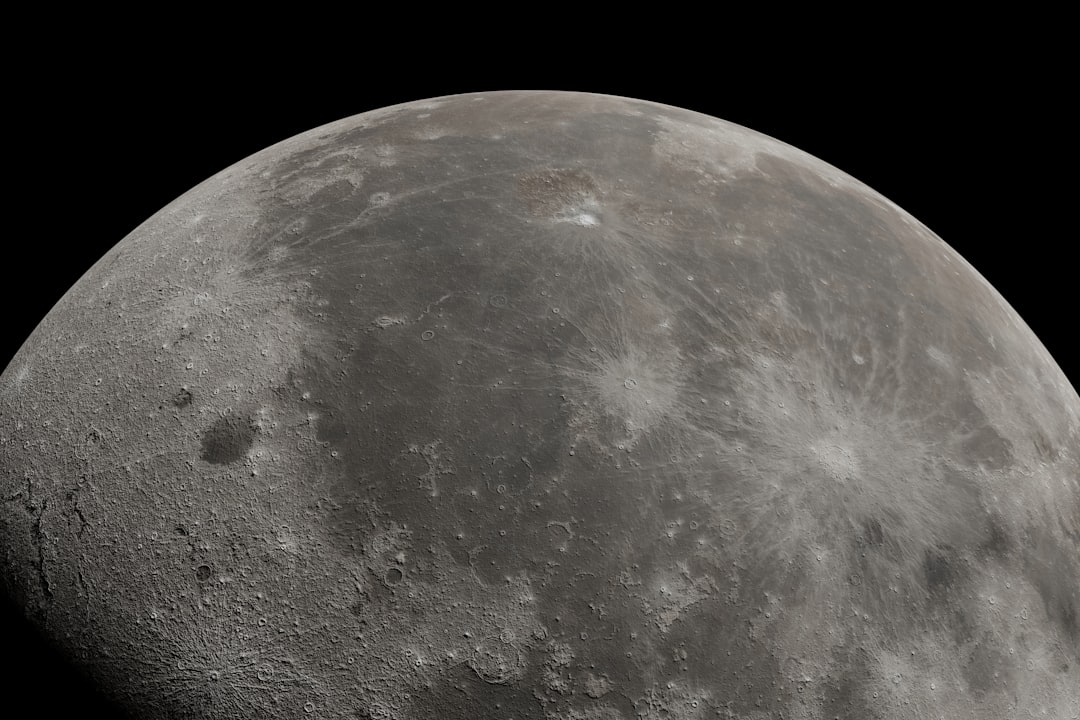
If Venus Had An Ancient Moon, It Was Doomed
You don't hear it much anymore, but for decades planetary scientists referred to Venus as Earth's sister planet. The comparison was logical: the two worlds are remarkably close in size, mass, and bulk composition, born from the same swirling disk of gas and dust some 4.5 billion years ago. Yet the resemblance is largely superficial. While Earth is warm, wet, and teeming with life, Venus is a blistering, pressure-crushed inferno — its surface hot enough to melt lead, its skies choked with sulfuric acid clouds, and its atmosphere pressing down with roughly 90 times the force of Earth's at sea level.
Planetary scientists have long puzzled over how two worlds with such similar origins could diverge so dramatically. But beyond the well-documented differences in temperature, atmospheric chemistry, and geology, there is another distinction that quietly demands explanation: Earth has a moon, and Venus does not. Of the four rocky, terrestrial planets in our Solar System, only Earth boasts a large natural satellite. Mars has two tiny, captured asteroids. Mercury and Venus have none. Why? Did Venus ever possess a moon, and if so, what fate befell it?
Groundbreaking new research published in The Astrophysical Journal confronts these questions head-on. The study, titled "Tidal Demise: The Evolution and Fate of a Hypothetical Venus Moon," is led by Stephen R. Kane, professor of planetary astrophysics at the University of California, Riverside — a scientist renowned for his expertise in exoplanet research and the comparative study of Venus-like worlds.
The Question of a Vanished Moon
To appreciate why Venus's moonlessness is such a compelling mystery, it helps to understand how Earth's Moon likely formed. The leading explanation — the Giant Impact Hypothesis — proposes that roughly 4.5 billion years ago, a Mars-sized protoplanet dubbed Theia collided catastrophically with the proto-Earth. The resulting debris, flung into orbit, gradually coalesced under gravity to form the Moon. This scenario is supported by isotopic similarities between Earth and lunar rocks, as well as the Moon's unusually large size relative to its host planet.
Could a similar event have occurred at Venus? Theoretically, yes. The early Solar System was a chaotic place, rife with giant impacts. Some researchers have speculated that Venus did experience such a collision, but that the resulting moon was subsequently lost. Others argue Venus never suffered a Moon-creating impact at all. Still others have proposed that a Venusian moon might have been destroyed by a later collision — not with Venus itself, but with a third body that swept through the inner Solar System.
Kane and his colleagues set out to test these scenarios rigorously. As they write in the paper:
"Venus possesses no natural satellite, raising the question of whether a formed moon could have survived. We explore the tidal evolution of a Venus-moon system, coupling Venus's spin to the satellite's orbit under tides from the moon and Sun."
Their conclusion is striking: Venus almost certainly didn't need a catastrophic collision to lose a moon. The planet's own physics would have done the job quietly, inevitably, and completely.
Venus's Strange Rotation: The Key to Everything
To understand why a Venusian moon was doomed, one must first appreciate just how bizarre Venus's rotation is. Venus spins extraordinarily slowly — completing a single rotation in approximately 243 Earth days, which is actually longer than its orbital period around the Sun (225 days). This means that on Venus, a day is longer than a year. Even more peculiar, Venus rotates in a retrograde direction — that is, opposite to the direction most planets spin. If you could stand on Venus and watch the sky, the Sun would rise in the west and set in the east.
This unusual spin state has profound consequences for any satellite that might orbit Venus. Consider what happens on Earth: our planet rotates rapidly (once every 24 hours), and because it spins faster than the Moon orbits, Earth's tidal bulge is pulled slightly ahead of the Moon's position. This transfers rotational energy from Earth to the Moon, gradually pushing the Moon farther away at a rate of about 3.8 centimeters per year. Earth's spin is simultaneously slowing down — very, very slightly — as a result.
At Venus, this dynamic works in reverse. Because Venus rotates so slowly — and in the opposite direction — any moon would orbit faster than the planet rotates beneath it. The tidal interaction would therefore transfer energy from the moon's orbit into Venus's rotation, causing the moon to spiral inward rather than outward. Combined with the gravitational tug of the nearby Sun, which adds another destabilizing influence, a hypothetical Venusian moon would face an inexorable death spiral toward the planet's surface.
As Kane explained in a press release accompanying the study:
"My study shows Venus didn't require a catastrophe to arrive at what we can see today. It turns out the gravity of the planet itself combined with the rate at which it spins naturally caused the moon to collapse on top of it."
Building a Model of Planetary Doom
To quantify this process, Kane and his colleagues constructed a sophisticated computational model of gravitational and tidal interactions between planetary bodies. They first validated the model by testing it against the known history of the Earth-Moon system — confirming that the simulation accurately reproduced the Moon's gradual recession from Earth over geological time.
With confidence in their tool, the team then explored a wide range of scenarios for a hypothetical Venus-moon system. They varied two key parameters:
- Moon mass: ranging from half the mass of Earth's Moon to ten times its mass, probing whether a more or less massive satellite might have survived longer.
- Venus's initial spin rate: scientists believe Venus once rotated much more rapidly than it does today, before being gradually slowed by tidal forces from the Sun and, potentially, its own atmosphere. The simulations explored a range of initial spin periods to reflect this uncertainty.
The results were remarkably — and perhaps surprisingly — consistent. Across the vast majority of simulated scenarios, the hypothetical moon spiraled inward and slammed into Venus. Furthermore, the more massive the simulated moon, the sooner the fatal impact occurred. A heavier moon would have exerted stronger tidal forces on Venus, accelerating the exchange of angular momentum and hastening its own destruction.
Kane described his reaction to the findings:
"When I made this discovery, I was shocked. I thought surely the broad range of scenarios I was exploring would lead to a variety of results. But it all went pretty much in the same direction."
The researchers identified a narrow "sweet spot" in parameter space where both observational constraints on Venus — the loss of any satellite and the despinning of an initially rapid rotator — could be simultaneously satisfied. As they write:
"Explaining Venus's present state requires satisfying two constraints simultaneously: loss of the satellite and despinning of an initially rapid rotator. Both are met only within a restricted region of parameter space, favoring moderate post-impact spin periods and lunar-to-super-lunar masses."
What Would a Moon Crash Look Like?
When a moon spirals close enough to its host planet, it crosses the Roche limit — the critical distance within which the planet's tidal forces exceed the moon's own self-gravity, tearing it apart. The debris would initially form a ring system around Venus before ultimately raining down onto the surface in a catastrophic bombardment. The energy released by such an event would be staggering, potentially dwarfing even the largest volcanic eruptions in Earth's history.
The authors emphasize just how consequential such an event might have been for the planet's climate and habitability:
"The eventual destruction of the moon at the Roche limit would deliver a massive energy pulse to the Venusian surface and atmosphere, with potential implications for the loss of surface water and the onset of a runaway greenhouse state."
This is a remarkable implication. Scientists have long debated whether Venus once hosted liquid water oceans and a more temperate climate during its early history — perhaps for as long as its first billion years. NASA's ongoing research into Venus suggests the planet may have been far more Earth-like in its youth before a catastrophic greenhouse runaway transformed it into the hellscape we see today. If a moon impact delivered a tremendous pulse of energy to the surface and atmosphere, it could have been the trigger — or at least a major contributing factor — to Venus's transition from potentially habitable world to permanent inferno.
The Moon's Role in Habitability
The study raises deeper questions about the relationship between moons and planetary habitability — questions with implications far beyond our own Solar System. Earth's Moon is thought to play several important roles in stabilizing our planet's environment:
- Axial stability: The Moon's gravitational influence stabilizes Earth's axial tilt (obliquity) within a narrow range of roughly 22–24.5 degrees over long timescales. Without the Moon, Earth's tilt could vary chaotically between near zero and more than 85 degrees, causing wild swings in climate that could be catastrophic for life.
- Tidal mixing: Lunar tides drive the mixing of ocean waters, distributing heat and nutrients across the globe — processes that may have been critical for the emergence of early life.
- Biological timekeeping: Many organisms have evolved biological rhythms synchronized to the lunar cycle, suggesting the Moon has influenced the trajectory of life's evolution on Earth.
A hypothetical Venusian moon of similar mass to Earth's Moon would have provided analogous benefits during the planet's early history. As the authors note:
"A moon of ∼1 MMoon would stabilize Venus's obliquity against chaotic variations, potentially maintaining favorable insolation patterns for surface habitability."
But Kane is careful not to overstate the moon's necessity for life. "My feeling is there are benefits to having a moon, but it isn't required for habitability," he said. "The moon has definitely changed the way Earth has evolved through time, but we don't fully know how important that role is." This nuanced view is important as scientists search for life elsewhere in the universe, on worlds that may orbit their stars without any large natural satellite.
Finding Evidence: An Enormous Challenge
If Venus's hypothetical ancient moon did crash into the planet, could we ever find the evidence? The challenge is formidable — perhaps uniquely so among Solar System exploration targets. Venus's surface presents several obstacles:
- Crushing atmosphere and extreme heat: The most successful landers ever sent to Venus — the Soviet Venera probes of the 1970s and 1980s — survived on the surface for no more than about two hours before succumbing to conditions equivalent to the bottom of Earth's ocean, but at 465°C (869°F).
- Volcanic resurfacing: Venus's surface is remarkably smooth and lightly cratered compared to other rocky worlds. This is widely interpreted as evidence that a massive, global volcanic event resurfaced the planet between 300 million and 700 million years ago, obliterating most surface features and likely erasing direct geological evidence of any ancient moon impact.
Yet the situation may not be entirely hopeless. Scientists have detected subsurface seismic anomalies on Earth that have been linked to the Giant Impact event that created our Moon — suggesting that the deep interior of a planet can preserve evidence of cataclysmic collisions for billions of years. If Venus retains a similar subsurface signature, future seismological missions — a capability some scientists are actively advocating for — might one day detect it.
Upcoming Missions to Venus
Fortunately, a new era of Venus exploration is on the horizon. Two NASA missions are in development that will shed unprecedented light on the planet's geology, atmosphere, and history:
- DAVINCI (Deep Atmosphere Venus Investigation of Noble gases, Chemistry, and Imaging): This mission combines an orbiter with a descent probe that will plunge through Venus's atmosphere, sampling its chemical composition layer by layer and capturing high-resolution images of surface "tesserae" — ancient, highly deformed terrain that may preserve clues about Venus's distant past.
- VERITAS (Venus Emissivity, Radio Science, InSAR, Topography, and Spectroscopy): This orbiter will produce a high-resolution topographic and mineralogical map of Venus's entire surface using synthetic aperture radar, potentially identifying evidence of a catastrophic global resurfacing event. While detecting such an event won't prove it was caused by a moon impact, it will ensure scientists cannot rule out that possibility.
Notably, lead author Stephen Kane has been an outspoken advocate for these Venus missions, having testified before Congress in support of their scientific value and funding. His research now directly strengthens the scientific case for sending sophisticated spacecraft to our enigmatic neighbor world.
The European Space Agency's EnVision mission is also planned to orbit Venus and work in coordination with NASA's VERITAS to build a comprehensive picture of the planet's geological and atmospheric evolution.
Implications for Worlds Beyond Our Solar System
Perhaps the most far-reaching implications of Kane's research extend beyond Venus entirely — to the thousands of rocky exoplanets discovered in recent years, many of which orbit in the inner regions of their host star systems, in zones analogous to Venus's position around the Sun.
The study demonstrates that slowly rotating terrestrial planets close to their stars are, by the physics of tidal dynamics alone, almost certain to lose any large natural satellites they might once have possessed. This has significant consequences for their long-term habitability, since a missing moon means no axial stabilization, no tidal mixing of oceans, and potentially wild climatic swings over geological timescales.
As the authors conclude:
"The application of these results to Venus Zone exoplanets suggests that slowly rotating terrestrial planets in the inner regions of planetary systems are unlikely to retain large satellites, with important implications for their obliquity stability and long-term habitability."
This finding is particularly relevant as the James Webb Space Telescope and future observatories begin characterizing the atmospheres of rocky exoplanets. If Venus-like worlds in the inner orbits of their star systems are inherently moonless — and therefore prone to greater climatic instability — this could help explain why truly habitable, life-bearing planets may be rarer than optimistic estimates suggest.
A Puzzle That Reshapes Our Understanding
Kane's research does not definitively prove that Venus once had a moon. That question remains open, and may remain so until missions capable of probing deep beneath Venus's surface are flown. What the study does establish, with computational rigor, is that if Venus ever possessed a moon, that moon's fate was sealed — not by a dramatic external collision, but by the quiet, inexorable mechanics of gravity