The question of cosmic age represents one of the most profound achievements in modern astrophysics. When cosmologists confidently state that our universe is 13.77 billion years old, this precision reflects decades of observational astronomy, theoretical physics, and technological innovation. But beneath this seemingly simple number lies a fascinating journey through the fabric of spacetime itself, challenging our most fundamental assumptions about the nature of reality and temporal measurement on cosmic scales.
This comprehensive exploration marks the first installment in an extensive series examining the age of the universe, its measurement methodologies, and the cutting-edge challenges that continue to refine our understanding. The confidence with which scientists declare the universe's age isn't merely about decimal-point precision—though achieving that level of accuracy represents a remarkable scientific triumph. Rather, it stems from a robust theoretical framework supported by multiple independent lines of evidence, from the cosmic microwave background radiation to the observed expansion rate of space itself.
Yet fundamental questions remain: How can we meaningfully discuss the age of the entire universe? What constitutes a universal timekeeper in a cosmos where Einstein demonstrated that time itself is relative? And how do we reconcile the concept of a cosmic clock with the principles of relativity that govern our understanding of spacetime?
The Paradox of Universal Time in Einstein's Universe
Before diving into modern cosmological measurements, we must confront a seemingly insurmountable philosophical and physical challenge: Can the universe possess a universal clock when special relativity explicitly denies such a concept? This question strikes at the heart of how we understand temporal measurement across cosmic scales.
In the pre-Einstein era of Newtonian physics, the universe operated according to absolute standards. Sir Isaac Newton's framework required what we might call a universal reference frame—an absolute stage upon which all cosmic events unfolded. Time flowed uniformly everywhere, and space existed as a fixed, unchanging backdrop. Objects and events had no intrinsic sense of their own temporal or spatial coordinates; instead, they relied on these external, absolute standards to define when and where interactions occurred.
This wasn't a literal cosmic timepiece hidden behind some distant nebula, nor was there a celestial Bureau of Standards maintaining platinum-iridium bars defining the meter. Rather, these concepts served as mathematical scaffolding, allowing Newton's equations to describe motion and gravitation with remarkable accuracy—at least for the terrestrial and planetary scales accessible to 17th and 18th-century science.
Then came Einstein's revolutionary insight. Special relativity, published in 1905 and validated through countless experiments over the past century, demolished the notion of absolute time and space. According to Einstein's framework, every object in the universe possesses its own unique reference frame, complete with its own measurements of temporal duration and spatial distance. What one observer measures as a second, another might measure as slightly more or less, depending on their relative motion. Simultaneity becomes a local, temporary phenomenon—two events that appear simultaneous to one observer may occur at different times for another.
"The revolutionary aspect of special relativity isn't just that it changed our understanding of time—it revealed that time itself is a dynamic, observer-dependent quantity intrinsically woven into the fabric of spacetime," notes Dr. Brian Greene, theoretical physicist and author of The Fabric of the Cosmos.
This presents an apparent paradox for cosmology: If there's no absolute reference frame, if every observer has their own unique temporal measurements, how can we meaningfully discuss the universe's age? Wouldn't the answer depend entirely on who's asking the question and where they're located?
General Relativity and the Emergence of Cosmic Time
The resolution to this paradox comes from general relativity—Einstein's more comprehensive theory that extends special relativity to include gravity and the curvature of spacetime. While special relativity prohibits a mandatory universal reference frame, general relativity doesn't forbid the possibility of one emerging under specific conditions. And remarkably, our universe provides exactly those conditions.
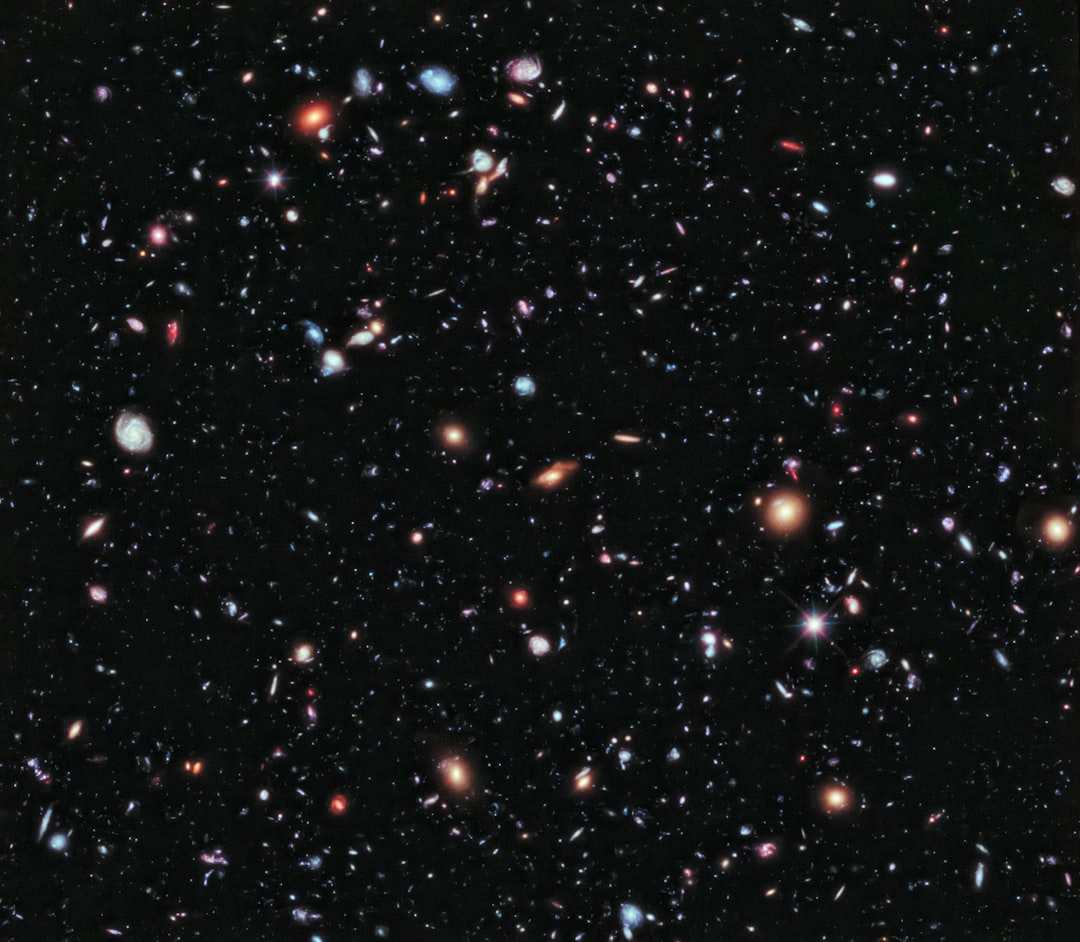
The key lies in what cosmologists observe when they examine the large-scale structure of the cosmos. Through powerful telescopes like the Hubble Space Telescope and its successors, astronomers have documented a fundamental fact: distant galaxies are receding from us, and the farther away they are, the faster they're moving. This isn't because galaxies are flying through space away from some central point—rather, space itself is expanding, carrying galaxies along with it.
To model this cosmic expansion, physicists employ the FLRW metric (named for Alexander Friedmann, Georges Lemaître, Howard Robertson, and Arthur Walker), which represents the most parsimonious solution to Einstein's field equations for a homogeneous, isotropic universe. This mathematical framework makes a crucial assumption that breaks the symmetry of special relativity: the universe is filled with matter and energy distributed relatively uniformly on the largest scales.
The Cosmic Reference Frame: Matter in Motion
This ubiquitous "stuff"—stars, galaxies, dark matter, radiation—provides the universe with a preferred reference frame. Not because physics demands it, but because the actual distribution and motion of matter creates one naturally. Here's the crucial insight: all this cosmic material is participating in a collective, coordinated motion—the expansion of space itself.
As the universe expands, several things happen simultaneously:
- Decreasing density: The matter and energy in the universe become more dilute as space expands, with the average density dropping predictably over time
- Cooling radiation: The cosmic microwave background radiation, a relic from the early universe, cools as its wavelengths stretch with cosmic expansion
- Evolving structure: Galaxies, clusters, and large-scale structures form and evolve in predictable ways as the universe ages
- Changing physics: The dominant forces and particles in the universe shift as it expands and cools, creating distinct cosmological epochs
This creates what physicists call broken symmetry—the past genuinely differs from the future in measurable, objective ways. Yesterday, the universe was demonstrably smaller, denser, and hotter. Tomorrow, it will be larger, more diffuse, and cooler. These aren't observer-dependent statements; they're objective features of cosmic evolution that any sufficiently advanced civilization anywhere in the universe would observe and measure.
Building the Universal Clock: Cosmic Chronometry
This shared evolutionary history enables cosmologists to construct what amounts to a universal clock. An observer in a galaxy billions of light-years away, if they develop sophisticated enough cosmological models, will reach the same fundamental conclusions about the universe's history. They'll measure the same cosmic microwave background temperature, observe the same expansion rate (accounting for their local position), and calculate the same age for the cosmos.
The mechanism works like this: By measuring how fast the universe is currently expanding (the Hubble constant) and understanding the composition of the universe (the relative amounts of matter, dark matter, and dark energy), cosmologists can essentially "run the clock backward." Using Einstein's field equations from general relativity, they calculate how long it would take for the universe to expand from an infinitely dense, infinitely hot initial state to its current size and temperature.
The precision of 13.77 billion years comes from extraordinarily detailed measurements, particularly from spacecraft like the Planck satellite, which mapped the cosmic microwave background with unprecedented accuracy. These measurements reveal tiny temperature fluctuations—typically just millionths of a degree—that encode information about the universe's composition, geometry, and age.
The Robustness of Cosmic Age Determination
What makes cosmologists so confident in this number isn't just one measurement technique, but the convergence of multiple independent methods:
- Cosmic microwave background analysis: The detailed pattern of temperature fluctuations in the CMB provides a snapshot of the universe at 380,000 years old, allowing precise age calculations
- Expansion rate measurements: Observations of distant supernovae and other standard candles reveal how the expansion rate has changed over cosmic history
- Stellar population studies: The oldest stars in globular clusters provide independent age constraints that must be younger than the universe itself
- Big Bang nucleosynthesis: The observed abundances of light elements match predictions for a universe of this age and composition
Each method involves completely different physics and observational techniques, yet they all converge on remarkably similar age estimates. This convergence provides powerful confirmation that cosmologists aren't just measuring some artifact of their models, but rather capturing a genuine property of the universe itself.
Challenges on the Horizon
Despite this impressive concordance, the story doesn't end here. Modern cosmology faces several potential challenges to our understanding of cosmic age—puzzles that might require refinements to our models or even hint at new physics beyond our current theories. These challenges don't necessarily undermine the basic framework, but they keep cosmologists honest and drive the field forward.
In the continuation of this series, we'll explore three significant challenges to our cosmic chronometry:
First, the Hubble tension—a growing discrepancy between different methods of measuring the universe's expansion rate, which could imply our age calculations need revision. Second, anomalies in the cosmic microwave background that might suggest our simple models miss important complexity. And third, the discovery of surprisingly mature galaxies in the very early universe, which challenges our understanding of how quickly structure could form after the Big Bang.
Each of these challenges represents not a crisis, but an opportunity—a chance to refine our understanding and potentially discover new physics. The confidence cosmologists express in the universe's age stems not from blind certainty, but from a robust framework that has survived decades of increasingly precise tests. As we'll see, even challenges to specific numbers or models tend to reinforce the overall picture of a universe with a definite age and a comprehensible history.
The journey to understanding cosmic time continues, blending observational astronomy, theoretical physics, and philosophical inquiry into one of humanity's grandest intellectual achievements: knowing not just where we are in the universe, but when we exist in its vast temporal expanse.